Demifluid Pride Flag
Demigender Pride Flag ·
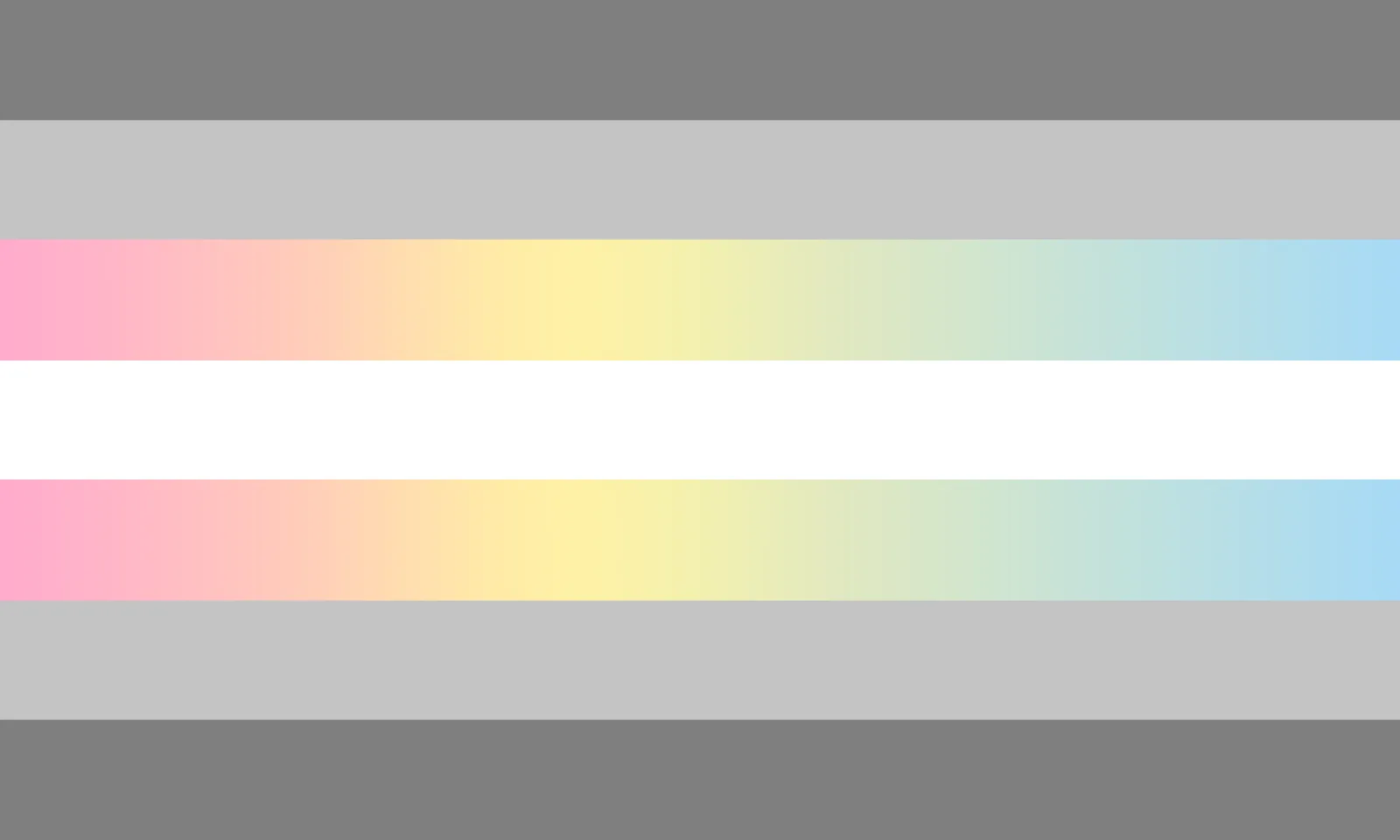
A seven-stripe mirrored flag with gray outer bands and a white centre, its third and fifth bands carrying a horizontal gradient from pink through yellow and green to light blue, for a gender that is partly fixed and partly fluid. It is one of two designs Tumblr user pbjkid submitted to pride-flags-for-us on 18 February 2015 with the definition "demigenderfluid or demifluid - gender changes between demigenders"; the account deactivated seven weeks later. [1] Three earlier demifluid flags had reached the same blog in July 2014, one by abstrusetheorist, the month the word's earliest located use appears; the MOGAI Wiki instead dates the coining to a November 2014 post by demigenders. [2][3][4] Renderings disagree about the palette, and the flag.is version ends in lavender. [5]
Key facts
- Designer
- pbjkid
- Created
- First documented public use
- In use
- 2015–present
- Aspect Ratio
- 3:5 · standard
- Stripes
- 7
- Represented Identity
- demifluid / demigenderfluid
Also known as
- Demigenderfluid Flag
- Demifluid Flag
Archive categories Gender Identity Pride Flags
Overview
To represent the specific experience of partially fluid gender identity within the demigender framework, an identity that combines the fixed partiality of demigender with the temporal movement of genderfluidity.
Demifluid identity describes a specific intersection of two gender experiences: the partial quality of demigender (a fixed, stable component that is only part of one's gender) and the shifting quality of genderfluidity (movement between genders over time). A demifluid person has one component of their gender that remains constant, partial and stable, while another component shifts. This dual structure is reflected in the flag's design: the gray outer bands and white center carry the demigender family's fixed framework, while the multicolor gradient in the interior bands carries the fluid component. [4][6]
The flag was one of two designs Tumblr user pbjkid submitted to pride-flags-for-us on 18 February 2015 with the definition "demigenderfluid or demifluid - gender changes between demigenders". [1] It was not the first demifluid flag: three distinct designs had reached the same blog the previous July, in the same days as the word's earliest located use. On 6 July 2014 an unnamed submitter, writing "I'm demifluid and wasn't happy with the options I was seeing", combined the genderfluid flag's colors with a variation of the demiboy, demigirl and deminonbinary scheme; about a day earlier a post titled "a demifluid flag that i just made" had carried a design that no longer survives; and within the week abstrusetheorist submitted a third, based on transrants's demiboy and demigirl designs. [2][7][3]
Identity & Context
- Represented Identity
- demifluid / demigenderfluid
- Subcommunity
- demigender umbrella
Creators
The Creators
pbjkid
Designer and submitter of the two 18 February 2015 demifluid flags, the gradient design among them
A Tumblr user known only through the submission record: pbjkid submitted two demifluid flag designs to pride-flags-for-us on 18 February 2015, defining demifluid as "gender changes between demigenders", and deactivated their account on 10 April 2015. No other documented information about them has been located. [1]
demigenderfluid or demifluid - gender changes between demigenders [1]
abstrusetheorist
Designer of the July 2014 pink-to-blue demifluid flag, a predecessor design
A Tumblr user who submitted a demifluid flag to pride-flags-for-us in July 2014, writing "I really liked the idea of a flag for demifluid, so I made this. I based this design off of transrants's demiboy/demigirl flag designs." The design was later archived on DeviantArt as the pink-to-blue demifluid rendering. [3][8]
I really liked the idea of a flag for demifluid, so I made this. I based this design off of transrants's demiboy/demigirl flag designs. [3]
Attribution notes
pbjkid submitted the flag to pride-flags-for-us on 18 February 2015 at 7:45am, one of two demifluid designs in a single submission carrying the definition "demigenderfluid or demifluid - gender changes between demigenders" and no stated stripe meanings. The submission record in the post's notes names the account, which deactivated on 10 April 2015, seven weeks later; nothing else about the person is documented. [1] The MOGAI Wiki confirms the two-flag submission and its date. [4]
Origin
- Digital Origin
- Tumblr (likely)
Digital origin; no verified physical location.
Originated on Tumblr at pride-flags-for-us, the moderated community flag blog: the entry's flag arrived as pbjkid's submission of 18 February 2015, after a first wave of three distinct demifluid flags in July 2014. [1][2][3][7]
Dates & Chronology
- Year Created
- Exact date
- First public use
- Period in Use
- 2015–present
- Creation Bounds
- The flag itself is dated by its origin post: submitted 18 February 2015 at 7:45am. [1] The identity's flag history begins earlier: three distinct demifluid flags reached pride-flags-for-us in July 2014, and the word's earliest located use is 6 July 2014. [2][3][7] An earlier claim that reference sources place the design before 2013 did not survive checking; the primary record supports nothing before July 2014.
The DeviantArt archive account Pride-Flags carried the designs outward in August 2015, uploading the gradient version on 23 August and the banded companion on 30 August, both citing pbjkid's submission post, and abstrusetheorist's pink-to-blue design on 29 August, citing its July 2014 post. [9][10][8] The gradient version became the commonly reproduced demifluid flag, appearing in demigender flag guides including Library.LGBT and the wikis; further alternates by pride-color-schemes, peridaut and others were catalogued by 2016, and another appeared around 2020. [11][6][4]
Major revisions
Three distinct demifluid flags reached pride-flags-for-us in July 2014: an unrecoverable design of about 5 July; the 6 July design combining the genderfluid flag's colors with the demigender scheme; and abstrusetheorist's design based on transrants's demiboy and demigirl flags, later archived as the pink-to-blue rendering.
pbjkid's submission of 18 February 2015 carried two designs: the gradient version this entry documents and a banded companion built from three discrete blocks, both archived by Pride-Flags that August.
Further alternates by pride-color-schemes, peridaut and others were in circulation by mid-2016, catalogued in pride-color-schemes' demifluid post; another design by an unknown maker appeared around 2020.
The relationship between demifluid and genderfluid is one of overlap rather than hierarchy: demifluid specifies that only part of one's gender is fluid while another part remains fixed. [6][12]
The reference wikis disagree about the term's coining. The MOGAI Wiki credits Tumblr user demigenders with coining demifluid on 11 November 2014 in a demigender definitions post; lgbtqia.wiki dates the coining to on or before 6 July 2014 with the coiner unknown. The primary record supports the July bound: the word appears in the pride-flags-for-us submissions of 5 to 8 July 2014, four months before the demigenders post. [4][6][2] The documented definitions also shift over time, from demigenders' partially-fluid-with-static-parts (2014) through pbjkid's "gender changes between demigenders" (2015) and pride-color-schemes' "fluid between demigenders" (2016) to lexicon.library.lgbt's partially-genderfluid formulation (2020). [4]
Lineage
- Indirect influences
- Genderfluid Pride Flag, Rainbow Pride Flag, Transgender Pride Flag
pbjkid published this design on 18 February 2015 with a definition and no stated influences. [1] The July 2014 demifluid designs by abstrusetheorist and an unnamed submitter did name the genderfluid, demiboy and demigirl flags as sources, but that evidence belongs to those designs and does not transfer to this later one. [2][3] The generic rainbow and transgender edges earlier versions carried are removed. The design sits in the demigender visual family, which is a classification rather than a documented derivation.
Colors & Symbolism
A member of the demigender flag family, using the shared mirrored seven-stripe structure with a multicolor spectrum replacing the single-color interior stripes to indicate that the gender component is fluid rather than fixed. [11]
| Colour | Hex | Meaning | Note |
|---|---|---|---|
| Dark gray | #7F7F7F | Partial connection to gender identity. | Measured from the 5000 by 3000 Pride-Flags reproduction of 23 August 2015, whose file size matches the size that page reports for its own original. [9] |
| Light gray | #C3C3C3 | Partial connection to gender identity. | Measured from the 5000 by 3000 Pride-Flags reproduction of 23 August 2015, whose file size matches the size that page reports for its own original. [9] |
| Multicolor spectrum (upper) | — | Multiple gender identities and fluidity. | — |
| White | #FFFFFF | Agender or nonbinary identity. | Measured from the 5000 by 3000 Pride-Flags reproduction of 23 August 2015, whose file size matches the size that page reports for its own original. [9] |
| Multicolor spectrum (lower) | — | Multiple gender identities and fluidity. | — |
| Light gray | #C3C3C3 | Partial connection to gender identity. | Measured from the 5000 by 3000 Pride-Flags reproduction of 23 August 2015, whose file size matches the size that page reports for its own original. [9] |
| Dark gray | #7F7F7F | Partial connection to gender identity. | Measured from the 5000 by 3000 Pride-Flags reproduction of 23 August 2015, whose file size matches the size that page reports for its own original. [9] |
| Spectrum gradient | #F3F1B0 | — | A continuous horizontal sweep, not a flat field. Sampled at the hoist, centre and fly it reads #FFACCD, #F3F1B0 and #A7DAF7; the value given here is the centre. Measured from the 5000 by 3000 Pride-Flags reproduction of 23 August 2015, whose file size matches the size that page reports for its own original. [9] |
This flag has no official digital palette. Color values shown are approximate.
pbjkid's submission published no stripe meanings: its text is the definition alone. [1] The meanings above are the demigender family's guide-circulated readings of the shared layout, with the gradient carrying the fluid element; they are convention, not creator specification. [11][6] Unlike the demiboy (blue), demigirl (pink), and deminonbinary (yellow) siblings, the demifluid version replaces the single-color interior stripes with a spectrum.
Four colours, not twelve. The flag has seven horizontal bands, two of which are a continuous horizontal gradient rather than a flat field, so points sampled along that sweep are readings of one band and not additional stripes. An earlier version of this entry listed five such sample points as separate rows, which read as if the flag had twelve bands. The gradient runs pink at the hoist through a pale yellow centre to light blue at the fly, measured at #FFACCD, #F3F1B0 and #A7DAF7. The light gray measures #C3C3C3 throughout; an earlier version of this entry gave a different value in the table from the one in its own prose. [9]
Design
- Aspect Ratio
- 3:5 · standard
- Orientation
- horizontal
- Stripe Count
- 7
- Layout
- horizontal_stripes
- Stripes (Top → Bottom)
- Dark gray, Light gray, Spectrum gradient, White, Spectrum gradient, Light gray, Dark gray
Seven horizontal bands of equal depth, measured at about 428 rows each in the 3000-row source file. Bands three and five are a continuous horizontal gradient running pink to pale yellow to light blue; the other five are flat. The source reproduction is 5000 by 3000, exactly 5:3. [9]
Seven horizontal stripes in a mirrored arrangement: dark gray, light gray, spectrum, white, spectrum, light gray, dark gray. The interior bands carry a continuous left-to-right gradient rather than flat colour or sub-stripes. [9] A banded variant built from three discrete blocks of pink, yellow and blue was published alongside it. [10]
A seven-stripe mirrored flag for demifluid identity. The outer bands are dark gray and the second and sixth light gray; the centre is white. The third and fifth bands carry a single horizontal gradient running from pink at the hoist through peach, pale yellow and green to teal and light blue at the fly. The gradient is what distinguishes the design from its demigender siblings, which fill the same two bands with one flat colour: blue for demiboy, pink for demigirl, yellow for deminonbinary. [9]
Usage & Adoption
- Geographic Usage
- Internet circulation
- Online Usage
- Documented in demigender flag guides
- Current Status
- documented online circulation; established in demigender flag guides
Less widely known than demiboy or demigirl, but established within demigender flag reference material. [11]
Image Archive
Source-era republication, highest resolution surviving
Smaller circulating copy
Discourse & Debates
- Whether demifluid belongs primarily under the demigender umbrella, the genderfluid umbrella, or both, community usage varies [6][12]
- Whether the multicolor spectrum interior bands should use standardized colors (matching the genderfluid flag) or remain as-is with their own palette [11]
Common misidentifications
- Sometimes confused with the genderfluid flag due to the shared concept of gender fluidity, the key distinction is the gray "demi" frame indicating partiality [6][12]
- Distinct from genderflux, which describes changing intensity of a single gender rather than movement between genders [6][12]
Criticisms
- The conceptual specificity of demifluid, combining partial gender with fluid gender, is sometimes dismissed as 'too niche' by people who feel that nonbinary is a sufficient umbrella. The counter-position is that precision in language creates visibility for experiences that would otherwise be invisible, and that the same criticism was once leveled at terms like 'nonbinary' itself. [6][12]
Demifluid is a compound of demi- (partial) and fluid, also written demigenderfluid, the doublet pbjkid's own submission used. [1] It is distinct from demigender broadly (which may be stable), from genderfluid (which does not imply a fixed partial component), and from genderflux (which describes changing intensity rather than changing direction). [6][12] The wikis carry conflicting coining accounts, the MOGAI Wiki crediting demigenders' 11 November 2014 definitions post and lgbtqia.wiki dating the term to on or before 6 July 2014; the earliest located use is the 6 July 2014 pride-flags-for-us submission. [4][6][2]
Footnotes & Citations
Sources and footnotes 15 sources
- 1. Social media demigenderfluid or demifluid (the pbjkid submission). pbjkid. pride-flags-for-us, Tumblr (2015-02-18). Accessed 2026-08-15 · Archived version
- 2. Social media Im demifluid and wasnt happy with the options I was seeing. Unnamed submitter. pride-flags-for-us, Tumblr (2014-07-06). Accessed 2026-08-15 · Archived version
- 3. Social media I really liked the idea of a flag for demifluid. abstrusetheorist. pride-flags-for-us, Tumblr (2014-07). Accessed 2026-08-15 · Archived version
- 4. Encyclopedias & Reference Demifluid. MOGAI Wiki (Miraheze). Accessed 2026-03-18
- 5. Reference Demifluid. flag.is. Accessed 2026-03-09
- 6. Encyclopedias & Reference Demifluid. LGBTQIA+ Wiki. Accessed 2026-03-09
- 7. Social media a demifluid flag that i just made (unrecoverable). pride-flags-for-us, Tumblr (c. 2014-07-05). Accessed 2026-08-15
- 8. Image file page Demifluid / Demigenderfluid (3). Pride-Flags. DeviantArt (2015-08-29). Accessed 2026-08-14
- 9. Image file page Demifluid / Demigenderfluid (1). Pride-Flags. DeviantArt (2015-08-23). Accessed 2026-08-14
The canonical file behind this rendering is 5000 by 3000 and 2,452,317 bytes, a size the flat-band flags in the same gallery do not approach because the gradient bands carry hundreds of distinct values.
- 10. Image file page Demifluid / Demigenderfluid (4). Pride-Flags. DeviantArt (2015-08-30). Accessed 2026-08-14
- 11. Reference Demifluid. Library.LGBT Pride Flag Guide. Accessed 2026-03-09
- 12. Encyclopedias & Reference Demifluid. Nonbinary Wiki. Accessed 2026-03-15
- Encyclopedias & Reference Demigender. Gender Wiki. Accessed 2026-03-15
- Encyclopedias & Reference Genderfluid. Nonbinary Wiki. Accessed 2026-03-15
- Encyclopedias & Reference Demifluid Flag. Pride Flag Wiki (Fandom). Accessed 2026-03-18
Image Sources
- Rendering
- seven-stripe spectrum version
- The design as Pride-Flags reproduced it on 23 August 2015, at 5000 by 3000; the page reports the same file size for its own original, so this is that file. Seven equal bands of about 428 rows, two of them a continuous horizontal gradient. Every colour value in this entry is measured from it. Source-era republication, not pbjkid’s own upload. [9] · Credit: Rendering by Pride-Flags (DeviantArt); design by pbjkid, submitted to pride-flags-for-us on 18 February 2015. · DeviantArtRights The deviation states no licence. Rights in the underlying design are unresolved and separate from rights in this file.
- A smaller, lossier copy of the same 2015 reproduction, 688 by 420, which this entry used as its artwork until August 2026. It is not 3:5 and shows re-encoding artefacts, so no measurement is taken from it. [9] · Credit: Rendering by Pride-Flags (DeviantArt); design by pbjkid. · DeviantArtRights No licence located. Separate from rights in the underlying design.