Multigender Pride Flag
Umbrella Pride Flag · c. 2016-present
A pride flag for multigender identity, representing people who experience more than one gender identity simultaneously or at different times. The creator of the original three-stripe design (purple, blue, orange) is unknown. The flag was in documented use by January 16, 2016, when it was uploaded to DeviantArt by the Pride-Flags archival account. At least 12 alternate designs exist from various creators.
Key facts
- First documented public use
- In use
- c. 2016-present
- Aspect Ratio
- 3:5 · standard
- Stripes
- 3
- Represented Identity
- multigender
Also known as
- Multigender Flag
Archive categories Gender Identity Pride Flags
Overview
To provide an umbrella pride symbol for people who experience more than one gender, encompassing the various specific multigender identities.
The original multigender flag appeared online by early 2016. It was uploaded to the Pride-Flags DeviantArt archival account, which compiles and re-posts pride flags in high quality but is not the original designer. No Tumblr, DeviantArt, or wiki source has identified the original creator. [1][2]
Identity & Context
- Represented Identity
- multigender
- Subcommunity
- multigender umbrella / nonbinary umbrella
- Language Context
- Multigender can be used as a specific identity or as an umbrella term for all identities involving multiple genders, including bigender, trigender, quadgender, quintgender, polygender, pangender, and genderfluid (when shifting between multiple genders).
Creators
Creator unknown
No identification located
The original three-stripe multigender flag's creator is unknown. It was uploaded to DeviantArt by the Pride-Flags archival account on or around January 16-17, 2016. The Nonbinary Wiki documents at least 12 distinct multigender flag designs from at least 7 different creators. [1][2]
Contribute information about who designed this flag.
Attribution
- Additional Designers
- astrofluix (7-stripe alternate), Hahahjdgehejeh (7-stripe alternate, Nov 29 2020), g-e-n-d-e-r-f-u-c-k (alternate, Oct 26 2019), duwang-flags-inc (3-stripe redesign), uuj007 (white star version), pennytable21 (3-stripe alternate)
Origin
- Digital Origin
- Yes
Digital origin; no verified physical location.
Earliest confirmed online appearance is January 16-17, 2016, on the Pride-Flags DeviantArt account. The actual creation date may be earlier. [2]
Dates & Chronology
- First public use
- Period in Use
- c. 2016-present
The three-stripe version (purple, blue, orange) is the most widely recognized and is referenced by flagcolorcodes.com, the LGBTQIA+ Wiki, and institutional pride flag guides including Worcester Polytechnic Institute. [1][3][4]
Multigender falls under both the nonbinary and transgender umbrellas. The relationship between multigender and polygender has shifted. Earlier usage sometimes treated the terms as interchangeable, while more recent usage tends to treat polygender as a specific identity (experiencing many but not all genders) under the broader multigender umbrella. [1]
Lineage
- Indirect influences
- Rainbow Pride Flag
Conceptually the umbrella flag for the family of multigender identities. Related to bigender, trigender, pangender, and polygender flags as specific-identity counterparts. [1]
Colors & Symbolism
The original three-stripe design uses secondary-adjacent colors. The uuj007 version's rationale draws on the metaphor that secondary colors cannot be made without primary colors yet still exist as their own separate and individual colors, reflecting the nature of multigender identity. [1]
| Colour | Hex | Pantone | Meaning |
|---|---|---|---|
| Purple | #3F47CD | 2368 C | Being both partially masculine and feminine at once. [1] |
| Blue | #00A3E8 | 299 C | Being partially masculine genders. [1] |
| Orange | #FA7F27 | 1575 C | Being partially a gender that is outside the masculine-feminine spectrum. [1] |
flagcolorcodes.com. Not creator-issued. [3]
This flag has no official digital palette. Color values shown are approximate.
Stripe meanings are documented on wiki sources but have not been verified from a direct creator statement, since the original creator is unknown. The Hahahjdgehejeh 7-stripe version (Nov 2020) adds pink (feminine genders), white/light grey (agender), yellow (neutral gender), and green (multiple genders at once). [1]
Hex values from flagcolorcodes.com. Circulating community values, not creator-issued (creator is unknown). Pantone values are approximate. Purple stands for being both partially masculine and feminine at once, blue for partially masculine genders, orange for partially a gender outside the masculine-feminine spectrum. [3]
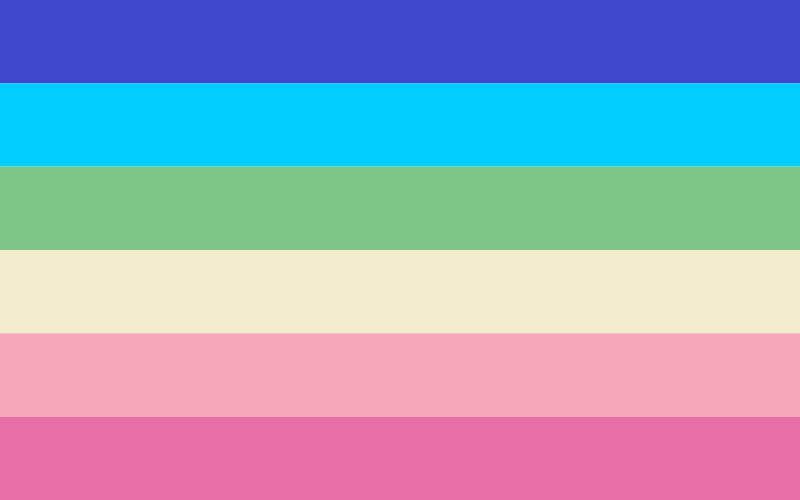
The vector published here was redrawn on 16 August 2026. The file previously served at this entry's URL painted six bands, #3F47CC, #01CDFE, #7CC587, #F3EDCE, #F5A9B8 and #E86FA6. Only the first was close to anything in this record. It was not the flag this entry describes, and no source cited here documents a six-band multigender design.
Design
- Aspect Ratio
- 3:5 · standard
- Orientation
- horizontal
- Stripe Count
- 3
- Layout
- horizontal stripes
- Stripes (Top → Bottom)
- Purple, Blue, Orange
Three horizontal stripes. Multiple alternate designs exist with 3-7 stripes and various color schemes. The Nonbinary Wiki documents at least 12 distinct designs. [1][5]
Three equal horizontal stripes: purple (top), blue (middle), orange (bottom). [1]
Three equal horizontal stripes in purple, blue, and orange. This is the most commonly referenced and widely recognized version.
Usage & Adoption
- First Users
- Online multigender and nonbinary communities
- Organizations
- Worcester Polytechnic Institute (LGBTQIAP+ flags guide) [4]
- Online Usage
- DeviantArt, Tumblr, LGBTQIA+ identity wikis
- Current Status
- active
The three-stripe version is the most widely recognized and appears in institutional pride flag guides.
Discourse & Debates
- Whether the multigender umbrella usefully encompasses identities like bigender, trigender, polygender, and pangender, or whether each of those identities is distinct enough to stand alone. The umbrella terminology has been useful for cross-identity solidarity but may flatten meaningful distinctions.
Common misidentifications
- The relationship between multigender and polygender is sometimes unclear. More recent usage treats polygender as a specific identity (many but not all genders) under the broader multigender umbrella. [1]
Multigender can be used as a specific identity or as an umbrella term. Related specific identities include bigender (two genders), trigender (three), quadgender (four), quintgender (five), polygender (many but not all), and pangender (all genders).
Footnotes & Citations
Sources and footnotes 7 sources
- 1. Multigender. LGBTQIA+ Wiki. Accessed 2026-03-31
- 2. Multigender (2) by Pride-Flags. Pride-Flags (archival repost). DeviantArt (2016-01-17). Accessed 2026-03-31
- 3. Multigender flag color codes. Flag Color Codes. Accessed 2026-03-31
- 4. LGBTQIAP+ Flags and Terms. Worcester Polytechnic Institute. Accessed 2026-03-31
- 5. Category:Multigender pride flags. Nonbinary Wiki. Accessed 2026-03-31
- Multigender. pride-color-schemes (Tumblr). Accessed 2026-03-31
- Rainbow flag (LGBTQ). Wikipedia contributors. Wikipedia (2026-06-25). Accessed 2026-07-24
Image Sources
- Rendering
- original 3-stripe version