Polyromantic Pride Flag
Identity Pride Flag ·
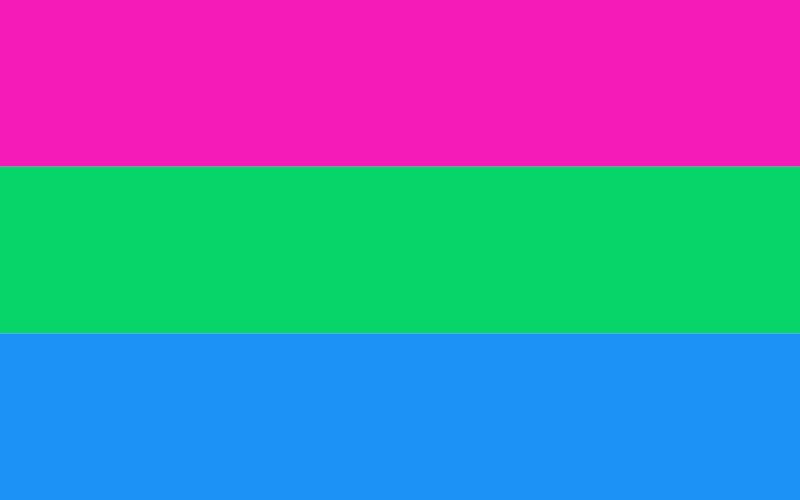
The polyromantic identity most commonly uses the polysexual pride flag (pink, green, and blue, designed by Samlin in 2012), which is shared across both polysexual and polyromantic communities. Polyromantic describes romantic attraction to many but not all genders, distinguished from polysexual through the split attraction model.
Key facts
- Created
- First documented publication of polyromantic-specific designs
- In use
- 2015-present
- Aspect Ratio
- 3:5 · standard
- Stripes
- 3
- Represented Identity
- Polyromantic people, meaning individuals who experience romantic attraction to many but not all genders
Also known as
- Polyromantic Flag
Status Proposed
Archive categories Sexual & Romantic Orientation Pride Flags
Overview
To provide a pride symbol specifically for polyromantic identity, distinct from but related to the polysexual flag, reflecting the split attraction model.
Polyromantic is the romantic counterpart of polysexual, describing romantic attraction to many but not all genders. The term was coined before July 4, 2015. The split attraction model, which distinguishes romantic and sexual orientation as separate dimensions, is the framework that gives polyromantic its distinct meaning from polysexual. Multiple flag designs exist. An early flag consisted of the polysexual flag with a heart overlay (creator unknown, before May 10, 2016). A distinct design was created by Tumblr user pride-flags-for-us on or before August 30, 2015. An alternative flag was designed by an anonymous wiki user on October 21, 2020, using lighter pink and blue for aromantic-spectrum polyromantic individuals and light green for peace and trans polyromantic individuals.
Identity & Context
- Represented Identity
- Polyromantic people, meaning individuals who experience romantic attraction to many but not all genders
- Subcommunity
- multi-attraction spectrum
Creators
The Creator
pride-flags-for-us
primary designer
Tumblr-based pride flag designer. The account has been deactivated and no further biographical information is available.
Attribution notes
No polyromantic design has a recoverable designer. The 2016 documentation that covers the identity credits the shared three-stripe flag to "Unknown", the five-stripe polyromantic flag with a yellow heart to "[Deactivated]", and the pink, cyan and blue flag with a grey heart to "Unknown"; one of the shared alternates is credited to @nova-pride-flags, an account now gone. [1] The identity wikis report a flag by Tumblr user pride-flags-for-us posted on or before 30 August 2015, an earlier flag consisting of the polysexual flag with a heart overlay existing before 10 May 2016, and an alternative by an anonymous wiki user on 21 October 2020. Those pages could not be opened to check, and nothing located this round corroborates them. [2][3] The shared three-stripe flag itself is the polysexual flag, designed by Samlin in 2012; the 2016 blog recorded its designer as unknown, which reflects what that blog knew rather than a competing claim.
Origin
- Digital Origin
- Yes
Digital origin; no verified physical location.
Digital origin, on Tumblr. The earliest documentation located is the pride-color-schemes post of 5 July 2016, which carries four polyromantic-specific designs alongside the shared polysexual flag. [1] The 2015 dates this entry gives come from wiki pages that could not be opened. [2][3]
Dates & Chronology
- Year Created
- First documented publication of polyromantic-specific designs
- Period in Use
- 2015-present
The polysexual pride flag (pink, green, and blue, designed by Samlin on Tumblr in 2012) is often used for polyromantic identity as well. Dedicated polyromantic flags have limited but growing recognition in online Queer communities.
Major revisions
An alternative polyromantic flag was designed by an anonymous wiki user, using lighter pink and blue for a-spec poly individuals, and light green for peace and trans poly individuals.
The polysexual flag by Samlin (2012) remains the most widely recognized symbol associated with polysexual and polyromantic identities. Dedicated polyromantic flags are less widely adopted. Four polyromantic-specific designs were documented together on 5 July 2016. A five-stripe flag with a centred yellow heart, its centre band three times the width of an outer one and its second and fourth bands very narrow, samples #FF8CF5, #FFE169, #3AA657, #FFE169 and #558FF2, and is credited to an account already deactivated. Two are the three-stripe flag with a large heart overlaid and the colours outside the heart lightened, one in red, green and blue and one in pink, green and blue. The fourth places a small grey heart in the upper left of a pink, cyan and blue field. [1] The same post records two further designs shared with polysexual: a dark red, light green and light blue flag by an anonymous designer, and a five-stripe design by @nova-pride-flags sampling #3386CC, #5F55CC, #42A66D, #9361B2 and #D96CBA. [1]
Lineage
- Indirect influences
- Polysexual Pride Flag, Rainbow Pride Flag
The polyromantic flag is conceptually related to the polysexual pride flag (Samlin, 2012), which is often used interchangeably for both polysexual and polyromantic identities. The early heart-overlay flag was a direct modification of the polysexual design.
Colors & Symbolism
Pink for attraction towards women, green for attraction towards nonbinary people, and blue for attraction towards men. The 2016 documentation states these meanings under a heading covering polysexual and polyromantic together, so they apply to the flag in either use, the difference being romantic rather than sexual attraction. [1]
| Colour | Hex | Meaning |
|---|---|---|
| Pink | #F61CB9 | Attraction towards women. [1] |
| Green | #07D569 | Attraction towards nonbinary people. [1] |
| Blue | #1C92F6 | Attraction towards men. [1] |
Sampled from the image published by pride-color-schemes, 5 July 2016. [1]
This flag has no official digital palette. Color values shown are approximate.
The meanings are stated directly in documentation that covers polyromantic, not only inherited from the polysexual flag. [1] Polyromantic-specific designs distinguish themselves from the shared flag by adding a heart: three of the four documented in 2016 carry one, either overlaid large across the flag with the colours outside it lightened, centred and yellow, or small and grey in the upper left. [1]
Values sampled from the flag as published in polyromantic documentation; they match the values previously carried here to within two units per channel, and the green exactly. [1] These are the polysexual flag's colours, since polyromantic most often uses that flag.
Design
- Aspect Ratio
- 3:5 · standard
- Orientation
- horizontal
- Stripe Count
- 3
- Layout
- horizontal stripes
- Stripes (Top → Bottom)
- pink, green, blue
Three equal horizontal stripes. The published image is 700 by 420 pixels. [1] Polyromantic-specific variants alter this, adding a heart or, in one case, five bands of unequal width. [1]
Three horizontal bands of equal depth: pink, green, blue. No emblem. The design is the polysexual flag, used unchanged for polyromantic identity, which is why the entry carries no polyromantic designer. [1] The dedicated polyromantic designs depart from this by adding a heart, and one of them by using five bands of unequal width. [1]
Three equal horizontal stripes, from top to bottom: pink, green, and blue. This is the polysexual pride flag designed by Samlin on Tumblr in 2012, which is the most commonly used flag for polyromantic identity as well. The green stripe replaces the yellow of the pansexual flag to distinguish polysexual/polyromantic (attraction to many genders) from pansexual/panromantic (attraction to all genders). Dedicated polyromantic variants include a heart-overlay version (creator unknown, pre-2016), a design by pride-flags-for-us (on or before August 30, 2015, now deactivated), and a 2020 alternative with softer colors by an anonymous wiki user.
Usage & Adoption
- First Users
- Online Queer and multi-attraction spectrum communities
- Online Usage
- Tumblr, LGBTQIA+ identity wikis
- Current Status
- active
Dedicated polyromantic flags have limited adoption. The polysexual pride flag (Samlin, 2012) is more commonly used to represent both polysexual and polyromantic identities.
Image Archive
Flag design (shared with polysexual-pride-flag-2012-samlin entry)
Discourse & Debates
- Whether polyromantic is meaningfully distinct from biromantic, given that both describe romantic attraction to multiple genders. Some community members find the distinction useful (biromantic implies two or more, polyromantic implies many but not all), while others view the proliferation of closely related labels as fragmenting multi-attraction solidarity.
Common misidentifications
- Polyromantic flags are sometimes confused with polysexual flags, since the polysexual flag is frequently used for both identities.
- Polyromantic is distinct from polyamorous. Polyromantic describes romantic attraction to many genders; polyamorous describes a relationship structure involving multiple partners.
- Polyromantic is the romantic counterpart of polysexual. The distinction is grounded in the split attraction model, which treats romantic and sexual attraction as separate dimensions.
- Polyromantic is regularly confused with polyamory. The flag's own documentation heads that off in its definition of the prefix, noting it is "not to be confused with polyamory (when a person has relationships with multiple people simultaneously, with the consent of all involved)". Polyromantic describes which genders a person is attracted to; polyamory describes how many partners a person has. [1]
The split attraction model distinguishes polyromantic (romantic attraction to many but not all genders) from polysexual (sexual attraction to many but not all genders). The term was coined before July 4, 2015.
Footnotes & Citations
Sources and footnotes 9 sources
Designer page
- 1. Poly-. pride-color-schemes. Tumblr (2016-07-05). Accessed 2026-08-16
Encyclopedias & Reference
- 2. Polyromantic. LGBTQIA+ Wiki. Accessed 2026-03-30
- 3. Polyromantic. LGBTQIA+ Wiki (Fandom). Accessed 2026-03-30
- Polyromantic. LGBT+ Pride Wiki (Fandom). Accessed 2026-03-30
- Polysexual. LGBTQIA+ Wiki. Accessed 2026-03-30
Reference
- Polysexual: Definition, Identity and History. Taimi. Accessed 2026-03-30
- What Does It Mean to Be Polyromantic?. ENM Living. Accessed 2026-03-30
- What Is Polysexuality?. WebMD. Accessed 2026-03-30
- Rainbow flag (LGBTQ). Wikipedia contributors. Wikipedia (2026-06-25). Accessed 2026-07-24
Image Sources
- Rendering
- Shared polysexual flag (Samlin, 2012)
- Credit: Design by Samlin (2012). The shared polysexual flag, which polyromantic use has adopted; the separate 2015 pride-flags-for-us design is not pictured. · Samlin's 2012 Tumblr post, preserved in the surviving reblog
- The polysexual pride flag (Samlin, 2012), which is the most widely used flag for polyromantic identity as well. Pink represents attraction to women, green represents attraction to nonbinary people, and blue represents attraction to men. The flag is shared across both polysexual and polyromantic communities. · Credit: Design by Samlin (2012) · Shared with the Polysexual Pride Flag entry