Omnisexual Pride Flag
Identity Pride Flag ·
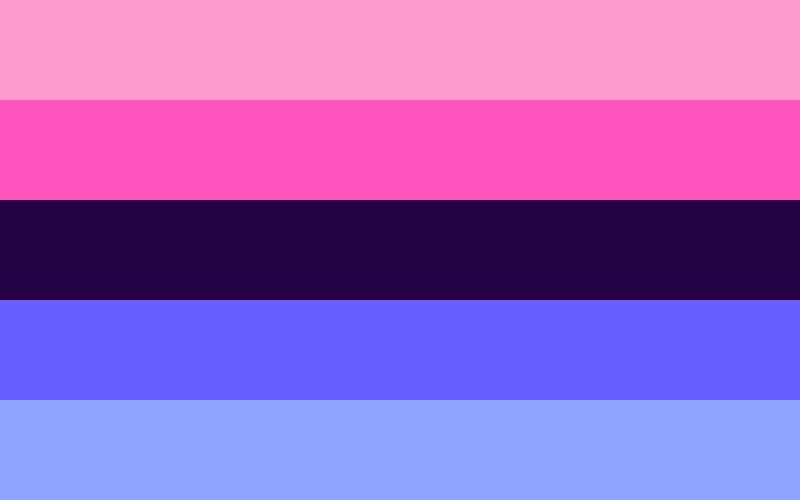
Published by Pride-Flags on DeviantArt on 4 July 2015 under the title "Omni-", this five-stripe pink, purple and blue flag was attributed to Pastelmemer by a flag-documentation post the following year. [1][2] Omnisexual generally describes attraction to all genders. Many contemporary resources distinguish it from pansexuality by saying that gender may remain relevant to attraction, although definitions and personal use of the labels overlap. [1][3]
Key facts
- Designer
- Pastelmemer
- Created
- Earliest located publication
- In use
- Documented circulation 2015 to present
- Aspect Ratio
- 3:5 · standard
- Stripes
- 5
- Represented Identity
- omnisexual
Also known as
- Omnisexual Flag
- Omnisexuality Flag
- Omni Flag
Archive categories Sexual & Romantic Orientation Pride Flags
Overview
No creator statement of motivation has been located. The 2015 publication carries a definition of the term rather than an account of why the design was made. [1]
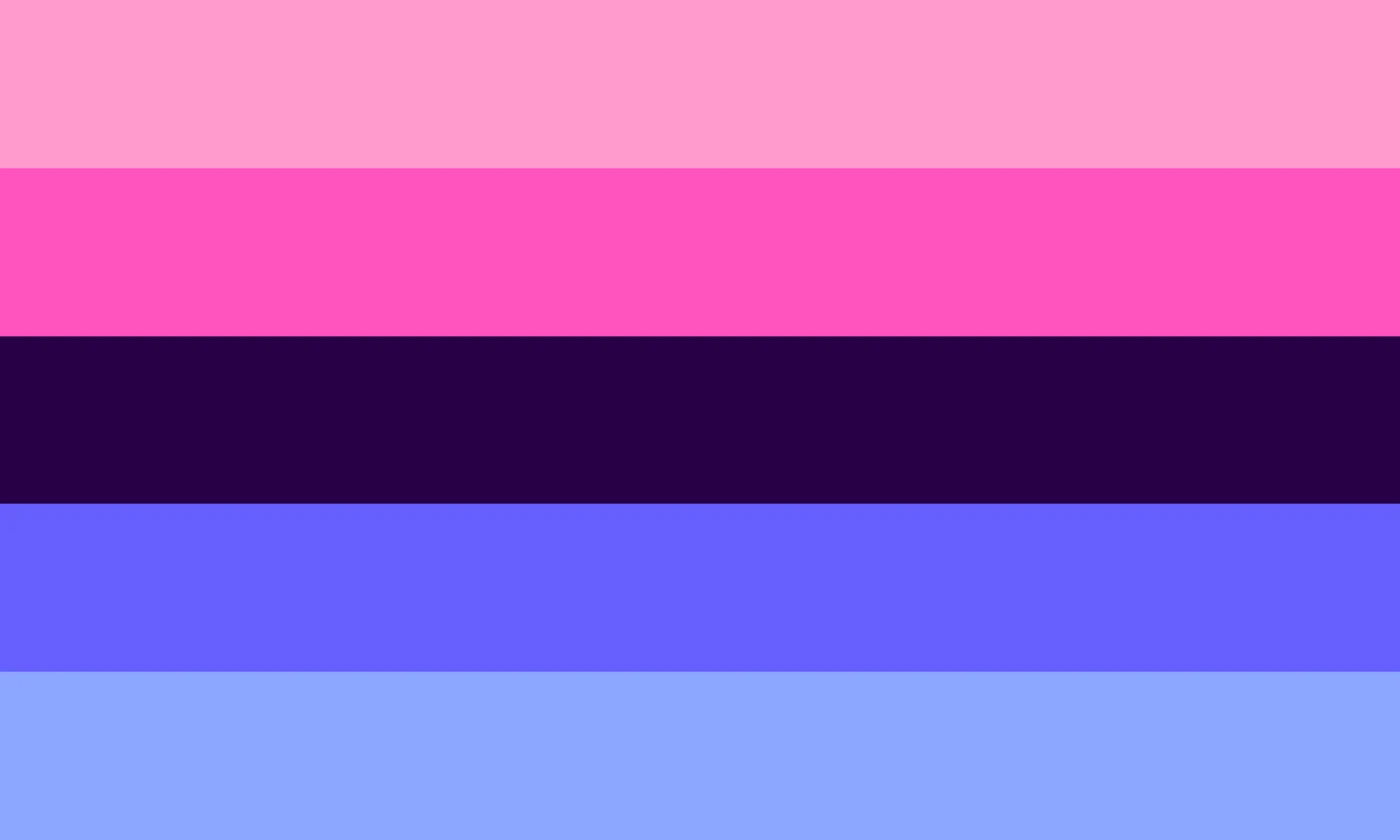
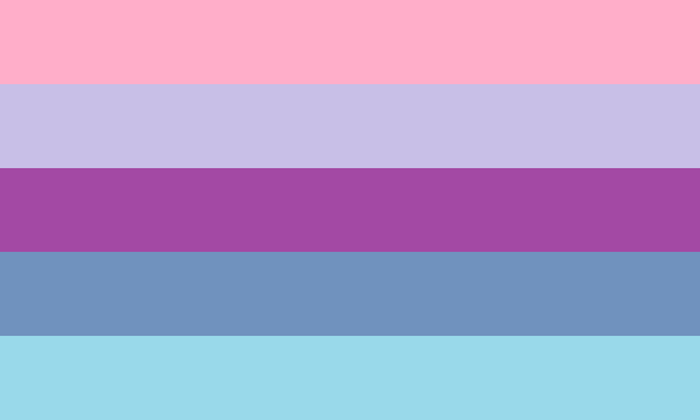
The earliest located publication is Pride-Flags' DeviantArt upload titled "Omni-", dated 4 July 2015. Its description reads: "Omni- attraction to all genders. Sometimes interchangeable with Pan-. Some who are omni- don't limit their attractions to humans only, and say that they could possibly be attracted to advanced sentient races (i.e. aliens)." [1] A July 2016 pride-color-schemes post linked to that upload and credited the flag to Pastelmemer; the same post preserved a second, muted five-stripe design by a creator whose account was already deactivated, along with heart-overlay omniromantic versions of both. [2] The word itself is older than the flag: the Canadian Pride Historical Society, citing Merriam-Webster, gives 1960 as the first known use of "Omnisexual" in something like its present sense. [4]
Identity & Context
- Represented Identity
- omnisexual
- Subcommunity
- multisexual and bi+ contexts (community framing)
Omnisexual commonly refers to attraction to people of all genders. Current institutional explanations distinguish it from pansexuality by whether gender remains a factor: the University of British Columbia's guide defines it as "the sexual attraction to people of all genders, where gender does have an influence on attraction", and the Canadian Pride Historical Society writes that "the key difference between the two identities is that for Omnisexual people, gender does play a role in the attraction". [5][4] The 2015 source called omni and pan "sometimes interchangeable", so the distinction is a later framing rather than a universal rule, and individual use of the labels varies. [1]
Creators
The Creator
Pastelmemer
Attributed designer
Pastelmemer, on Tumblr as PastelRoswell, is the attributed designer of the omnisexual flag. The attribution comes from a July 2016 pride-color-schemes post that credits "@pastelmemer" beneath the flag and links to the 2015 DeviantArt upload; the 2015 page itself names no designer. [2][1] The name continuity is recorded in a March 2020 post about the nine-stripe queer pride flag, also theirs, which describes "deviantart user pastelmemer (pastelroswell on tumblr)" and their Redbubble shop. [6] A 2021 Wikimedia Commons upload of the omnisexual flag gives pastelroswell as its author. [7] No statement by them about this flag's colours has been located.
Pride-Flags
Uploader and archival publisher of the earliest located artifact
Pride-Flags published the earliest located artifact, titled "Omni-", on DeviantArt on 4 July 2015 at 5000 by 3000 pixels under a Creative Commons Attribution 3.0 licence. Its description reads: "Omni- attraction to all genders. Sometimes interchangeable with Pan-. Some who are omni- don't limit their attractions to humans only, and say that they could possibly be attracted to advanced sentient races (i.e. aliens)." The page does not identify the designer. [1]
Attribution notes
Pastelmemer is the attributed designer of the Omnisexual Pride Flag. The earliest located artifact was uploaded by Pride-Flags on DeviantArt on 4 July 2015, and that page names no designer. [1] A July 2016 pride-color-schemes post links to the DeviantArt upload and credits the design to @pastelmemer. [2] A 2021 Wikimedia Commons file dated 2015 records the author as pastelroswell and cites both of those pages as its sources, and the Canadian Pride Historical Society writes that the flag "was designed by Deviantart user Pastelmemer around July 4th, 2015". [7][4] A 2020 community post about a different flag of theirs records the account names as one person: "deviantart user pastelmemer (pastelroswell on tumblr)". [6] No creator-authored explanation of the bright flag's individual stripe meanings has been located.
Origin
- Digital Origin
- Yes
Digital origin; no verified physical location.
Digital origin; no physical location is documented. The earliest located public artifact is the Pride-Flags DeviantArt publication of 4 July 2015, and Pastelmemer is attributed as designer by the linked July 2016 Tumblr documentation. [1][2] The Canadian Pride Historical Society names DeviantArt as the platform; no 2015 posting by Pastelmemer's own account has been located, so whether the design first appeared there or was supplied to Pride-Flags is unresolved. [4]
Dates & Chronology
- Year Created
- Earliest located publication
- Period in Use
- Documented circulation 2015 to present
The design appears in later flag guides, community reference works, Wikimedia files and institutional pride resources, which supports describing it as widely circulated rather than official or formally standardized. [3][7][5] Writing in 2024, the Canadian Pride Historical Society calls it "relatively new in the grand scheme of GSRD flags" but "widely adopted as a loved symbol of the Omnisexual community". [4]
Omnisexual Visibility Day is observed on 6 July, two days after the date given for the flag. The Canadian Pride Historical Society's observance article opens "July 6th marks Omnisexual Visibility Day" and separately dates the flag to "around July 4th, 2015"; no located source connects the two dates. [4] The July 2016 documentation post shows four images in sequence: the attributed flag, the muted alternative, and heart-overlay omniromantic versions of each. Neither the alternative nor the heart versions displaced the five-stripe design. [2]
Lineage
- Direct children
- Omniromantic Pride Flag
- Related flags
- Multisexual Pride Flag (Synp attribution, 2019)
The Omniromantic Pride Flag is recorded as a derivative: the July 2016 pride-color-schemes post shows the omniromantic version built on this design with a heart overlay. [2] The bisexual, pansexual, polysexual and multisexual entries are contextual neighbours for navigation, not documented visual or historical sources; identity proximity is not design lineage. The muted five-stripe design preserved in the same 2016 post is a contemporary alternative for the same identity rather than a parent or child, and its designer is listed only as a deactivated account. [2]
Lineage tree
Every record reachable from this one through documented parent and child relationships: 2 records across 2 generations.
- This record
- Omnisexual Pride Flag
- Children
- Omniromantic Pride Flag
Colors & Symbolism
No creator-authored explanation of the stripes has been located. Three later reference sources give substantially the same reading: the pink bands for attraction to femininity and women, the blue bands for attraction to masculinity and men, the light outer bands for the ends of the gender spectrum, and the dark central band for attraction to people whose gender falls outside those categories. [4][5][3] These are later readings, not statements by Pastelmemer.
| Colour | Hex | Meaning |
|---|---|---|
| Light Pink | #FF9BCD | Feminine end of the gender spectrum. Later reference reading, not creator-issued. [5][3] |
| Pink | #FF53BE | Femininity and women, as objects of attraction. Later reference reading, not creator-issued. [4][5][3] |
| Dark Purple | #260046 | Genders outside the binary, as objects of attraction. The band is dark enough that the 2016 accessibility description records it as black. [4][5][2] |
| Blue | #665EFF | Masculinity and men, as objects of attraction. Later reference reading, not creator-issued. [4][5][3] |
| Light Blue | #8CA6FF | Masculine end of the gender spectrum. Later reference reading, not creator-issued. [5][3] |
Measured from the 5000 by 3000 artifact published by Pride-Flags on DeviantArt in 2015; the 2016 pride-color-schemes copy carries the same fills. Not a creator-issued specification. [8][2]
The July 2016 pride-color-schemes post carries its own colour note: "The flag colours represent the gender binary and all genders in between. Moreover, they go to show how even binary genders are more than what meets the eye. This design can also be used as the omnigender design." It sits after the second, muted flag rather than after Pastelmemer's, and the post does not say which design it describes, so this entry does not attribute it to the bright flag. [2] The per-stripe readings above come from later reference sources and are labelled as such. [4][5][3]
These values are measured from the 5000 by 3000 DeviantArt artifact of 4 July 2015 and match the 700 by 420 copy preserved by pride-color-schemes in 2016. No creator-issued specification has been located. [8][2] The Tumblr copy carries a few one-pixel transition rows from resizing or re-encoding; those are artifacts of that file, not additional bands or palette colours. Library.LGBT's circulating palette (#FE9BCC, #FF55BE, #240045, #675FFE, #8DA5FE) agrees to within one or two units per channel, which is what sampling a re-encoded copy of the same artwork looks like. [3] The muted five-stripe alternative preserved in the same 2016 post is a separate design and measures #FFAEC9, #D1BCE2, #A144A1, #7092BE and #99D9EA. [2]
Design
- Aspect Ratio
- 3:5 · standard
- Orientation
- horizontal
- Stripe Count
- 5
- Layout
- horizontal_stripes
- Stripes (Top → Bottom)
- Light Pink, Pink, Dark Purple, Blue, Light Blue
Five equal horizontal bands. The 2015 DeviantArt artifact measures 5000 by 3000 pixels with bands of 598 to 601 rows, matching the database's standard 3:5 production ratio; the copy preserved by pride-color-schemes in 2016 is the same design at 700 by 420, and the archive's reconstruction is drawn at 800 by 480 with five 96-pixel bands. [8][2]
Five equally sized horizontal stripes ordered top to bottom: light pink, pink, dark purple, blue, light blue. No emblem or additional symbols. [8]
Five equal horizontal stripes: light pink, pink, a very dark purple, blue, light blue. The 2016 accessibility description records the sequence as "light pink, pink, black, blue, light blue", the centre band being dark enough to read as black. [8][2]
Usage & Adoption
- Online Usage
- DeviantArt, where the earliest located artifact was published in 2015 [1], Tumblr, through the July 2016 pride-color-schemes documentation [2], Later flag guides, Wikimedia files and institutional pride resources [3][7][5]
- Current Status
- widely circulated
The design appears in later flag guides, community reference works, Wikimedia files and institutional pride resources, which supports describing it as widely circulated rather than official or formally standardized. [3][7][5] The Canadian Pride Historical Society describes it as "widely adopted as a loved symbol of the Omnisexual community". [4] No organization is documented as having formally adopted it.
Image Archive
Earliest Located Publication
Attribution Source
Contemporary Alternative
Archive Reconstruction
Discourse & Debates
Common misidentifications
- Omnisexual and pansexual are frequently treated as synonyms. The 2015 publication itself called the terms "sometimes interchangeable", while later institutional and community sources distinguish them by whether gender remains a factor in attraction. [1][4][5]
The 2015 publication described omni attraction as attraction to all genders, called the term "sometimes interchangeable" with pan, and added that "some who are omni- don't limit their attractions to humans only". [1] Later resources more often present the two as distinct, on the basis that gender may remain a factor in omnisexual attraction; personal use of both labels overlaps. [4][5][3] The 2015 upload's title was "Omni-", which is the title of that file rather than an alternate name for the design. [1]
Footnotes & Citations
Sources and footnotes 8 sources
- 1. Image file page Omni-. Pride-Flags. DeviantArt (2015-07-04). Accessed 2026-08-16
The earliest located publication of the design, timestamped 2015-07-04T00:30:03-07:00 and marked Creative Commons Attribution 3.0. The page names no designer.
- 2. Social media Omni-. pride-color-schemes. Tumblr (2016-07-05). Accessed 2026-08-16
Timestamped 2016-07-05T00:55:07Z. Links the DeviantArt upload, credits the design to @pastelmemer, and shows a second, muted omnisexual design credited to a deactivated account.
- 3. Reference Pride Flag Guide: Omnisexual. Library.LGBT (Albany Pride initiative). Library.LGBT Pride Flag Guide. Accessed 2026-03-09
A tertiary flag guide: it names no author and cites no sources. Used here only alongside independent support.
- 4. Organizations Omnisexual Visibility Day. Holly Mitchell. Canadian Pride Historical Society (2024-07-06). Accessed 2026-08-16 · Archived version
- 5. Organizations Guide to pride flags. University of British Columbia, Equity and Inclusion Office. University of British Columbia. Accessed 2026-08-16
The page records a last update of 17 March 2025.
- 6. Social media On the origin of the nine-stripe queer pride flag. genderqueerpositivity. Tumblr (2020-03-29). Accessed 2026-08-16
Cited for name continuity only. The post concerns a different flag and says nothing about the omnisexual design.
- 7. Image file page File:Omnisexuality flag.svg. Uploaded by Nikki; author field records pastelroswell. Wikimedia Commons (2021-06-20). Accessed 2026-08-16
A 1200 by 720 SVG released under CC BY-SA 4.0, dated 2015 in its information template and citing both the DeviantArt upload and the pride-color-schemes post as its sources.
- 8. Image file page Source PNG behind the 2015 DeviantArt publication, 5000 by 3000 pixels. Published by Pride-Flags. DeviantArt (2015-07-04). Accessed 2026-08-16 · Archived version
The downloaded file, measured for this entry: five bands of 598 to 601 rows each and the colour values published in Colors.

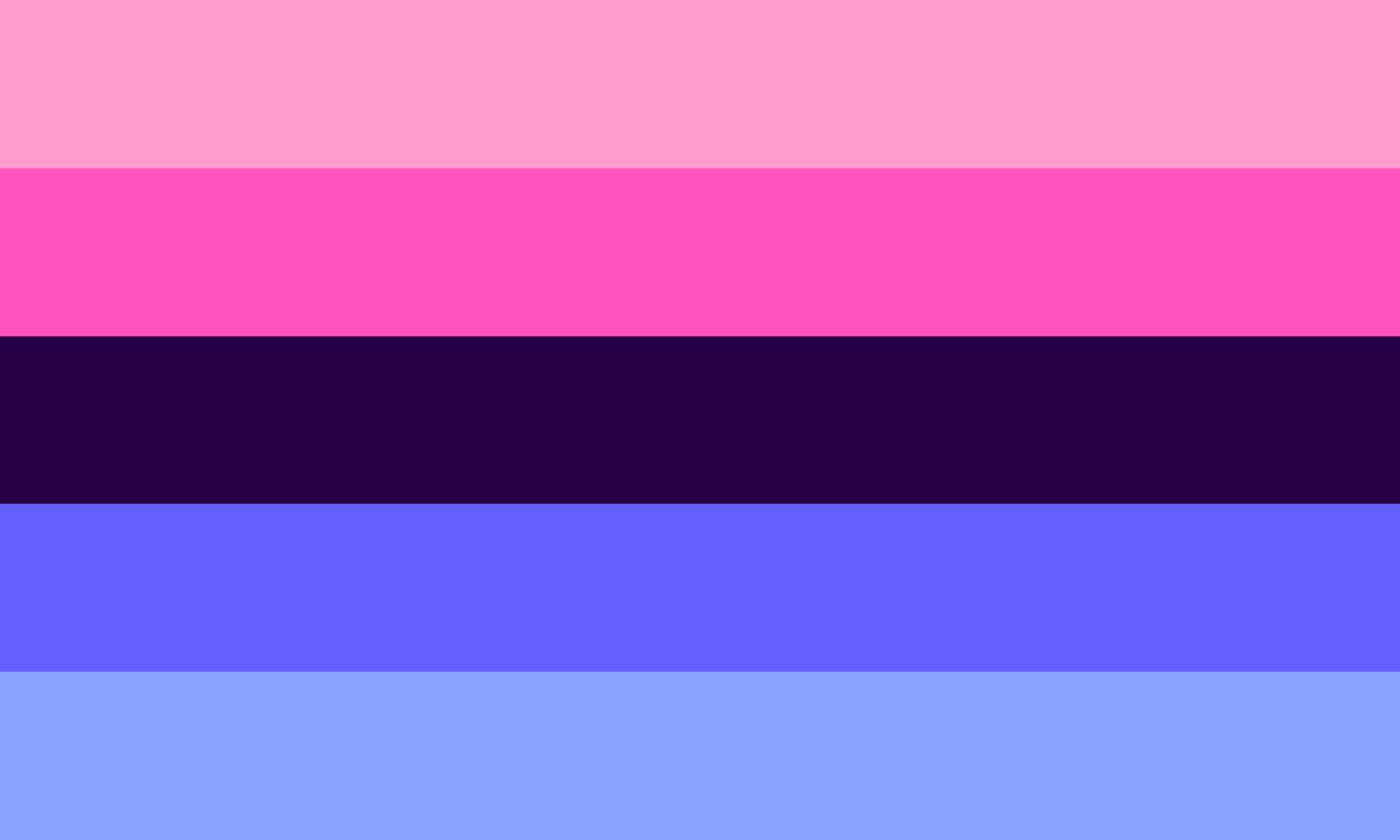
Image Sources
- Rendering
- design attributed to Pastelmemer
- Encycloflaggia reconstruction of the five-stripe omnisexual flag attributed to Pastelmemer · Credit: Design attributed to Pastelmemer; reconstruction by Encycloflaggia · Encycloflaggia · reconstruction
- The 5000 by 3000 artifact published by Pride-Flags on DeviantArt on 4 July 2015 · Credit: Published by Pride-Flags; design attributed to Pastelmemer · DeviantArt · verified
- Five-stripe omnisexual flag published by Pride-Flags on DeviantArt on 4 July 2015. A July 2016 flag-documentation post attributes the design to Pastelmemer. [1][2] · Credit: Published by Pride-Flags; design attributed to Pastelmemer · DeviantArt · CC BY 3.0
- The 700 by 420 copy preserved by pride-color-schemes in July 2016, the post that credits the design to @pastelmemer and links to the 2015 DeviantArt upload. [2] · Credit: Preserved by pride-color-schemes; design attributed to Pastelmemer · Tumblr · No reuse statement located
- Muted five-stripe omnisexual alternative preserved by pride-color-schemes in July 2016. The source lists its designer only as a deactivated account. Do not attribute this variant to Pastelmemer. [2] · Credit: Preserved by pride-color-schemes; designer listed as a deactivated account · Tumblr · Rights unknown; no reuse statement located
- The archive's reconstruction, drawn at 800 by 480 with five equal bands using colours measured from the 2015 DeviantArt artifact. [8] · Credit: Design attributed to Pastelmemer; reconstruction by Encycloflaggia · Encycloflaggia reconstruction · Archive-produced reconstruction, subject to the rights status of the underlying design