Queer Pagan Flag
Rainbow Pride Flag ·
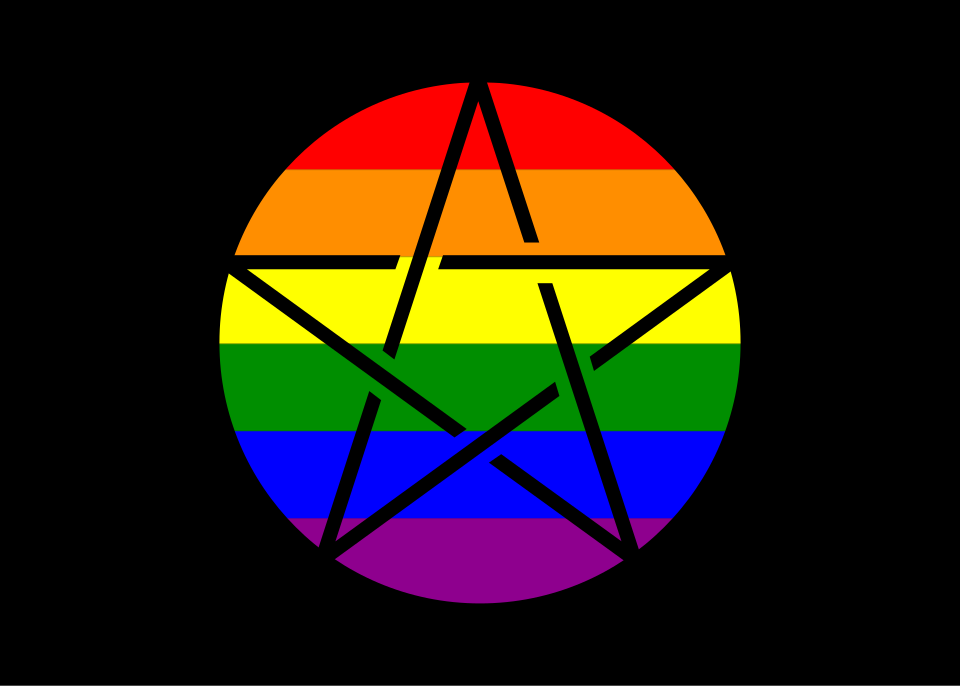
Laura Anne Seabrook designed this in 1997: a rainbow disc charged with an interwoven black pentagram, on black. The first version was vinyl and carried an "Athena" symbol at the pentagram's centre for the modern Galli or Gallae, transgender followers of the Magna Mater, Cybele; she dropped it to make the flag a general one, and carried a full-sized copy in the 2006 Sydney Gay and Lesbian Mardi Gras Parade. She released the design under Creative Commons on 28 July 2006 at half past ten at night. [1]

Key facts
- Designer
- Laura Anne Seabrook
- Created
- First documented public use
- In use
- 1997 to the present
- Aspect Ratio
- 5:7
- Stripes
- 0
- Origin
- Sydney, New South Wales, Australia
- Represented Identity
- LGBTQ
Also known as
- Queer Pagan Pride Flag
Archive categories Religious and Spiritual Pride Flags
Overview
"The design represents the intersection of Queer and Neo-Pagan communities, and is intended as the general flag of Queer Paganism." [1]
Laura Anne Seabrook designed the flag in 1997. The first version was made in vinyl and carried an "Athena" symbol at the centre of the pentagram, "to represent the modern Galli or Gallae (transgendered followers of the Magna Mater, Cybele)." [1]
Identity & Context
- Represented Identity
- LGBTQ
- Subcommunity
- neo-Pagan
- Religious Context
- Neo-Paganism
Creators
The Creator
Laura Anne Seabrook
Designer
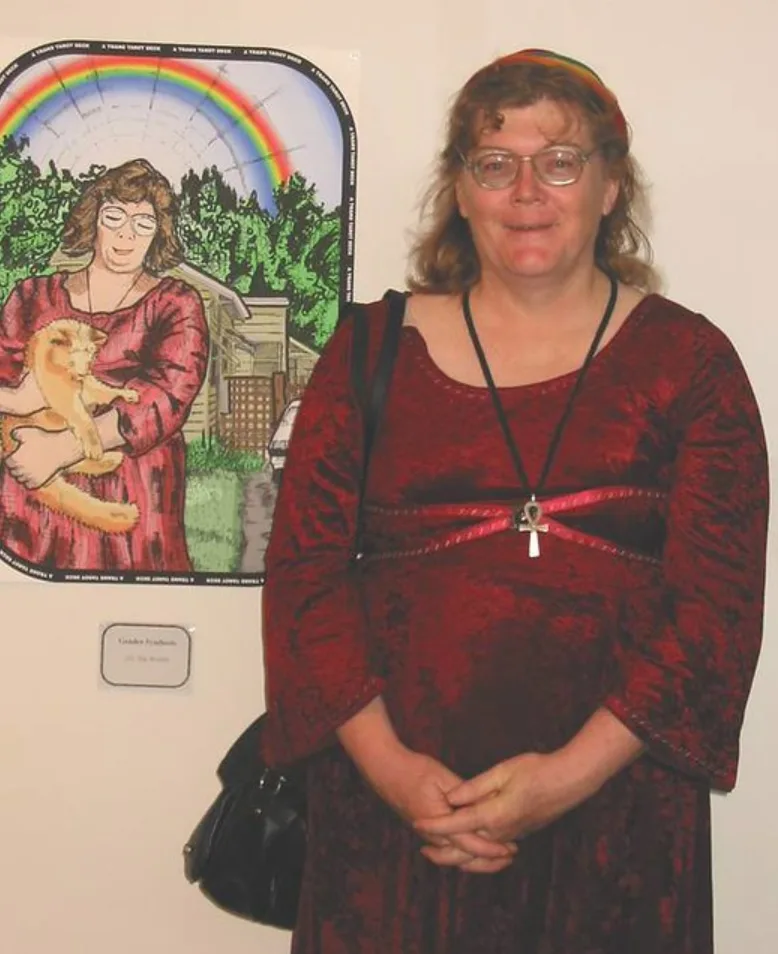
An artist and writer of Barnsley, New South Wales, Australia, publishing as LauraSeabrook and, on Flickr, as Laura Ess. She uses she/her pronouns and lists Gallae among her interests. [2] She designed the Queer Pagan Flag in 1997, first in vinyl with an "Athena" symbol at the centre of the pentagram for the modern Galli or Gallae, and later dropped that symbol "to make it more appropriate as a general Queer Pagan flag." A full-sized flag was made and carried in the 2006 Sydney Gay and Lesbian Mardi Gras Parade. She released the design under Creative Commons on 28 July 2006 and restated the release on DeviantArt in 2014, where she also published two variations of her own, an inverted version and the Fey Pagan Flag. [1]
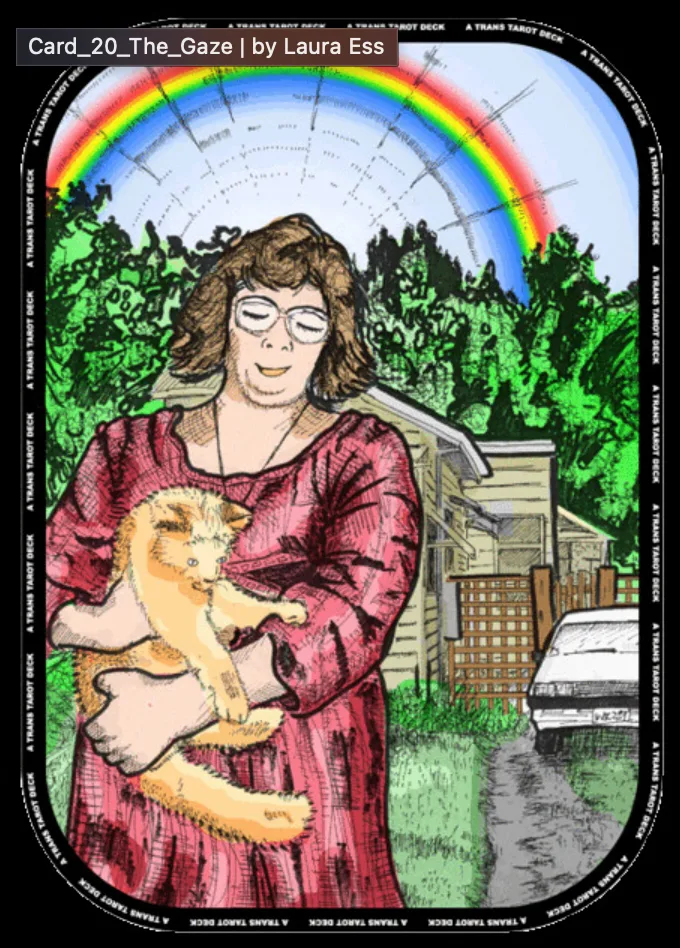
She also makes A Trans Tarot Deck, publishing on Flickr as Laura Ess. Its twentieth card, The Gaze, draws her standing outside her home holding her cat Gabby, and she describes the figure plainly: "The model for this figure is myself, holding Gabby the cat. I'm standing in front of my home, 'Rainbow Haven', and life feels good." [3]
The design represents the intersection of Queer and Neo-Pagan communities, and is intended as the general flag of Queer Paganism.
The original version was made in vinyl and included an "Athena" symbol at the centre of the pentagram, to represent the modern Galli or Gallae (transgendered followers of the Magna Mater, Cybele).
The black of the field and the pentagram represent the strength in unity, and the circle represents the whole rather than the part.
Attribution notes
Laura Anne Seabrook, an artist and writer of Sydney, Australia, designed the flag in 1997 and published its description, symbolism, history and licence herself. [1][4] She is photographed twice on her own documentation sheet, holding the full-sized flag and carrying it in the Mardi Gras parade. [1]
Origin
- Country
- Australia
- Region / state
- New South Wales
- City
- Sydney
Designed by someone in Sydney, on Gadigal land of the Eora Nation.
Indigenous land context
Gadigal people of the Eora Nation — traditional owners of the land on which Sydney was built. Named on the same principle the archive applies to entries documented in the United States, Canada and Palestine: the land is identified by the people it belongs to, not by the settler state alone. Which Country the design was actually made on has not been established beyond the city; sovereignty was never ceded.
Colonial / settler context
Sydney was founded as a British penal colony in 1788 on Gadigal land. Australia was claimed under terra nullius, the legal fiction that the continent belonged to no one, which the High Court rejected in Mabo (1992). Aboriginal and Torres Strait Islander peoples never ceded sovereignty. This note carries no citation and is written from general knowledge; it needs Aboriginal sources read in full before this entry is treated as finished.
- Land status
- Gadigal land, Eora Nation. Never ceded.
- Indigenous engagement
- None. No Aboriginal person or organisation has been consulted about this entry.
- Continuing presence
- Gadigal and other Eora people live in Sydney today.
Pending Review Land-context note is uncited and written from general knowledge. Needs Aboriginal sources. The entry itself is a stub built from one vexillological contributor page.
The designer gives her residence as Barnsley, New South Wales. [2] Flags of the World gives her as being of Sydney, which is where the flag was first flown. Where the design was made is not separately documented. [4][1]
Dates & Chronology
- Year Created
- First public use
- Period in Use
- 1997 to the present
- Creation Bounds
- Designed in 1997 and first flown at the 2006 Sydney Gay and Lesbian Mardi Gras Parade. Both dates come from the designer, and the Commons file, uploaded on 4 June 2006 from her own Flickr, gives the same year independently. [1][5] Flags of the World gives 2005 for the march; two sources against one, and this entry follows them. [4] The Creative Commons release has a time as well as a date: 28 July 2006 at 10:30 pm Australian Eastern Standard Time, made via LiveJournal and restated on DeviantArt "for further confirmation of this." [1]
A full-sized flag was made and carried in the 2006 Sydney Gay and Lesbian Mardi Gras Parade, where the designer was photographed with it. [1] The vector on Wikimedia Commons illustrates the English Wikipedia's articles on Religion and LGBTQ people and on Modern paganism and LGBTQ people, and the corresponding articles on the German, Russian, Serbian and Ukrainian Wikipedias. [5] Flags of the World reports the basic version as commercially manufactured, and cites for it the Jersey Flags online shop at jerseyflags.co.uk, where it was listed as product 13171. [4]
Major revisions
The inner Athena symbol was dropped, in the designer's words, "to make it more appropriate as a general Queer Pagan flag." The undated revision is the version in circulation, and the one made at full size for the 2006 march. [1] Flags of the World dates a revision to 2005 and describes it as making the flag "more inclusive in terms of the users' religious beliefs"; Seabrook gives no year and a different reason, the shift from a specifically Gallae emblem to a general one. [4]
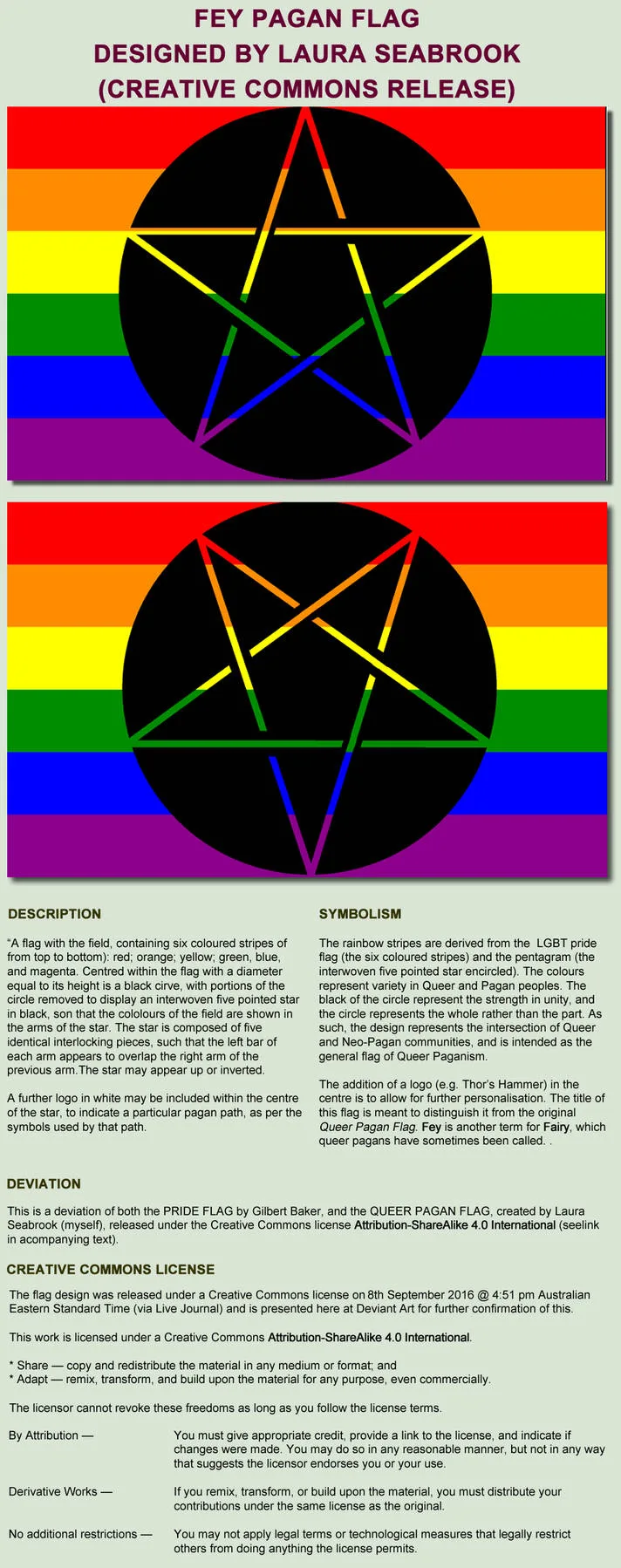
Two derivatives are recorded and neither is documented in use: an inverted version with the pentagram upside down, made later for followers of the "Left Handed Path"; and the Fey Pagan Flag, which keeps the meaning but puts the field and pentagram in rainbow colours and the disc in black, with the pentagram again upright or inverted. Flags of the World states that these "seem not to have appeared in real life so far." [4]
Lineage
The rainbow stripes are taken from the six-stripe pride flag, on the designer's own statement. [1] She lists two variations of her own: an inverted version and the Fey Pagan Flag. Flags of the World says neither "seem[s] to have appeared in real life so far." [1][4]
Colors & Symbolism
Seabrook's own account: "The rainbow stripes are derived from the LGBT pride flag (the six coloured stripes) and the pentagram (the interwoven five pointed star encircled). The colours represent variety in Queer and Pagan peoples. The black of the field and the pentagram represent the strength in unity, and the circle represents the whole rather than the part." [1]
- Pentagram, interwoven, encircled by the disc
- Black, for strength in unity, with the circle standing for "the whole rather than the part." [1]
Every meaning here is the designer's own, published with the design. [1]
Seabrook names six colours in order from the top of the disc: red, orange, yellow, green, blue and magenta, and says they are derived from the LGBT pride flag. [1] She published no values. Note that she calls the sixth colour magenta where the six-stripe flag calls it violet. The artwork here uses the six-stripe values for the first five.
Design
- Aspect Ratio
- 5:7
- Orientation
- horizontal
- Stripe Count
- 0
- Layout
- charge_on_plain_field
- Center Symbol
- Black pentagram on a rainbow disc
A black field carrying a disc of six rainbow stripes, charged with an interwoven black pentagram whose five arms are identical interlocking pieces, each overlapping the last. [1] The vector on Wikimedia Commons, uploaded from the designer's own Flickr in June 2006, is nominally 350 by 250, a ratio of 5:7. [5] The artwork here is redrawn to the written description and renders the star as a single stroked pentagram rather than five interlocking pieces, so the weave is approximated.
Seabrook's own description: "A flag with black field, and centre circle containing six coloured stripes of from top to bottom): red; orange; yellow; green, blue, and magenta. Upon the circle is displayed an interwoven five pointed star in black. The star is composed of five identical interlocking pieces, such that the left bar of each arm appears to overlap the right arm of the previous arm." [1]
Usage & Adoption
- First Users
- Laura Anne Seabrook, carrying a copy at the 2005 Sydney Gay and Lesbian Mardi Gras march [4]
- Geographic Usage
- Australia
- Online Usage
- Wikipedia, in six languages, illustrating articles on religion, modern paganism and LGBTQ people. [5]
- Event Usage
- Sydney Gay and Lesbian Mardi Gras, 2006, carried by the designer. Flags of the World gives 2005 for the same march. [1][4]
- Current Status
- active
One documented user, the designer. Commercial manufacture is reported. [4]
Image Archive
The designer
The designer's own record
Variations
Discourse & Debates
Common misidentifications
Footnotes & Citations
Sources and footnotes 6 sources
- 1. Designer page Queer Pagan Flag (CC BY-SA 4.0). Laura Anne Seabrook. DeviantArt (2014-07-04). Accessed 2026-08-10
- 2. Designer page LauraSeabrook profile. Laura Anne Seabrook. DeviantArt. Accessed 2026-08-10
- 3. Designer page Laura Seabrook photostream (Queer Pagan Flag; A Trans Tarot Deck). Laura Seabrook, publishing as Laura Ess. Flickr (2009-10-16). Accessed 2026-08-10
- 4. Databases Gay Pride/Rainbow Flags - Religious Variants. randy young (editor); flag documentation by Tomislav Todorović and António Martins. Flags of the World (2023-09-30). Accessed 2026-08-10
A signed contributor page rather than vetted reference text. Its dated sightings and design descriptions are cited here; contributor opinion is attributed to the named contributor and date.
- 5. Image file page File:Queer Pagan Flag.svg. Laura Anne Seabrook; uploaded by Fibonacci. Wikimedia Commons (2006-06-04). Accessed 2026-08-10
- 6. Designer page Fey Pagan Flag. Laura Anne Seabrook. DeviantArt. Accessed 2026-08-10
Image Sources
- Rendering
- 2006 revision
- Laura Anne Seabrook's own vector of the Queer Pagan Flag, released by her under CC BY-SA 4.0 and held on Wikimedia Commons with VRT ticket 2016090810002991. The pentagram is interwoven, passing over and under itself at each crossing. · Credit: Laura Anne Seabrook, CC BY-SA 4.0 · Wikimedia Commons · creator artwork
- Card 20, The Gaze, from Seabrook's A Trans Tarot Deck, published on Flickr under her Laura Ess byline. She describes the figure as a self-portrait: "The model for this figure is myself, holding Gabby the cat. I'm standing in front of my home, 'Rainbow Haven', and life feels good." The rainbow recurs across her work. [3] · Credit: Laura Seabrook (Laura Ess) · Flickr
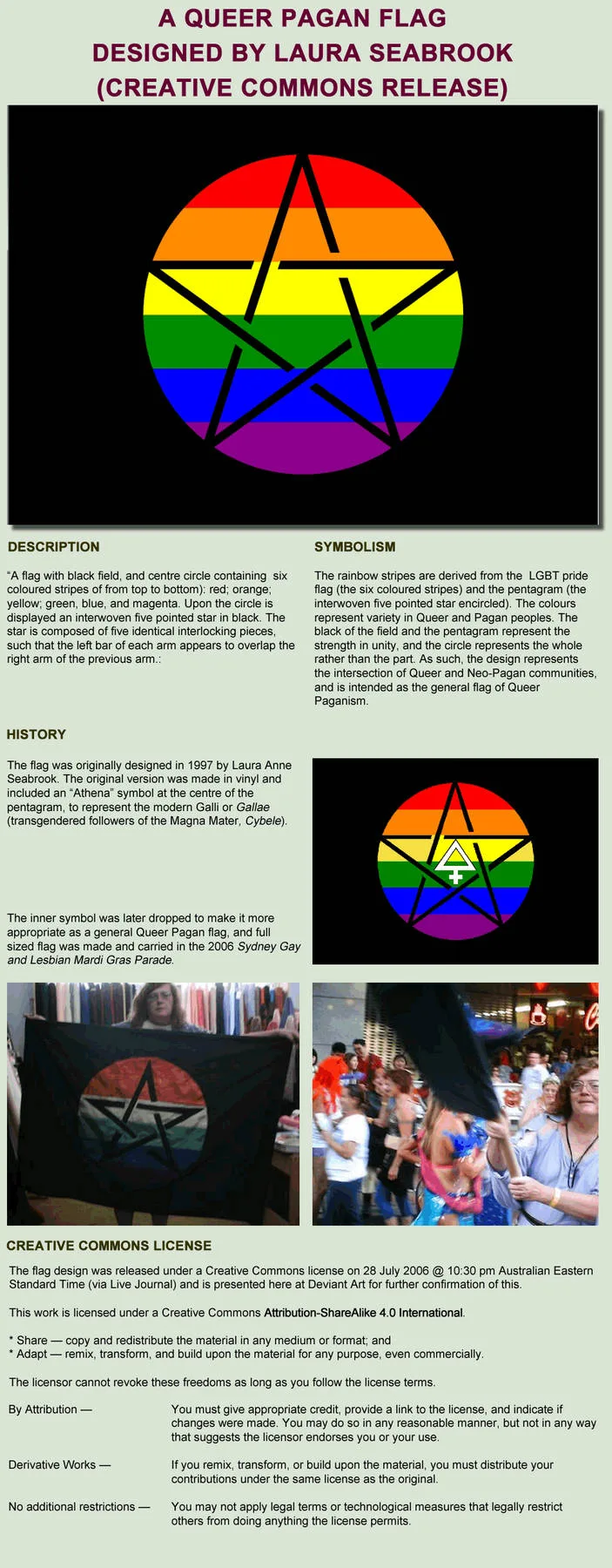
- Seabrook's own documentation sheet, published on DeviantArt on 4 July 2014. It carries the description, the symbolism, the history and the licence terms in her words, and four images: the flag as circulated; the 1997 original with the "Athena" symbol at the centre of the pentagram for the modern Galli or Gallae; the designer holding the full-sized flag indoors; and the designer carrying it in the Sydney Gay and Lesbian Mardi Gras Parade. Everything this entry states about the flag's making, meaning and licence comes from this sheet. [1] · Credit: Laura Anne Seabrook · DeviantArt · CC BY-SA 4.0
- The Fey Pagan Flag, Seabrook's own variation: the field and pentagram in rainbow colours and the disc in black, inverting the arrangement of the Queer Pagan Flag while keeping its meaning. Flags of the World records that this and her inverted version "seem not to have appeared in real life so far." [6][4] · Credit: Laura Anne Seabrook · DeviantArt