Demibisexual Pride Flag (2016, Pride-Flags)
Compound Identity Pride Flag ·
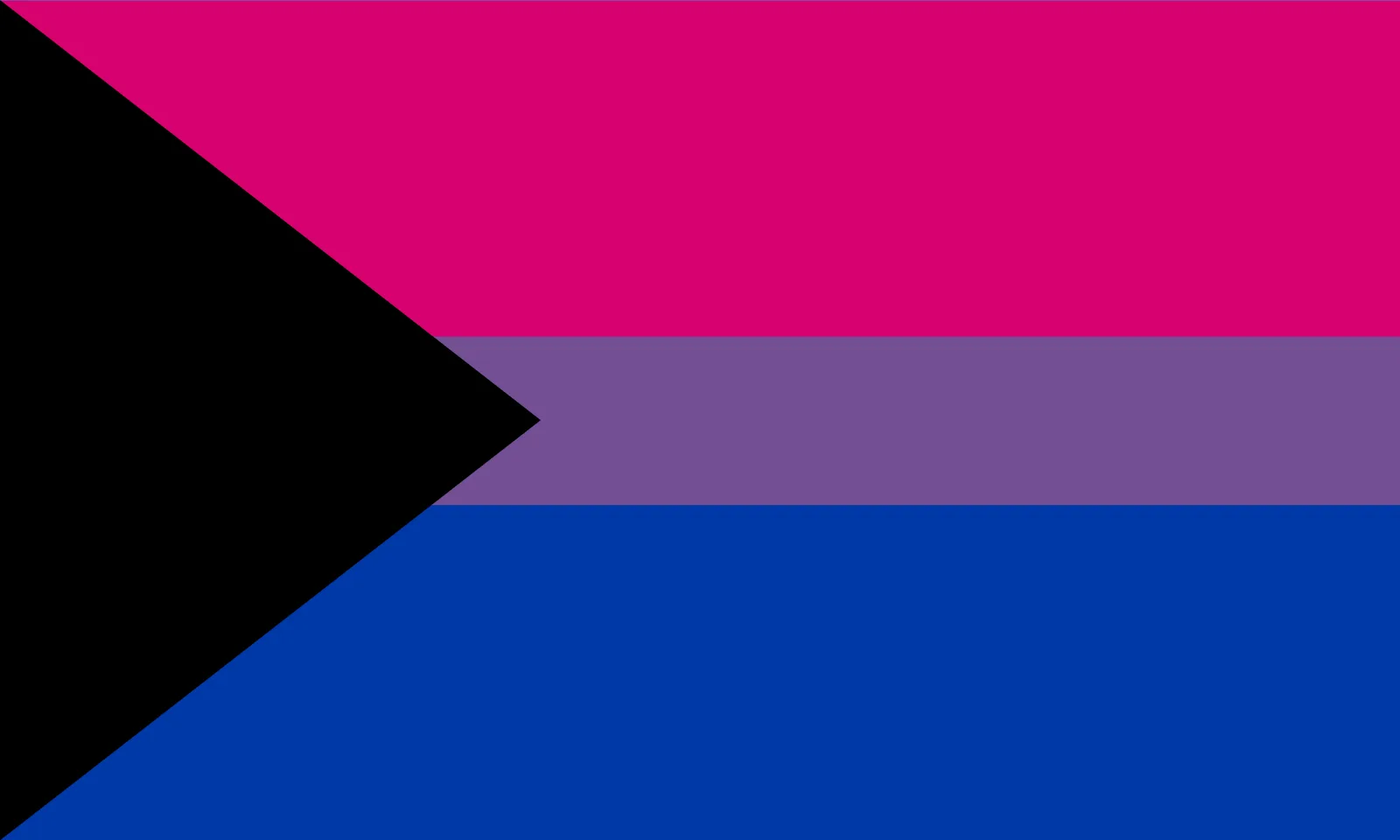
A 2016 compound design for demibisexual identity, published by the Pride-Flags archive on 15 May 2016 without an individual designer credit. It sets a full-height black hoist triangle, the demi-orientation convention, against the bisexual flag's bands. [1][2]
Key facts
- Designer
- Unknown
- Created
- Publication on DeviantArt
- In use
- Published 15 May 2016
- Aspect Ratio
- 3:5 · apparent
- Ratio Notes
- Measured from the source file, 5000 by 3000 pixels, exactly 5:3. [2]
- Stripes
- 3
- Represented Identity
- demibisexual
Also known as
- Demibi Pride Flag
- Demibi Flag
- Demibi-
Status Variant
Archive categories Sexual & Romantic Orientation Pride Flags
Overview
No creator statement has been located. [1]
Pride-Flags published the design on 15 May 2016 at 08:56:34 UTC, a 5000 by 3000 file titled "Demibi-". The description defines both halves of the compound and names no designer. [1]
Identity & Context
- Represented Identity
- demibisexual
- Subcommunity
- a-spec and multisexual contexts
The deviation defines both halves of the compound. "Bi- Attraction to two or more genders." and "Demi-: An a-spectrum orientation where one does not experience attraction to a person until they have developed an emotional connection to them. There is no guarantee that this attraction will develop after an emotional connection is formed, but it is required in order for attraction to be possible." [1]
Creators
Associated Figure
Pride-Flags
Publisher and high-resolution rendering source
A DeviantArt archive of pride flag artwork. It published this 5000 by 3000 file on 15 May 2016 at 08:56:34 UTC, with definitions of the component terms and no designer credit. [1]
Attribution notes
The designer is unknown. The deviation defines the component terms and names no designer. [1] Pride-Flags published the file and supplied the high-resolution rendering; the account name does not imply authorship, and the archive's FAQ states that work it created itself would be identified in the post description. [3]
Origin
- Digital Origin
- Yes
No verified physical origin location. Without a confirmed location, Indigenous land context cannot be attributed.
Digital origin on DeviantArt. No physical origin is documented. [1]
Dates & Chronology
- Year Created
- Exact date
- Publication on DeviantArt
- Period in Use
- Published 15 May 2016; adoption not established
Documented in the Pride-Flags archive and in later online reference resources. No formal organizational adoption and no direct usage source have been located. [1]
The neighbouring demipansexual design was published by the same account the previous evening, on 14 May 2016; it is a companion publication and not evidence of this design’s adoption. [4]
Lineage
- Direct predecessors
- Bisexual Pride Flag, Demisexual Pride Flag
- Indirect influences
- Asexual Pride Flag
Two documented visual sources. The Bisexual Pride Flag supplies the bands, measured identical to its palette. The demisexual flag supplies the hoist-triangle convention, though only the black element is present here. [2][1]
Lineage tree
Every record reachable from this one through documented parent and child relationships: 4 records across 3 generations.
- Ancestors -2
- Asexual Pride Flag
- Ancestor
- Bisexual Pride Flag, Demisexual Pride Flag
- This record
- Demibisexual Pride Flag (2016, Pride-Flags)
Colors & Symbolism
No symbolism was published. The source description defines the terms instead: "Bi- Attraction to two or more genders.", and demi- as "An a-spectrum orientation where one does not experience attraction to a person until they have developed an emotional connection to them. There is no guarantee that this attraction will develop after an emotional connection is formed, but it is required in order for attraction to be possible." It adds that some demi people further specify the genders they may become attracted to, and others do not find that necessary or may not have enough experience to specify. [1]
| Colour | Hex | Meaning |
|---|---|---|
| Pink | #D70170 | Inherited from the Bisexual Pride Flag; no meaning was published for this band on the composite's deviation. [1] |
| Purple | #734F95 | Inherited from the Bisexual Pride Flag; no meaning was published for this band on the composite's deviation. [1] |
| Blue | #0038A7 | Inherited from the Bisexual Pride Flag; no meaning was published for this band on the composite's deviation. [1] |
| Black triangle | #000000 | — |
These hexadecimal values are exact measurements from the cited 5000 by 3000 source PNG. They document that artifact rather than a creator-issued color specification. [2]
- Black hoist triangle
- The demi-orientation convention used by the demisexual flag, here in black alone. [2][1]
The background mechanically reuses the bisexual flag's stripe structure, keeping its 40:20:40 division and colour sequence. The black triangle invokes the demi-orientation convention used by the demisexual flag. Pride-Flags defines demi- in the deviation text but does not publish new symbolism for this composite, so the band readings are those of the Bisexual Pride Flag entry and are inherited rather than original. [1]
Four values, measured from the source file and not issued by a creator. The field is the bisexual flag’s 40:20:40 in the saturated colours, with a solid black triangle spanning the full height at the hoist. The visible construction reproduces the bisexual flag; the source description defines the terms and states no derivation, so the construction is recorded as visible rather than as a documented creator statement. [2][1]
Design
- Aspect Ratio
- 3:5 · apparent
- Ratio Notes
- Measured from the source file, 5000 by 3000 pixels, exactly 5:3. [2]
- Orientation
- horizontal
- Stripe Count
- 3
- Layout
- horizontal_stripes
- Stripes (Top → Bottom)
- Pink, Purple, Blue
- Additional Symbols
- Full-height black hoist triangle
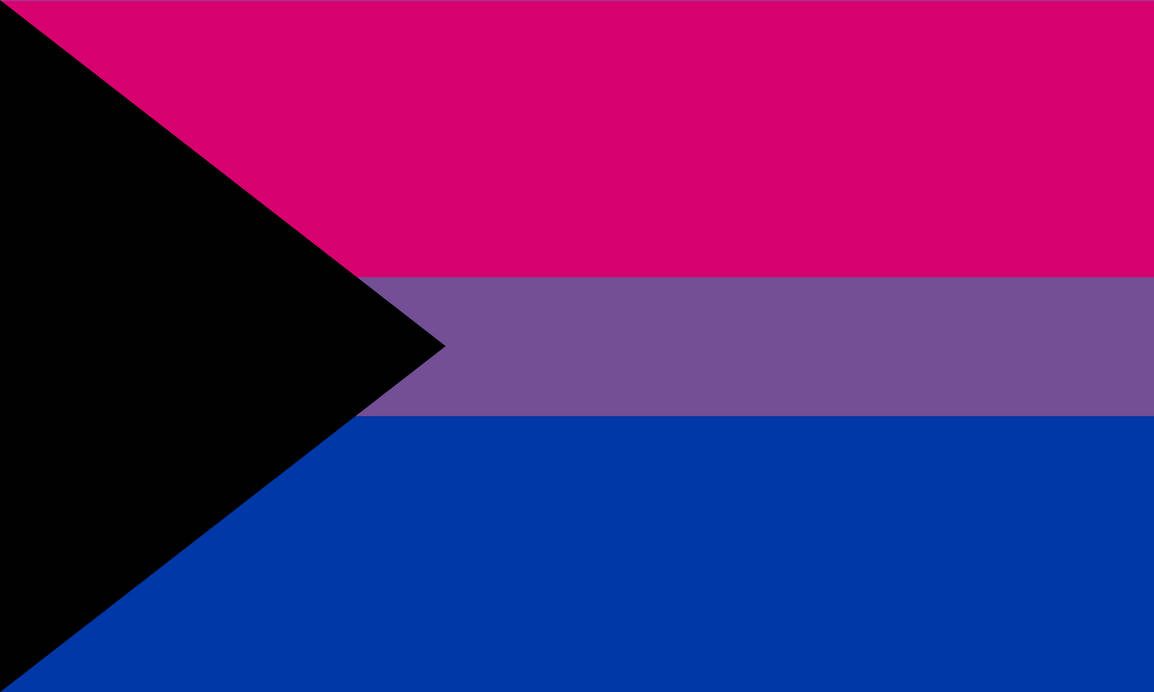
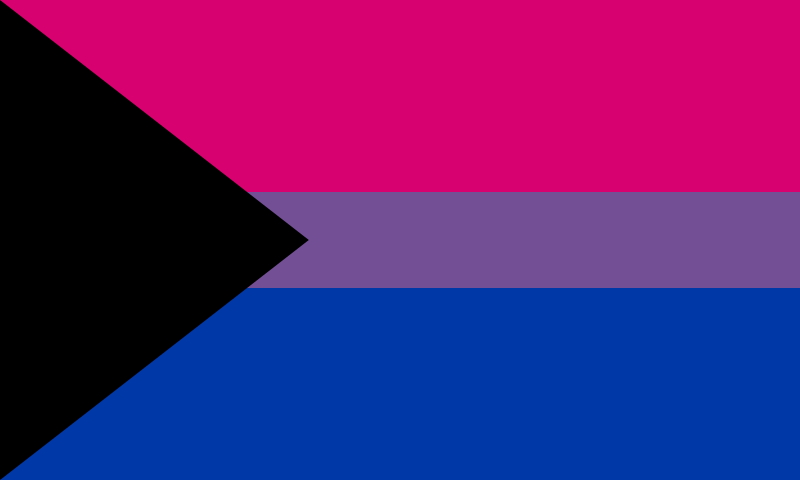
Three horizontal bands in a 40:20:40 division, measured at 1201, 602 and 1196 rows of 3000 in the 5000 by 3000 source file, with a full-height black triangle at the hoist reaching a point at 1930 pixels, about 38.6 percent of the width. The display reconstruction is normalised to 3:5 at 800 by 480. [2]
Three horizontal bands measured at the bisexual flag’s 40:20:40 proportions, with a solid black full-height triangle at the hoist. [2]
Three horizontal bands in the bisexual palette at 40:20:40, with a solid black triangle spanning the hoist. The demi- triangle device follows the demisexual flag family’s convention; the source publishes no statement about either borrowing. [2][1]
Usage & Adoption
- Online Usage
- DeviantArt, where the design was published [1], Later online reference resources
- Current Status
- Creator-account publication; no established adoption located
Documented in the Pride-Flags archive and in later online reference resources. No direct usage source has been located. [1]
Image Archive
2016 Publication
Source Previews
Archive Reconstruction
Discourse & Debates
Common misidentifications
- Later reference pages describe this design with the demisexual flag's full palette of white, grey and purple. The inspected 5000 by 3000 file contains only the three pink, purple bands, their partner band, and a solid black triangle. [2]
The deviation defines demi- as "an a-spectrum orientation where one does not experience attraction to a person until they have developed an emotional connection to them", adding that the connection is required but does not guarantee attraction. [1]
Footnotes & Citations
Sources and footnotes 4 sources
- 1. Image file page Demibi-. Published by Pride-Flags. DeviantArt (2016-05-15). Accessed 2026-08-16
The publication, 5000 by 3000, timestamped 08:56:34 UTC on 15 May 2016. Defines demi- and the parent orientation, names no designer, and displays no Creative Commons licence.
- 2. Image file page Source PNG behind the 15 May 2016 publication, 5000 by 3000. Published by Pride-Flags. DeviantArt (2016-05-15). Accessed 2026-08-16 · Archived version
The source file itself, measured for this entry: 5000 by 3000 pixels with the palette and triangle geometry published above.
- 3. Social media FAQ. pride-color-schemes. Tumblr. Accessed 2026-08-16
The archive's gallery policy: it invites pride-related reuse, discusses commercial reuse, and states that work it created itself would be identified in the post description.
- 4. Image file page Demipan- Pride Flag. Published by Pride-Flags. DeviantArt (2016-05-14). Accessed 2026-08-16
The neighbouring demi- composite from the same account, cited for the publication timing.
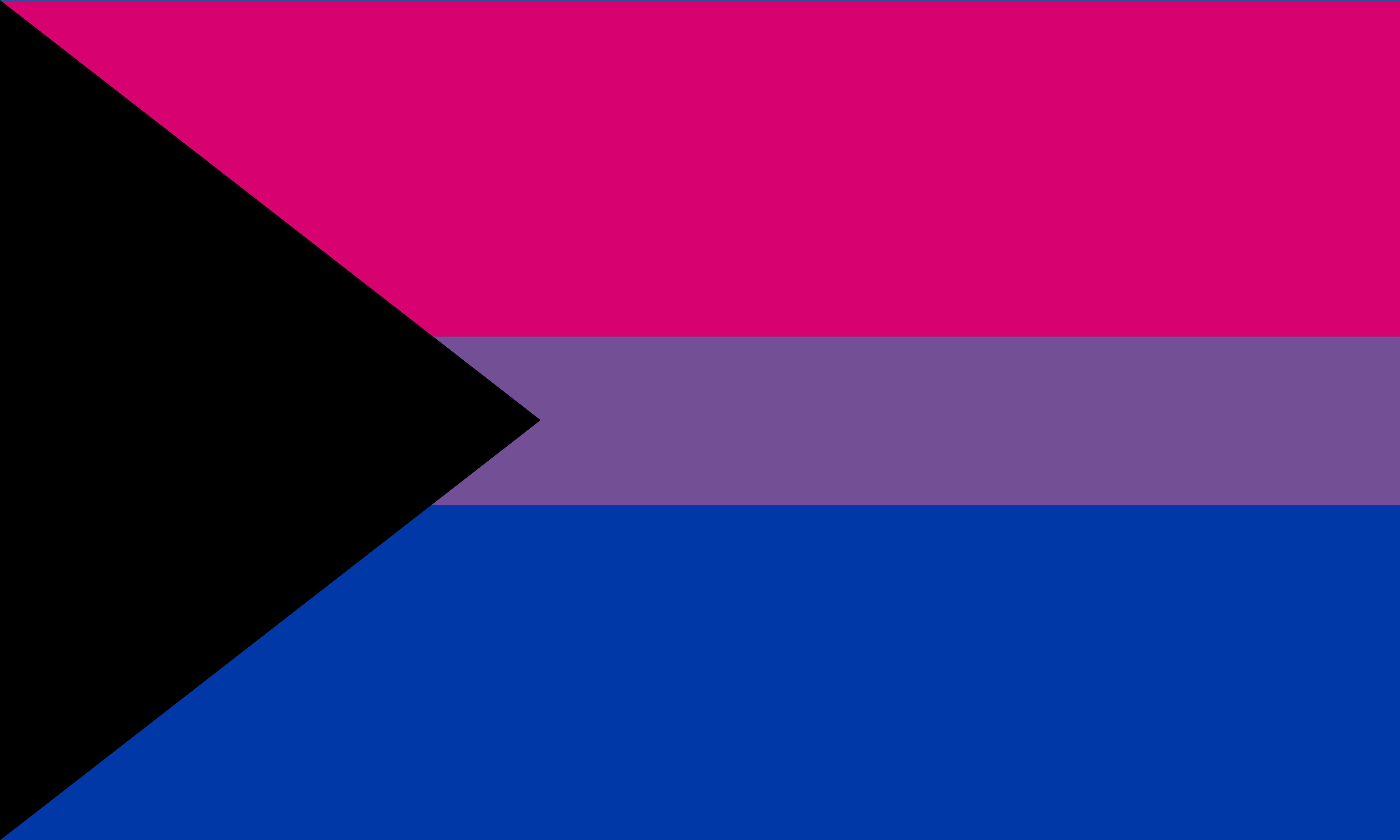
Image Sources
- Rendering
- "Demibi-", Pride-Flags archive, 2016
- Encycloflaggia reconstruction of the 2016 demibisexual design · Credit: Designer unknown; reconstruction by Encycloflaggia · Encycloflaggia · reconstructionRights Archive-produced reconstruction; geometry measured from the 2016 source PNG
- The 5000 by 3000 file published by Pride-Flags on 15 May 2016 · Credit: Published by Pride-Flags; designer unknown · DeviantArt · verifiedRights No Creative Commons licence displayed; gallery reuse statement only
- The source file as Pride-Flags published it under the title "Demibi" on 15 May 2016, 5000 by 3000 pixels, exactly 5:3. Every value in this entry is measured from it. [2] · Credit: Published by Pride-Flags; designer unknown · DeviantArt · No Creative Commons licence displayed; gallery reuse statement onlyRights No formal licence. Pride-Flags states gallery designs are free for pride-related use; that covers this rendering only, and the unknown designer’s rights are unresolved.
- The DeviantArt preview rendition, retained as a separate derivative record. · Credit: Published by Pride-Flags · DeviantArt preview · No Creative Commons licence displayed; gallery reuse statement onlyRights Platform-generated derivative of the source rendering.
- Encycloflaggia reconstruction, normalised for interface consistency. Not the source artifact. · Credit: Designer unknown; reconstruction by Encycloflaggia · Encycloflaggia reconstruction · Archive-produced reconstruction, subject to the rights status of the underlying design