Polysexual Pride Flag
Identity Pride Flag ·
Samlin published this three-stripe Polysexual Pride Flag through the Fuck Yeah Polysexuality Tumblr blog on 24 June 2012. [1] [2] The accompanying post named the bisexual and pansexual flags as its models and placed all three within a multisexual umbrella. [1] Physical appearances are documented from 2017, after several years of online circulation. [3] [4]

Key facts
- Designer
- Samlin
- Created
- First published
- In use
- 2012–present
- Aspect Ratio
- 3:5 · standard
- Ratio Notes
- 3:5 is the archive's practical reference reconstruction; no creator-specified overall ratio survives. Samlin's preserved Tumblr source image is retained separately at its 1000 × 750 pixel canvas. [1]
- Stripes
- 3
- Represented Identity
- polysexual
Also known as
- Polysexuality flag
Status Canonical
Archive categories Sexual & Romantic Orientation Pride Flags
Overview
Samlin, writing as "a poly individual," was saddened that polysexual people lacked a flag and made one, modelled on the bisexual and pansexual flags. [1]
The Fuck Yeah Polysexuality Tumblr blog published the flag on 24 June 2012: a pink, green and blue flag image above a post signed "Samlin." [1] [2] The post opened, "I, as a poly individual, was greatly saddened by the fact that we don't have a flag…so I made one :P", and named the bisexual and pansexual flags as its models, placing all three within a multisexual umbrella. [1] It does not assign meanings or digital values to the individual colours; those explanations were supplied by later reference guides. [1] [3] [5]
Identity & Context
- Represented Identity
- polysexual
- Subcommunity
- multisexual umbrella / bi+ spectrum (community framing)
Creators
The Creator
Samlin
Designer
Samlin is the name signed at the end of the post introducing the flag; the surviving evidence does not establish whether it was a Tumblr username or handle, and the identity is otherwise unverified. [1] No verified geographic location or portrait is associated with the credit.
I made it similar to the bi and pan flags, since they're all in under the multisexual umbrella.
From the post introducing the flag. The wording is Samlin's, including "all in under".
Motivations
- Samlin perceived that polysexual people lacked a flag. [1]
Stated inspirations
- The bisexual and pansexual flags, named in the post as the models.[1]
Attribution notes
The post introducing the flag is signed "Samlin" and was published through the Fuck Yeah Polysexuality Tumblr blog; the surviving record does not establish whether Samlin operated the blog or contributed the design to it. [1] The reference works credit Samlin, while the LGBTQIA+ Wiki credits the blog's name instead. [5] [3] [6] [7] [8]
Origin
- Digital Origin
- Yes
Digital publication on Tumblr. No geographic place of creation is documented, so Indigenous land and settler context cannot be assigned.
Published through the Fuck Yeah Polysexuality Tumblr blog. No geographic place of creation has been documented. [1]
Dates & Chronology
- Year Created
- First published
- Period in Use
- 2012–present
- Creation Bounds
- Made in 2012, on or before the 24 June publication. [2]
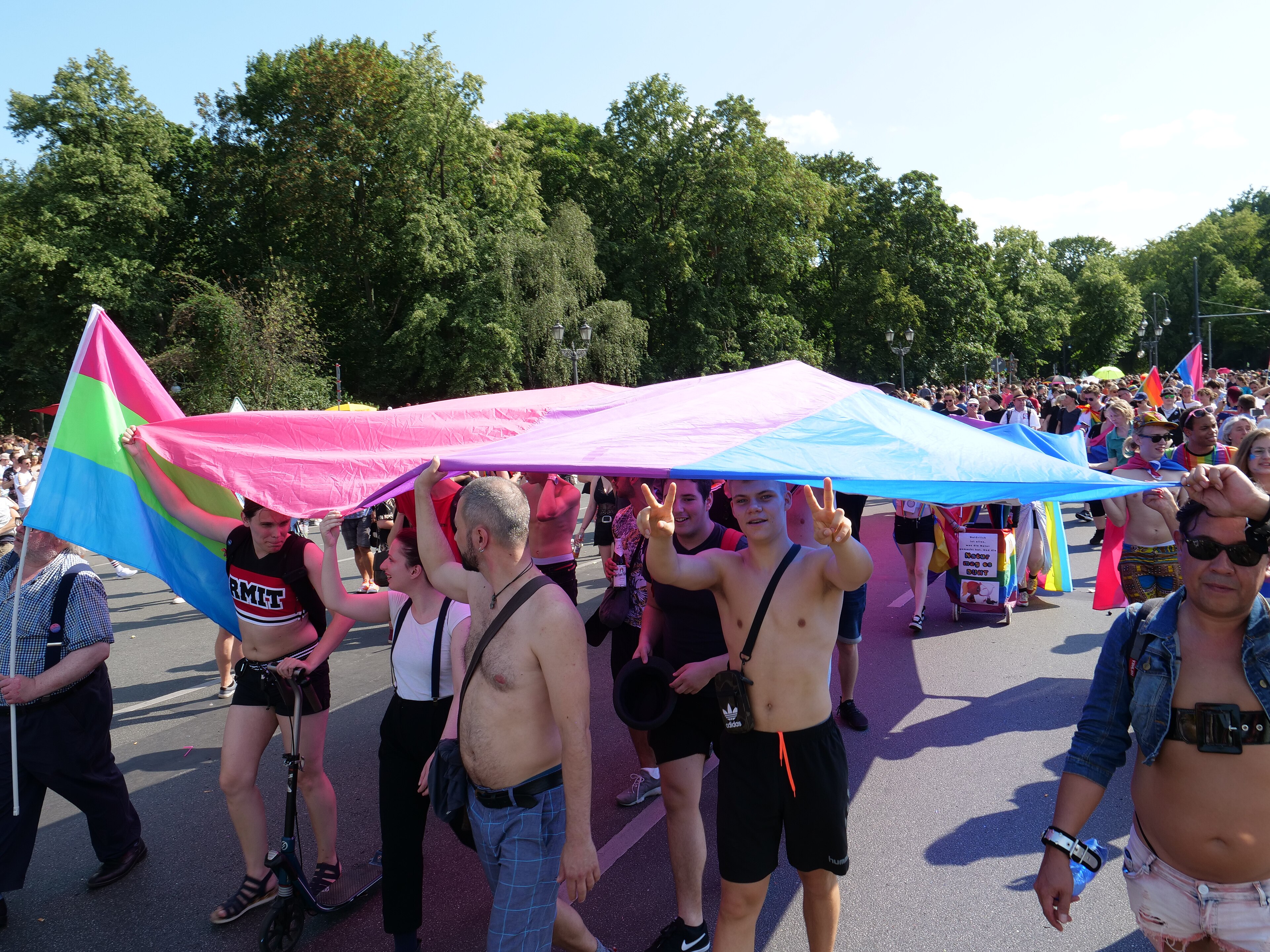
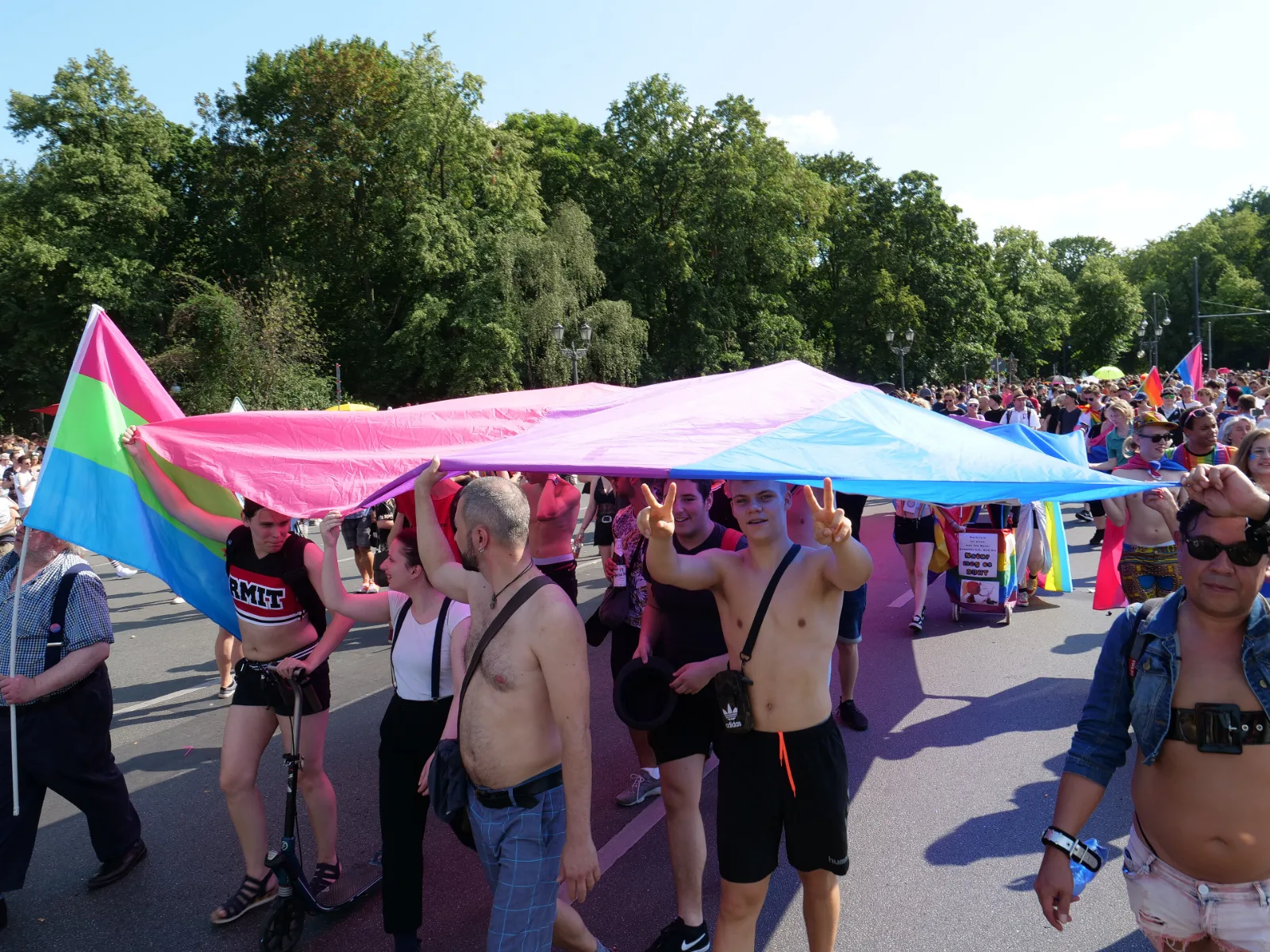
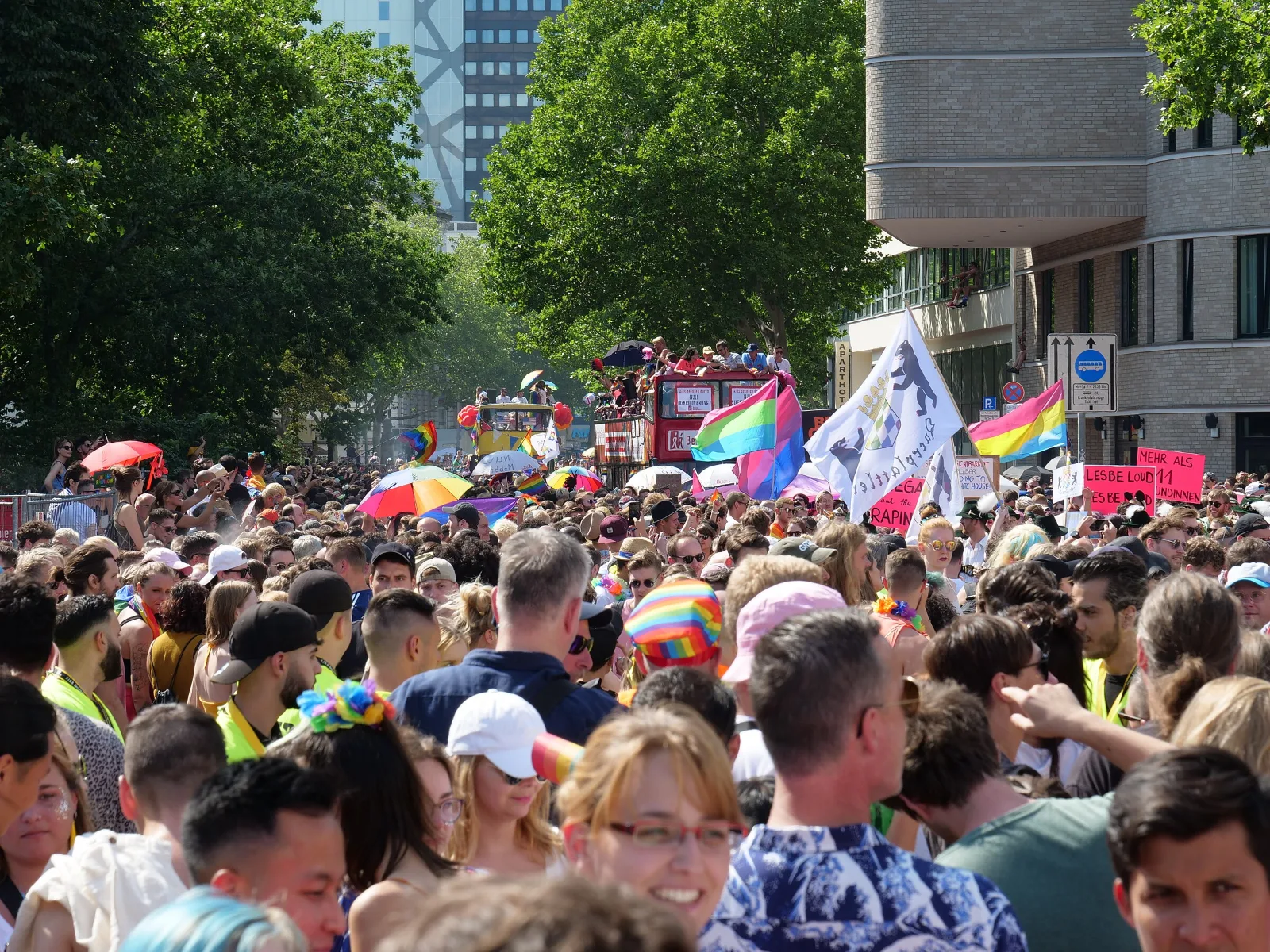
The ohyeahpolysexual blog reblogged the post on 11 July 2012, and reference pages that assign that date to the flag's introduction inherited the reblog's date rather than the root post's. [10] [2] [3] [6] McLennonSon uploaded an SVG recreation to Wikimedia Commons on 6 February 2015. [11] The earliest physical use in the located source trail is the Chicago Pride Parade of 25 June 2017. [3] [4] By 5 June 2018 the flag had been photographed among pride flags displayed on Rothschild Boulevard in Tel Aviv; [12] it appeared at Stonewall Columbus Pride on 15 June 2019, [13] at Christopher Street Day in Berlin on 27 July 2019 with oversized bisexual and pansexual flags, [14] [9] [3] and at Manchester Pride on 24 August 2019. [15] Flags of the World's assessment in May 2020 was that online circulation considerably exceeded the physical examples it had located, [3] and institutional glossaries at the University of California, Santa Barbara and the University of British Columbia list the flag. [6] [7]
The flag is also used for polyromantic identity, its romantic counterpart under the split attraction model; dedicated polyromantic designs, including a 2020 alternative in lighter shades, are less widely adopted. [16]
Lineage
- Direct predecessors
- Bisexual Pride Flag, Pansexual Pride Flag
- Direct children
- Polyromantic Alternative Pride Flag (2020)
- Related flags
- Multisexual Pride Flag (Synp attribution, 2019)
Samlin named the bisexual and pansexual flags as the design's models. [1] The three equal stripes are structurally closer to the pansexual flag, and Flags of the World reads the design as "modelled after the flags representing bisexuality and pansexuality, clearly borrowing the shades of pink and blue from the latter of those." [3] No source supports a more exact division of inherited elements, and Samlin named no other model; beyond its two named models the design shares only the striped idiom common to Pride flags.
Lineage tree
Every record reachable from this one through documented parent and child relationships: 4 records across 3 generations.
- Ancestor
- Bisexual Pride Flag, Pansexual Pride Flag
- This record
- Polysexual Pride Flag
Colors & Symbolism
Samlin's post assigns no colour meanings; the design is modelled on the bisexual and pansexual flags. [1]
| Colour | Hex | Meaning |
|---|---|---|
| Pink | #F61CBB | Top stripe; later commonly associated with attraction to women. |
| Green | #07D569 | Middle stripe; later commonly associated with attraction to nonbinary people and other genders outside the woman and man binary. |
| Blue | #1C92F6 | Bottom stripe; later commonly associated with attraction to men. |
Working values sampled from the preserved 2012 Tumblr source image. [1]
The associations in the table were supplied by later reference guides, which state them as attraction to women, to men and to nonbinary people. [3] [6] [7] [8] Library.LGBT alone abstracts pink and blue to femininity and masculinity. [5]
Working values are sampled from the preserved 2012 Tumblr JPEG; Samlin did not publish a separate digital palette, and the values are not a manufacturing standard. [1] The Wikimedia Commons SVG embeds #F61CB9, #07D569 and #1C92F6, and Library.LGBT's later reference guide gives #F51BB8, #07D569 and #1C92F6; the three sets differ only in the pink. [11] [5]
Design
- Aspect Ratio
- 3:5 · standard
- Ratio Notes
- 3:5 is the archive's practical reference reconstruction; no creator-specified overall ratio survives. Samlin's preserved Tumblr source image is retained separately at its 1000 × 750 pixel canvas. [1]
- Orientation
- horizontal
- Stripe Count
- 3
- Layout
- horizontal_stripes
- Stripes (Top → Bottom)
- Pink, Green, Blue
Three equal horizontal stripes, pink above green above blue, spanning the full field without an emblem, canton, border or charge. [1] [3]
Usage & Adoption
- Geographic Usage
- United States (Chicago 2017; Columbus, Ohio 2019) [3] [4] [13], Israel (Tel Aviv, by June 2018) [12], Germany (Berlin, 2019) [14] [9] [3], United Kingdom (Manchester, 2019) [15]
- Online Usage
- Tumblr, where the flag was published on 24 June 2012 and reblogged from July 2012 [1] [10] [2], Wikimedia Commons, from February 2015 [11], Institutional pride flag guides including UCSB and the University of British Columbia [6] [7]
- Event Usage
- Chicago Pride Parade, 25 June 2017, the earliest physical use in the located source trail [3] [4], Pride flag display on Rothschild Boulevard, Tel Aviv, documented by 5 June 2018 [12] [3], Stonewall Columbus Pride, 15 June 2019 [13], Christopher Street Day, Berlin, 27 July 2019, carried with oversized bisexual and pansexual flags [14] [9] [3], Manchester Pride, 24 August 2019 [15]
- Current Status
- active
Flags of the World's assessment in May 2020 was that online circulation considerably exceeded the physical examples it had located: "the examples from real life are still very few." [3] Independent adoption is documented through physical appearances and institutional flag guides. [6] [7]
Image Archive
Original Source and Reconstructions


Documented Use
Related Polysexual Symbols



Discourse & Debates
Common misidentifications
- Polysexuality concerns attraction to multiple genders, often though not necessarily all; polyamory concerns the structure of relationships. A person may identify with either, both or neither, and the flags are unrelated. [8]
- The design is sometimes credited to the blog it appeared on, Fuck Yeah Polysexuality, rather than to Samlin, whose name signs the post. [8] [1]
- The 11 July 2012 date in general circulation is the reblog's date; the root post was published 24 June 2012. [10] [2]
"Polysexuality flag" is Flags of the World's name for the flag. [3] The identity is also spelled plysexual or polisexual and shortened to ply; lgbtqia.wiki gives polyromantic as the romantic counterpart. [8] [16]
Footnotes & Citations
Sources and footnotes 18 sources
- 1. Primary statement fuckyeahpolysexuality: I, as a poly individual, was greatly saddened by the fact that we don't have a flag. Signed "Samlin", published through the Fuck Yeah Polysexuality blog. Tumblr (2012-06-24). Accessed 2026-08-11
The post introducing the flag, with the source image attached. Deleted at source; the body and image survive verbatim in the reblog trail, and Tumblr metadata preserved there dates the root post to 24 June 2012. [2]
- 2. Social media Tumblr embed metadata for the surviving reblog. Tumblr. Tumblr. Accessed 2026-08-12
Tumblr's embed data for the reblog preserves the deleted root post's record: root post 25804459193, published 24 June 2012 at 21:08:12 UTC; reblog 26964203712, published 11 July 2012 at 06:33:26 UTC.
- 3. Databases Polysexuality flag. Tomislav Todorović; page edited by randy young. Flags of the World (2020-09-05). Accessed 2026-08-11
Last modified 5 September 2020. Its 31 May 2020 text is the only reference source reviewed that dates real-world use, and it names the oldest example it had found. Its 11 July 2012 introduction date is the reblog's date.
- 4. Image file page Chicago Pride Parade, 48th Annual Pride Parade Chicago. Kiersten Meybaum. Flickr (2017-06-25). Accessed 2026-08-11
The photograph Flags of the World names as the oldest recorded real-world use. All rights reserved; cited rather than reproduced.
- 5. Reference Pride Flag Guide: Polysexual. Library.LGBT, an initiative of Albany Pride. Library.LGBT Pride Flag Guide (2021-06-11). Accessed 2026-08-11 · Archived version
Last modified 14 February 2022. A later reference guide: its palette and its "femininity / masculinity" wording are its own, not the designer's. It files the flag under Bisexual+ Spectrum Flags.
- 6. Organizations Pride Flags Glossary. Resource Center for Sexual & Gender Diversity. University of California, Santa Barbara. Accessed 2026-08-11
Its 11 July 2012 date is the reblog's date.
- 7. Organizations Guide to pride flags. UBC Equity & Inclusion Office. University of British Columbia (2025-03-17). Accessed 2026-08-11
- 8. Encyclopedias & Reference Polysexual. LGBTQIA+ Wiki contributors. Fandom. Accessed 2026-08-11
A crowdsourced wiki, carrying a "Needs backups" maintenance tag. It credits the design to the blog name, fuckyeahpolysexuality, rather than to Samlin.
- 9. Image file page File:Christopher Street Day Berlin 2019 186.jpg. Leonhard Lenz. Wikimedia Commons (2019-07-27). Accessed 2026-08-12
Released CC0 1.0. The clearest view of the flag at the march: carried at the left, under the oversized bisexual flag.
- 10. Social media ohyeahpolysexual: fuckyeahpolysexuality: I, as a poly individual…. ohyeahpolysexual-blog, reblogging the root post. Tumblr (2012-07-11). Accessed 2026-08-11 · Archived version
The surviving reblog of 11 July 2012, through which the root post's body and image are preserved. Reference pages that give 11 July as the flag's introduction inherited this reblog's date.
- 11. Image file page File:Polysexuality Pride Flag.svg. McLennonSon, uploader. Wikimedia Commons (2015-02-06). Accessed 2026-08-12
A recreation by an uploader, not the designer; Keymap9's 2018 revision gave the file its current 800 × 480 geometry. Marked public domain at the file level as simple geometry. Its embedded values are #F61CB9, #07D569 and #1C92F6.
- 12. Blogs & Personal Sources Gay Tel Aviv: pinkwashing or genuine?. Trip By Trip. Trip By Trip (2018-06-05). Accessed 2026-08-12
Photographs a group of pride flags displayed on Rothschild Boulevard, the polysexual flag among them. Cited narrowly as documentary evidence of the display; the article's subject is a wider debate it frames itself.
- 13. Image file page Stonewall Columbus Pride 2019. Stonewall Columbus. Flickr (2019-06-15). Accessed 2026-08-12
All rights reserved; cited rather than reproduced.
- 14. Image file page File:Christopher Street Day Berlin 2019 69.jpg. Leonhard Lenz. Wikimedia Commons (2019-07-27). Accessed 2026-08-11
Released CC0 1.0. Commons files it under Photographs of polysexuality flags, of bisexuality flags and of pansexuality flags.
- 15. Image file page Manchester Pride 2019. Flickr user 46122435@N05. Flickr (2019-08-24). Accessed 2026-08-12
All rights reserved; cited rather than reproduced.
- 16. Encyclopedias & Reference Polysexual. lgbtqia.wiki contributors. lgbtqia.wiki (2026-02-26). Accessed 2026-08-11
Last edited 26 February 2026, CC BY-SA 4.0. The page carries the wiki's own quality notice: "many pages on this wiki come from a time when resourcing was not required." Cited here for the community symbols, the 2020 alternative flag and its transcription of Samlin's post.
- 17. Image file page File:Christopher Street Day Berlin 2019 185.jpg. Leonhard Lenz. Wikimedia Commons (2019-07-27). Accessed 2026-08-12
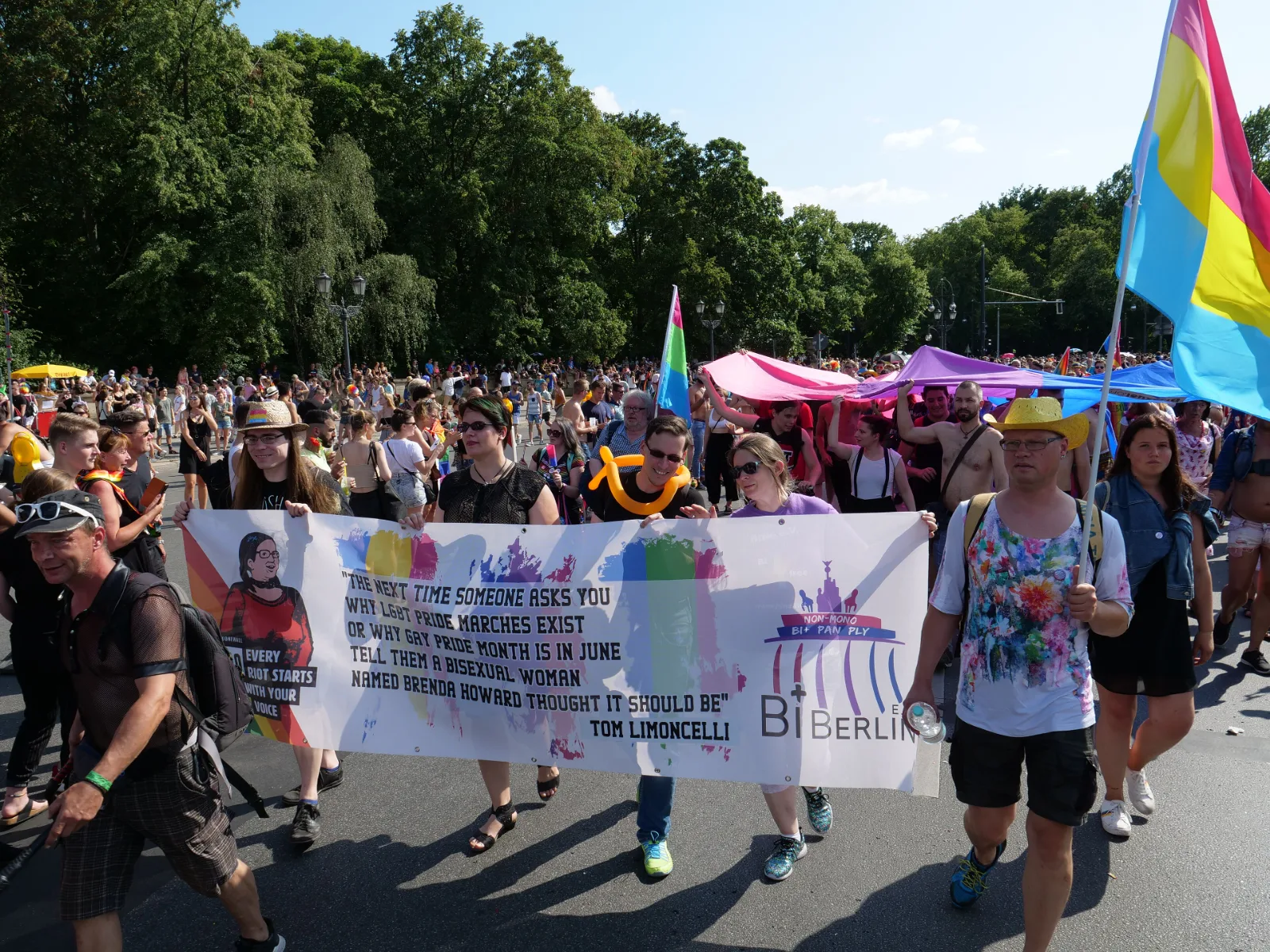
Released CC0 1.0. Shows the BiBerlin contingent, whose banner logo reads "non-mono bi+ pan ply".
- 18. Social media Ply symbol. system-lgbt. Tumblr. Accessed 2026-08-11
The symbol's source as cited by lgbtqia.wiki, read through the Wayback capture of 26 April 2021.
Image Sources
- Rendering
- three-stripe standard
- Credit: Design by Samlin · Samlin's 2012 Tumblr post, preserved in the surviving reblog
- The flag image attached to the post that introduced the design, published through the Fuck Yeah Polysexuality Tumblr blog on 24 June 2012 and preserved in the surviving reblog. Its 1000 × 750 canvas documents the source post rather than an intended manufacturing ratio; the archive's working colour values are sampled from this file. [1] [2] · Credit: Design and source image credited to Samlin · TumblrRights Creator-stated invitation to use; no named licence.
- The Wikimedia Commons SVG recreation, uploaded by McLennonSon on 6 February 2015 and given its current 800 × 480 geometry in Keymap9's 2018 revision. Its embedded values differ from the source image only in the pink. Neither contributor designed the flag. [11] · Credit: SVG file by McLennonSon; ratio revision by Keymap9 · Wikimedia Commons · Public domain (Commons, threshold of originality)
- Christopher Street Day, Berlin, 27 July 2019. The Polysexual Pride Flag is carried at the left, under an oversized bisexual flag, with a pansexual flag among the marchers behind. [9] [3] · Credit: Leonhard Lenz · Wikimedia Commons · CC0 1.0
- The same march from the crowd: polysexual, bisexual and pansexual flags carried together, with the parade route behind. [14] [3] · Credit: Leonhard Lenz · Wikimedia Commons · CC0 1.0
- The BiBerlin contingent at the same march. The banner's logo reads "non-mono bi+ pan ply"; a pansexual flag is carried at the right and the polysexual flag, partly furled, at the centre distance. [17] · Credit: Leonhard Lenz · Wikimedia Commons · CC0 1.0
- Archive-standardized reconstruction after Samlin's preserved 2012 source image, at the archive's 3:5 reference proportions with colour values sampled from that file. · Credit: Design by Samlin; archive-standardized rendering
- The ply symbol, a later polysexual identity symbol credited by lgbtqia.wiki to the Tumblr account system-lgbt. It is not part of Samlin's 2012 flag and is used beside it rather than on it. [16] [18] · Credit: system-lgbt, via lgbtqia.wiki · lgbtqia.wikiRights No licence is stated by the symbol's maker; rights undetermined.