Multisexual Pride Flag (Synp attribution, 2019)
Umbrella Pride Flag ·
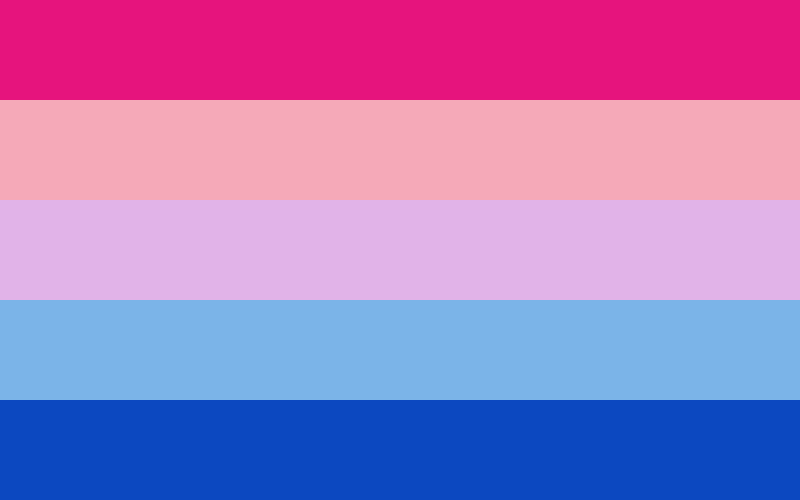
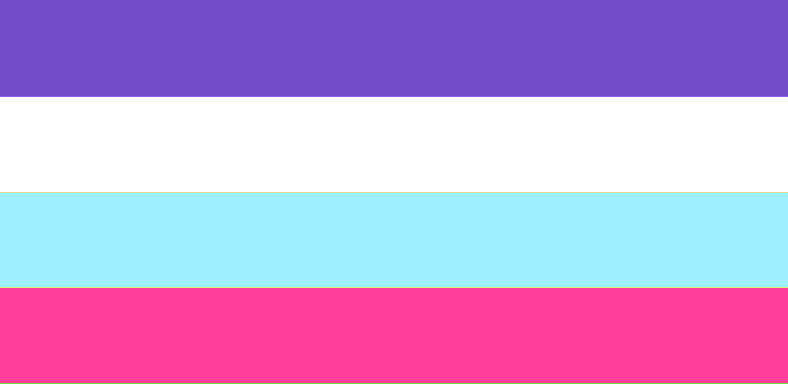
Four horizontal bands in purple, white, light blue and pink, for peace, unity, freedom, and compassion and love. [1] The design is credited to a person who "goes by 'synp'" by the DeviantArt account kinkflagsrus, which published it on 13 February 2019 in a 788 by 384 pixel file; that post is the earliest publication located and no post, account or statement by Synp has been found. [1] Its title calls the flag official, but no authorising body has been located, and several other flags circulate under the same name. [2][3]
Key facts
- Designer
- Synp, attributed by kinkflagsrus
- Created
- Earliest located publication
- In use
- 2019 to present
- Aspect Ratio
- 197:96 · apparent
- Ratio Notes
- Measured from the published file: 788 by 384 pixels, a width to height of about 2.052, which reduces to 197:96. [1] No proportion is stated in words. The archive's own vector regularises the design to 5:3 for display and is an editorial reconstruction rather than the source proportion.
- Stripes
- 4
- Represented Identity
- multisexual / m-spec
Also known as
- Multisexual Pride Flag
- M-Spec Pride Flag
- Plurisexual Pride Flag
Status Proposed
Archive categories Sexual & Romantic Orientation Pride Flags
Overview
A neutral umbrella symbol for people attracted to more than one gender, in the terms of the post that published it. No statement of intent by the credited designer exists. [1]
The four-band flag was published on DeviantArt by kinkflagsrus on 13 February 2019, credited to a person who "goes by 'synp'", with four colour meanings and a note distinguishing multisexuality from pansexuality and polysexuality. [1] The post calls 13 February 2019 the day the flag "was deemed the official flag" and names no body as having deemed it. The LGBTQIA+ Wiki repeats the claim in the same terms, "The flag was made official on February 13th, 2019 and the creator went by 'synp'", citing that same post. [3][1] No independent record of any such decision has been located.
The term is older than any of its flags. It "appears to have been created in the 1970s" and has been used in professional literature; it gained currency online during the 2010s as an alternative to Multiple Gender Attraction and to the bisexual spectrum, with the abbreviation m-spec attested from March 2016. [3]
Identity & Context
- Represented Identity
- multisexual / m-spec
- Subcommunity
- bi+ / multisexual umbrella
- Language Context
- Multisexual (also plurisexual) is an umbrella term for all sexual orientations involving attraction to more than one gender. The word 'plurisexual' dates to 1879 in German sexology, where Eugen Wilhelm formulated 'plurisexualitat.' The modern use of 'multisexual' as an orientation label can be traced to the 1970s. [3][4]
Identities under the multisexual umbrella include bisexual, pansexual, omnisexual, polysexual, abrosexual, and ceterosexual, among others. The related umbrella term 'pluralian' was coined by Tumblr user Kulinda on October 6, 2016, as an adjective parallel to 'achillean,' 'sapphic,' and 'diamoric.' [3]
Creators
The Creator
Synp
Credited designer; attribution only
Everything on record about Synp is one clause in somebody else's post: "The flag creator goes by 'synp'." [1] What is known is that the account that published the flag in February 2019 credited the design to that name. What is not known is anything else. No DeviantArt, Tumblr or other account under the name has been located, no statement about the design has been found, no date of creation earlier than the publication is documented, and nothing records how the design was made, why the four colours were chosen, or whether Synp published it anywhere first. The name is carried here because the publisher gave it, and the entry claims nothing further for it.
kinkflagsrus
Publisher of the earliest located file; not the designer
kinkflagsrus is the DeviantArt account that published the flag on 13 February 2019, supplying the Synp credit, the four colour meanings and a long note distinguishing multisexuality from pansexuality and polysexuality. [1] The 788 by 384 pixel PNG attached to that post is the earliest located file of the design and the source of every colour value recorded here. The account's own title for the post, "Multisexual Official Pride Flag", and its statement that the flag "was deemed the official flag on Feb 13 2019", are the origin of the officiality claim that later sources repeat; the post names no body as having deemed anything.
The official PRIDE flag for the multisexual community. The flag was deemed the official flag on Feb 13 2019. The flag creator goes by "synp".
Color meanings: Purple: peace / White: unity / Light blue: freedom / Pink/magenta: compassion, love
Attribution notes
The design is credited to Synp by kinkflagsrus, whose DeviantArt post of 13 February 2019 is the earliest publication of it located and reads: "The official PRIDE flag for the multisexual community. The flag was deemed the official flag on Feb 13 2019. The flag creator goes by 'synp'." [1] kinkflagsrus is the publisher, not the designer. No post, account, organisation or design statement by Synp has been located, so the credit exists only inside a third party's description.
Other flags circulate under the same name and belong to other people. An m-spec flag by Mod AP of Beyond MOGAI Pride Flags followed on 14 February 2019. [5] A five-band design published on DeviantArt by Pride-Flags on 10 October 2015 is documented by Flags of the World as a distinct flag. [2][6] Later alternates include two by Cryptocrew of February 2021 and one by the Tumblr blog lucky-leaf-clover of 9 May 2021. [3]
Origin
- Digital Origin
- Yes
Digital origin; no verified physical location.
Digital origin. The earliest located publication is a DeviantArt post of 13 February 2019 by kinkflagsrus. Where and when the design itself was made is not documented, because its credited designer is not. [1]
Dates & Chronology
- Year Created
- Exact date
- Earliest located publication
- Period in Use
- 2019 to present
The four-band design is the one most often reproduced in online flag guides. [3] Documented circulation is online; no organisational adoption and no photographed physical use of this design has been located.
Several other flags carry the same name and should not be read as versions of this one. One was published by Pride-Flags on or before 24 August 2015, with neither creator nor meaning recorded. [3] A five-band design in pink, purple, yellow, green and blue followed on 10 October 2015; Flags of the World treats it as the multisexuality flag and documents its only known use, a hoisting on Rothschild Boulevard in Tel Aviv in early June 2018, noting that the photographer did not recognise it. [3][2][6] That use predates this design by eight months and is evidence for the 2015 flag alone. The m-spec flag by Mod AP of Beyond MOGAI Pride Flags followed on 14 February 2019, drawing its colours from the bisexual, polysexual, pansexual, omnisexual, trisexual, quadsexual and quintsexual flags, with orange "for any other identity & those identifying just as multi- and nothing else". [5] Later alternates include two by Cryptocrew of February 2021 and one by lucky-leaf-clover of 9 May 2021. [3]
The name carries an argument about umbrellas. The LGBTQIA+ Wiki records that a push to use "bisexual umbrella" in place of multisexual "was largely started by m-spec exclusionists", and that many m-spec people who do not identify as bisexual object to having their identity "watered down to 'a subtype of bisexual'". [3][7] That dispute is about the word rather than about this design, which arrived after it and takes no position on it.
Lineage
- Indirect influences
- Rainbow Pride Flag
No design source is documented. Neither the publisher nor any statement by the credited designer names a flag this design draws on, and the entry records no ancestry for it. [1]
The bisexual, pansexual and polysexual flags are recorded as related because their identities sit under the same umbrella, not because any source connects them to this design. That distinction matters here because a neighbouring flag does work that way: the m-spec flag by Mod AP of 14 February 2019 states that its colours are drawn from the bisexual, polysexual, pansexual, omnisexual, trisexual, quadsexual and quintsexual flags. [5] That is a documented sampling relationship, and it belongs to that flag rather than to this one.
Colors & Symbolism
Four meanings, given by the account that published the flag rather than by its credited designer: purple for peace, white for unity, light blue for freedom, and pink or magenta for compassion and love. [1]
| Colour | Hex | Meaning |
|---|---|---|
| Purple | #724DC9 | Peace. [1] |
| White | #FFFFFF | Unity. [1] |
| Light Blue | #9EEFFF | Freedom. [1] |
| Pink | #FF3D9B | Compassion and love. [1] |
Sampled from the 788 by 384 file published by kinkflagsrus, not a creator-specified value. [1]
This flag has no official digital palette. Color values shown are approximate.
The four meanings appear on the post that published the flag, in the order purple, white, light blue, pink. [1] They are the publisher's wording; no statement of them by the credited designer exists. The m-spec flag by Mod AP of 14 February 2019 works on a different principle, sampling colours from existing m-spec identity flags, and its meanings belong to that design. [5]
No creator-specified values exist, because the credited designer left no statement of any kind. The four above are sampled from the 788 by 384 pixel PNG attached to the post that introduced the Synp credit, taking the modal colour of each band's interior; the publisher is not the designer, so these are values of a third party's file rather than a specification. [1]
The values reproduced elsewhere differ materially, most of all in the light blue: flagcolorcodes.com gives #7E55C7, #9BDBE8 and #F14E98 where the published file measures #724DC9, #9EEFFF and #FF3D9B. [8] An earlier version of this entry recorded a third set again, close to the flagcolorcodes values but not equal to them, and marked the palette as officially known.
Design
- Aspect Ratio
- 197:96 · apparent
- Ratio Notes
- Measured from the published file: 788 by 384 pixels, a width to height of about 2.052, which reduces to 197:96. [1] No proportion is stated in words. The archive's own vector regularises the design to 5:3 for display and is an editorial reconstruction rather than the source proportion.
- Orientation
- horizontal
- Stripe Count
- 4
- Layout
- horizontal stripes
- Stripes (Top → Bottom)
- Purple, White, Light Blue, Pink
Four horizontal bands of near-equal depth. In the 788 by 384 published file the bands occupy 96, 95, 94 and 95 rows, separated by single rows of antialiasing. [1] The five-band flag documented by Flags of the World is a different design and uses width ratios of 3:1:1:1:3. [2]
Four horizontal bands: purple, white, light blue, pink. [1]
Four horizontal bands of near-equal depth in purple, white, light blue and pink. [1] Not to be confused with the five-band multisexuality flag of 10 October 2015, which runs pink, purple, yellow, green and blue with the outer bands three times the depth of the inner three, measures #FF228C, #734F95, #FFD800, #07D568 and #1B92F6, and shares no colour with this design. [2][6]
Usage & Adoption
- Earliest located user
- kinkflagsrus, the account that published it
- Online Usage
- DeviantArt, LGBTQIA+ identity wikis, Online flag guides
- Current Status
- documented online proposal; reference circulation
Documented circulation is online: the design appears in identity wikis and flag guides, which is reference circulation rather than evidence of adoption. No organisation is recorded as using it and no photographed physical use has been located. The Tel Aviv hoisting of June 2018 that is sometimes attached to this flag concerned the five-band 2015 design and predates this one. [3][2]
Image Archive
Source artwork (2019)
Discourse & Debates
- Whether 'bisexual' or 'multisexual' should be the umbrella term for attraction to more than one gender. Advocates of the bisexual umbrella point to its longer history; advocates of m-spec argue that subsuming every label under 'bisexual' implies the others are unnecessary. The LGBTQIA+ Wiki records that the push toward the bisexual umbrella "was largely started by m-spec exclusionists". [3][7]
Common misidentifications
- Confused with the five-band multisexuality flag of October 2015, which shares no colour with this design and is the flag documented by Flags of the World. [2][6]
- Credited with the Tel Aviv hoisting of June 2018. That use belongs to the five-band 2015 flag and predates this design by eight months. [2]
- Described as officially adopted. The word originates in the publisher's own title and description, which name no deciding body, and the wiki that repeats the claim cites that same post. [1][3]
- Confused with the m-spec flag by Mod AP, published one day later on 14 February 2019, which samples its colours from seven existing m-spec flags. [3][5]
- Credited to kinkflagsrus. That account published the file and supplied the credit; the design is attributed to Synp. [1]
Multisexual, plurisexual and m-spec are used as synonymous umbrella terms; 'bi+' is a compromise that some find still centres bisexuality, and the romantic counterpart is multiromantic. [3] The word 'plurisexual' has a much longer history than the flag: Eugen Wilhelm formulated "plurisexualitat" in German sexology in 1879, and the modern use of 'multisexual' as an orientation label traces to the 1970s. [3][4]
Footnotes & Citations
Sources and footnotes 8 sources
- 1. Designer page Multisexual Official Pride Flag. kinkflagsrus. DeviantArt (2019-02-13). Accessed 2026-08-16
The earliest located publication of this design and the origin of both the Synp credit and the four colour meanings. DeviantArt records the attached file as 788 by 384 pixels, 1,828 bytes.
- 2. Databases Multisexuality Flag. Tomislav Todorovic. Flags of the World (CRW Flags) (2021-08-21). Accessed 2026-08-16
Documents the five-band 2015 multisexuality flag and its only known use, the Tel Aviv hoisting of June 2018. It does not document this design.
- 3. Encyclopedias & Reference Multisexual. LGBTQIA+ Wiki. Accessed 2026-08-16
Dates the term to the 1970s, sets out the umbrella-term argument, and lists the competing flags with their creators and dates. Carries its own notice that many of its pages predate a sourcing requirement.
- 4. Academic Monosexual/Plurisexual: A Concise History. Journal of Homosexuality (Taylor & Francis) (2023). Accessed 2026-03-31
- 5. Blogs & Personal Sources Mspec pride flag. Mod AP (arco-pluris). Beyond MOGAI Pride Flags (2019-02-14). Accessed 2026-08-16
A separate design by a different person, published the day after. Read via the blog's own mirror at beyondmogai.home.blog, whose publication time is 15 February 2019 at 03:57 UTC.
- 6. Designer page Multi- (4). Pride-Flags. DeviantArt (2015-10-10). Accessed 2026-08-16
The 2015 five-band multisexuality flag, which Flags of the World cites as its source.
- 7. Encyclopedias & Reference M-Spec Exclusionist. LGBTQIA+ Wiki. Accessed 2026-03-31
- 8. Reference Multisexual flag color codes. Flag Color Codes. Accessed 2026-03-31
A colour-code aggregator that cites nothing and names no author. Recorded here only because its values differ from the published file.
Image Sources
- Rendering
- The design attributed to Synp, as published February 2019
- Credit: Published by kinkflagsrus, DeviantArt, 13 February 2019; design credited there to SynpRights Unknown. The publisher is not the designer, and DeviantArt's site terms are not a licence from Synp. [1]
- Credit: Encycloflaggia, drawn from the published fileRights Reconstruction by this archive; the underlying design's rights are unknown. [1]
- The flag as published on 13 February 2019, 788 by 384 pixels, which is the proportion of the source artwork rather than a standard flag ratio. Every colour value in this entry is sampled from this file. [1] · Credit: Published by kinkflagsrus on DeviantArt; design credited there to Synp · kinkflagsrus on DeviantArt