Asexual Pride Flag
Identity Pride Flag ·
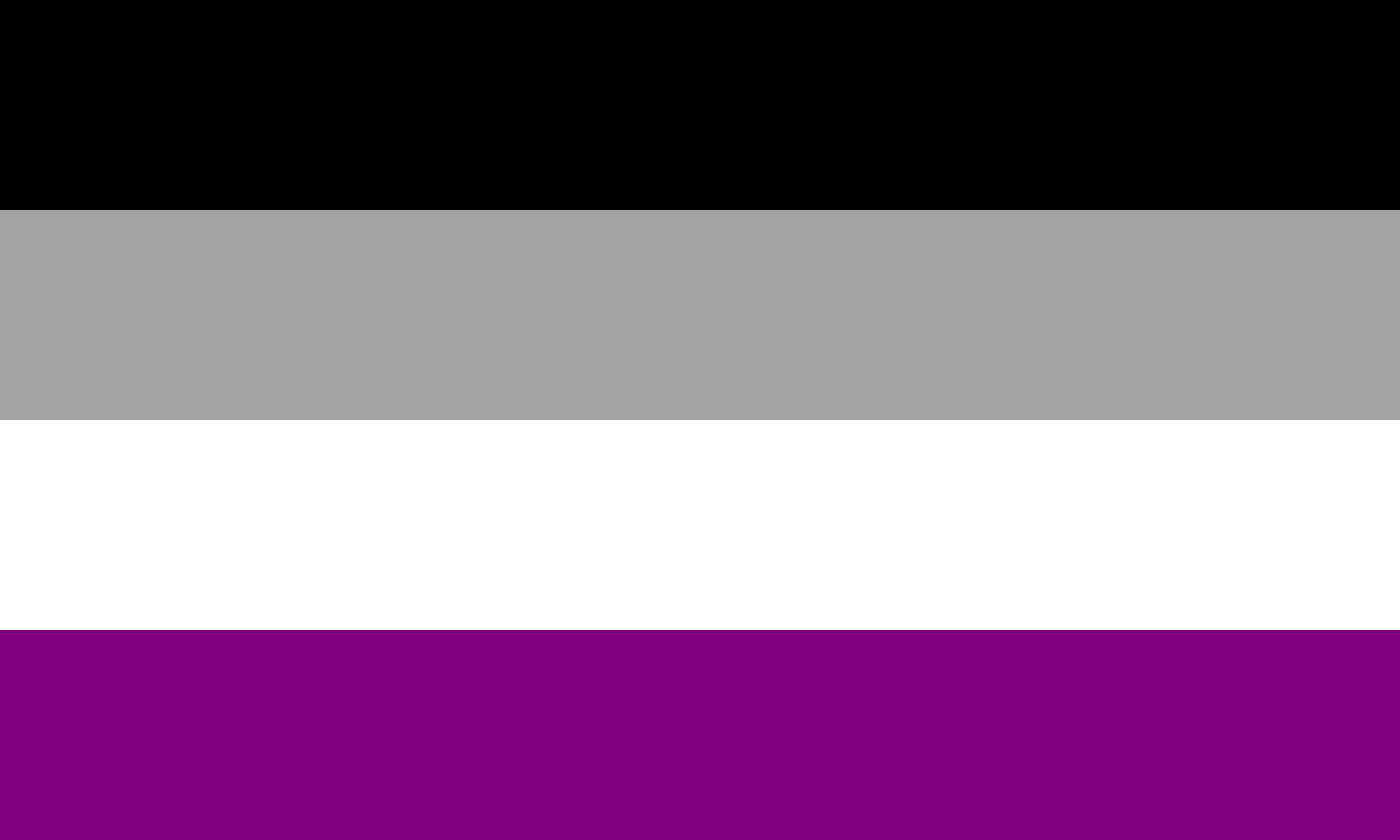
Four equal stripes in black, gray, white and purple, designed by the AVEN user standup and chosen through a multi-stage community selection process run across asexual communities in the summer of 2010, with bristrek running the final round and announcing A1 the winner on 11 August. The design was already circulating on Tumblr before that announcement. standup stated the meanings the day the design was posted and called the flag "not meant to be officially official." The palette predates the flag, settled in a bracelet thread three days earlier and drawn from the AVEN triangle and the site's purple.
Key facts
- Designer
- standup
- Created
- In use
- 2010–present
- Aspect Ratio
- 3:5 · standard
- Stripes
- 4
- Represented Identity
- asexual
Also known as
- Asexual Flag
- Ace Pride Flag
- Ace Flag
Status Canonical
Archive categories Sexual & Romantic Orientation Pride Flags
Overview
Much of the ace-community organizing documented here took place online, with AVEN serving as a major hub, and its existing symbols were felt to be inadequate: the AVEN triangle was the logo of a single website rather than the whole community, and the half-filled heart implied romance, leaving many aromantic aces uncomfortable using it. [1] The idea of a flag had been raised on AVEN as early as May 2009. In the summer of 2010 the user standup organized a selection process, with Bristrek among those spreading it to other communities: a submissions thread, a first round of voting opened on 4 July 2010 across three categories of designs, a discussion thread opened on 6 July to settle guidelines before further rounds, and a final vote promoted beyond AVEN, including to non-English forums, with translation volunteers for Spanish, Korean, Polish and French. [2][3][4] The winning design, four equal stripes of black, gray, white and purple, had been posted by standup on 30 June 2010, and was announced as the winner in August. [1][4]
standup presented the project's ambitions plainly at the time: "This flag is not meant to be officially official and is merely a flag that the community can choose to use if they so wish." [3]
Identity & Context
- Represented Identity
- asexual
- Subcommunity
- ace spectrum umbrella
Creators
The Creators
standup
Designer
standup is the AVEN forum username of the designer. No identity beyond the handle is documented, and Wikimedia Commons credits the design the same way, "AVEN user standup." [2][5]
They opened the design thread on 30 June 2010 as "a remake of the last flag thread, because I think it's high time that the asexual orientation had a flag," posted the four-bar design the same day in answer to calls for simplicity, and stated its meanings the same day. Their design reasoning is on the record: the other orientation flags "are just horizontal stripes, we should stick to that too"; hearts were out "because with our colors it'd be wayyy too close to the 'Leather Pride' flag"; and on the shades, "choosing lighter and less saturated hues makes the flag look a little more lively." [6][7]
They then ran the process rather than the campaign: the first-round poll, the discussion thread with its submission guidelines, and the mid-course corrections, adding a no-flag option when members objected and apologising to an administrator who found the process high-handed, with an offer to hand over the lead. bristrek ran the final vote and the announcement. An earlier effort, a December 2009 poll of more complicated designs carrying the older triangle and spade motifs, had gone nowhere; between the two attempts the community had settled on the black, gray, white and purple scheme, apparently in a thread about bracelet colours days before the design thread opened. [2][3][8]
The idea behind the white/gray/black is that it represents the shades of sexuality. White is sexual, gray is for "gray-A" people, and black represents asexual. Purple is added because AVEN is primarily purple and it adds a nice accent color that most of us are able to agree on. [6]
Asexuality is the only orientation that doesn't have a flag. If nothing else, it'll help to spread the word about asexuality and may help people to understand themselves. It'll also look pretty hawt at parades, amirite? ;D [6]
This flag is not meant to be officially official and is merely a flag that the community can choose to use if they so wish. [3]
Motivations
- To create a community symbol for asexuality not tied solely to AVEN's own logo [2]
- To represent the wider ace community and spectrum [2]
Stated inspirations
bristrek
Organizer of the final round
bristrek, posting from England as a demi-panromantic asexual, took the project through its final stage: running the last poll, copying the discussion to other communities and language forums, and announcing the result on 11 August 2010. bristrek had also argued the case for a plain striped design in the very first replies to standup's thread, and had written in the bracelet thread three days earlier that "one day we all need to come up with a flag or something." [6][7][10]
Offered credit for the flag, bristrek redirected it: "It wasn't jut me, Standup actually started the ball rolling and I've just been a very loud cheerleader and throwing ideas around for a while until this last round. And plenty of people helped it happen." Spelling as posted. Asked afterwards to stand for the AVEN Project Team, the answer was no: "I have enough to worry about with real life ones lol." [7] No source located here gives bristrek's pronouns.
We can come up with a design, and colours, but we can't force anybody to use it. If it sticks will be the question. [7]
Attribution notes
standup designed the winning flag and opened the thread that produced it. bristrek took over the final round, ran the poll, carried it to other ace communities and announced the result, and declined design credit when it was offered: "It wasn't jut me, Standup actually started the ball rolling and I've just been a very loud cheerleader and throwing ideas around for a while until this last round. And plenty of people helped it happen." Spelling as posted. [7] The process ran on the forums of the Asexual Visibility and Education Network, which describes itself as hosting the world's largest online asexual community, [11] and drew on its membership, but AVEN neither commissioned the design nor adopted it as an organizational mark; standup described the result as "not meant to be officially official." [3] The Wikimedia Commons upload credits the design to AVEN, which is an uploader's credit rather than evidence of authorship. [5] No source located here gives bristrek's pronouns, and none are used.
Origin
- Digital Origin
- Yes
Digital origin; no verified physical location.
Developed through online community design process hosted on AVEN forums and other asexual community hubs. [2]
Dates & Chronology
- Year Created
- Exact date
- Period in Use
- 2010–present
- Creation Bounds
- Four points are separable and the entry keeps them apart. standup posted the winning design, then labelled A1, in the flag thread on 30 June 2010. [6] The final poll closed at midnight GMT on 10 August and bristrek announced A1 as the winner on 11 August. [7] Online use had already begun by then: the announcement records that A1 "has already been used around the place such as on Queer Secrets on Tumblr, even alongside other LGBTQI etc flags," and an AVEN administrator said the same in the first replies. The earliest such use has not been dated. [7] The earliest physical use documented here is San Francisco Pride in June 2011. [12] The forum shows post times in each reader's own timezone, so a clock time taken from it is not a fact about the post. The same comment by standup renders as 7:36 PM in one capture and has been cited elsewhere as 4:36 PM. Only the date is used here. [6]
The flag existed first as a digital design, in use on Tumblr before the vote had even finished; the announcement itself notes A1 "has already been used around the place such as on Queer Secrets on Tumblr, even alongside other LGBTQI etc flags." [8][7] The first physical flags are verified from 2011: Stockholm Pride on 6 August, Manchester Pride on 27 August, and San Francisco Pride in June, where Siggy marched in the asexual contingent and recorded the moment the flags first flew on camera: "Since we had asexual flags handy, I commented that we have no pictures on the internet of these flags waving around in the sky. Well, now we do." David Jay wore one as a cape, on roller blades. [13][12] In 2012 Bristrek spoke about the flag at WorldPride in London, her slides showing the otherwise-lost candidate designs of 2010. [8]
Writing in February 2012, the Asexuality Archive already described the flag's use as having "exploded": buttons, bumper stickers, clothing, commercial flag makers, and site designs incorporating it, with the black-gray-white-purple scheme itself becoming a way of signalling asexuality on shirts, nail polish and bracelets. [1] Flags of the World's sighting list runs continuously from 2011 through Helsinki, Milan, Toronto, Madrid, Taipei, London, Washington, Wetzlar, Berlin and Cologne to 2019. [13] The Human Rights Campaign includes the flag in its published flag guide. [14]
Whether to have a flag at all was contested, and the dissent is on the record of the selection process itself. The first-round poll asked "Do you want a flag to represent Asexuality?" and returned 216 yes to 51 no, with a per-category abstention option added mid-poll after members objected to its absence. [2] The objections were substantive: one member argued a flag "trivializes us," would create "a sort of us vs. them attitude" and breed subgroup flags, and that "We are so much more than a flag... Flags don't solve things." An AVEN administrator, daveb, objected to the process itself and closed: "I'd rather have no flag anyway." standup answered the first that a flag "isn't just for you. It's for a community... It's about unity," and the second with an apology and an offer to hand over the lead. [2][3]
The stripes' format was itself an argument. Members favoured the four plain bars because they "fit in with the striped designs of most other GSM pride flags," against symbol candidates that each carried a problem: the triangle read as AVEN's own mark and carried a Holocaust association, the ace of spades carried associations of war and death, and a heart read as romance. [1][3]
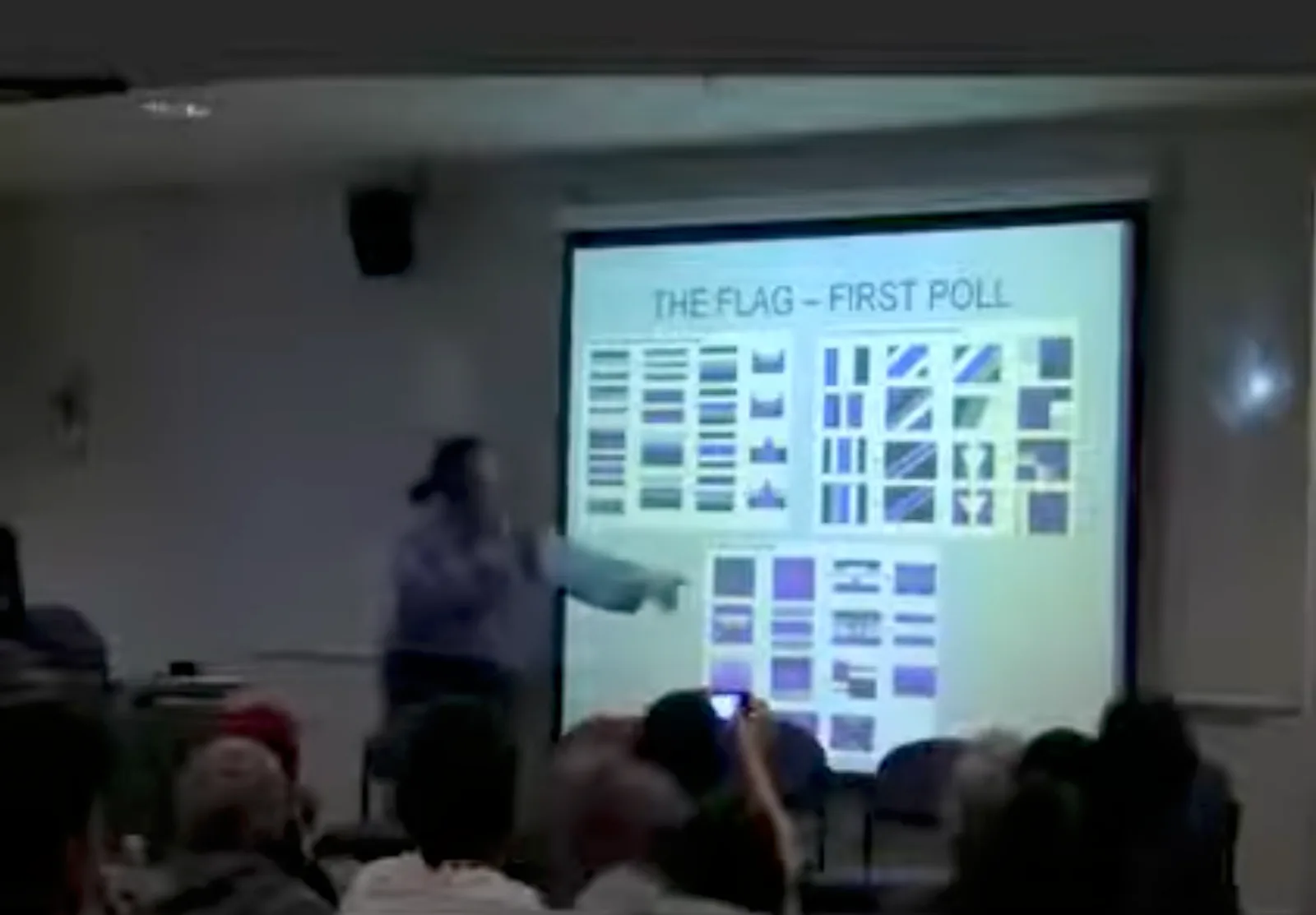
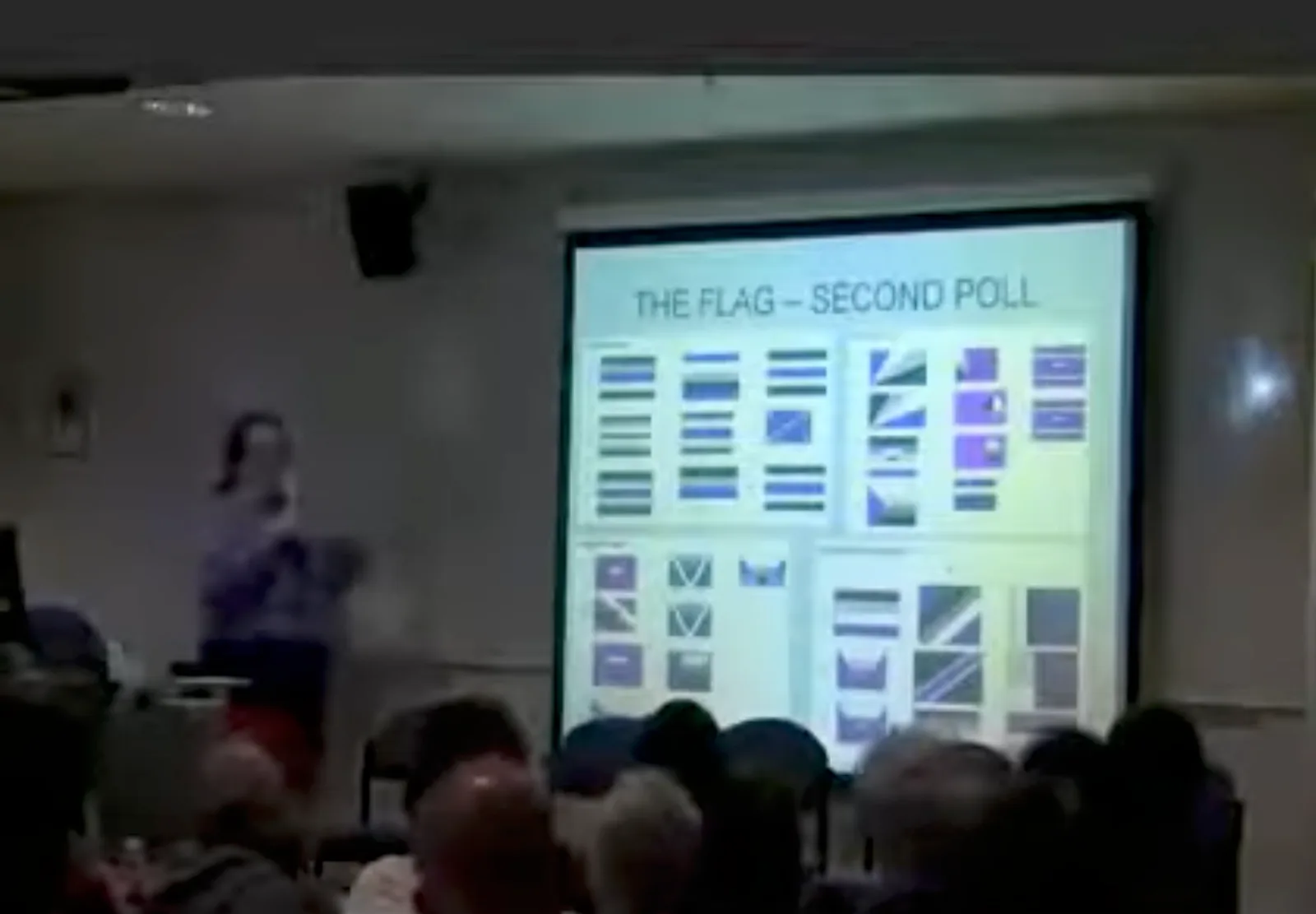
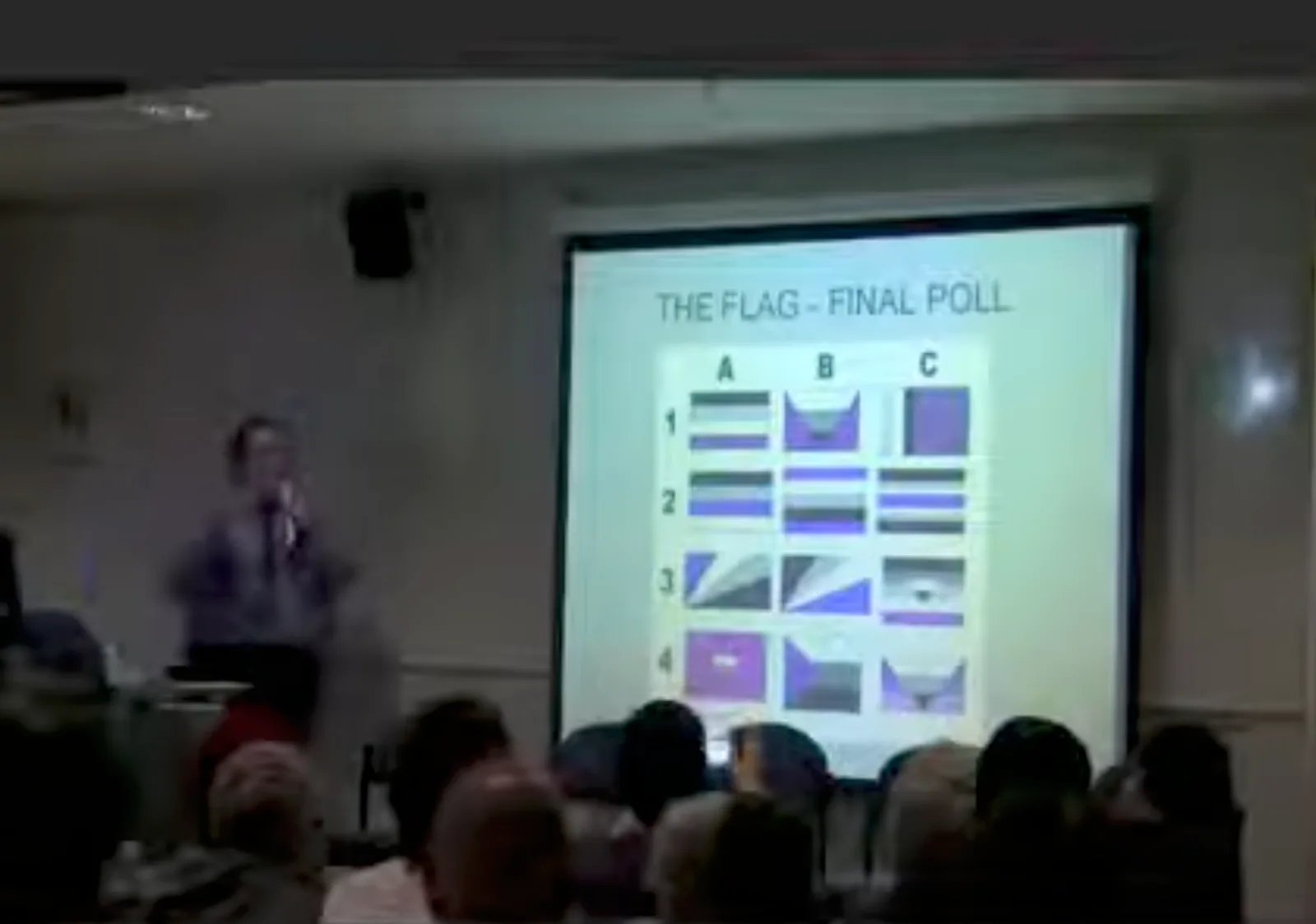
The losing designs were thought lost. The image hosts carrying the 2010 voting sheets expired, and Siggy's 2018 history could describe the other candidates only from memory. They survive in one place: the slides Neth Dugan projected at the WorldPride Asexual Conference in London on 8 July 2012, recorded and posted by Asexual Media Archives. Asked in a comment on that recording whether she still had the presentation, Dugan answered, "Alas, sorry. I don't think I have the powerpoint any longer." The three frames in this entry's archive are the surviving record: roughly fifty candidates in the first round across standup's three categories, about thirty in the second, and twelve in the final grid lettered A to C, in which A1 is the flag. [15][8]
Lineage
- Indirect influences
- AVEN triangle / AVEN logo, Rainbow Pride Flag
The primary ace-spectrum reference flag. The demisexual flag uses the same colours with a black triangle at the hoist; its origin is unknown, and the ace flag's own historians say only that it "may have been proposed" the same way the gray-asexual flag was. [4] The gray-asexual flag was proposed in 2013 by Milith Rusignuolo. [4][13] The aroace flag draws from both ace and aro lineages rather than descending from this flag alone. The Aromantic Pride Flag occupies a parallel position in the aro-spectrum lineage.
Lineage tree
Every record reachable from this one through documented parent and child relationships: 13 records across 3 generations.
- This record
- Asexual Pride Flag
Colors & Symbolism
The scheme predates the flag, and its arrival can be dated. A thread headed "Colors for an ace pride bracelet?" opened on 27 June 2010, three days before the flag thread, after a member asked a maker of pride friendship bracelets to add an asexual design and was asked which colours to use. An AVEN administrator proposed the set that stuck: "purple (because AVEN is (usually) purple); gray (for gray A's); black (for the black ring thing) and/or white." Its poll returned purple 61, black 53, gray 52, white 40. [10] bristrek closed a post in that thread by writing "one day we all need to come up with a flag or something ... most seem to agree on purple/black/grey and there's some who like white and some who don't. But no flag, we should make one!" [10] standup opened the flag thread on 30 June with the palette already treated as given: "It seems as though the color scheme of black/grey/white/purple has been decided to represent asexuality the best." [6]
Behind the four colours are older ace symbols. Black, gray and white derive from the AVEN triangle, whose white-to-black gradient represented an earlier model of the sexual-to-asexual spectrum, and purple was AVEN's site accent, its meaning moving over the years from the website to the community. "The flag colors slightly predate the flag," as Siggy put it. [4][1]
| Colour | Hex | Meaning |
|---|---|---|
| Black | #000000 | Asexuality. standup, 30 June 2010: "black represents asexual." |
| Gray | #A3A3A3 | Gray-asexuality; demisexuality was folded in by the community. standup's gloss: "gray is for 'gray-A' people." |
| White | #FFFFFF | Sexuality, in standup's own gloss: "White is sexual." Later standard wordings give non-asexual partners and allies. |
| Purple | #800080 | AVEN's colour, "a nice accent color that most of us are able to agree on" in standup's gloss; community, in the reading that stabilised. |
Measured from this archive's own rendering [15]
standup stated the meanings on 30 June 2010, the day the design was first posted: "The idea behind the white/gray/black is that it represents the shades of sexuality. White is sexual, gray is for 'gray-A' people, and black represents asexual. Purple is added because AVEN is primarily purple and it adds a nice accent color that most of us are able to agree on." [6]
White was the least settled of the four from the start. The bracelet thread carried several readings at once: that white is "all colours put together into one. All of us, differences and similarities, coming together into one"; that it made the set "less depressing" and gave more pattern options; and that it was "a little redundant considering the symbolism we want it to have." [10] The announcement of 11 August gave "white = sexuals," and the Commons upload of 16 August already gave white as "(mostly allies)." [7][5] Later guides give allosexuality, non-asexual partners, or allies, and that wording has itself drawn objection on the ground that "the flag isn't for allosexuals." [8] The 2010 discussion used the word sexuals throughout; allosexual is the later term. [6][7]
Purple's documented reasoning is community rather than symbolic. bristrek: "The purple to me means our community. It's usually the colour of this board, it's the colour most of us wear on Pride," adding that purple's historical association with rarity appealed, "like us!" A member who asked whether purple had a deeper meaning got no answer beyond the website. [10]
No palette was ever agreed. bristrek closed the winner announcement with "Now all we have to do is standardise the colours. Thoughts?", and the discussion that followed proposed CSS keyword colours, argued over three shades of grey, and reached for Pantone equivalents, 426 C black, 877 C grey and 513 C purple, before trailing off. standup's advice was that "a lot of people think the ace colors are kind of morbid looking, so choosing lighter and less saturated hues makes the flag look a little more lively." The question was left open and has never been closed by the community that raised it. [7]
The values in the table are this archive's, not the community's: they were sampled from the rendering the archive publishes, which carries four uniform bands at 1500 by 900 pixels. Three of the four are the CSS keywords black, white and purple; the grey is #A3A3A3. They match the file in worldwide circulation, which reached those values through Wikimedia Commons rather than through any decision on AVEN. [15][16]
The original A1 raster was a different shape. Writing in the announcement thread, a member gave its dimensions as 640 by 361, "which should probably be 640x360, so a 16:9 ratio." The 3:5 shown here is the archive's standard production ratio, not a specification by standup. [7]
Design
- Aspect Ratio
- 3:5 · standard
- Orientation
- horizontal
- Stripe Count
- 4
- Layout
- horizontal_stripes
- Stripes (Top → Bottom)
- Black, Gray, White, Purple
Four equal horizontal stripes. No ratio was specified by the process; Flags of the World records 3:5 and 2:3 as the most common in use, with the shades of grey and purple varying between renderings. [13]
Four equally sized horizontal stripes ordered top to bottom: black, gray, white, purple. No emblem or additional symbols. [2] [9]
Usage & Adoption
- First Users
- AVEN community
- Geographic Usage
- International circulation
- Online Usage
- Dominant pride flag for asexuality and one of the most widely recognized ace-community symbols
- Event Usage
- Stockholm Pride, 6 August 2011, and again in 2012 [13], Manchester Pride, 27 August 2011 [13], San Francisco Pride, June 2011 [8][13], WorldPride 2012, London, where Neth Dugan spoke about the flag [8], Helsinki Pride 2015 [13], Milano Pride 2017 [13], Toronto Pride 2017 [13], WorldPride 2017, Madrid [13], Taiwan Pride 2017 [13], London Pride 2017, 2018 and 2019 [13], Capital Pride, Washington DC, 2018 [13], Christopher Street Day Mittelhessen, Wetzlar, 2018 [13], Christopher Street Day Berlin 2018 and 2019 [13], Christopher Street Day Cologne 2019 [13]
- Current Status
- active
This is the dominant pride flag for asexuality and one of the most widely recognized ace-community symbols. [14]
Image Archive
The selection process
The flag in use
The lost candidate designs, recovered
Documented Use
.jpg)

Precursor symbols

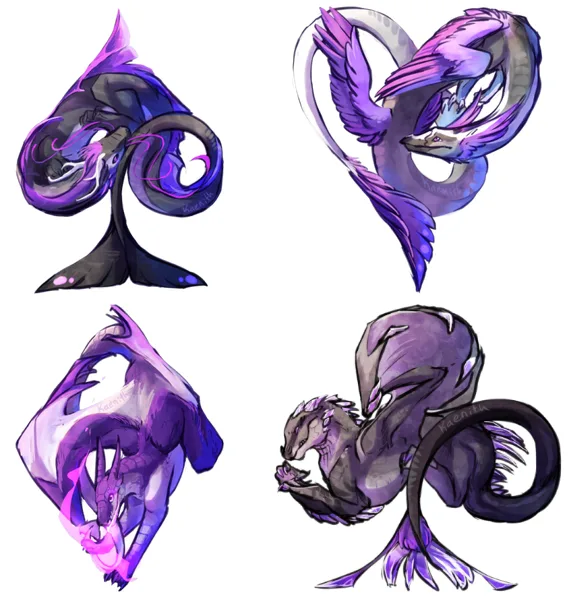
The palette as vocabulary
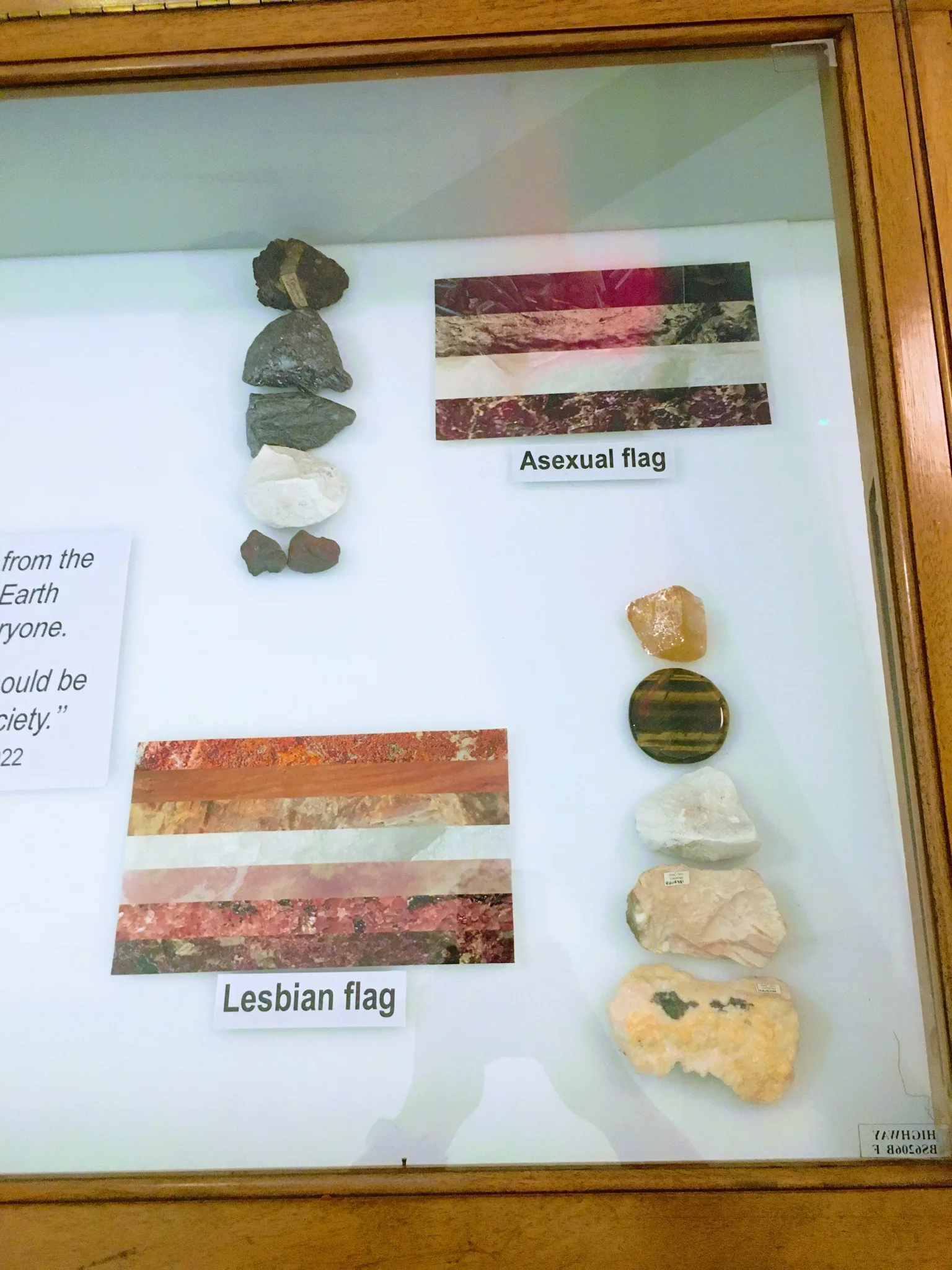
Photograph by the Tumblr user feral-critter. No licence is stated and none has been sought; published at the site owner's direction with the rights status recorded as undetermined.
Discourse & Debates
- Whether the white stripe represents allosexuality, non-asexual partners, or allies varies by source, and none of those is the 2010 wording. [2][9]
- The voting method was challenged as soon as the result was posted. Because each respondent could select up to four designs, one member argued that A1 might have been many voters' second or third choice and asked for a run-off among the top designs. bristrek declined: the method had been stated in advance, voters were free to choose fewer, and A1 had led throughout. "So I don't think we need another round, no." [7]
Common misidentifications
- Asexuality and aromanticism are frequently collapsed into one concept in popular coverage, though they describe distinct spectra. The distinction was live in the flag thread itself, where the half-filled heart was rejected partly because it read as romance. [1][6]
Criticisms
- Whether the flag should align with LGBT visual language was argued in the design thread itself, and participants disagreed. One member opposed horizontal bars: "I feel like we should avoid horizontal bars. It's very LGBT... and many asexuals do not want Asexuals to be part of the LGBT." Another argued for them on the same ground: linking the symbols "does make some modicum of sense ... since we are an 'alternative' sexual identity," pointing to the polyamory and BDSM flags, which are not part of LGBT either. A third wrote that "the horizontal stripes indicate a 'sexuality' flag." standup's own argument was formal: "All of the other orientation flags are just horizontal stripes, we should stick to that too." The design eventually selected uses horizontal bars. [6]
- A member of the French AVEN forum objected to the whole exercise during the final round, disliking the shortlist as "too classic, too 'flag of a country or a pharmaceutical trademark'," preferring a design built on the letter A, and asking "why not try to be in the LGBT movement, to become LGBTA?" Writing in a second language, they added: "i just want to give my opinion out of language frontier." [17]
- After the result, one member rejected the premise of a designed symbol: "I think that a true symbol has to evolve gradually through familiarity and usage, not be suddenly imposed from out of the blue. In that sense, the AVEN logo will always symbolize asexuality to me." bristrek agreed the point was open: "we can come up with a design, and colours, but we can't force anybody to use it. If it sticks will be the question." [7]
Footnotes & Citations
Sources and footnotes 18 sources
- 1. Community The Asexuality Flag. asexualityarchive. Asexuality Archive (2012-02-20). Accessed 2026-08-08
- 2. Primary statement Asexual Flag Voting (First Round). standup and others. AVEN forum (2010-07-04). Accessed 2026-08-08
- 3. Primary statement Discussion 2.0: Asexual Flag. standup and others. AVEN forum (2010-07-06). Accessed 2026-08-08
- 4. Community The Ace Flag: A History. F. Murray. Ace Week (Asexual Outreach) (2020-10-26). Accessed 2026-08-08
- 5. Image file page File:Asexual flag.png. Britrek87 (upload); AVEN user standup (design, as credited). Wikimedia Commons (2010-08-16). Accessed 2026-08-09
- 6. Primary statement Asexual Flag Thread. standup and others. AVEN forum (2010-06-30). Accessed 2026-08-09
- 7. Primary statement Asexual Flag: And the winner is...... bristrek. AVEN forum (2010-08-11). Accessed 2026-08-09
- 8. The Ace Flag: A History and Celebration. Siggy. The Asexual Agenda (2018-02-21). Accessed 2026-08-08
- 9. Pride Flag Guide: Asexual. Library.LGBT (Albany Pride initiative). Library.LGBT Pride Flag Guide. Accessed 2026-03-09
- 10. Community Colors for an ace pride bracelet?. 20thCenturyGirl and others, Asexual Visibility and Education Network forums. AVEN forums (2010-06-27). Accessed 2026-08-10
- 11. Overview. Asexual Visibility and Education Network. Asexual Visibility and Education Network. Accessed 2026-03-30
- 12. Primary statement Asexuality at SF pride 2011. Siggy. Skeptic's Play (2011-06-29). Accessed 2026-08-09
- 13. Reference Asexuality flag. Tomislav Todorović; ed. Randy Young. Flags of the World (2020-03-27). Accessed 2026-08-08
- 14. Pride Flags. Human Rights Campaign. Accessed 2026-03-09
- 15. Other Sources Palette measured from the archive's own rendering. Encycloflaggia. Encycloflaggia (2026-08-10). Accessed 2026-08-10 [no stable URL]
- 16. Image file page File:Asexual Pride Flag.svg. AnonMoos (SVG); AVEN (flag design). Wikimedia Commons (2010-09-18). Accessed 2026-08-09
- 17. Community Asexual Flag - Round Three. bristrek and others, Asexual Visibility and Education Network forums. AVEN forums (2010-08-03). Accessed 2026-08-10
- Aroace. LGBTQIA+ Wiki. lgbtqia.wiki (2026-01-01). Accessed 2026-07-24


Image Sources
- Rendering
- four-stripe standard
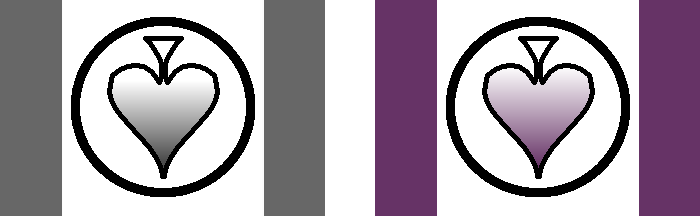
- Two surviving proposals from the December 2009 poll that went nowhere: complicated designs carrying the older spade and triangle-gradient motifs, before the colour scheme had solidified. Most of the 2009 designs are lost to expired image hosts. [8] · Credit: Designers unrecorded · The Asexual Agenda
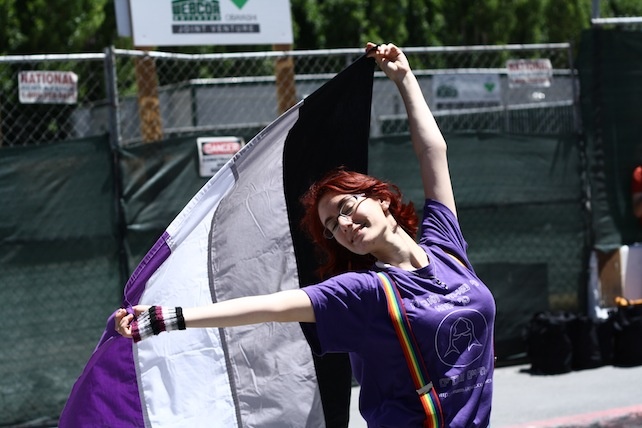
- The flag being waved in 2012, the photograph Siggy chose to open his 2018 history of the flag. [8] · Credit: Vice · Vice, via The Asexual Agenda
- The first-round voting sheet, projected in Neth Dugan's WorldPride talk. The three categories standup set out on 4 July 2010 are visible as three blocks: horizontal and triangle designs, vertical and diagonal designs, and symbol flags. Roughly fifty candidates. These frames are the only surviving record of the losing designs: the image hosts that carried the original voting sheets have died, and Dugan replied to a request for them in 2019, "I don't think I have the powerpoint any longer." [15][8] · Credit: Neth Dugan (slides); Asexual Media Archives (recording) · WorldPride Asexual Conference, London, 8 July 2012
- The second round, the field cut to about thirty. The surviving designs are mostly stripe arrangements, with a smaller group carrying diagonals, chevrons and emblems. These frames are the only surviving record of the losing designs: the image hosts that carried the original voting sheets have died, and Dugan replied to a request for them in 2019, "I don't think I have the powerpoint any longer." [15][8] · Credit: Neth Dugan (slides); Asexual Media Archives (recording) · WorldPride Asexual Conference, London, 8 July 2012
- The final round: twelve designs in a grid lettered A to C and numbered 1 to 4, the coordinates bristrek used to report the result. A1, at top left, is the four-stripe design that won with 41.1 per cent of 302 votes. These frames are the only surviving record of the losing designs: the image hosts that carried the original voting sheets have died, and Dugan replied to a request for them in 2019, "I don't think I have the powerpoint any longer." [15][8] · Credit: Neth Dugan (slides); Asexual Media Archives (recording) · WorldPride Asexual Conference, London, 8 July 2012
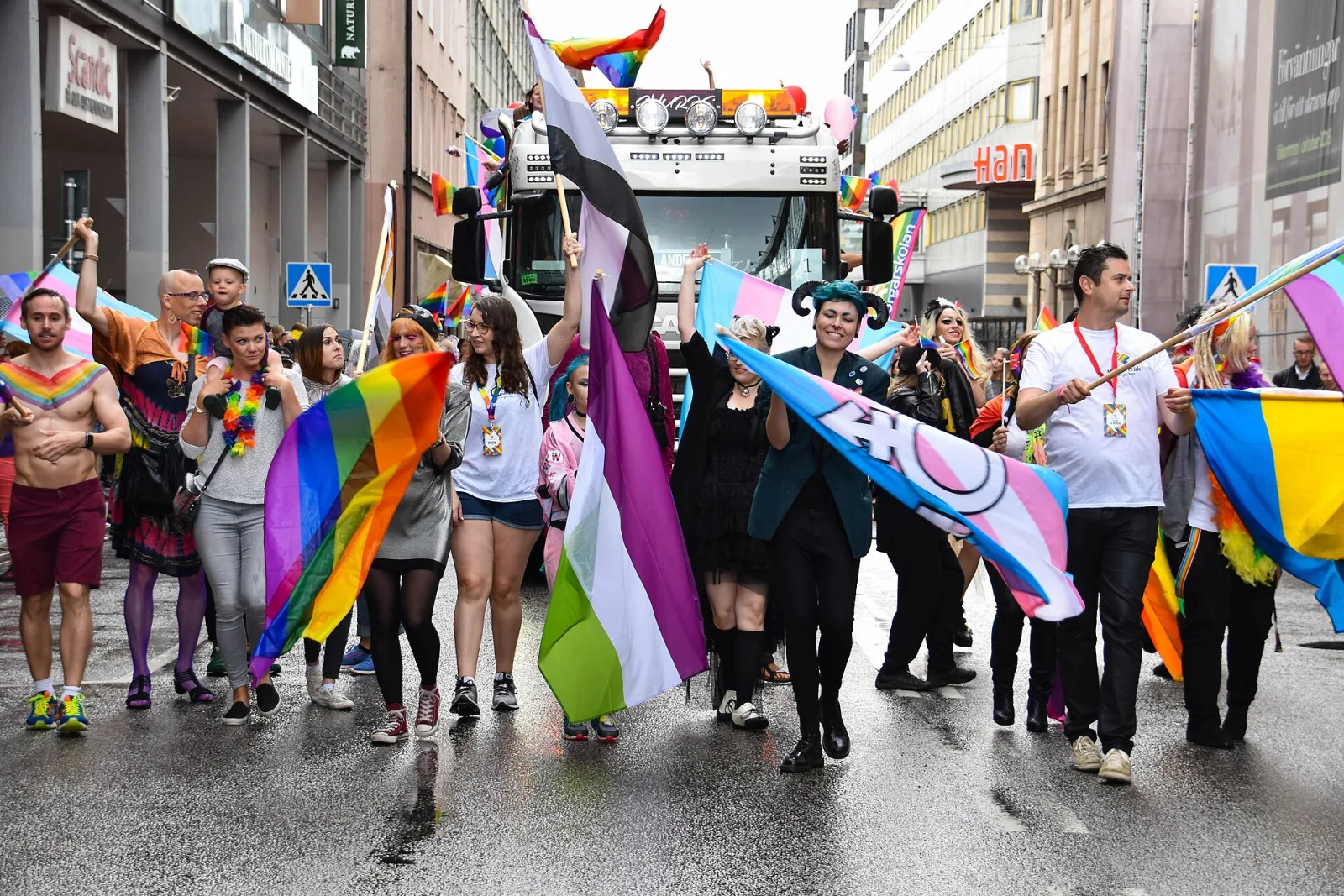
- Malmö Pride, 6 August 2016. The Asexual flag is carried on the float at the head of the march, among transgender, Genderqueer and pansexual flags. Photographed by Maria Eklind. · Credit: Maria Eklind, CC BY-SA 2.0 · Wikimedia Commons
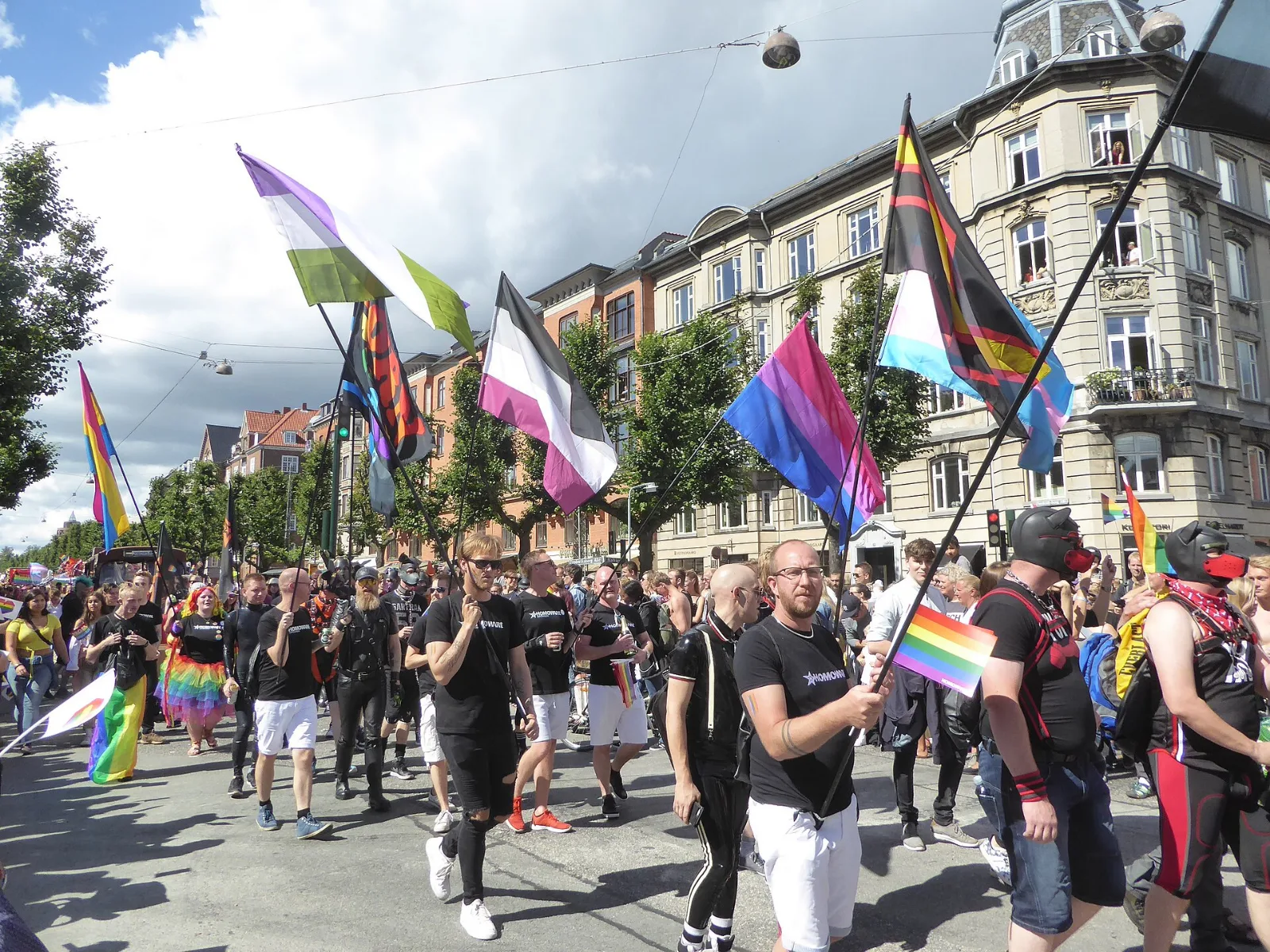
- Copenhagen Pride, Frederiksberg Allé, 19 August 2017. The Asexual flag is carried here among bisexual, transgender, bear, rubber, asexual and pansexual flags. Photographed by Leif Jørgensen. · Credit: Leif Jørgensen, CC BY-SA 4.0 · Wikimedia Commons
- The AVEN triangle, the most widely known asexual symbol before the flag. Its white-to-black gradient encoded an older model of the sexual-to-asexual spectrum and gave the flag three of its four colours. [8][4] · Credit: AVEN · Via The Asexual Agenda
- kaenith's ace-suit dragons, Siggy's example of how "a simple design empowers us to create infinite mutations": the palette itself, detached from the stripes, working as a free-standing sign of asexuality. [8] · Credit: kaenith · kaenith, via The Asexual Agenda
- Pride flags rendered in rock and mineral specimens in a museum display case, each flag laid out beside the stones its colours were taken from. This case shows the asexual flag and the five-band lesbian flag. The case is most likely in the Cambridge geology museum: the quotation card in it is credited to a Coleridge student in 2022, and Coleridge Community College is a Cambridge school. The museum has not confirmed it. If you can add its formal name or the dates the display ran, contribute. · Credit: feral-critter, via Tumblr · feral-critter on Tumblr