Graysexual Pride Flag
Identity Pride Flag ·
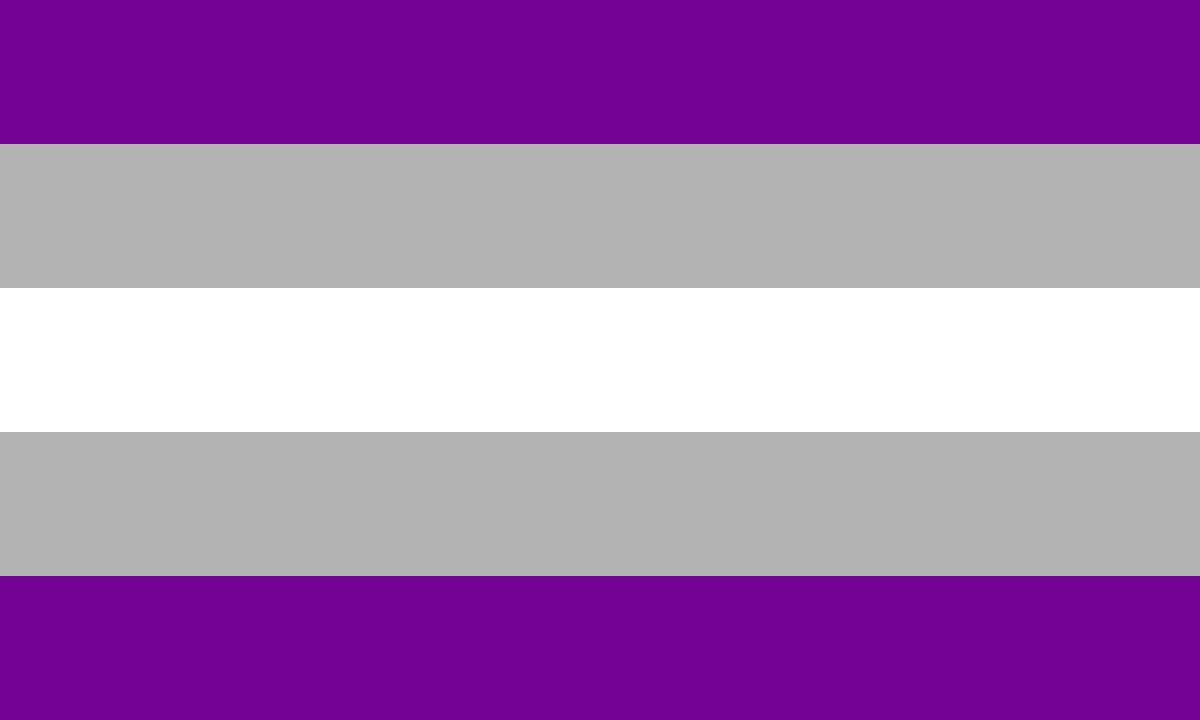
Five stripes in purple, gray, white, gray and purple, designed by Milith Rusignuolo and uploaded to Wikimedia Commons on 21 June 2013 as Grey-A flag proposal. [1] [2] Commons deleted the file five weeks later in a batch of proposed identity flags; the design survived through merchandise and Tumblr circulation, in the designer's account, and is the predominant documented graysexual flag, flown at NYC Pride in 2019. [1] [3] [2] [4] The gray stripe carried the designer's own symbolism, a "transitional stage between asexuality and allosexuality"; contemporary definitions describe graysexuality as an orientation in itself, not a stage. [2] [5]

Key facts
- Designer
- Milith Rusignuolo
- Created
- First documented publication
- Documented circulation
- 2013–present
- Aspect Ratio
- 3:5 · standard
- Ratio Notes
- No creator-specified ratio has been located. The creator-hosted raster is 500 × 322 pixels and is recorded at that native canvas as source evidence; equal stripes and 3:5 are archive standardizations, matching the 1200 × 720 rendering Commons has carried since 2021. [6] [7]
- Stripes
- 5
- Represented Identity
- graysexual
Also known as
- Gray-Asexual Pride Flag
- Grey-Asexual Pride Flag
- Gray-Ace Pride Flag
- Grey-Ace Pride Flag
- Greysexual Pride Flag
- Grey-A flag proposal (original file title)
Archive categories Sexual & Romantic Orientation Pride Flags
Overview
To give gray-asexual identity a flag of its own within the ace spectrum. [2] [8]
Rusignuolo designed the flag for gray-asexual identity in 2013, seven years after the term Gray-A entered use on AVEN, and uploaded it to Wikimedia Commons on 21 June 2013 under the title Grey-A flag proposal. [2] [1] [9]
Identity & Context
- Represented Identity
- graysexual
- Subcommunity
- ace spectrum umbrella
- Language Context
- Gray-asexual terminology predates the flag. The earliest located AVEN discussion of an identity-space between asexual and sexual is an October 2003 post proposing "semisexuality"; the term Gray-A dates from 12 April 2006, when AVEN user KSpaz self-identified as gray-A for the "fuzzy" space between asexual and sexual, referencing the gradient in AVEN's triangle logo. [10] [9] Spellings vary: graysexual, greysexual, gray-asexual, grey-asexual, gray-ace, grey-ace. [8]
Creators
The Creator
Milith Rusignuolo
Designer
Milith Rusignuolo designed the flag and, on the designer's own page preserved from 2018, describes uploading it to Wikimedia Commons on 21 June 2013 as Grey-A flag proposal, explains the stripe symbolism, and recounts how the design survived its deletion through merchandise and Tumblr circulation. [2] The same page documents other pride and non-pride flag designs by Rusignuolo. [2]
The idea here was that it was supposed to be symbolic of someone starting out with no sexual attraction, then entering a single episode of it, an exception to asexuality, and then going back to being asexual.
On the symmetrical purple-to-white-and-back sequence, as quoted in Library.LGBT's guide.
Motivations
Stated inspirations
- The asexual pride flag's colours, reassigned: purple for asexuality, gray for the transition, white for allosexuality.[2][8]
Attribution notes
The design is Milith Rusignuolo's, per the designer's own page, preserved in a Wayback Machine capture of 10 February 2018. [2] Commons' surviving log records the file uploaded by the account Shikku27316 on 21 June 2013 and recompressed the same day by AnonMoos; no located source states the relationship between the designer's name and the uploading account. [1]
Origin
- Specific Place
- Wikimedia Commons
- Place Type
- website
- Digital Origin
- Yes
Digital origin; no verified physical location.
Published digitally: uploaded to Wikimedia Commons on 21 June 2013. [1] No physical place of creation is documented, and no geographic origin is assigned.
Dates & Chronology
- Year Created
- First documented publication
- Documented circulation
- 2013–present
- Creation Bounds
- Made in 2013, on or before the Commons upload, which the surviving upload log dates to 16:10 UTC on 21 June 2013. [1]

Commons deleted the upload at 06:02 UTC on 29 July 2013, five weeks after it was published. [1] In the designer's account, the design survived because it had already been picked up for merchandise, on Zazzle or a similar site in the designer's recollection, and circulated on Tumblr. [2] It became the form carried by ace-spectrum resources and pride flag guides. [8] [11] [12] Physical use is documented at NYC Pride on 30 June 2019, where the flag was flown in the ace-spectrum contingent in footage published by the Asexuality Archive. [4] Commons regained the design in 2021: Kautr uploaded a raster in May and Nikki replaced it with a vector at exactly 1200 × 720 in June. [7]
The deletion was part of a batch. At 06:02 UTC on 29 July 2013 the same administrator deleted twenty-one files, proposed identity flags among them, each with the log comment "Nonsense." [1] [3] An undeletion request argued the deletions were out of process, since practice had tolerated proposed flags; the deleting administrator answered that proposal flags are out of Commons' scope, another administrator endorsed the deletions, and the files stayed deleted. [3] The comment was an administrative label about scope, and the same batch removed proposed genderfluid, polysexual, neutrois and androgynous flags.
The upload's own history also survives in the log: the account Shikku27316 created the file at 16:10 UTC on 21 June 2013, and AnonMoos overwrote it the same day to increase PNG compression. [1] The designer's page describes the upload as Rusignuolo's own; the relationship between the name and the account is not stated in any located source. [2]
No file from the 2013 upload is retrievable. The closest surviving creator-associated image is a 500 × 322 raster preserved from the designer's website in a 2018 Wayback capture; it is not established to be the exact 2013 file. [6]
Lineage
- Direct predecessors
- Asexual Pride Flag
- Direct children
- Grayromantic Pride Flag (2014)
- Related flags
- Graygender Pride Flag
Rusignuolo adapted the asexual pride flag's palette, reassigning the colours: purple for asexuality, gray for the transition, white for allosexuality. The assignments are the designer's own and are not identical to the asexual flag's standard explanations. [2] [8] The grayromantic flag of 2014 is a documented structural recolour of this design, substituting the aromantic flag's green. [13] Sibling flags share the asexual flag as a documented parent; broader ace-spectrum flags are reachable through the category rather than listed as relatives.
Lineage tree
Every record reachable from this one through documented parent and child relationships: 3 records across 3 generations.
- Ancestor
- Asexual Pride Flag
- This record
- Graysexual Pride Flag
- Children
- Grayromantic Pride Flag (2014)
Colors & Symbolism
A symmetrical sequence from asexuality into allosexuality and back, in the designer's stated symbolism: purple for asexuality, gray for the transitional stage, white for allosexuality, mirrored around the centre. [2] [8]
| Colour | Hex | Meaning |
|---|---|---|
| Purple | #790196 | Asexuality. |
| Gray | #B0B2AF | The "transitional stage between asexuality and allosexuality," in the designer's original design language. |
| White | #FFFFFF | Allosexuality. |
| Gray | #B0B2AF | The transitional stage, mirrored. |
| Purple | #790196 | Asexuality. |
Sampled from the creator-hosted raster preserved in the 2018 Wayback capture [6]
This flag has no official digital palette. Color values shown are approximate.
The stripe symbolism is the design's narrative, not a definition of the identity. Contemporary community terminology describes graysexual people as experiencing attraction rarely, weakly, under limited circumstances, or in another way that differs substantially from allosexual experience, as an orientation or umbrella term in itself, not a temporary stage. [5]
Rusignuolo published no colour specification; nothing here is official. The values are sampled from the creator-hosted raster preserved in the 2018 capture, whose centre stripe is true white. [6] The Commons rendering in circulation since 2021 uses #740195 and #B2B2B2. [7] Library.LGBT's later guide gives #680B7E, #A294A5 and #EEE0F1, a pale lilac in place of white, without stating where its values come from. [8]
Design
- Aspect Ratio
- 3:5 · standard
- Ratio Notes
- No creator-specified ratio has been located. The creator-hosted raster is 500 × 322 pixels and is recorded at that native canvas as source evidence; equal stripes and 3:5 are archive standardizations, matching the 1200 × 720 rendering Commons has carried since 2021. [6] [7]
- Orientation
- horizontal
- Stripe Count
- 5
- Layout
- horizontal_stripes
- Stripes (Top → Bottom)
- Purple, Gray, White, Gray, Purple
The sequence is symmetrical and reads the same from either edge. [2] [8]
Five horizontal stripes: purple, gray, white, gray, purple, with no emblem. The archive's hero draws them at equal depths on a 3:5 field; the creator-hosted raster's bands are not pixel-perfectly equal, and no creator-specified geometry has been located. [6]
Usage & Adoption
- Geographic Usage
- United States (New York, 2019) [4]
- Online Usage
- Wikimedia Commons, 21 June to 29 July 2013, as Grey-A flag proposal [1], Merchandise and Tumblr circulation after the deletion, in the designer's account [2], Ace-spectrum resources and pride flag guides [8] [11] [12], Wikimedia Commons again from May 2021, in the standardized rendering [7]
- Event Usage
- NYC Pride, 30 June 2019: the flag flown in the ace-spectrum contingent, in footage published by the Asexuality Archive [4]
- Current Status
- widely documented and physically used
The predominant documented design for graysexual identity: the form carried by the reference guides reviewed, and the graysexual flag documented in physical use. [8] [11] [12] [4]
Image Archive
Later Renderings
Discourse & Debates
- Whether gray asexuality is a distinct orientation or a transitional state. Community terminology treats it as a stable orientation or umbrella term: attraction occurring rarely, weakly, or under limited circumstances, not a phase. [5] The transitional sequence belongs to the flag's stripe symbolism, not to the identity's definition. [2]
- Whether gray-asexual and graysexual are meaningfully different labels or the same experience named from different starting points. Both spellings and several others are current. [8]
Common misidentifications
- Sometimes confused with the asexual pride flag, which shares purple, gray and white; this flag has no black stripe and mirrors its sequence around a white centre. [8]
The original file title was Grey-A flag proposal. [1] Spellings of the identity vary: graysexual, greysexual, gray-asexual, grey-asexual, gray-ace, grey-ace. [8] The term Gray-A dates from KSpaz's AVEN thread of 12 April 2006; an October 2003 AVEN post had earlier proposed "semisexuality" for the space between asexual and sexual. [9] [10]
Footnotes & Citations
Sources and footnotes 14 sources
- 1. Databases Deletion and upload log for File:Grey-A flag proposal.png. Wikimedia Commons. Wikimedia Commons. Accessed 2026-08-12
The surviving platform record: uploaded by the account Shikku27316 at 16:10 UTC on 21 June 2013, recompressed the same day by AnonMoos, and deleted at 06:02 UTC on 29 July 2013 with the administrative comment "Nonsense."
- 2. Designer page Flags (avia-viridis.neocities.org). Milith Rusignuolo. The designer's website, via the Wayback Machine. Accessed 2026-08-12
The designer's own page, preserved in a Wayback Machine capture of 10 February 2018; the live page has since been removed. It identifies Rusignuolo as the designer, dates the Commons upload to 21 June 2013, explains the stripe symbolism, and recounts the design's survival through merchandise, on Zazzle or a similar site in the designer's recollection, and Tumblr.
- 3. Community Out of process deletions by User:Hedwig in Washington. Wikimedia Commons contributors. Wikimedia Commons (2013-07-29). Accessed 2026-08-12
The undeletion discussion of 29 July 2013, listing the twenty-one files deleted in the same batch and recording the dispute over the deletions, which were upheld as out of scope.
- 4. Blogs & Personal Sources Pride Flags In The Wind. Asexuality Archive. Asexuality Archive (2018-06-03). Accessed 2026-08-12
Posted 3 June 2018 and updated since with NYC Pride 2019 footage captioned "Gray-ace, grayro, demiro, rainbow, and ace and aro flags together at NYC Pride 2019!". The graysexual flag is plainly visible flying in the first clip, timestamped 30 June 2019. The Archive's media carry no stated licence and are cited rather than reproduced.
- 5. Organizations Identity Terminology. The Ace and Aro Advocacy Project. TAAAP. Accessed 2026-08-12
Current community terminology: gray-sexual or -romantic describes attraction occurring only rarely, weakly, under limited circumstances, or in another way that significantly differs from allosexual or alloromantic experience; an umbrella term or an orientation label in itself.
- 6. Image file page gray-a.png, creator-hosted raster. Milith Rusignuolo (design); hosted on the designer's website. The designer's website, via the Wayback Machine. Accessed 2026-08-12
A 500 × 322 raster preserved from the designer's website in the 2018 capture: the closest surviving creator-associated image, and the source of the sampled palette. It is not established to be the exact file uploaded in 2013.
- 7. Image file page File:Grey asexuality flag.svg. Kautr, uploader; vector by Nikki. Wikimedia Commons (2021-05-11). Accessed 2026-08-12
The standardized rendering Commons has carried since 2021: a raster uploaded by Kautr on 11 May 2021, replaced by Nikki's 1200 × 720 vector on 20 June 2021. Its embedded values are #740195, #B2B2B2 and #FFFFFF. Presented as public-domain simple geometry.
- 8. Reference Greysexual Flag. Library.LGBT, an initiative of Albany Pride. Library.LGBT Pride Flag Guide. Accessed 2026-03-30
A later secondary guide, and the source through which the designer's symbolism statement is quoted. It supplies its own reference palette, #680B7E, #A294A5 and #EEE0F1, without stating where the values come from, and simplifies the publication platform to Wikipedia; the upload was to Wikimedia Commons. [1]
- 9. Community Gray-A's. KSpaz. AVEN, Asexual Musings and Rantings (2006-04-12). Accessed 2026-08-12
The thread in which the term Gray-A entered use, posted 12 April 2006.
- 10. Blogs & Personal Sources The Development of Gray Asexuality and Demisexuality as Identity Terms. pianycist. WordPress (2013-05-08). Accessed 2026-08-12
A terminology history. It locates the earliest AVEN discussion of the space between asexual and sexual in an October 2003 post proposing "semisexuality," and dates gray-A to KSpaz's April 2006 self-identification.
- 11. Encyclopedias & Reference Greysexual. LGBTQIA+ Wiki contributors. LGBTQIA+ Wiki. Accessed 2026-03-31
A crowdsourced wiki, retained as further reading on the identity and the flag's circulation.
- 12. Encyclopedias & Reference Greysexual. MOGAI Wiki contributors. Miraheze. Accessed 2026-03-31
A crowdsourced wiki, retained as further reading.
- 13. Encyclopedias & Reference Greyromantic. LGBTQIA+ Wiki contributors. LGBTQIA+ Wiki. Accessed 2026-04-07
Documents the grayromantic flag of 2014 as a green recolour of this design; carried by the grayromantic entry as its own source.
- Articles & Reports The Ace Flag: A History. F. Murray. Ace Week (Asexual Outreach) (2020-10-26). Accessed 2026-07-24


Image Sources
- Rendering
- five-stripe standard
- Credit: Design by Milith Rusignuolo; archive-standard 3:5 reconstruction, colours sampled from the creator-hosted raster preserved in 2018 · Wayback Machine capture of the designer's page
- The standardized rendering Wikimedia Commons has carried since 2021: uploaded as a raster by Kautr in May and replaced with this vector by Nikki in June, at exactly 1200 × 720. Its purple and gray differ slightly from the creator-hosted raster. Commons presents the file as public-domain simple geometry; that statement describes this file, not the deleted 2013 upload. [7] · Credit: Raster by Kautr; vector by Nikki. Neither is the designer. · Wikimedia Commons · Public domain (Commons, simple geometry)