Demisexual Pride Flag
Identity Pride Flag ·
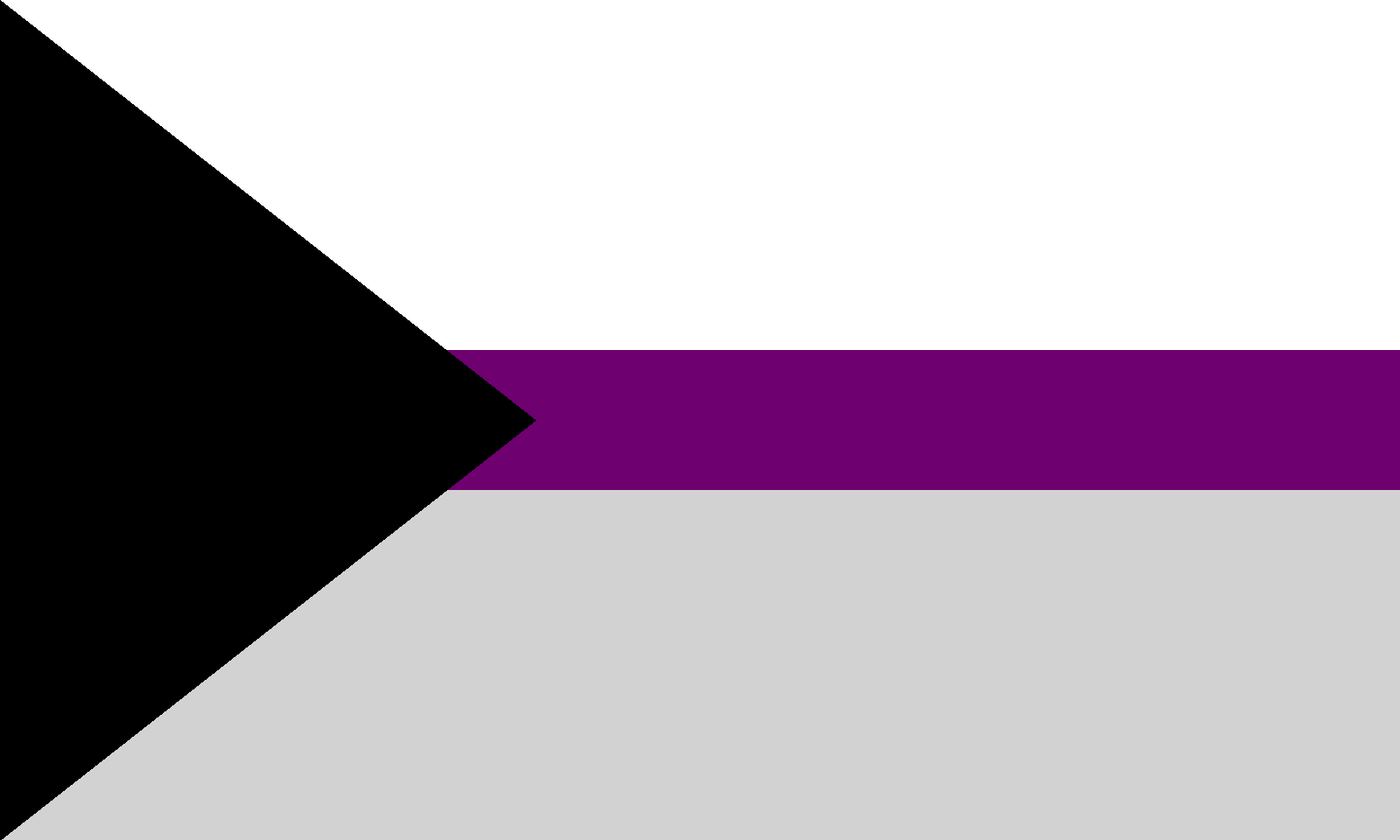
A black chevron at the hoist over white, purple and grey, using the asexual flag's colours. Its origin is undocumented: the earliest dated record is a Wikimedia Commons upload of 22 April 2013 credited to the user Vimopu, and in December 2019 AVEN asked its followers who had made the flag and when, calling it "a mystery." Demisexual blogs were still describing it as proposed in 2014 and weighing alternative designs in 2015.

Key facts
- Designer
- Vimopu (attributed by the 2013 upload)
- Created
- First documented public use
- In use
- 2013 to the present
- Aspect Ratio
- 3:5
- Ratio Notes
- No ratio was published with the design. The Commons vector's viewBox is 800 by 480, which is the archive's standard 3:5 proportion, so the rendering here does not alter the file's shape. [1]
- Stripes
- 3
- Represented Identity
- demisexual
Also known as
- Demisexual Flag
- Demi Pride Flag
- Demi Flag
Status Canonical
Archive categories Sexual & Romantic Orientation Pride Flags
Overview
Not documented. No statement of purpose by whoever made the flag has been located, and the design's record begins with a file upload rather than an announcement. [1][2]
The LGBTQIA+ Wiki dates the coinage of "demisexual" to a 2006 post on the AVEN forums by the user sonofzeal. [3] Before any flag, the demisexual corner of the ace spectrum used a fleur-de-lis in the asexual flag's colours. Its own origin is untraced. The admin of the Demi Grace forum, which took it as the forum's logo, wrote in 2013 that it "predates this forum and was used by a couple small blogs by demi and grey-ace folk; the blogs don't appear to exist any longer," that they adopted it with those users' permission, and that it "shows up already on a lot of demi memorabilia, buttons and pins and the like." The stated reason for the choice was that the fleur "avoided hearts (suggestions of romantic orientation by default) and triangles (allusion to the Holocaust) entirely, but is iconically recognizable." [4]
The thread that records this is about what the forum's logo should be, not about a flag. In December 2012 it ruled the triangle out of the logo categorically: "The triangle will always carry overtones of the Holocaust, however unintentionally, and as a matter of respect to those who suffered under the mark of an inverted triangle, Demi Grace will not in any way be utilizing it in our logo... this is not negotiable," with a second objection that a triangle would misleadingly imply an AVEN offshoot. Members proposed hearts, a monogram, an open umbrella and a Rubik's cube in the ace colours. No located source connects that decision to the chevron flag, which reached Wikimedia Commons four months later. [4]
Where the chevron design came from is not established. It appears on Wikimedia Commons on 22 April 2013, uploaded by Vimopu, and no located source records it earlier. [1][5][2]
Identity & Context
- Represented Identity
- demisexual
- Subcommunity
- ace spectrum umbrella
Creators
The Creator
Vimopu
Attributed designer; uploader of the earliest dated record
Vimopu is the Wikimedia Commons account credited with the design. It uploaded File:Demisexual Flag.jpg on 22 April 2013 with an "own work" source field, and Commons names Vimopu as the original author, with AnonMoos vectorising the design that June. No identity beyond the account is documented and none should be sought. Whether Vimopu drew the design or uploaded one already in circulation is not established by any located source. [1][5][2]
Attribution notes
Attribution rests on one record. Wikimedia Commons credits the design to the user Vimopu and dates it to 2013: the raster File:Demisexual Flag.jpg is Vimopu's own-work upload of 22 April 2013, and the vector File:Demisexual Pride Flag.svg is AnonMoos's work of 22 June 2013, drawn "from scratch based on abstract geometry" as an equivalent of that raster. The vector's author field reads "Original: Vimopu Vector: AnonMoos" and its caption "Demisexual flag, designed in 2013, by Vimopu." [1][5] Commons hedges on the flag's standing, describing it as a "Claimed flag for the demisexual sexuality." [1]
Whether Vimopu drew the design or uploaded one already circulating is not established. Secondary sources carry an earlier account crediting an "AVEN user Alexander" around 2010, which no located primary source supports and which the LGBTQIA+ Wiki treats as a misattribution. [3] Ace Week's own history says the origin remains unknown. [6] This entry names Vimopu as attributed on the strength of the upload, and treats neither the 2010 date nor the authorship as established.
Origin
- Digital Origin
- Yes
Digital origin; no verified physical location.
The earliest records are two Wikimedia Commons file pages: Vimopu's raster File:Demisexual Flag.jpg of 22 April 2013, and AnonMoos's vector equivalent of 22 June 2013, whose description reads "designed in 2013, by Vimopu." No place of design is documented and no source names one. [1][5] The widely repeated circa-2010 date is not substantiated by any located primary source, and Ace Week's own account says "the exact origins of the demisexual flag remain unknown." [6]
Dates & Chronology
- Year Created
- First public use
- Period in Use
- 2013 to the present
- Creation Bounds
- The design existed by 22 April 2013, when the user Vimopu uploaded File:Demisexual Flag.jpg to Wikimedia Commons; AnonMoos drew the vector equivalent on 22 June. The Commons description dates the design to 2013 and credits Vimopu. This entry uses 2013 because it is the earliest dated record of the flag, not because a source records the design being made that year, and the circa-2010 date carried by secondary guides is unattributed. [1][5] The April 2013 date records a file upload rather than a documented use. The earliest circulation community researchers recovered is an April 2014 Tumblr exchange, and the earliest documented flying located is Christopher Street Day in Karlsruhe on 1 June 2019. [2][7][8]
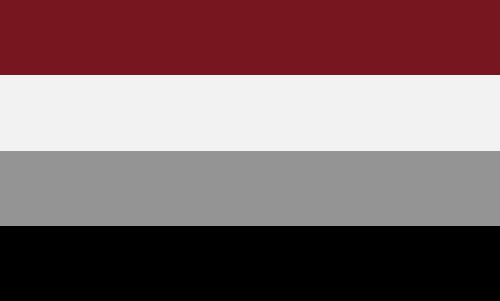
Asked in April 2014 whether a demisexual flag existed, the Demi Gray blog, a resource for demisexual and gray-asexual readers, answered: "I have seen this one proposed, but I don't know how widely used or accepted it is." A note on the same post preferred the asexual flag as it stood. [7] In March 2015 a reader submitted an alternative design to the same blog, arguing that the chevron flag "still uses the same colors" as the asexual flag so that "people making and buying pride accessories... can't get something unique to demisexuality alone," and reporting that vendors at a convention had told her they would make demisexual merchandise "as soon as the community comes together and officially decides on a flag." She added that "the one with the triangle isn't really full accepted either." The blog replied: "if people like this, they should use it, and see if it gains traction." No later use of the submitted design has been located. [9]
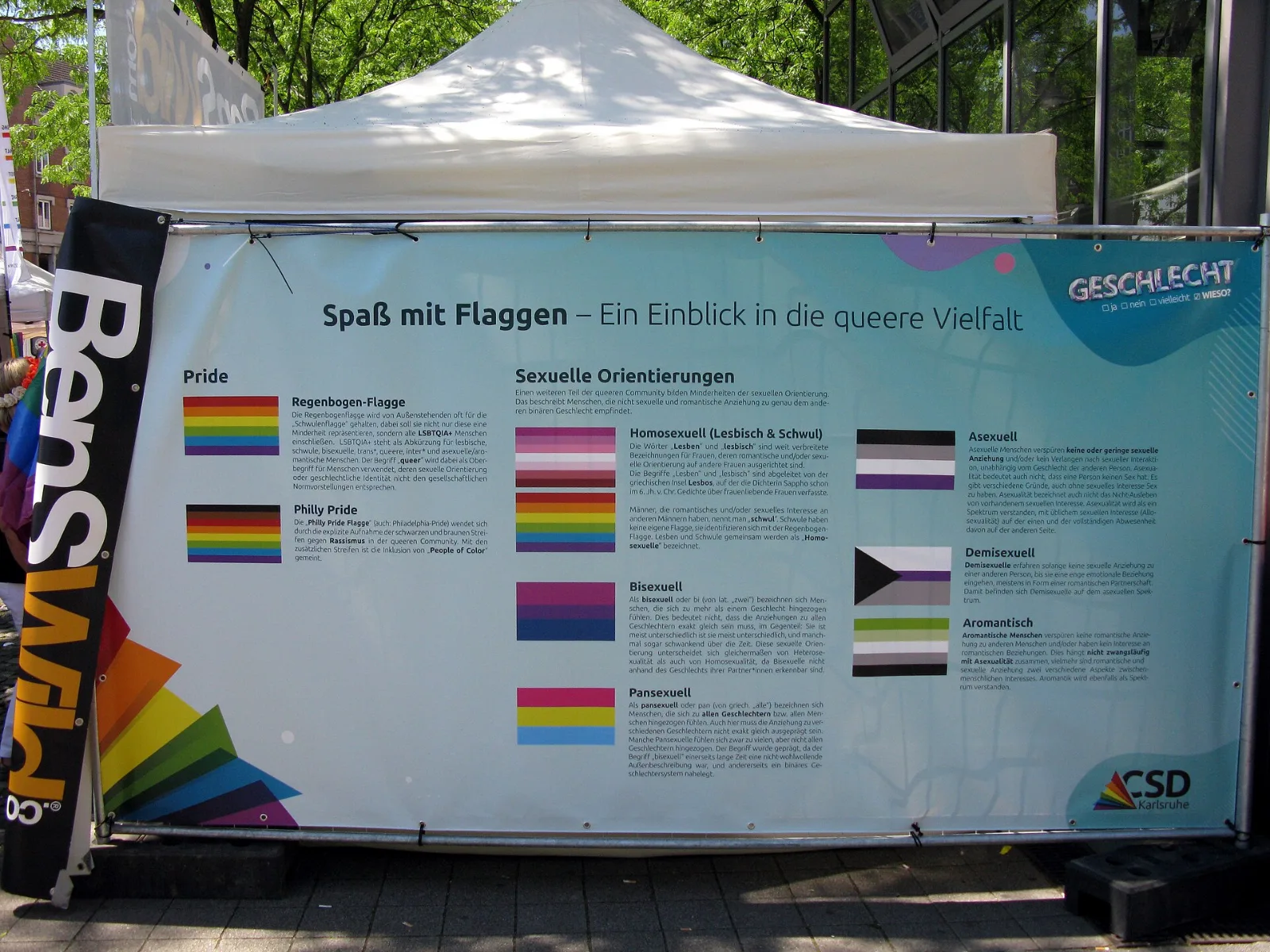
The flag is now carried in the Human Rights Campaign's pride flag guide and appears on merchandise and at Pride events. [10] CSD Karlsruhe put it on its own explanatory banner in 2019 with a definition attached. [8]
On 27 December 2019 the Asexual Visibility and Education Network asked its followers, publicly: "We've been searching and searching, to no avail--do any of you know the history behind the demisexual flag? Who created it and when? It seems to be a mystery! Any help would be appreciated!" The organisation whose own forums produced the asexual flag, and whose colours this one borrows, could not establish where it came from. [11]
The search continued into the following weeks on Pillowfort, among community researchers including Siggy of The Asexual Agenda and sennkestra, and reached the same end: none could trace the flag past its April 2013 Wikimedia Commons upload. The earliest circulation they recovered was an April 2014 Tumblr exchange, and demi blogs were still weighing alternative designs in 2015. Siggy's reading, offered as a guess: "I'm guessing it came from tumblr. And I guess it didn't really gain consensus until years later after nobody could remember where it came from." [2]
sennkestra noticed that the Vimopu account "appears to be created like...1-2 hours before they posted the demi flag, and demi flags are the only things they have ever posted," which together with the "own work" source field she read as arguing against Vimopu having moved someone else's design across, and so mildly for their having had a hand in it. She was explicit that this is "still just a hunch, not something I have any evidence for." [2]
Lineage
- Direct predecessors
- Asexual Pride Flag
- Direct children
- Demibisexual Pride Flag (2016, Pride-Flags), Demipansexual Pride Flag (2016, Pride-Flags), Demiromantic Pride Flag
The colours and their circulated meanings come from the asexual flag, which Ace Week names as the influence on both the demisexual and gray-asexual designs; the hoist chevron is what distinguishes it. [6] The demiromantic flag places a comparable hoist chevron over the aromantic flag's colours. The demibisexual and demipansexual flags of 2016 combine this design with the bisexual and pansexual flags respectively.
Lineage tree
Every record reachable from this one through documented parent and child relationships: 5 records across 3 generations.
- Ancestor
- Asexual Pride Flag
- This record
- Demisexual Pride Flag
Colors & Symbolism
No symbolism was issued with the design. The four colours are the asexual flag's, and the meanings attached to them are later circulated readings transferred from that flag rather than statements by whoever drew this one; the earliest attestation located presents them as guesses. The chevron is the design's only distinct element, and no located source records a reason for its shape. [6][12]
| Colour | Hex | Meaning |
|---|---|---|
| Black (chevron) | #000000 | Asexuality, in the reading carried over from the asexual flag. |
| White | #FFFFFF | Sexuality, in the same transferred reading. |
| Purple | #6E0070 | Community. |
| Gray | #D2D2D2 | The area between asexual and allosexual, and so demisexuality. |
Wikimedia Commons file, stated colour table [1]
This flag has no official digital palette. Color values shown are approximate.
- Black hoist chevron
- In the circulated readings the black carries the asexual flag's meaning of asexuality; the chevron itself is what separates this design from the asexual flag's four horizontal bands. No located source records why the shape was chosen.
The meanings were read off the asexual flag by the community rather than issued with the design, and the earliest attestation located says so outright. A gloss circulating on AVEN in November 2014 opens "The meaning of the colors is unknown, though it appears to be based on the Asexual Pride Flag," then hedges every clause: the white "might symbolize sexuality, agender, intersexuality, transitioning, genderlessness," the purple "might represent female and male relationships," the grey "might stand for asexuality," the black triangle "might stand for romantics who reject traditional romance." [12] The readings that later hardened into standard guides, black for asexuality, grey for the grey area, white for sexuality, purple for community, are the asexual flag's own, transferred. [10][6]
No creator-published values have been located. The four listed are those of the Wikimedia Commons file, which prints its own rendered colour table: grey 210 210 210, purple 110 0 112, white, black. That file is the illustration in worldwide circulation, in use on this flag's article across a dozen language Wikipedias. As with the asexual flag whose scheme this borrows, no standardisation was ever issued. [1]
Design
- Aspect Ratio
- 3:5
- Ratio Notes
- No ratio was published with the design. The Commons vector's viewBox is 800 by 480, which is the archive's standard 3:5 proportion, so the rendering here does not alter the file's shape. [1]
- Orientation
- horizontal
- Stripe Count
- 3
- Layout
- chevron_with_horizontal_stripes
- Stripes (Top → Bottom)
- White, Purple, Gray
- Additional Symbols
- Black hoist-side chevron
Three horizontal bands with a black triangle at the hoist. On the Commons file, whose viewBox is 800 by 480: white for the top 200, purple from 200 to 280, grey from 280 to 480, and the triangle reaching 306 across, a little over a third of the width. The purple band is the narrowest, at a fifth of the height above the grey. [1]
A black chevron pointing rightward at the hoist, with three horizontal bands: white at top (widest), purple in the middle (narrower), and gray at bottom (widest). The chevron occupies the left portion of the flag.
Usage & Adoption
- Organizations
- CSD Karlsruhe, which included the flag and a definition on its public explanatory banner in 2019 [8]
- Geographic Usage
- International circulation
- Online Usage
- The Commons vector illustrates this flag on the Demisexuality and related articles of the Asturian, Central Bicolano, Catalan, Czech, Danish, German, Greek and English Wikipedias among others, and is used on fourteen Commons pages. [1]
- Event Usage
- Christopher Street Day, Karlsruhe, 1 June 2019, on the organisers' own explanatory banner of Pride flags [8]
- Current Status
- active
Mainstream guides now treat this as the standard demisexual pride flag. [10]
Image Archive
The design
Alternatives that did not take
Documented use

Discourse & Debates
- Whether a distinct demisexual flag was wanted at all was argued for years. In February 2014 a Demi Grace member wrote "I really don't like the current flag. It's aesthetically displeasing to me, and I know that I'm not alone in this sentiment," objecting that stripes are "visually divisive and too similar to the Gay Pride flag." [4] Two months later a demisexual resource blog, asked whether a flag existed, could say only "I have seen this one proposed, but I don't know how widely used or accepted it is," and a reader replied preferring the asexual flag as it stood. [7]
- The sharpest argument against the design was practical. A 2015 submission to the same blog held that because the flag "still uses the same colors" as the asexual flag, "people making and buying pride accessories that rely on the colors can't get something unique to demisexuality alone, as it'll just be associated with asexuality," and reported vendors at a convention saying they would produce demisexual merchandise "as soon as the community comes together and officially decides on a flag." [9]
- The black triangle carries the same unease the AVEN triangle did. Demi Grace refused triangles for its forum logo in December 2012 on Holocaust grounds. [4] The objection recurs; in 2020 a Jewish participant in an ace research thread pushed back on it, arguing that the shape is common on flags and that the demisexual triangle is not attempting to replicate the camp badges. [2]
Common misidentifications
- Secondary guides circulate a circa-2010 origin and an attribution to an "AVEN user Alexander." No located primary source supports either, and the LGBTQIA+ Wiki treats the Alexander attribution as a misattribution. The only dated record is the April 2013 Commons upload. [3][1][5]
"Demisexual" was coined on the AVEN forums; the LGBTQIA+ Wiki dates the coinage to 2006 and credits the user sonofzeal. Demisexual sits on the asexual spectrum alongside graysexual, aceflux and other identities describing varying relationships to sexual attraction. [3]
Footnotes & Citations
Sources and footnotes 12 sources
- 1. Image file page File:Demisexual Pride Flag.svg. Original: Vimopu; Vector: AnonMoos. Wikimedia Commons (2013-06-22). Accessed 2026-08-09
- 2. Community Does anyone have any links/other info on the history of the demi flag?. laura-g, sennkestra, osteophage, trivialknot and others. Pillowfort. Accessed 2026-08-09
- 3. Demisexual. LGBTQIA+ Wiki. Accessed 2026-03-15
- 4. Community The Fleur de Lis logo: keep, lose, change-to-what?. Aisling and others. Demi Grace forum (2012-09-08). Accessed 2026-08-09
- 5. Image file page File:Demisexual Flag.jpg. Vimopu. Wikimedia Commons (2013-04-22). Accessed 2026-08-09
- 6. The Ace Flag: A History. Ace Week. Accessed 2026-03-18
- 7. Community Is there a specific flag for demisexual?. demigray (Arf). Tumblr (2014-04-28). Accessed 2026-08-09
- 8. Image file page File:Christopher Street Day in Karlsruhe, Spaß mit Flaggen.jpg. Andreas Schwarzkopf. Wikimedia Commons (2019-06-01). Accessed 2026-08-09
- 9. Community Submission: New demisexual flag?. voiceactresskurutta, with a reply from demigray. Tumblr (2015-03-02). Accessed 2026-08-09
- 10. Pride Flags. Human Rights Campaign. Accessed 2026-03-09
- 11. Social media "We've been searching and searching, to no avail". AVEN (@asexuality). Twitter/X (2019-12-27). Accessed 2026-08-09
- 12. Community Demiromantic colors?. ICantThinkOfAGoodUser and others. AVEN forum (2014-11-03). Accessed 2026-08-09

Image Sources
- Rendering
- standard chevron version
- Redrawn to the proportions and colour values of the Wikimedia Commons vector. · Credit: AnonMoos, after Vimopu · Wikimedia Commons, File:Demisexual Pride Flag.svg
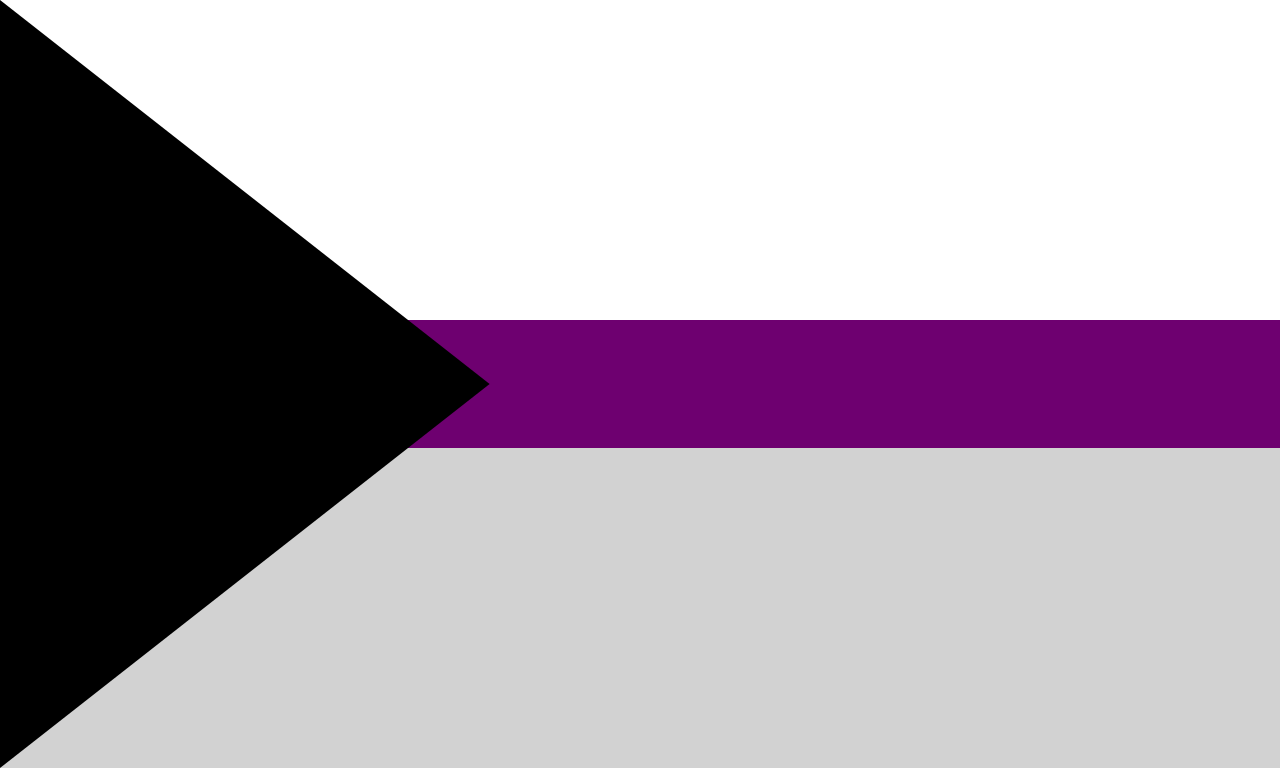
- The Wikimedia Commons illustration, the version of the flag in circulation across a dozen language Wikipedias. AnonMoos drew it on 22 June 2013 "from scratch based on abstract geometry" as a vector equivalent of Vimopu's raster upload of 22 April, and it prints its own rendered colour values: grey 210 210 210, purple 110 0 112, white and black. [1][5] · Credit: AnonMoos, after Vimopu · Wikimedia Commons · Public domain
- An alternative demisexual flag submitted to the Demi Gray blog by voiceactresskurutta on 2 March 2015, taking three of the asexual flag's colours, inverting the order and adding maroon. It was proposed because the chevron design "still uses the same colors" as the asexual flag, leaving demisexual people without merchandise of their own. No later use of it has been located. [9] · Credit: voiceactresskurutta · Submitted to Demi Gray
- CSD Karlsruhe's own explanatory banner, "Spaß mit Flaggen," fun with flags, photographed at Stephanplatz on 1 June 2019. The demisexual flag appears in the sexual-orientations column between the asexual and aromantic flags, with the organisers' definition beneath it: demisexual people feel no sexual attraction to another person until they have formed a close emotional bond, usually a romantic partnership, which places them on the asexual spectrum. This is the flag being explained to the public by a Pride organisation, rather than simply flown. [8] · Credit: Andreas Schwarzkopf · Wikimedia Commons · CC BY-SA 4.0