Queerplatonic Pride Flag (anonymous heart design)
Identity Pride Flag ·
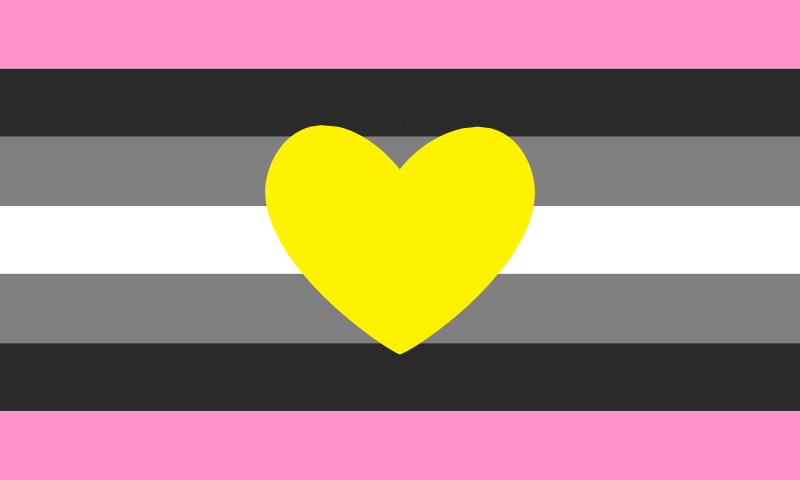
An anonymous flag for queerplatonic relationships: seven mirrored bands of pink, near-black, grey and white under a large yellow heart. The file was on DeviantArt by 22 August 2015 [1] and the pride-color-schemes archive documented it on 6 July 2016 beside a separate five-band design, crediting neither and giving one set of colour meanings for both, pink for a lighter red than romantic attraction, yellow for platonic attraction, and white, grey and black as a likely gray-aromantic reference. [2] No located source connects the design to a designer named Mist.
Key facts
- Created
- First documented publication
- In use
- 2015–present
- Aspect Ratio
- 3:5 · standard
- Stripes
- 7
- Represented Identity
- Queerplatonic relationships (QPRs)
Also known as
- QPR Pride Flag
- Quasiplatonic Pride Flag
- Quirkyplatonic Pride Flag
- Qplatonic Flag
Status Variant
Archive categories Sexual & Romantic Orientation Pride Flags
Overview
A queerplatonic relationship is a committed non-romantic relationship that departs from the cultural norm for a friendship. AUREA's aromantic glossary defines it that way and credits the terminology to Meloukhia and Kaz. [3] The pride-color-schemes post that documents this flag opens with a definition it takes from S. E. Smith, writing as realsesmith: the relationship is one where "an intense emotional connection transcending what people usually think of as 'friendship' is present, but the relationship is not romantic in nature", and "The 'queer' is a reference to the idea of queering relationships and ideas about relationships, not for describing the orientations or genders of anyone in a queerplatonic relationship." [2]
Identity & Context
- Represented Identity
- Queerplatonic relationships (QPRs)
- Subcommunity
- Aromantic spectrum; asexual spectrum; relationship diversity
Queerplatonic relationships are closely associated with aromantic and asexual communities without being exclusive to them. People of any orientation may be in one.
Creators
The Creator
Unknown
Designer
The designer of this flag is not named in any located source. The DeviantArt file page for the original artwork reads "Flag by anonymous", the archive that documents the design records "Designed by: Unknown", and Wikimedia Commons gives the author of the companion design as Anonymous. [1][2][4] If you can identify the designer, the archive would like to hear from you.
Attribution notes
The design is anonymous, and both sources that carry it say so. The DeviantArt file page describes it as "Flag by anonymous", and the pride-color-schemes post that documents it records "Term coined by: Unknown" and "Designed by: Unknown". [1][2] The Wikimedia Commons record for the five-band companion design gives its author as Anonymous and its source as that same post. [4]
A credit to a designer named Mist, paired with the date 6 July 2016, circulates with this flag in guides and reposts. No located source carries it. FlagColorCodes, cited for it in earlier versions of this entry, publishes five colour swatches with their conversions and no designer, date or history at all. [5] Mist is recorded here as an unresolved credit rather than as an attribution.
Origin
- Place Type
- online
- Digital Origin
- Yes
Digital origin. No specific geographic location documented.
Published to the Pride-Flags DeviantArt gallery at 19:25 Pacific on 21 August 2015, which is 22 August in UTC and the date the site displays. The pride-color-schemes Tumblr write-up followed on 6 July 2016. Where and by whom the design was made is not documented. [1][2]
Dates & Chronology
- Year Created
- First documented publication
- Period in Use
- 2015–present
Documented circulation is online and wide: the Pride-Flags DeviantArt gallery, the pride-color-schemes Tumblr post, flag reference sites, and a Wikimedia Commons copy of the companion design used on Wikipedia language editions. [5][1][2][4]
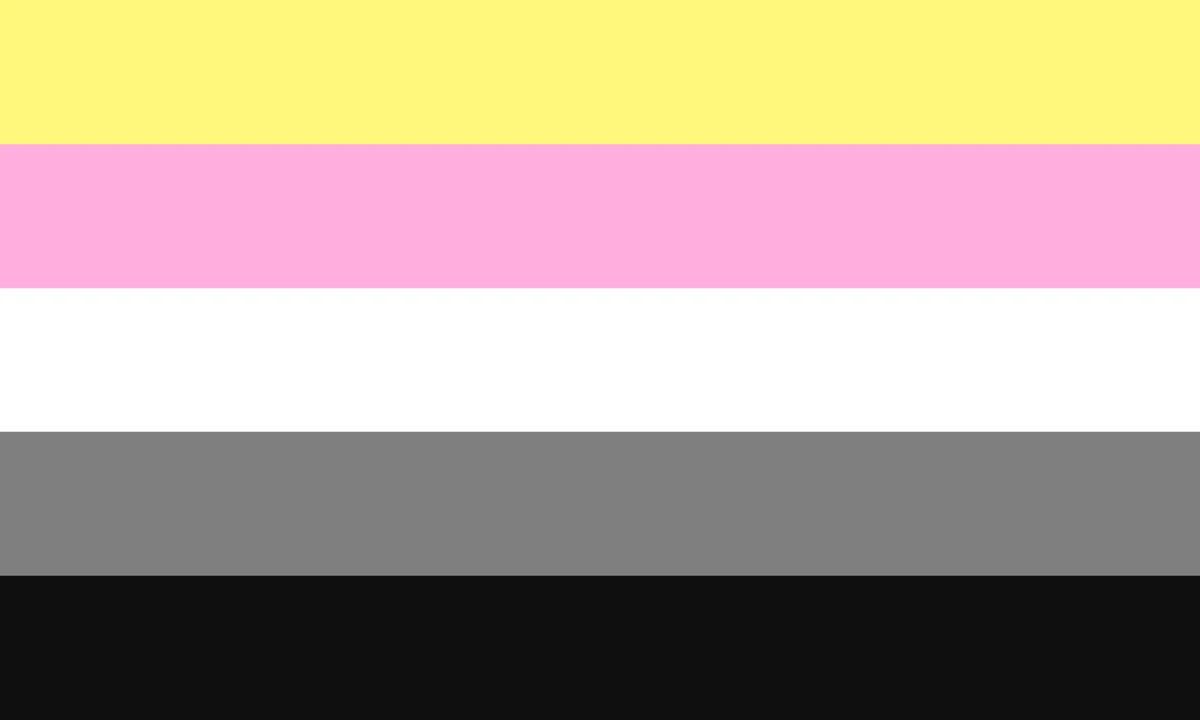
Two designs were published together and are documented together. This one carries seven mirrored bands and a yellow heart; the other carries five bands in pastel yellow, pastel pink, white, grey and black and no emblem. The archive's post of 6 July 2016 sets them out one after the other, gives "Designed by: Unknown" once, and gives one colour key for both. [2]
The files predate that post. The five-band design went up on DeviantArt on 17 August 2015 and the heart design on 22 August 2015, ten and a half months before the write-up that is usually cited as the flag's date. [1][6]
The copy of the five-band design on Wikimedia Commons, uploaded on 2 May 2023, is dated 2016 there and sourced to the Tumblr post rather than to the earlier DeviantArt file. [4]
Lineage
- Indirect influences
- Aromantic Pride Flag
- Related flags
- Asexual Pride Flag
The white, grey and black of both designs are read by the archive that documents them as a gray-aromantic reference, in its own hedged wording: "Likely symbolizes the gray-aro spectrum." [2] That is a reading offered by a documenting party rather than a statement by the designer, so the connection to the aromantic flag is recorded as a qualified influence and not as derivation.
Colors & Symbolism
The archive that documents the flag gives one colour key covering both designs in its post: "Pink: A lighter version of red, which stands for romantic attraction. Yellow: Platonic attraction. White, Gray, and Black: Likely symbolizes the gray-aro spectrum." The key sits below both images and is not written for either one specifically, so it reads as family-level meaning; the hedge on the third line is the archive's own. [2]
| Colour | Hex | Meaning | Note |
|---|---|---|---|
| Pink | #FF93C9 | A lighter version of red, which stands for romantic attraction. [2] | Sampled from the 5000 by 3000 original; bands 1 and 7. [1] |
| Near-black | #2A2A2A | Given with grey and white as a likely reference to the gray-aromantic spectrum. [2] | Sampled from the 5000 by 3000 original; bands 2 and 6. [1] |
| Grey | #7F7F7F | Given with near-black and white as a likely reference to the gray-aromantic spectrum. [2] | Sampled from the 5000 by 3000 original; bands 3 and 5. [1] |
| White | #FFFFFF | Given with near-black and grey as a likely reference to the gray-aromantic spectrum. [2] | Sampled from the 5000 by 3000 original; band 4. [1] |
| Yellow (heart) | #FFF200 | Platonic attraction. [2] | Sampled from the 5000 by 3000 original; the heart. [1] |
The key is published for the pair of designs rather than for this one, which matters because only this design has a yellow heart while both carry pink, white, grey and black. The bands are mirrored, so the four band colours cover seven positions; the order is in the design specification. Nothing from the designer has been located. [2]
No palette was published, so these are sampled values, taken from the 5000 by 3000 file the archive links for the full-size copy. [1]
A second set of values circulates and does not come from that file. FlagColorCodes publishes #F89FC9, #2E2826, #7E7E7E, #FFFFFF and #FEE900, which are the pixel values of its own redrawn rendering rather than of the original artwork. Both sets describe the same design; the values here are the designer's file. [5][1]
Design
- Aspect Ratio
- 3:5 · standard
- Orientation
- horizontal
- Stripe Count
- 7
- Layout
- stripes_with_emblem
- Stripes (Top → Bottom)
- Pink, Near-black, Grey, White, Grey, Near-black, Pink
- Center Symbol
- Yellow heart
Seven bands of equal depth, symmetric about the white centre, under a yellow heart. The archive's image description reads "7 horizontal stripes from top to bottom: pink, dark gray, gray, white, gray, dark gray, pink. There is a yellow heart in the center." [2] Measured on the 5000 by 3000 original, each band is a seventh of the height and the heart spans a third of the width, from 0.33 to 0.67, and just under half the height, from 0.26 to 0.74. [1]
Seven horizontal bands of equal depth with a centred yellow heart. No aspect ratio was published with the design; the file is 5000 by 3000 pixels, which is the archive's standard canvas rather than a specification for this flag. [1]
Seven equal horizontal bands, symmetric about the centre: pink #FF93C9, near-black #2A2A2A, grey #7F7F7F, white #FFFFFF, grey, near-black, pink. A yellow #FFF200 heart is centred on the flag. [1]
Usage & Adoption
- Online Usage
- Pride-Flags DeviantArt gallery and pride-color-schemes Tumblr. [1][2], Flag reference sites, which publish colour values for the design. [5], The five-band companion design is on Wikimedia Commons and is used on Wikipedia language editions. [4]
- Current Status
- Documented variant; circulation documented online
Documented in online reference material and in flag guides. No photographed physical use has been located.
Image Archive
The two 2015 designs

Discourse & Debates
- Whether queerplatonic is exclusive to aromantic and asexual people or open to anyone regardless of orientation. The definition the archive quotes takes the second position: "Anyone, sexual or asexual, romantic or aromantic, straight, gay, queer, bi, lesbian, poly, cis, trans, etc can be in a queerplatonic relationship." [2]
- Quasiplatonic, quirkyplatonic and qplatonic circulate as alternatives for people who would rather not use the word Queer here. The archive's own post title carries three of them at once. [2]
Common misidentifications
- Credited to a designer named Mist, usually with the date 6 July 2016. No located source carries that credit, and the page most often cited for it publishes colour swatches and nothing else. [5]
- Dated 2016, which is the date of the write-up. The file has been on DeviantArt since August 2015. [1][2]
- Merged with the five-band design published beside it. They are separate designs with separate files and separate upload dates. [1][6]
- Confused with the aromantic flag, whose black, white and grey it echoes.
AUREA's aromantic glossary credits the terminology to Meloukhia and Kaz, and records QPR for the relationship and QPP for a partner in one. [3] The LGBTQIA+ Wiki gives a fuller chronology, placing the first use on 25 December 2010 in a Dreamwidth thread called Kaz's Scribblings and the spread from a Tumblr post by Meloukhia, also known as S. E. Smith, on 22 January 2011, and dating quasiplatonic to May 2014 as an alternative for aromantic people uncomfortable with the word Queer. [7] Those coiners named the relationship, not the flag; no source connects any of them to a flag design.
Footnotes & Citations
Sources and footnotes 7 sources
- 1. Image file page Queerplatonic / Quasiplatonic / Quirkyplatonic (1). Pride-Flags. DeviantArt (2015-08-22). Accessed 2026-08-16
The heart design. Described as "Flag by anonymous". Original file 5000 by 3000 pixels; published 21 August 2015 at 19:25 Pacific. Licence field: Creative Commons Attribution 3.0.
- 2. Blogs & Personal Sources Queerplatonic, Quasiplatonic, or Quirkyplatonic. pride-color-schemes. pride-color-schemes (Tumblr) (2016-07-06). Accessed 2026-08-16
Sets out both designs, records the coiner and the designer as unknown, and gives one colour key for the pair.
- 3. Reference All Aromantic Terms. AUREA. Aromantic-spectrum Union for Recognition, Education and Advocacy. Accessed 2026-08-16
Credits the queerplatonic terminology to Meloukhia and Kaz.
- 4. Image file page File:QPR flag.webp. Acidapplepie (uploader). Wikimedia Commons (2023-05-02). Accessed 2026-08-16
The five-band design. Author given as Anonymous, source given as the pride-color-schemes post, date given as 2016. Carries the PD-flag threshold-of-originality rationale.
- 5. Reference Queerplatonic Flag Color Codes. flagcolorcodes.com. Accessed 2026-08-16
Publishes five colour values with their conversions, taken from its own redrawn rendering. Names no designer, gives no date, carries no history.
- 6. Image file page Queerlpatonic / Quasiplatonic / Quirkyplatonic (2). Pride-Flags. DeviantArt (2015-08-17). Accessed 2026-08-16
The five-band design. Described as "Flag by anonymous". Original file 5000 by 3000 pixels; published 17 August 2015 at 16:14 Pacific. Licence field: Creative Commons Attribution 3.0.
- 7. Encyclopedias & Reference Queerplatonic Relationship. LGBTQIA+ Wiki. Accessed 2026-08-16
Community wiki, unsigned. Documents the term's chronology in detail and records several proposed flag designs, naming a designer for none.
Image Sources
- Rendering
- Anonymous heart design (2015)
- The anonymous heart design, published to DeviantArt on 22 August 2015 and documented by the pride-color-schemes archive on 6 July 2016. Archive rendering, with the band depths and the five colours sampled and the heart outline traced on the original 5000 by 3000 file. · Credit: Design: anonymous. Source documentation: pride-color-schemes, 6 July 2016. Source file published by Pride-Flags on DeviantArt. Rendering: Encycloflaggia, measured from the original file. · DeviantArt (Pride-Flags) · reconstructionRights The DeviantArt file page carries a Creative Commons Attribution 3.0 licence, applied by the account that uploaded the file. The design itself is anonymous and no statement from its designer has been located.
- The five-band queerplatonic design, published to DeviantArt on 17 August 2015 and documented beside the heart design in the pride-color-schemes post of 6 July 2016. This copy is the Wikimedia Commons file, uploaded on 2 May 2023 while its uploader was editing the English Wikipedia article on queerplatonic relationships. · Credit: Design: anonymous. Source documentation: pride-color-schemes, 6 July 2016. Commons upload: Acidapplepie, 2 May 2023. · Wikimedia Commons · verifiedRights Commons applies its threshold-of-originality rationale to this file, classifying it as public domain because it consists of information that is common property and contains no original authorship. That is a classification of this file by Commons, not a licence issued by the anonymous designer. The DeviantArt file page for the same design carries a Creative Commons Attribution 3.0 licence applied by the uploading account.