Androsexual Pride Flag
Identity Pride Flag ·
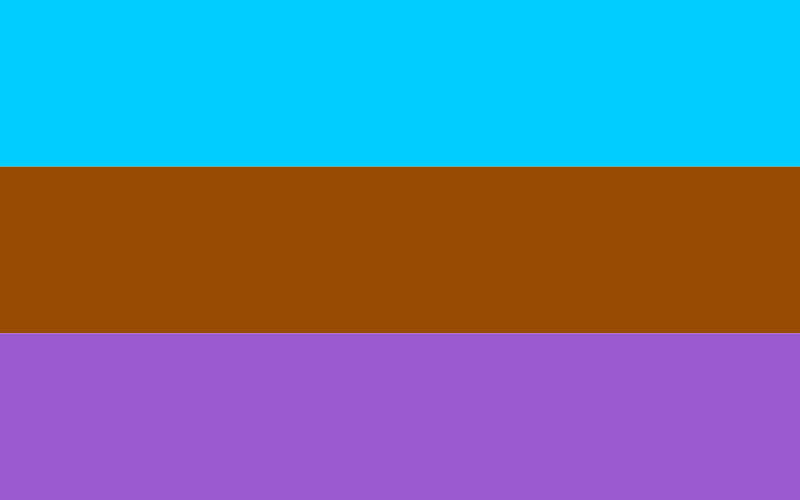
A three-stripe horizontal pride flag for androsexual identity, representing sexual attraction to men or masculinity regardless of one's own gender. The creator is unknown. The design was made on or before July 20, 2014, when the same blog's gynesexual submission described being based on it; the earliest located appearance still online is a November 7, 2015 Tumblr documentation post, with the widely known Pride-Flags DeviantArt copy following on April 23, 2016. [1][2]
Key facts
- Created
- First documented public use
- In use
- 2014–present
- Aspect Ratio
- 3:5 · standard
- Stripes
- 3
- Represented Identity
- androsexual
Also known as
- Androsexual Flag
Status Proposed
Archive categories Sexual & Romantic Orientation Pride Flags
Overview
To provide a symbol for androsexual identity, which describes attraction to men or masculinity in a gender-neutral way.
The flag's original creator is unknown. It existed on the Tumblr blog pride-flags-for-us by 20 July 2014, when the blog's Gynesexual submission stated it was based on this earlier Androsexual flag; the Pride-Flags DeviantArt account posted it on 23 April 2016. [1] [3]
Identity & Context
- Represented Identity
- androsexual
- Language Context
- From Greek 'andro-' (man/male). Androsexual describes attraction to men or masculinity regardless of the attracted person's own gender. The concept has deep roots in sexology. Magnus Hirschfeld used 'androphile' in the early twentieth century to classify men attracted to adult males. Psychologist Ron Langevin popularized the androphilia/gynephilia framework in the 1980s, and Freund et al. (1984) defined androphilia as 'sexual interest in physically adult males.' The modern term 'androsexual' appeared as early as 1997 in a Usenet post. Researchers such as Sam Winter have argued that Western orientation labels lack easy translations in many cultures, making the androphilia/gynephilia terminology useful cross-culturally. [3][4]
Creators
Creator unknown
No identification located
The original creator is unknown. The flag was posted by the Pride-Flags DeviantArt account on April 23, 2016, labeled 'Masc- (1).' Two wiki sources suggest it shares a designer with the gynesexual flag. [3][5] This archive's own record of that flag does not support it: the gynesexual design was made by desintoxiquer in answer to an anonymous request and published on 20 July 2014, twenty-one months before this one.
Contribute information about who designed this flag.
Origin
- Specific Place
- DeviantArt (Pride-Flags account)
- Place Type
- blog
- Digital Origin
- Yes
Digital origin; no verified physical location.
On the pride-flags-for-us Tumblr blog by 20 July 2014, when the Gynesexual submission named it as its base; the 23 April 2016 date previously carried here is the Pride-Flags DeviantArt account's later repost. [1] [3]
Dates & Chronology
- Year Created
- First public use
- Period in Use
- 2014–present
- Creation Bounds
- Made on or before 20 July 2014: the archived Gynesexual submission of that date states it was based on the blog's earlier Androsexual flag. [1]
Documented in community wikis and flag reference guides. [3][5] The earliest located appearance still online is a November 7, 2015 documentation post by Roy (equality-universe-roy) on Tumblr, predating the April 23, 2016 Pride-Flags DeviantArt copy. [2]
A distinct 'androphilia flag' with 4 stripes (black, gray, white, green) also exists and should not be confused with this design. [5]
Lineage
A shared designer with the gynesexual flag is suggested by two wiki sources and is not borne out by that flag's own documented origin: it was made by desintoxiquer in answer to an anonymous request and published on 20 July 2014, twenty-one months before this one. The androromantic flag uses the same base design. [3]
Lineage tree
Every record reachable from this one through documented parent and child relationships: 3 records across 2 generations.
- This record
- Androsexual Pride Flag
Colors & Symbolism
The three stripes represent attraction to men or masculinity. The androsexual/androromantic and gynesexual/gyneromantic flags form a conceptual pair. The top blue stripe references the transgender flag, while the bottom purple stripe references the genderqueer flag. Both the green and purple bottom stripes from the respective flags appear on the genderqueer pride flag. Color meanings were not specified by the original creator; community speculation connects blue/cyan to attraction to men, brown to stability, and purple to attraction regardless of gender identity. [3][6]
| Colour | Hex | Meaning |
|---|---|---|
| Dark Blue / Cyan | — | Speculated: attraction to men or masculinity (community interpretation) [3] |
| Brown / Dark Maroon | — | Speculated: stability and support (community interpretation) [3] |
| Purple / Lavender | — | Speculated: attraction regardless of gender identity (community interpretation) [3] |
| Cyan | #00CCFF | — |
| Dark brown | #603524 | — |
| Lavender | #B899DF | — |
Measured from the Pride-Flags source file at 5000 by 3000, the publication the entry's own account of the flag rests on. [7]
This flag has no official digital palette. Color values shown are approximate.
Color meanings were not specified by the original creator. All meanings above are community speculation and should not be treated as authoritative. [3]
Three bands of equal depth, measured from the 5000 by 3000 pixel file the Pride-Flags account published as "Masc- (1)" on 23 April 2016 and held in this archive. [7] Two independent artefacts of the flag, seven months apart, agree on these values. No creator specification has been located. Earlier versions of this entry carried #01CDFE, #964B00 and #9B59D0, described as sampled from a circulating SVG reconstruction; none of the three matches the published file, and the brown differs by more than fifty units in two channels.
Design
- Aspect Ratio
- 3:5 · standard
- Orientation
- horizontal
- Stripe Count
- 3
- Layout
- horizontal_stripes
- Stripes (Top → Bottom)
- Cyan, Dark brown, Lavender
Three equally sized horizontal stripes. The stripes are described as cyan, brown, and purple by the ask-pride-color-schemes Tumblr. [3]
Three equal horizontal stripes: dark blue/cyan (top), brown/dark maroon (middle), purple/lavender (bottom).
Usage & Adoption
- Online Usage
- Wikis and community flag guides
- Current Status
- active
The flag circulates in online Queer and nonbinary communities, identity wikis, and pride flag reference guides. It is particularly used by nonbinary individuals for whom terms like 'gay' or 'straight' (which are defined relative to one's own gender) do not apply.
Image Archive
Flag design
Discourse & Debates
- Whether the androsexual/gynesexual terminology framework, rooted in clinical sexology, carries unwanted medicalized connotations when adopted as community identity labels. Some users prefer the clinical neutrality, while others find it cold or inaccessible compared to community-coined terms.
Common misidentifications
- Should not be confused with the 'androphilia flag' (4 stripes: black, gray, white, green), which is a different design
- Androsexual and androromantic use the same base design; the distinction is between sexual and romantic attraction
Androsexual describes attraction to men or masculinity regardless of the attracted person's own gender. This distinguishes it from labels like 'gay' or 'straight,' which are defined relative to one's own gender.
Footnotes & Citations
Sources and footnotes 10 sources
- 1. Primary statement Gynesexual flag. Submitted by desintoxiquer to pride-flags-for-us. Tumblr, via the Wayback Machine (2014-07-20). Accessed 2026-08-12
The 20 July 2014 Gynesexual submission, which states it was based on the blog's earlier Androsexual flag: the earliest documentation of this flag's existence.
- 2. Social media Androsexual Pride Flag: Someone who is.... Roy (equality-universe-roy). Tumblr (2015-11-07). Accessed 2026-08-14
- 3. Androsexual. LGBTQIA+ Wiki (Fandom). Accessed 2026-03-19
- 4. What Does It Mean to Be Gynosexual?. Medical News Today. Accessed 2026-03-30
- 5. Androsexual Flag 3. Pride Flag Wiki (Fandom). Accessed 2026-03-19
- 6. Androsexual. Library.LGBT. Accessed 2026-03-30
- 7. Designer page Masc- (1). Pride-Flags. DeviantArt (2016-04-23). Accessed 2026-08-16
The publication the entry's account of the flag rests on, and the file its palette is measured from. Its description defines the term and names no designer.
- Androsexual. MOGAI Wiki. Accessed 2026-03-30
- Androphilia and gynephilia. Wikipedia. Accessed 2026-03-31
- Rainbow flag (LGBTQ). Wikipedia contributors. Wikipedia (2026-06-25). Accessed 2026-07-24
Image Sources
- Rendering
- three-stripe standard
- The Androsexual Pride Flag. Blue references the transgender flag, brown represents stability, and purple references the genderqueer flag. Colors are approximated from circulating images. · SVG reconstruction