Omniromantic Pride Flag
Identity Pride Flag ·
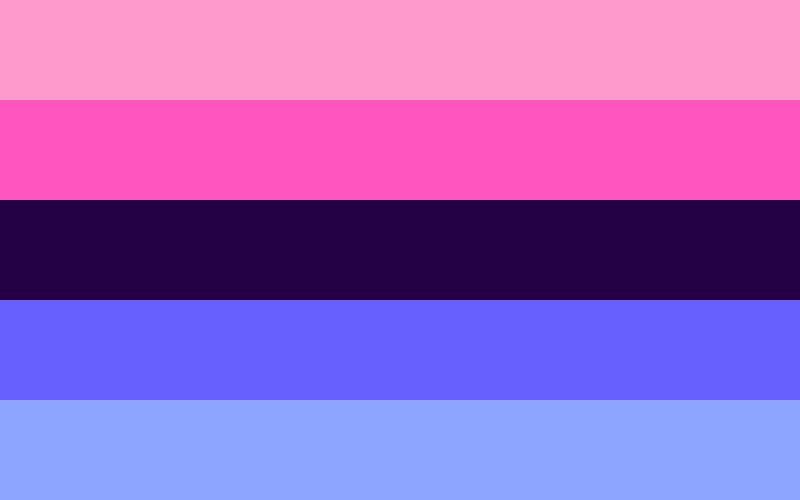
A 2016 flag for omniromantic identity, published by the Pride-Flags archive without an individual designer credit. Five horizontal bands are lightened across the field while a large heart retains the saturated omnisexual-derived palette; a second, differently colored version was published one second later. [1][2][3]
Key facts
- Designer
- Unknown
- Created
- Publication on DeviantArt
- In use
- 2016 to present
- Aspect Ratio
- 3:5 · standard
- Stripes
- 5
- Represented Identity
- omniromantic
Also known as
- Omniromantic Flag
- Omniromantic (1)
Status Variant
Archive categories Sexual & Romantic Orientation Pride Flags
Overview
No creator statement has been located. The description defines the term rather than the design. [1]
Pride-Flags published Omniromantic (1) and Omniromantic (2) one second apart on 10 May 2016, at 02:27:40 and 02:27:41 UTC, both at 5000 by 3000 pixels. They share a description that defines the prefix and names no designer. [1][3]
Identity & Context
- Represented Identity
- omniromantic
- Subcommunity
- multiromantic contexts
Omniromantic describes romantic attraction to all genders. The deviations define the prefix rather than the romantic term: "Omni- attraction to all genders. Sometimes interchangeable with Pan-." [1]
Creators
Associated Figure
Pride-Flags
Publisher and high-resolution rendering source
A DeviantArt archive of pride flag artwork. It published Omniromantic (1) and Omniromantic (2) one second apart on 10 May 2016, both at 5000 by 3000 pixels, with a shared description defining omni attraction and no designer credit. [1][3]
Attribution notes
The designer is unknown. Neither 10 May 2016 deviation names an individual designer, and the archive's FAQ states that work it created itself would be identified in the post description. These posts do not identify the archive as the designer. [1][3][4] Pride-Flags published the files and supplied the high-resolution renderings.
Origin
- Digital Origin
- Yes
Digital origin; no verified physical location.
Digital origin on DeviantArt. No physical origin is documented. [1]
Dates & Chronology
- Year Created
- Publication on DeviantArt
- Period in Use
- 2016 to present
Documented in online flag archives and community reference resources. [1][5]
The shared description carries the archive's unusual gloss on the term: "Omni- attraction to all genders. Sometimes interchangeable with Pan-. Some who are omni- don't limit their attractions to humans only, and say that they could possibly be attracted to advanced sentient races (i.e. aliens)." The same wording appears on the account's earlier omnisexual and Omni- / Omnigender posts. [1][6] The 2015 Omni- / Omnigender deviation of 29 August 2015 also quotes the term coiner's own definition at length; that text documents that separate artifact. [6]
Lineage
- Direct predecessors
- Omnisexual Pride Flag
The omnisexual flag is the visual source: the saturated values inside the heart are its palette exactly, and the heart is the archive's romantic-orientation convention added on top. [2] No other formal ancestry is recorded.
Lineage tree
Every record reachable from this one through documented parent and child relationships: 2 records across 2 generations.
- Ancestor
- Omnisexual Pride Flag
- This record
- Omniromantic Pride Flag
Colors & Symbolism
Neither 2016 omniromantic deviation publishes stripe meanings. The heart is the romantic marker: the field is lightened outside it and the bands keep their saturated values inside it. [1][3][2]
| Colour | Hex | Meaning | Note |
|---|---|---|---|
| Light pink | #FF9BCD | No creator-issued meaning has been located for this band. [1][3] | Saturated inside the heart. The same band measures #FFC8E4 in the lightened field outside it. These hexadecimal values are exact measurements from the cited 5000 by 3000 source PNG. They document that artifact rather than a creator-issued color specification. [2] |
| Pink | #FF53BE | No creator-issued meaning has been located for this band. [1][3] | Saturated inside the heart. The same band measures #FFA1DB in the lightened field outside it. These hexadecimal values are exact measurements from the cited 5000 by 3000 source PNG. They document that artifact rather than a creator-issued color specification. [2] |
| Dark purple | #260046 | No creator-issued meaning has been located for this band. [1][3] | Saturated inside the heart. The same band measures #887399 in the lightened field outside it. These hexadecimal values are exact measurements from the cited 5000 by 3000 source PNG. They document that artifact rather than a creator-issued color specification. [2] |
| Blue | #665EFF | No creator-issued meaning has been located for this band. [1][3] | Saturated inside the heart. The same band measures #ABA7FF in the lightened field outside it. These hexadecimal values are exact measurements from the cited 5000 by 3000 source PNG. They document that artifact rather than a creator-issued color specification. [2] |
| Light blue | #8CA6FF | No creator-issued meaning has been located for this band. [1][3] | Saturated inside the heart. The same band measures #C0CEFF in the lightened field outside it. These hexadecimal values are exact measurements from the cited 5000 by 3000 source PNG. They document that artifact rather than a creator-issued color specification. [2] |
- Centered heart
- The romantic-orientation marker used across the archive's 10 May 2016 batch. It is a mask rather than an overlay: the bands run through it unbroken, saturated inside and lightened outside. [2]
Later reference sites read the bands through the omnisexual flag, treating the pinks as attraction across feminine identities, the dark centre as attraction to genders outside the binary, and the blues as attraction across masculine identities. That is a later community interpretation attached to the parent design, not symbolism issued with either omniromantic deviation. [5] A separate 2015 Pride-Flags deviation, Omni- / Omnigender of 29 August 2015, does quote the term coiner at length, but that text belongs to that artifact and cannot be transferred to the 2016 omniromantic flag. [6]
Five bands, each measured twice from the 5000 by 3000 source PNG: saturated inside the heart at #FF9BCD, #FF53BE, #260046, #665EFF and #8CA6FF, and lightened outside it at #FFC8E4, #FFA1DB, #887399, #ABA7FF and #C0CEFF. The saturated set is the omnisexual flag's palette. [2] Omniromantic (2), published one second later, is a separate pastel design rather than a recolouring of this one, measuring #FFAEC9, #C8BFE7, #A349A4, #7092BE and #99D9EA inside its heart. [3]
Design
- Aspect Ratio
- 3:5 · standard
- Orientation
- horizontal
- Stripe Count
- 5
- Layout
- horizontal_stripes
- Stripes (Top → Bottom)
- Light pink, Pink, Dark purple, Blue, Light blue
- Center Symbol
- Centered heart
Five equal horizontal bands of 598 to 601 rows in the 5000 by 3000 source file. A large heart is centred on the field, its lobes reaching the top edge and its point the bottom, spanning roughly x 864 to 4136. The display reconstruction is normalised to 3:5 at 800 by 480. [2]
Five equal bands with a single centred heart acting as a saturation mask over the lightened field. [2]
Five equal horizontal bands running light pink, pink, a very dark purple, blue and light blue, lightened across the field and saturated inside a large centred heart. [2]
Usage & Adoption
- Online Usage
- DeviantArt, where both 2016 designs were published [1][3], Online flag archives and community reference resources [5]
- Current Status
- documented variant
Documented in online flag archives and community reference resources. No formal organizational adoption has been located. [1][5]
Image Archive
2016 Publication

Second 2016 Design

Source Previews


Archive Reconstruction
Discourse & Debates
Common misidentifications
- Two omniromantic designs were published one second apart on 10 May 2016 and are easily merged. They carry different palettes and are separate artifacts. [1][3]
The deviations define the prefix rather than the romantic term itself: "Omni- attraction to all genders. Sometimes interchangeable with Pan-." [1]
Footnotes & Citations
Sources and footnotes 6 sources
- 1. Image file page Omniromantic (1). Published by Pride-Flags. DeviantArt (2016-05-10). Accessed 2026-08-16
This record's primary publication, 5000 by 3000, timestamped 02:27:40 UTC. Names no designer and displays no Creative Commons licence.
- 2. Image file page Source PNG behind Omniromantic (1), 5000 by 3000. Published by Pride-Flags. DeviantArt (2016-05-10). Accessed 2026-08-16 · Archived version
The downloaded file, measured for this entry: 163,555 bytes, five bands of 598 to 601 rows, and the ten values published in Colors. The heart outline in the reconstruction is traced from it.
- 3. Image file page Omniromantic (2). Published by Pride-Flags. DeviantArt (2016-05-10). Accessed 2026-08-16 · Archived version
The second design, timestamped 02:27:41 UTC, one second after the first. Measured as a separate pastel palette, not a recolouring.
- 4. Social media FAQ. pride-color-schemes. Tumblr. Accessed 2026-08-16
The archive's stated policy that work it created itself would be identified in the post description.
- 5. Reference Pride Flag Guide: Omniromantic. Library.LGBT (Albany Pride initiative). Library.LGBT Pride Flag Guide. Accessed 2026-03-30
A tertiary flag guide. Cited only for the later community reading of the bands and for documented circulation; the site went dark in July 2026 and could not be re-read.
- 6. Image file page Omni- / Omnigender. Published by Pride-Flags. DeviantArt (2015-08-29). Accessed 2026-08-16
A separate 2015 artifact whose description quotes the term coiner's definition. Cited for that context only.


Image Sources
- Rendering
- Omniromantic (1), published 10 May 2016
- Encycloflaggia reconstruction of Omniromantic (1) · Credit: Designer unknown; reconstruction by Encycloflaggia · Encycloflaggia · reconstructionRights Archive-produced reconstruction; heart outline traced from the 2016 source PNG
- The 5000 by 3000 file published by Pride-Flags on 10 May 2016 · Credit: Published by Pride-Flags; designer unknown · DeviantArt · verified
- The source artifact: 5000 by 3000 pixels, published by Pride-Flags as "Omniromantic (1)" on 10 May 2016 at 02:27:40 UTC. Measured saturated #FF9BCD, #FF53BE, #260046, #665EFF and #8CA6FF inside the heart, lightened #FFC8E4, #FFA1DB, #887399, #ABA7FF and #C0CEFF outside it. [1][2] · Credit: Published by Pride-Flags; designer unknown · DeviantArt · Gallery reuse statement located; no formal licence
- "Omniromantic (2)", published one second later at 02:27:41 UTC. A separate pastel design rather than a recolouring, measuring #FFAEC9, #C8BFE7, #A349A4, #7092BE and #99D9EA inside its heart. [3] · Credit: Published by Pride-Flags; designer unknown · DeviantArt · Gallery reuse statement located; no formal licence
- The DeviantArt preview rendition of Omniromantic (1), retained as a separate source artifact. [1] · Credit: Published by Pride-Flags · DeviantArt preview · Gallery reuse statement located; no formal licence
- The DeviantArt preview rendition of Omniromantic (2), retained as a separate source artifact. [3] · Credit: Published by Pride-Flags · DeviantArt preview · Gallery reuse statement located; no formal licence
- The archive's reconstruction, normalised to 3:5 with the heart outline traced from the source PNG. [2] · Credit: Designer unknown; reconstruction by Encycloflaggia · Encycloflaggia reconstruction · Archive-produced reconstruction, subject to the rights status of the underlying design