Intersex Pride Flag
Intersex and Variations of Sex Characteristics Flags ·
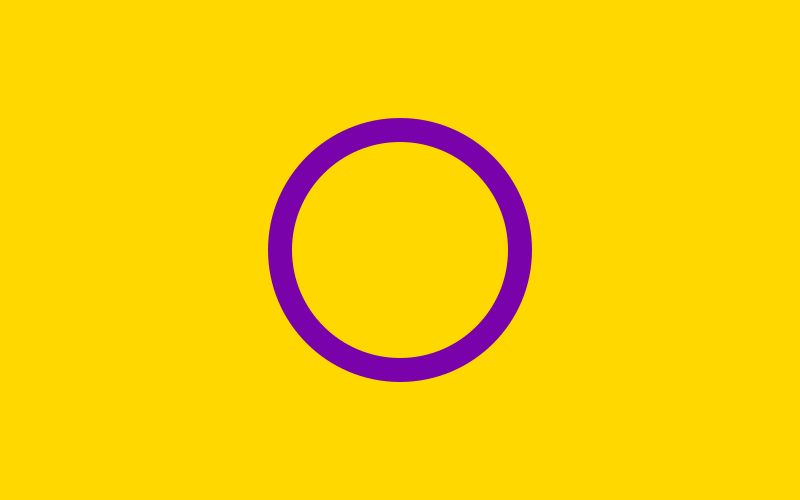
Designed by Morgan Carpenter and first shared online on 4 July 2013, the Intersex Pride Flag sets an unbroken purple ring on a golden-yellow field. Its colours and geometry deliberately avoid gendered pink-and-blue imagery. Carpenter described the circle as a symbol of wholeness, completeness, potential, bodily autonomy, and genital integrity, and dedicated the design to the public domain through CC0 in December 2013.
Key facts
- Designer
- Morgan Carpenter
- Created
- First documented online share
- In use
- 2013–present
- Aspect Ratio
- 3:5 · standard (archive production specification)
- Ratio Notes
- Source design: 900 × 600 · 3:2 width-to-height. The official vector is drawn on a 900 by 600 canvas, which is the 2:3 proportion in the conventional height-to-width notation. [1] The 3:5 figure above is the archive's own production specification, used so that flags display comparably across the database; it is not the proportion Carpenter published, and it is not offered as this flag's historical ratio. The artwork on this page is reproduced at the source proportion and is neither stretched nor cropped to the production figure.
- Stripes
- 0
- Origin
- Australia
- Represented Identity
- Intersex people and the intersex community
Also known as
- Intersex Flag
Status Canonical
Archive categories Intersex and Variations of Sex Characteristics Flags
Overview
Morgan Carpenter created the flag within the Australian intersex human-rights movement, then published through Organisation Intersex International Australia, to offer a symbol that was neither derivative of rainbow flags nor built from gender symbols or pink-and-blue conventions. His personal record says he first shared it online on 4 July 2013; the organization's resource page is dated 5 July. The organization later became Intersex Human Rights Australia and now operates within InterAction for Health and Human Rights.
The golden-yellow field and purple ring make the design visually distinct, but Carpenter's account locates its meaning in bodily autonomy rather than gender identity. The circle is "unbroken and unornamented," signifying wholeness, completeness, and potential. The flag has since become widely used by intersex-led organizations and advocates internationally. Carpenter formally applied CC0 1.0 on 18 December 2013, so reproduction, modification, and commercial use do not require permission or attribution, though archival credit remains appropriate.
Identity & Context
- Represented Identity
- Intersex people and the intersex community
- Movement
- Intersex human rights, bodily autonomy and genital integrity advocacy
- National Context
- Published in Australia; used internationally by intersex-led organizations and advocates
Creators
The Creator
Morgan Carpenter
Designer
Morgan Carpenter is an intersex bioethicist, advocate, and the sole designer of the Intersex Pride Flag. He was active with OII Australia when he published the design in July 2013 and became the organization's president that September. OII Australia became Intersex Human Rights Australia in 2018 and now operates under the InterAction for Health and Human Rights brand. [2] [3] [4]
Carpenter completed a PhD in bioethics in January 2024 and is Associate Professor of Practice at Sydney Health Ethics, University of Sydney, alongside a part-time role as Executive Director of InterAction. He took part in the first United Nations expert meeting on ending human rights violations against intersex people in 2015, and sat on the drafting committee for the Yogyakarta Principles plus 10 in 2017, which added sex characteristics as a distinct ground for protection. In 2024 he began leading Interconnect Health, a Medical Research Future Fund project developing models of care for intersex people. [3]
"Back when I created the intersex flag, there were far fewer visible people with intersex variations than there are now. So most media stories about us used symbols to represent us: toilet door symbols, gender symbols, and even a pink, blue and white striped flag." [5]
"I wanted to represent not ideas about gender or sex, but instead a symbol about bodily autonomy and bodily integrity. I wanted to create a symbol of wholeness or completeness. This is what the circle on the flag represents." [5]
Motivations
Attribution
- Organization
- Organisation Intersex International Australia (OII Australia), original publisher
Attribution notes
Morgan Carpenter is the sole designer. Organisation Intersex International Australia published the design and supplied its context; it is recorded here as the original publisher, not as a co-designer. [6] [2]
Origin
- Country
- Australia
- Place Type
- online publication
- Digital Origin
- Yes
- Origin Type
- first_publication
No creation site is recorded. Australia is supported as the organizational context of publication, not as a documented place of making, so no state, city or Country is named for this flag. [6] [2]
Australia is supported as the organizational and movement context, not as a documented site of creation. Carpenter was working within the Australian intersex human-rights movement and published the design through Organisation Intersex International Australia, whose website was the first platform to carry it. [6] [2] No source read states where the flag was drawn, so no region, city or physical creation site is claimed.
Dates & Chronology
- Year Created
- First documented online share
- Period in Use
- 2013–present
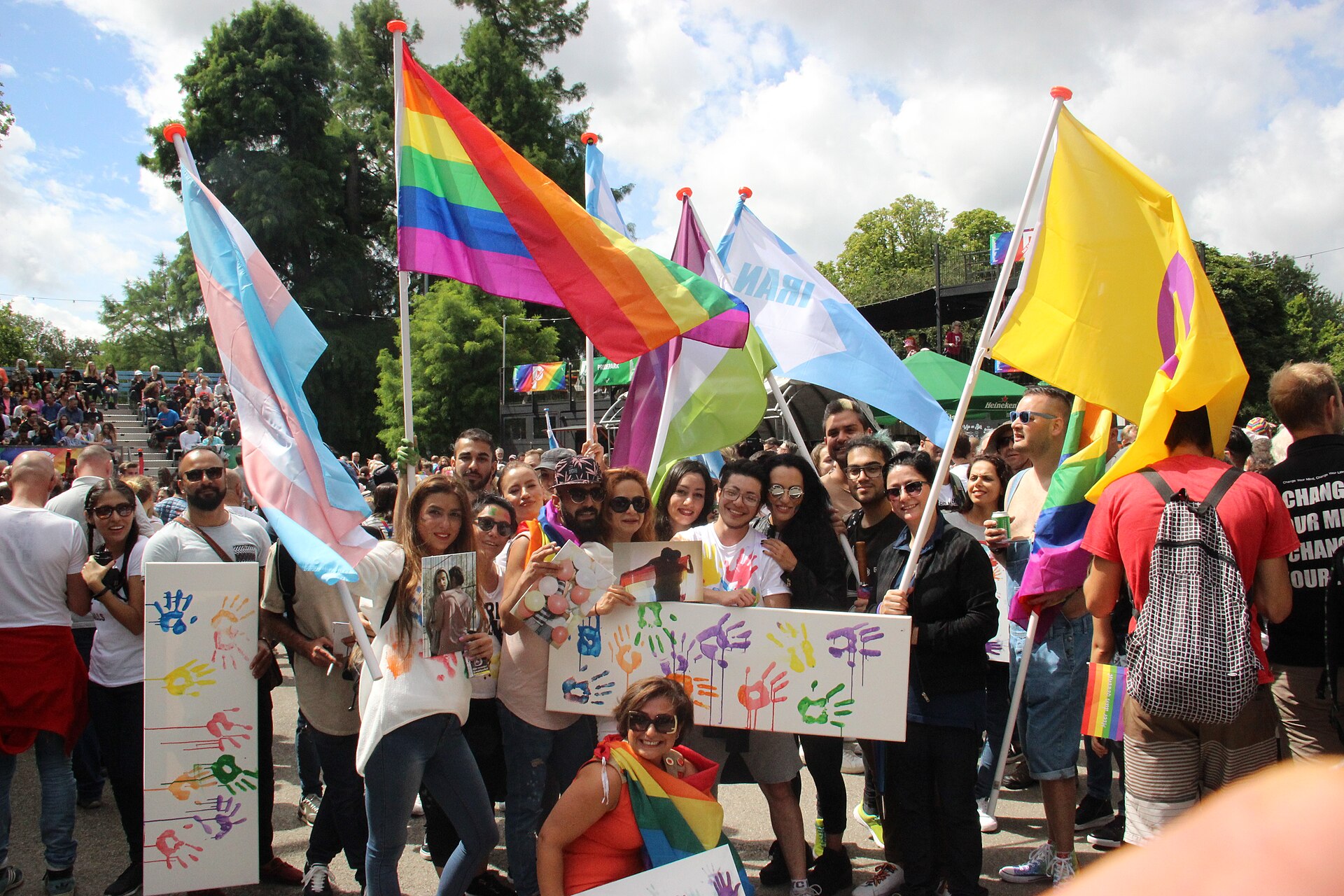
The flag was carried at Amsterdam Pride Walk on 29 July 2017, photographed as IranPride entered the Vondelpark. [7]
On 17 May 2018 the rainbow, bisexual, transgender and intersex flags were raised together on the forecourt of Parliament in Wellington to mark IDAHOBIT. PrideNZ, which recorded the ceremony, states it is believed to be the first time in the world that those four flags flew together in front of a seat of government. That is a narrower and more careful claim than the one often repeated, that New Zealand was the first country to fly the intersex flag at a national parliament, which no source read here establishes. [8]
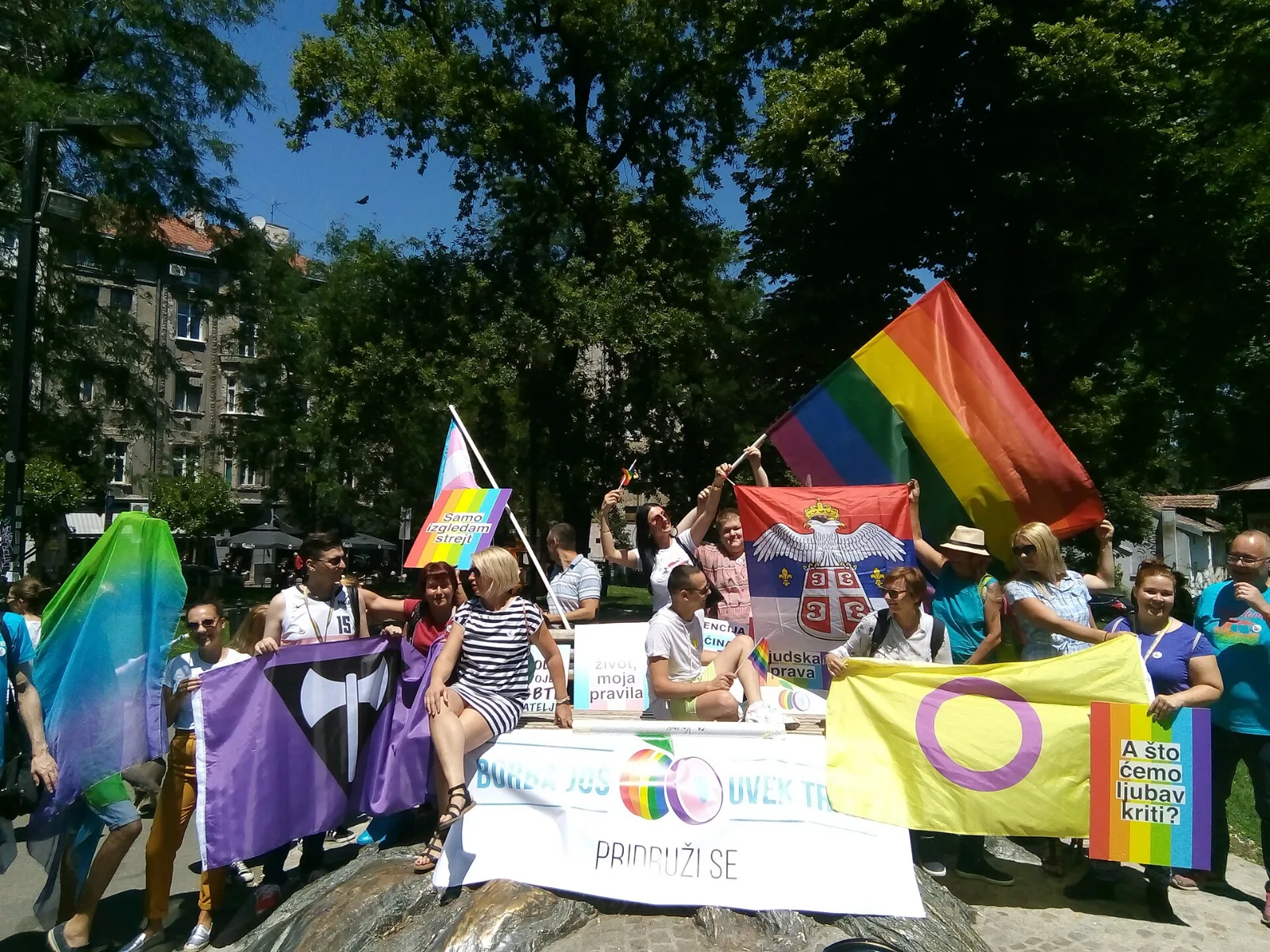
It was held at the fifth Pride Serbia in Academic Park, Belgrade, on 29 June 2019. [9]
In 2021 Valentino Vecchietti of Intersex Equality Rights UK set the yellow field and purple circle into the Progress Pride Flag, and that composite carried the emblem into far wider institutional use than the standalone flag had reached. [10] Writing at the flag's tenth anniversary, Carpenter described seeing "the flag used across the world, and to have that connection with groups on every continent." [5]
Major revisions
The resource page was revised. The design was unchanged; the text was rewritten to replace earlier terminology and to add Carpenter's explanation of that change. [6] [2]
In June 2019 Budweiser UK, as official beer of Pride London, produced limited-edition cups carrying nine Pride flags, the intersex flag among them, with wording about intersex people that Carpenter called ambiguous. CC0 left him no legal means to object, and he wrote that he cannot control the flag's use now that it is widely available, while expressing the hope that Budweiser would improve their language and resource work led by intersex people. That is Carpenter's response, not a settled community position. [2]
Lineage
- Direct children
- Intersex-Inclusive Pride Flag
- Related flags
- Jewish Progress Pride Flag (Keshet), Progress Pride Flag
No parent flags. Carpenter described the design as deliberately non-derivative, and the things it reacted against are precedents it rejected rather than ancestors: rainbow flags, gender symbols, and pink-and-blue conventions are named in his own account as what he was avoiding, so none of them is drawn as a lineage edge. [6] [2] [5]
The Intersex-Inclusive Progress Pride Flag of 2021 is the documented direct descendant, and later flags built on that 2021 design descend from it in turn. [10] The Intersex Ally Flag (Rosie) visibly carries an unbroken purple circle, but the source that documents that flag could not be read directly for this revision, so the derivation is recorded as a related connection rather than as descent until the source states it.
Lineage tree
Every record reachable from this one through documented parent and child relationships: 6 records across 3 generations.
- This record
- Intersex Pride Flag
- Children
- Intersex-Inclusive Pride Flag
Colors & Symbolism
Carpenter chose yellow and purple to keep the flag clear of gender symbolism. He wrote that the colours and circle "don't just avoid referencing gender stereotypes, like the colours pink and blue, they seek to completely avoid use of symbols that have anything to do with gender at all." The circle is "unbroken and unornamented, symbolising wholeness and completeness, and our potentialities," and he tied it directly to a continuing fight: "We are still fighting for bodily autonomy and genital integrity, and this symbolises the right to be who and how we want to be." [6] [2]
| Colour | Hex | Meaning |
|---|---|---|
| Golden Yellow | #FFD800 | The 2013 resource states that "the colour yellow has long been regarded as an intersex colour, neither blue nor pink." Carpenter selected it to avoid the pink-and-blue convention. [6] [2] |
| Purple | #7902AA | Purple is described in the same resource as having "been used for the same purpose." The ring is unbroken and unornamented, standing for wholeness, completeness and potential, and for bodily autonomy, genital integrity, and the right of intersex people to determine who and how they are. [6] [2] |
Designer page, official values [2]
The claim recorded here is Carpenter's design intention, that he picked colours already in use in intersex contexts and outside the pink-and-blue convention. It is not a claim that yellow and purple carry no gender associations anywhere. [6] [2]
Carpenter publishes both values as the official colours: golden yellow #FFD800, RGB 255, 216, 0, and purple #7902AA, RGB 121, 2, 170. The official vector uses the same two. [2] [1] They are taken from those sources rather than sampled from a manufactured flag or a photograph.
Design
- Aspect Ratio
- 3:5 · standard (archive production specification)
- Ratio Notes
- Source design: 900 × 600 · 3:2 width-to-height. The official vector is drawn on a 900 by 600 canvas, which is the 2:3 proportion in the conventional height-to-width notation. [1] The 3:5 figure above is the archive's own production specification, used so that flags display comparably across the database; it is not the proportion Carpenter published, and it is not offered as this flag's historical ratio. The artwork on this page is reproduced at the source proportion and is neither stretched nor cropped to the production figure.
- Orientation
- horizontal
- Stripe Count
- 0
- Layout
- solid field with centered emblem
- Center Symbol
- Unbroken purple ring, centered
The official vector published with the resource fills a 900 by 600 canvas with a #FFD800 rectangle and sets one circle on it, centred at 450, 300, with a radius of 147 and a stroke 53.625 units wide in #7902AA, with no fill. [1] Because the ring is a stroke on that path rather than a filled annulus, it runs from radius 120.1875 to radius 173.8125, giving an outer diameter of 347.625, a little over half the height of the flag. The archive's artwork reproduces those values exactly.
A golden-yellow field with a single centered purple ring. No stripes and no other marks. [6] [2]
Usage & Adoption
- First Users
- Unknown
- Organizations
- Organisation Intersex International Australia, later Intersex Human Rights Australia, now InterAction for Health and Human Rights (original publisher and current host) [6], Intersex Equality Rights UK, through the 2021 intersex-inclusive design [10]
- Geographic Usage
- Australia (publication origin), International
- Online Usage
- Offered as a downloadable PNG and SVG from the resource page [6]
- Event Usage
- Amsterdam Pride Walk, 29 July 2017 [7], IDAHOBIT flag raising, Parliament forecourt, Wellington, 17 May 2018 [8], Pride Serbia, Academic Park, Belgrade, 29 June 2019 [9]
- Current Status
- Widely recognized; de facto primary intersex flag
The tenth-anniversary article describes the flag as "inescapably associated with a worldwide human rights movement. One that recognises systemic injustice against intersex bodies and pursues vital protections." [5] No source read identifies who first flew or carried a physical copy, so first users are recorded as unknown rather than inferred from the publisher.
Image Archive
Official Artwork

Documented Use

_Park.jpg)
Discourse & Debates
- Intersex describes innate variations in sex characteristics. It is not itself a gender identity, and intersex people may have any gender identity or sexual orientation. [2] [10]
- Carpenter has discussed Budweiser UK's 2019 campaign as an instance of the loss of control that comes with public-domain circulation. The position is his, and is not presented here as a community-wide consensus on CC0. [2]
The original resource was revised on 20 June 2019 to replace earlier terminology and to add Carpenter's explanation of the change. He sets out the history of the word hermaphrodite, records that Intersex Human Rights Australia has long held that the term is best used only by people born with variations of sex characteristics, and notes that some people reclaim it while others find it offensive. The design was not altered. [6] [2]
Footnotes & Citations
Sources and footnotes 10 sources
- 1. Organizations intersex-flag.svg (official vector). Morgan Carpenter. Organisation Intersex International Australia; now hosted by InterAction for Health and Human Rights (2013-07-05). Accessed 2026-08-14
The published artwork itself. 900 × 600; circle cx 450, cy 300, r 147, stroke-width 53.625, stroke #7902AA, fill none; ground #FFD800.
- 2. Designer page The intersex flag. Morgan Carpenter. Morgan Carpenter (personal site). Accessed 2026-08-14
The designer's own page. States the 4 July 2013 first online share, the official hex values, and the 18 December 2013 CC0 dedication. Page last reviewed 12 November 2020.
- 3. Organizations Staff. Intersex Human Rights Australia. Accessed 2026-03-15
- 4. Organizations Governance. InterAction for Health and Human Rights. Accessed 2026-08-14
The publisher's own naming chronology: registered as Organisation Intersex International Australia Limited on 6 May 2010; renamed Intersex Human Rights Australia by special general meeting on 4 March 2018, approved 5 March 2018; the business name InterAction for Health and Human Rights registered in 2024.
- 5. Organizations 10 years of the intersex flag!. Cody Smith, with a reflection by Morgan Carpenter. InterAction for Health and Human Rights (2023-07-05). Accessed 2026-08-14
Anniversary post carrying a personal reflection by the designer on the flag's first decade.
- 6. Organizations An intersex flag. Morgan Carpenter. Organisation Intersex International Australia; now hosted by InterAction for Health and Human Rights (2013-07-05). Accessed 2026-08-14
Published 5 July 2013 and revised 20 June 2019. Published by OII Australia, which became Intersex Human Rights Australia in 2018 and now operates under the InterAction brand; the page is hosted at the current brand's domain.
- 7. Image file page File:Iran in Amsterdam Pride Walk 2017 - 02.jpg. JoopeA. Wikimedia Commons (2018-05-28). Accessed 2026-08-14
CC BY-SA 4.0. Photographed 29 July 2017. Original 2592 × 1728; the copy held here is the 1920 px rendering.
- 8. Archived Sources IDAHOBIT 2018. PrideNZ.com (2018-05-17). Accessed 2026-08-14
Audio recording of the flag-raising ceremony on the forecourt of Parliament, Wellington, 17 May 2018.
- 9. Image file page File:Pride Serbia 2019 - Academic (Student) Park.jpg. Bojan Cvetanović. Wikimedia Commons (2019-07-05). Accessed 2026-08-14
CC BY-SA 4.0. Original 3264 × 2448; the copy held here is the 1920 px rendering.
- 10. Encyclopedias & Reference Intersex flag. Wikipedia. Accessed 2026-08-14
Tertiary. Used here only for later reception and the 2021 composite; authorship, symbolism, colours, geometry, licensing and the publisher's name history are taken from the primary sources instead.
Image Sources
- Rendering
- Official 2013 construction
- The official artwork, reproduced from the 900 by 600 vector published with the resource page: circle centred at 450, 300, radius 147, stroke 53.625, #7902AA on #FFD800. [1] · Credit: Designed by Morgan Carpenter, 2013. Dedicated to the public domain under CC0 1.0. · Published by OII Australia; now hosted by InterAction for Health and Human Rights · CC0 1.0
- IranPride entering Vondelpark during Amsterdam Pride Walk, 29 July 2017. · Credit: Photograph by JoopeA, CC BY-SA 4.0, via Wikimedia Commons · Wikimedia Commons · CC BY-SA 4.0
- The intersex flag at the fifth Pride Serbia, Academic Park, Belgrade, 29 June 2019, alongside the rainbow, transgender and labrys lesbian flags. [9] · Credit: Photograph by Bojan Cvetanović, CC BY-SA 4.0, via Wikimedia Commons · Wikimedia Commons · CC BY-SA 4.0