Egogender Pride Flag
Identity Pride Flag ·
A pride flag for egogender identity, a gender so personal it can only be described as oneself; the coining post defines it as "a gender that is solely based on yourself, and no words seem to define it other than me gender, [name] gender, i'm just who i am and my gender is mine." The term was posted on 20 June 2014 and is credited to Tumblr user queerspike. [1][2] Three flags followed: Helkie-three's purple, cyan and blue original that November, posted with egoguy, egogirl and egononbinary variants; pastelmemer's black, light yellow, white and gold version, the most circulated; and momma-mogai-sphinx's 2019 nine-stripe design, the only one with stated meanings. [3][4][5]
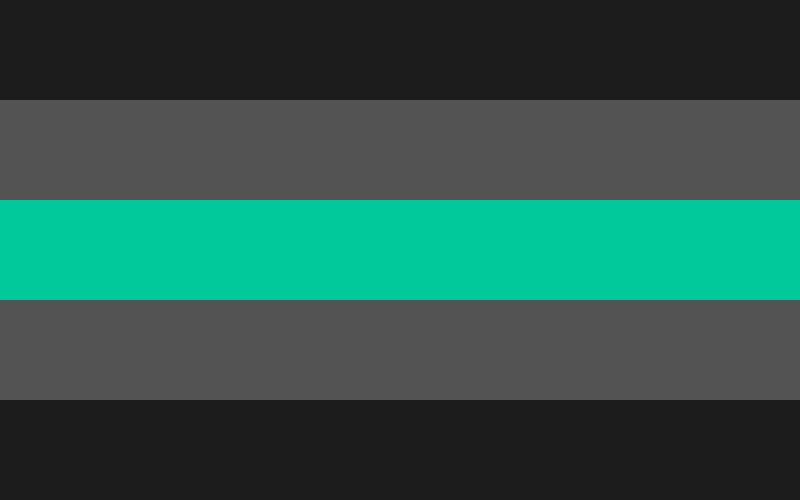
Key facts
- Designer
- Helkie-three
- Created
- First documented public use
- In use
- 2014-present
- Aspect Ratio
- 3:5 · standard
- Stripes
- 4
- Represented Identity
- egogender / charagender
Also known as
- Charagender Pride Flag
- [Name]gender Pride Flag
Status Proposed
Archive categories Gender Identity Pride Flags
Overview
To provide language and visual representation for a gender experience so personal and individual that existing terms cannot capture it.
The term egogender appears in a batch coinage post of 20 June 2014, which opens "sometimes i look through lists of prefixes and get inspired" and also coins ambigender, apogender, brevigender, hemigender, histrigender and paragender, closing "i don't know if any of these will resonate with anyone, but i believe we can never have too many words to help us describe ourselves." The post is credited to Tumblr user queerspike; the blog is deactivated and the post survives through a reblog by genderdefinitions of July 10, 2014, whose date some sources give for the coinage. Some sources also credit flynneleh as a co-coiner. The first flag followed in November. [1][6][2]
Identity & Context
- Represented Identity
- egogender / charagender
- Subcommunity
- xenogender umbrella / nonbinary umbrella
- Movement
- MOGAI identity framework
- Language Context
- From the Latin/Greek prefix ego (self, I). The coining post defines it: "a gender that is solely based on yourself, and no words seem to define it other than me gender, [name] gender, i'm just who i am and my gender is mine." The alternate name charagender derives from character. [1][2]
No two egogender individuals share the same gender experience. The identity can be combined with other terms (egogirl, egoboy, egononbinary, egoflux/charaflux). [2]
Creators
The Creator
Helkie-three / same-memes
Designer (first flag, 2014)
DeviantArt and Tumblr user who posted the first egogender flag on November 4, 2014, together with egoguy, egogirl and egononbinary variants, and identified themself as egogender in the posting. The Tumblr blog later moved; its final description points to a successor blog. [3][7]
I hope they're okay ;w; If anyone would like me to change something, add/switch/change a color, or anything notify me <33 I'm trying to make my fellow egogendered people happy.
From the November 4, 2014 post publishing all four flags.
Motivations
- Making flags for their own community: the post's wording identifies the designer as egogender. [3]
Attribution notes
Three flag designs exist. The first was posted by DeviantArt and Tumblr user Helkie-three (same-memes) on November 4, 2014, together with egoguy, egogirl and egononbinary variants, with the note "I hope they're okay ;w; If anyone would like me to change something, add/switch/change a color, or anything notify me <33 I'm trying to make my fellow egogendered people happy." [3][7] A second design by pastelmemer survives through a Pride-Flags DeviantArt rendering of August 22, 2015, and is the version most often shown in wiki sources. [4] A third, by Tumblr user momma-mogai-sphinx, was posted on August 28, 2019, at an anonymous requester's prompting, and is the only version with stated colour meanings. [5]
Origin
- Specific Place
- DeviantArt / Tumblr
- Place Type
- social media
- Digital Origin
- Yes
Digital origin; no verified physical location.
The first flag was posted on Tumblr and DeviantArt by Helkie-three on November 4, 2014. The term was coined in a post of 20 June 2014, credited to Tumblr user queerspike; the coining blog is deactivated and the post survives through a genderdefinitions reblog. [3][7][1]
Dates & Chronology
- Year Created
- Exact date
- First public use
- Period in Use
- 2014-present
The identity appears in MOGAI community spaces, wikis, and pride flag directories. In the 2020 and 2021 Gender Census, 4 respondents identified as egogender each year. In the 2021 census, over 1% described their identity as 'I'm just me' or similar phrasing, which aligns with the egogender concept without necessarily using the label. [2]
Major revisions
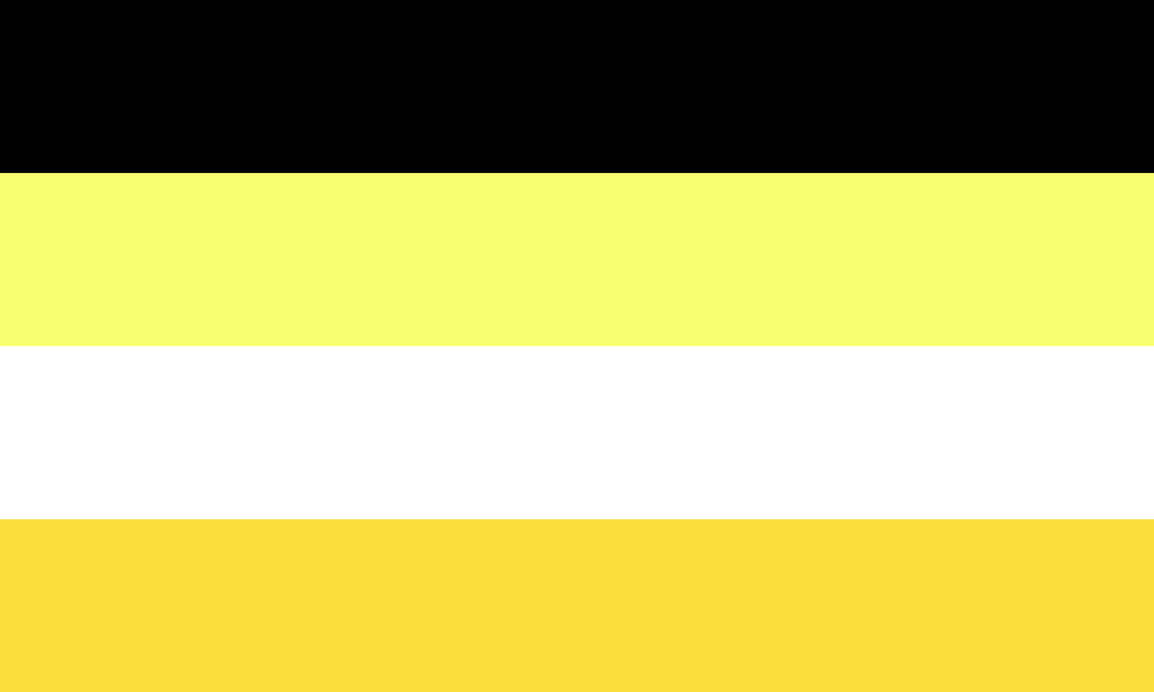
Alternate flag by pastelmemer (black, light yellow, white, gold), surviving through a Pride-Flags rendering of August 22, 2015. Often cited as the primary egogender flag in wiki sources. [4]
Alternate flag by momma-mogai-sphinx, posted at an anonymous requester's prompting, with stated meanings: purple for individuality, blue for peace and understanding, yellow for clarity. The artwork carries those colours: measured from the creator's own file, the nine mirrored bands run #8200C2, #5C00D1, #007DD1, #00CBFE, #FEE300, #00CBFE, #007DD1, #5C00D1 and #8200C2. [5]
Writer Eileen Myles has stated 'I'm the gender of Eileen,' and drag artist Valentina has said 'I feel like I'm my own gender,' both aligning with the egogender concept. [2]
Lineage
- Indirect influences
- Rainbow Pride Flag
Egogender is classified as a xenogender (a gender not defined in relation to male or female). Related terms include autogender, narkissigender, skelogender, and egoflux/charaflux. [2]
Colors & Symbolism
Three separate flag designs exist with different color palettes. Only the momma-mogai-sphinx version (2019) has documented color symbolism. The Helkie-three and pastelmemer designs have no creator-documented meanings. [7][4][5]
| Colour | Hex | Meaning | Note |
|---|---|---|---|
| Purple | — | Individuality. From the momma-mogai-sphinx (2019) design, the only egogender flag with stated colour meanings. [5] | — |
| Blue | — | Peace and understanding, in the creator's statement. [5] | — |
| Yellow | — | Clarity. From the momma-mogai-sphinx (2019) design. [5] | — |
| Black | #000000 | — | Sampled from the Pride-Flags rendering of the pastelmemer design. Not creator-issued. [4] |
| Light yellow | #F8FF71 | — | Sampled from the Pride-Flags rendering. Not creator-issued. [4] |
| White | #FFFFFF | — | Sampled from the Pride-Flags rendering. Not creator-issued. [4] |
| Gold | #FBDE3C | — | Sampled from the Pride-Flags rendering. Not creator-issued. [4] |
This flag has no official digital palette. Color values shown are approximate.
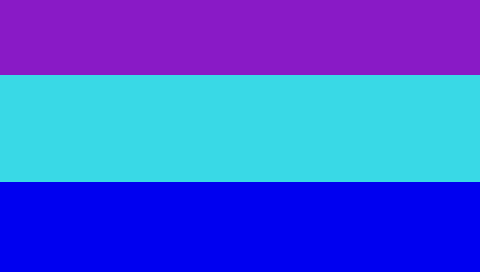
Helkie-three flag (2014): purple, cyan and blue in unequal stripes; no stated meanings. Pastelmemer flag (2015): black, light yellow, white and gold; no stated meanings. Momma-mogai-sphinx flag (2019): nine mirrored stripes running nine mirrored bands measuring #8200C2, #5C00D1, #007DD1, #00CBFE, #FEE300, #00CBFE, #007DD1, #5C00D1 and #8200C2. Its creator stated "The purple is for individuality, blue for peace/understanding, and yellow for clarity," and the artwork carries each of those colours. [5]
No creator has documented hex values for any of the three designs. The values here are sampled from the Pride-Flags rendering of the pastelmemer design, the version this entry displays, whose original file measures #000000, #F8FF71, #FFFFFF and #FBDE3C. [4] Helkie-three's original measures #891AC6, #39D9E6 and #0000F0. [3] The momma-mogai-sphinx design of 2019 runs nine mirrored bands, #8200C2, #5C00D1, #007DD1, #00CBFE, #FEE300, #00CBFE, #007DD1, #5C00D1 and #8200C2, measured from the creator's own file. [5] An earlier version of this entry published a different five-value set for that design; those values came from the blog's theme header rather than from the flag. The vector published here was redrawn on 16 August 2026 to carry these measured values; it had been left painting #010101 and #FFFF7B after the table was corrected.
Design
- Aspect Ratio
- 3:5 · standard
- Orientation
- horizontal
- Stripe Count
- 4
- Layout
- horizontal stripes (multiple designs)
Three distinct designs. Helkie-three (2014): three unequal horizontal stripes, 75, 107 and 90 pixels on a 480 by 272 canvas, purple, cyan, blue; posted with egoguy, egogirl and egononbinary variants differing only in the bottom stripe. [3] Pastelmemer (2015): four equal stripes, black, light yellow, white, gold, known through a 5000 by 3000 Pride-Flags rendering. [4] Momma-mogai-sphinx (2019): nine mirrored stripes from dark purple through magenta, orchid and salmon to a yellow centre. [5] Four horizontal bands, measured from the artwork this entry publishes.
Multiple designs circulate. The pastelmemer version (black, light yellow, white, gold) is most commonly shown in wiki sources and is the version this entry displays. The momma-mogai-sphinx version, a nine-stripe purple-to-yellow gradient, is the only one with stated symbolism. Helkie-three's original is three unequal stripes of purple, cyan and blue. [4][5][3]
Usage & Adoption
- First Users
- MOGAI Tumblr communities
- Online Usage
- Tumblr, DeviantArt, LGBTQIA+ identity wikis
- Current Status
- active
Low mainstream visibility. 4 respondents identified as egogender in both the 2020 and 2021 Gender Census. The concept resonates with people who describe their gender as 'I'm just me' without necessarily using the label. [2]
Image Archive
Original artwork
Circulating rendering
In-text images
Discourse & Debates
- Falls under the broader MOGAI (Marginalized Orientations, Gender Alignments, and Intersex) umbrella, which is itself contested. [2]
Common misidentifications
- The alternate name 'charagender' is unrelated to the character Chara from Undertale. [2]
Egogender can be combined with other terms: egogirl, egoboy, egononbinary, egoflux/charaflux. The '[name]gender' form is a placeholder where individuals use their own name (e.g., someone named Sam might say 'Samgender'). [2]
Footnotes & Citations
Sources and footnotes 8 sources
- 1. Social media Genders coined by queerspike. queerspike. Tumblr (genderdefinitions reblog) (2014-06-20). Accessed 2026-08-14
The coinage post, root-timestamped 20 June 2014; the reblog carrying it dates to July 10, 2014, the date some sources give for the coinage.
- 2. Egogender. LGBTQIA+ Wiki. Accessed 2026-03-31
- 3. Social media Egogender flag post. same-memes (Helkie-three). Tumblr (2014-11-04). Accessed 2026-08-14
- 4. Egogender/Charagender (1) by Pride-Flags. pastelmemer (original), Pride-Flags (repost). DeviantArt (2015-08-22). Accessed 2026-08-14
- 5. Social media Alternative egogender flag. momma-mogai-sphinx. Tumblr (2019-08-28). Accessed 2026-08-14
- 6. Egogender. Nonbinary Wiki. Accessed 2026-03-31
- 7. Egogender flag by Helkie-three. Helkie-three. DeviantArt (2014-11-04). Accessed 2026-08-14
- Rainbow flag (LGBTQ). Wikipedia contributors. Wikipedia (2026-06-25). Accessed 2026-07-24
Image Sources
- Rendering
- pastelmemer version (most commonly cited in wikis)
- Helkie-three's original egogender flag from the November 4, 2014 post, 480 by 272 pixels, posted together with egoguy, egogirl and egononbinary variants. [3] · Credit: Helkie-three (same-memes) · TumblrRights No licence located; the creator invited colour-change requests.
- The pastelmemer design as rendered by the Pride-Flags DeviantArt account on August 22, 2015; the version most often shown in wiki sources. [4] · Credit: pastelmemer (design); Pride-Flags (rendering) · DeviantArt