Pomosexual Pride Flag (2016, pride-color-schemes)
Identity Pride Flag ·
A seven-band pomosexual flag created by the pride-color-schemes archive, with pink, light pink and white mirrored around a pale lavender centre. It is one of several pomo- designs the archive documents together, each by a different hand, and the only one it marks "Designed by: Me"; no colour meanings were published for it. [1] The term is older than the flag by nineteen years, carried into circulation by the 1997 anthology PoMoSexuals, edited by Carol Queen and Lawrence Schimel. [2][3]

Key facts
- Designer
- pride-color-schemes
- Created
- First documented presentation
- In use
- 2016–present
- Aspect Ratio
- 3:5 · standard
- Stripes
- 7
- Represented Identity
- pomosexual
Also known as
- Pomo Pride Flag
Status Variant
Archive categories Sexual & Romantic Orientation Pride Flags
Overview
To give the pomo- prefix a design in the sexual-attraction position, within a set the archive was building across attraction types. [1][4]
Pomosexual describes a position or an identity involving not fitting, rejecting, or choosing not to use the conventional labels for a kind of attraction. The archive that made this flag gives the prefix a two-part definition: "1) An orientation where one denies or does not fit any labels for a particular kind of attraction. For example, someone who is pomosexual may or may not feel sexual attraction, but is not interested in specifying whether they feel it, and to whom. 2) 'Not straight'. A label for not wanting or needing a precise label." [1]
The word reached a wide readership through PoMoSexuals: Challenging Assumptions about Gender and Sexuality, a 1997 Cleis Press anthology edited by Carol Queen and Lawrence Schimel with a preface by Kate Bornstein. [3] The collection's framing is postmodern and anti-categorical, drawing on the analogy that postmodernism cannot be read without modernism behind it; the LGBTQIA+ Wiki credits Queen and Schimel with the coinage. [2]
Identity & Context
- Represented Identity
- pomosexual
- Movement
- Postmodern sexuality; label-resistant identity
- Language Context
- From pomo-, short for postmodern, plus -sexual.
Creators
The Creator
pride-color-schemes
Designer, seven-band pomosexual design
pride-color-schemes is a Tumblr blog and matching DeviantArt gallery, run under the account name Pride-Flags, which published several thousand identity pride flags during the mid-2010s MOGAI vocabulary expansion. Its FAQ is written by a moderator using the name Mod Hermy, described there as "the only active uploader on the DA", with Mod Tath and Mod Ez credited as other moderators. Most of the gallery is other people's work reissued at 5000 by 3000 pixels: "the majority of the work done here is simply cleaning up existing flags in high quality to be accessible and usable by the community." Designs the project made itself are marked in the post description, which is how this flag is credited. [4]
Anything made by us will be clearly marked in the post description. [4]
Motivations
- To complete a set: the archive states that for orientation flags it makes "variations with all 7 'main' attraction types whenever possible." [4]
Attribution notes
The archive claims this design as its own. Its post of 5 July 2016 sets out the pomo- family with a separate credit under each image, and the seven-band pomosexual flag is the one marked "Designed by: Me". The archive's FAQ states the convention: "Anything made by us will be clearly marked in the post description." [1][4]
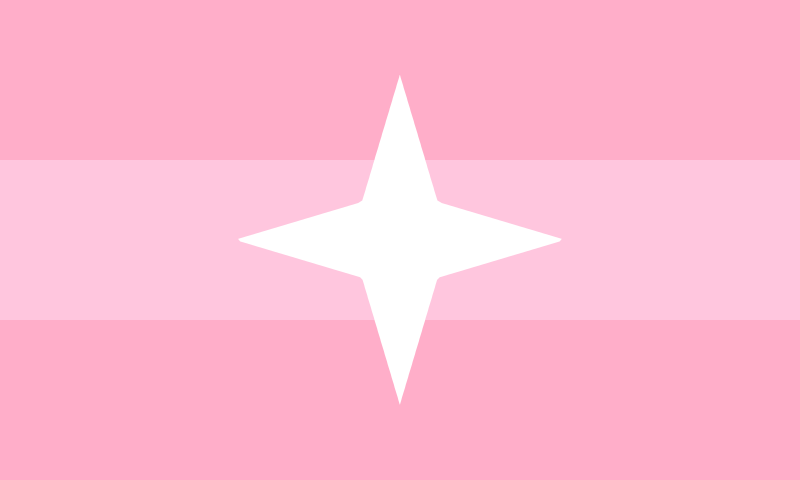
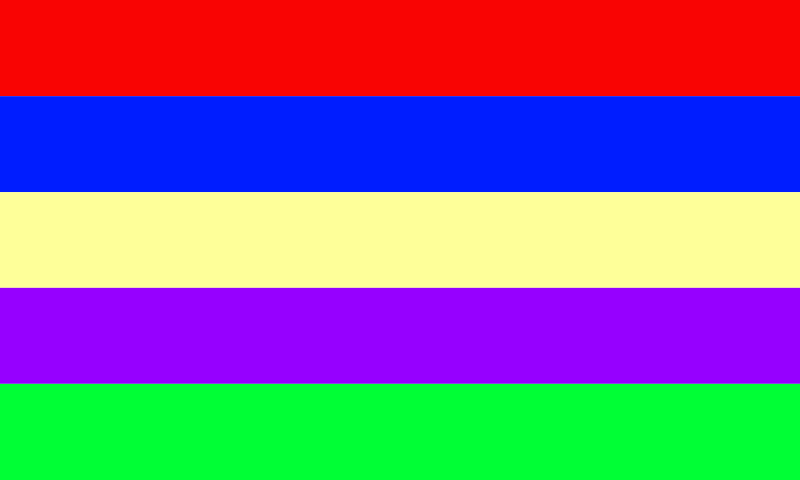
The other credits in the same post belong to other people and to other flags. The three-band design carrying a white four-pointed star, presented for pomosexual and pomoromantic together, is "Designed by: @pastelmemer". The five-band design in red, blue, pastel yellow, purple and lime green is "Designed by: @lgbtrainbowdolls". The seven-band pomoromantic flag beside this one carries no designer credit at all. [1]
The archive records the term's coiner as unknown. [1]
Origin
- Specific Place
- Tumblr (pride-color-schemes)
- Place Type
- online
- Digital Origin
- Yes
Digital origin; no verified physical location.
Presented on the pride-color-schemes Tumblr on 5 July 2016 and uploaded to the Pride-Flags DeviantArt gallery at 00:07 Pacific on 14 July 2016, two seconds before the seven-band pomoromantic flag. [1][5][6]
Dates & Chronology
- Year Created
- First documented presentation
- Period in Use
- 2016–present
Documented circulation is online: the archive's own Tumblr and DeviantArt gallery, and identity wikis that reproduce the design. [2][7][1][5]
The archive's pomo- post is a family portrait rather than a single design. As it now stands it carries five images: a three-band pink flag with a white four-pointed star, credited to pastelmemer and on DeviantArt from 22 August 2015; a five-band design in red, blue, pastel yellow, purple and lime green, credited to lgbtrainbowdolls; this seven-band pomosexual flag; a three-band pomoromantic variant that adds a large heart over the star; and a seven-band pomoromantic flag identical to this one but for a mint green centre band. [1][5][8][9][6]
The post has been edited since it was published. It is dated 5 July 2016, but the five-band design it presents was uploaded to DeviantArt on 26 January 2017. [1][8]
The term's use has moved. Queen and Schimel's 1997 collection uses pomosexual as a critical position on sexual-orientation categories rather than as a category to join. The Tumblr-era flags treat it as an identity label with a symbol, an attraction-type series and a romantic counterpart. Both readings are in circulation, and the later one is not a misreading of the earlier so much as a different use of the same word. [2][1][3]
Lineage
- Related flags
- Queer Pride Flag, Unlabeled Pride Flag
The Queer and Unlabeled flags are conceptual neighbours: all three stand for identities that resist a specific label, though Queer reclaims an umbrella term rather than declining one. No design relationship is documented between them, so they are related entries and not ancestors. Within the pomo- family the seven-band pomoromantic flag is the same design with one band changed, but the archive presents them as parallel members of a set rather than one derived from the other. [1][6]
Colors & Symbolism
No meanings were published for this design. The archive's post ends the pomo- entry with "Color meanings: Unknown". [1]
| Colour | Hex | Note |
|---|---|---|
| Pink | #FFAEC9 | Sampled from the 5000 by 3000 original; bands 1 and 7. [5] |
| Light Pink | #FFC6DE | Sampled from the 5000 by 3000 original; bands 2 and 6. [5] |
| White | #FFFFFF | Sampled from the 5000 by 3000 original; bands 3 and 5. [5] |
| Lavender | #E8CDFF | Sampled from the 5000 by 3000 original; band 4. [5] |
One flag in the family does carry an explanation, and it belongs to a different design. Of the five-band version credited to lgbtrainbowdolls the archive writes: "The red/blue/yellow are the primary colors, purple for the red and blue mixing together and green for the yellow and blue mixing together. I was thinking 'fashion/art; with this flag design because "post modern" is an art genre." That reading is about the primary and mixed colours of that five-band flag and does not describe the pink, white and lavender of this one. [1]
Four colours across seven bands: the design is symmetric, so the pink, light pink and white each appear twice. No palette was published, so these are sampled values, taken from the 5000 by 3000 file the archive links for the full-size copy. There is no green in this flag; the green centre belongs to the seven-band pomoromantic design published beside it. [5][6]
Design
- Aspect Ratio
- 3:5 · standard
- Orientation
- horizontal
- Stripe Count
- 7
- Layout
- horizontal_stripes
- Stripes (Top → Bottom)
- Pink, Light Pink, White, Lavender, White, Light Pink, Pink
Seven bands of equal depth, symmetric about the centre, so four colours appear across seven positions. The archive's image description reads "a flag with seven stripes. from top to bottom they are: pink, light pink, white, purple, white, light pink, pink", calling the centre band purple; measured on the original file it is a pale lavender. [1][5]
Seven horizontal bands of equal depth. No emblem or overlay. No aspect ratio was published with the design; the file is 5000 by 3000 pixels, which is the archive's standard canvas rather than a specification for this flag. [5]
Seven equal horizontal bands: pink #FFAEC9, light pink #FFC6DE, white #FFFFFF, lavender #E8CDFF, white, light pink, pink. The seven-band pomoromantic flag published two seconds later is identical but for the centre band, which is mint green #A8FFC3. [5][6]
Usage & Adoption
- Online Usage
- Pride-Flags DeviantArt gallery and pride-color-schemes Tumblr. [1][5], LGBTQIA+ identity wikis. [2][7]
- Current Status
- Documented variant; circulation documented online
Documented in online reference material. No photographed physical use has been located. An October 10 Pomosexual Pride Day appears in a Medium article by Anya Korolyov; no organisation observing it has been located. [10]
Image Archive
The pomo- family

Discourse & Debates
- Whether pomosexual is best understood as a discrete identity, with a flag and a set of attraction-type variants, or as a critical stance on the necessity of identity categories. The 1997 anthology uses it in the second sense; the Tumblr-era flags use it in the first. [2][1][3]
- Whether the term does distinct work beside Queer, unlabeled and questioning, with which its use overlaps. [2]
Common misidentifications
- The seven-band pomosexual flag is regularly reproduced with a green centre band. That is the seven-band pomoromantic flag, published two seconds after it and identical in every other respect. [5][6]
- The primary-and-mixed-colour explanation is often attached to this flag. It was published for the separate five-band design credited to lgbtrainbowdolls. [1]
Pomosexual can describe someone who rejects labels for sexual attraction, is averse to them, or simply does not fit the existing ones. The romantic counterpart is pomoromantic, and the archive that made this flag built the prefix out across attraction types. [2][1]
Footnotes & Citations
Sources and footnotes 10 sources
- 1. Blogs & Personal Sources Pomo-. pride-color-schemes. pride-color-schemes (Tumblr) (2016-07-05). Accessed 2026-08-16
Sets out the pomo- designs with a separate credit under each, and carries the only published colour explanation in the family.
- 2. Encyclopedias & Reference Pomosexual. LGBTQIA+ Wiki. Accessed 2026-03-31
Community wiki, unsigned. Source of the attribution of the coinage to Carol Queen and Lawrence Schimel.
- 3. Databases PoMoSexuals: Challenging Assumptions about Gender and Sexuality. Carol Queen and Lawrence Schimel (editors). Open Library (1997). Accessed 2026-08-16
Bibliographic record: Cleis Press, 1997, ISBN 1-57344-074-4, preface by Kate Bornstein.
- 4. Blogs & Personal Sources FAQ. Mod Hermy, with Mod Tath and Mod Ez. pride-color-schemes (Tumblr). Accessed 2026-08-16
States the project's crediting practice, its terms of reuse, and its practice of building attraction-type sets.
- 5. Image file page Pomosexual. Pride-Flags. DeviantArt (2016-07-14). Accessed 2026-08-16
The seven-band design the archive claims as its own. Original file 5000 by 3000 pixels; published 00:07 Pacific. Licence field: none.
- 6. Image file page Pomoromantic. Pride-Flags. DeviantArt (2016-07-14). Accessed 2026-08-16
Identical to the pomosexual flag but for the centre band, which is mint green #A8FFC3. Licence field: none.
- 7. Encyclopedias & Reference Pomosexual. LGBTQIA+ Wiki (Fandom). Accessed 2026-03-31
Community wiki, unsigned.
- 8. Image file page Pomosexual (five-band design). Pride-Flags. DeviantArt (2017-01-26). Accessed 2026-08-16
The design credited to lgbtrainbowdolls, both here and in the Tumblr post. Licence field: none.
- 9. Image file page Pomo- (1). Pride-Flags. DeviantArt (2015-08-22). Accessed 2026-08-16
The three-band design with the white four-pointed star, credited in the Tumblr post to pastelmemer. Licence field: none.
- 10. Articles & Reports Pomosexual Pride Day (October 10). Anya Korolyov. Medium. Accessed 2026-03-31
Self-published article. The only located source associating the identity with a date.
Image Sources
- Rendering
- Seven-band pomosexual design (2016)
- The three-band pomo- design credited to pastelmemer, presented for pomosexual and pomoromantic together and on DeviantArt from 22 August 2015. Archive rendering, with the colours sampled and the star outline traced on the original 5000 by 3000 file. · Credit: Design: pastelmemer. Source file published by Pride-Flags on DeviantArt. Rendering: Encycloflaggia, measured from the original file. · DeviantArt (Pride-Flags) · reconstructionRights No licence has been located from pastelmemer. The DeviantArt licence field on the source file reads none.
- The seven-band pomosexual flag, the design the pride-color-schemes archive marks "Designed by: Me" in its pomo- post of 5 July 2016 and uploaded to DeviantArt on 14 July 2016. Archive rendering, with the band depths and the four colours measured on the original 5000 by 3000 file. · Credit: Design: pride-color-schemes, published as Pride-Flags. Rendering: Encycloflaggia, measured from the original file. · DeviantArt (Pride-Flags) · reconstructionRights No licence was issued with the design; the DeviantArt licence field on the source file reads none.
- The seven-band pomoromantic flag, uploaded to DeviantArt two seconds after the pomosexual design on 14 July 2016 and identical to it but for the mint green centre band. The archive credits no designer for it. Archive rendering, with the band depths and colours measured on the original 5000 by 3000 file. · Credit: Designer not named by the source. Source file published by Pride-Flags on DeviantArt. Rendering: Encycloflaggia, measured from the original file. · DeviantArt (Pride-Flags) · reconstructionRights No designer is named and no licence has been located. The DeviantArt licence field on the source file reads none.
- The five-band pomosexual design credited to lgbtrainbowdolls, uploaded to DeviantArt on 26 January 2017. It is the only pomo- design with a published colour explanation, which turns on primary colours and the secondaries where they mix. Archive rendering, with the band depths and colours measured on the original 5000 by 3000 file. · Credit: Design: lgbtrainbowdolls. Source file published by Pride-Flags on DeviantArt. Rendering: Encycloflaggia, measured from the original file. · DeviantArt (Pride-Flags) · reconstructionRights No licence has been located from lgbtrainbowdolls. The DeviantArt licence field on the source file reads none.