Waria Pride Flag
Cultural Gender Pride Flag ·
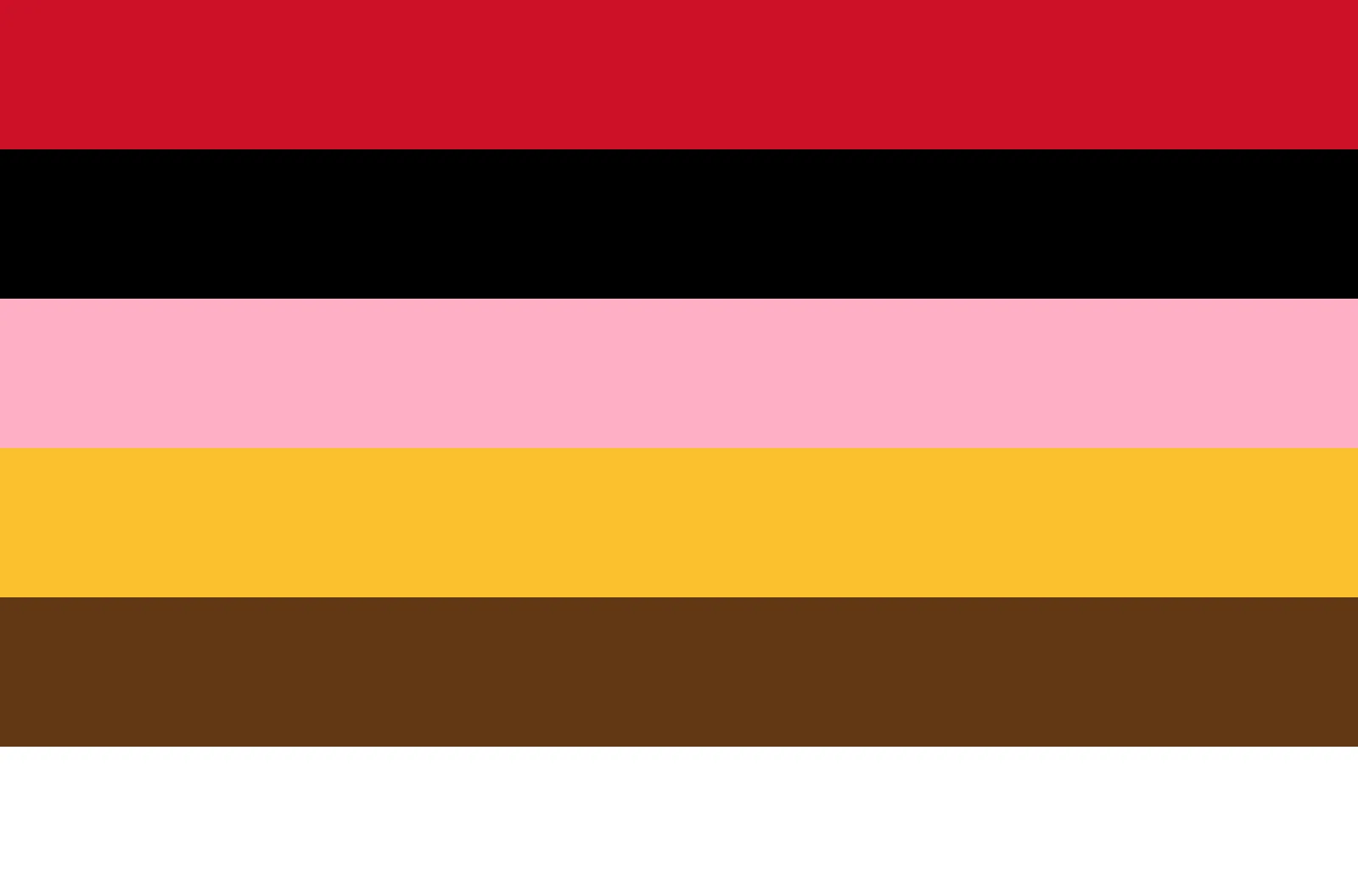
Six equal stripes of red, black, pink, gold, brown and white, drawn as pixel art and published to Pixilart on 12 June 2021 by WiiFyneLM, who wrote a meaning for every stripe in the artwork's own description: "in my culture, there are many, many genders, one of which I have found, doesn't really have a pride flag so I decided to make one." [1] No use of the design by a waria organisation or community event has been located; its documented circulation is online.
Key facts
- Designer
- WiiFyneLM
- Created
- Published by the creator on Pixilart
- Documented
- Documented online 2021 to the present
- Aspect Ratio
- Not standardized
- Ratio Notes
- Measured from the designer's own canvas. Pixilart records the artwork's size as 400 by 264 pixels, which reduces to 50:33; the six stripes are 44 pixels each. The 2000 by 1320 file the site serves is a five-times upscale of that canvas, not a separate specification. No proportion is published in words. [2] The delivered PNG is that canvas exported at five times scale, 2000 by 1320. [1]
- Stripes
- 6
- Origin
- Indonesia
- Represented Identity
- waria
Also known as
- Waria Flag
Status Proposed
Archive categories Gender Identity Pride Flags · Cultural Gender Pride Flags · Regional and Language-Specific Pride Flags
Overview
The creator's own account, from the artwork's description: "So, in my culture, there are many, many genders, one of which I have found, doesn't really have a pride flag so I decided to make one." [2] The phrase that he made it "to bring more attention to the waria community" is a wiki's wording rather than his. [3]
WiiFyneLM drew the flag as pixel art on a 400 by 264 canvas and published it to Pixilart on 12 June 2021, revising it twice. [2] The LGBTQIA+ Wiki calls it "The first known Waria pride flag". [3]
Identity & Context
- Represented Identity
- waria
- Subcommunity
- Indonesian cultural gender identity
- Language Context
- Indonesian (Bahasa Indonesia)
- Religious Context
- Majority Muslim context. Many waria are devout Muslims. Pondok Pesantren Waria Al-Fatah, a waria Islamic boarding school founded in 2008 in Yogyakarta, became a powerful symbol of waria Muslim identity before being forced to close in 2016 (later reopened). [4][5]
- Racial / Ethnic Context
- Indonesian
- National Context
- Indonesia
Waria is an Indonesian category of trans femininity with its own social and political history. It is often rendered in English as transgender woman, and waria activists have themselves used that language, while scholarship and activist accounts show that its relationship to transgender and to broader LGBT frameworks is historically specific rather than a direct translation. [6][7]
Organised waria community life long predates this 2021 design. Waria have built visibility and mutual support through beauty pageants, salon and beauty work, religious communities including a waria pesantren, and advocacy organisations. [7][8][9] The flag is one individual's proposal made on a drawing site, not the origin of waria collective identity or organising.
Waria is a culturally specific identity for people assigned male at birth who practice a range of femininities. The term combines 'wanita' (woman) and 'pria' (man), coined around the 1960s-70s, replacing an earlier term 'wadam' (from 'wanita' and 'Adam'). Waria are part of a broader pattern of gender diversity across the Indonesian archipelago, alongside Bugis calabai, calalai, and bissu. The identity does not straightforwardly equate to 'transgender woman,' and using Western terms risks cultural erasure. [10][4][5]
Creators
The Creator
WiiFyneLM
Designer
An Indonesian pixel artist posting as WiiFyneLM, who drew this flag on a 400 by 264 canvas and published it to Pixilart on 12 June 2021 after noticing that one of the genders recognised in his culture had no flag. His profile gives he/him. Nothing further about him appears in the record. [1] [2]
So, in my culture, there are many, many genders, one of which I have found, doesn't really have a pride flag so I decided to make one.
The artwork's description on Pixilart
Attribution notes
WiiFyneLM is a Pixilart username and is treated here as a pseudonym; no legal name is claimed. The profile gives he/him pronouns and describes the account only as "He/Him, Southeast Asian and is just here to... make whatever I feel like and see what everyone else does." [1]
He anchors the design to Indonesian culture throughout the description, writing "in my culture" and then referring to the Indonesian flag, Indonesian jewelry and Indonesian culture. He does not state that he is waria, and his own framing points the other way: waria is described as one of many genders in his culture that he found to lack a flag. The statement that Indonesia is "his home country" is a later wiki's wording rather than his. [1][11]
Origin
- Country
- Indonesia
- Digital Origin
- Pixilart
- Origin Type
- cultural context
- Physical Origin Status
- Where the creator made the artwork is not documented.
No verified physical origin location. The flag was created digitally on Pixilart.com.
Indonesia is the design's cultural and national context, stated by the creator through the description's references to his culture, the Indonesian flag, Indonesian jewelry and Indonesian history. [1] Pixilart is the publication venue, not a place. Where the creator was when he drew it is not documented and no finer location is recorded.
Dates & Chronology
- Year Created
- Exact date
- Published by the creator on Pixilart
- Documented
- Documented online 2021 to the present
- Creation Bounds
- The Pixilart record timestamps the artwork to 12 June 2021 at 06:02:29, with the description last edited at 06:19:36 the same morning. The creator's account was registered seven minutes before the artwork, at 05:55:10. [1] The date the two wikis give matches the creator's own record. No physical or organisational use has been located, so this is publication rather than use.
No use of this design by a waria organisation, community event or physical gathering has been located in the sources used for this entry. Its documented circulation is online: the creator's own Pixilart page, which recorded 21 views in January 2022 and 365 by August 2024, and later LGBTQIA+ flag wikis. [1][3][11]
Organised waria community life long predates this 2021 design. Waria have built visibility and mutual support through beauty pageants including Miss Waria Indonesia, through salon and beauty work, through religious communities such as the waria pesantren Pondok Pesantren Waria Al-Fatah in Yogyakarta, which was forced to close in 2016 and later reopened at a new location, and through advocacy organisations. [7][8][9][10][4][5] Those are documented practices in their own right; no source connects any of them to this flag.
Lineage
- Related flags
- Hijra Pride Flag
No pride flag is named as a source. The creator ties two of the six colours to the flag of Indonesia, red and white, which is a documented national-colour source rather than a Pride-flag ancestor. [1] A six-stripe horizontal layout is not by itself evidence of descent from the Rainbow Pride Flag, and the palette and meanings are unrelated, so no such lineage is recorded.
The Hijra Pride Flag is a contextual comparison, another flag for a culturally specific gender outside Western categories. Nothing connects the two designs or their makers.
Colors & Symbolism
The creator gave a meaning for every stripe in the artwork's description, and tied the flag's red and white to the Indonesian flag. [1]
| Colour | Hex | Meaning |
|---|---|---|
| Red | #CE1127 | Blood and courage, as on the Indonesian flag. [1] |
| Black | #000000 | Lives lost to sexually transmitted infections, which the creator attributes to waria being put out on the street and abandoned by their families. [1] |
| Pink | #FDAFC5 | Femininity. [1] |
| Gold | #FBC02D | Preciousness, and the commonness of gold in Indonesian jewelry. [1] |
| Brown | #613813 | How long the gender has been an integral part of Indonesian culture, which the creator dates to before colonisation and Islamisation. [1] |
| White | #FFFFFF | Purity and spirit, as on the Indonesian flag. [1] |
Measured from the creator’s artwork. [1]
These are the creator's own meanings, written in the artwork's description on the day he published it and paraphrased here. [1] Both wikis that carry the design restate them less precisely: each drops the causes he gives for the black stripe, and each drops the reference to colonisation and Islamisation from the brown. The lgbtqia.wiki article states all six in its own voice with no citation, and adds a meaning he did not write, that the red and white together represent the wholeness of a person. [3][11]
Measured from the creator's own pixel art, which contains exactly these six values and no others, each occupying exactly one sixth of the image with no antialiasing. The creator published no hex codes, so these are exact measurements of his file rather than issued specifications. [1]
Design
- Aspect Ratio
- Not standardized
- Ratio Notes
- Measured from the designer's own canvas. Pixilart records the artwork's size as 400 by 264 pixels, which reduces to 50:33; the six stripes are 44 pixels each. The 2000 by 1320 file the site serves is a five-times upscale of that canvas, not a separate specification. No proportion is published in words. [2] The delivered PNG is that canvas exported at five times scale, 2000 by 1320. [1]
- Orientation
- horizontal
- Stripe Count
- 6
- Layout
- horizontal_stripes
- Stripes (Top → Bottom)
- Red, Black, Pink, Gold, Brown, White
Six horizontal stripes of exactly equal depth, 44 native pixels each. The artwork contains exactly six colours and no antialiasing, so it is flat pixel art rather than a rendering. [1]
Six horizontal stripes in red, black, pink, gold, brown, and white from top to bottom.
Usage & Adoption
- Geographic Usage
- English-language internet circulation
- Current Status
- Proposed; limited online circulation
No use of this design by a waria organisation, community event or physical gathering has been located in the sources used for this entry. Its documented circulation is online, beginning with the creator's Pixilart page and continuing through LGBTQIA+ flag wikis. The artwork's own page recorded 21 views in January 2022 and 365 by August 2024, with one like and one comment. [1]
Discourse & Debates
Common misidentifications
- The colour meanings are often given in wiki voice as though they were the wikis' own summary. They are the creator's, written in the artwork's description on the day of publication, and both wikis state them less fully than he did. [1][3][11]
- The phrase that the flag was made 'to bring more attention to the waria community' is a wiki's wording, not the creator's. His own account is that waria is one of many genders in his culture that he found to lack a flag. [1][11]
The design was created by WiiFyneLM as an individual proposal. The located sources do not establish that the creator is waria or that any waria organisation took part in making it.
Footnotes & Citations
Sources and footnotes 12 sources
- 1. Designer page Waria Pride Flag. WiiFyneLM. Pixilart (2021-06-12). Accessed 2026-08-16 · Archived version
The creator's own artwork page: the 12 June 2021 timestamp, the 400 by 264 canvas, the six-colour palette, his description giving a meaning for every stripe, his profile pronouns, and the CC0 line he added to the description in June 2022. The live page returns HTTP 403 to this archive's tooling; it was read from captures of January 2022 and August 2024, and the artwork file itself was retrieved and measured directly.
- 2. Reference Terms of Use. Pixilart (2018-08-06). Accessed 2026-08-16 · Archived version
Cited for the platform licence a user grants on upload, which runs to Pixilart alone and is non-exclusive, with the user retaining ownership.
- 3. Community Waria. LGBTQIA+ Wiki. Accessed 2026-03-30
Later wiki documentation. Restates the creator's colour meanings in its own voice without citation and adds one he did not write. Cited here for the wiki record rather than for the design's facts.
- 4. Academic Waria Genres: Identity, Embodiment, and the Performance of Gendered Belonging in Contemporary Indonesia. Paige Morgan Johnson. UC Berkeley (dissertation) (2022). Accessed 2026-03-30
- 5. Academic Negotiation of Waria's Gender Identity in Indonesia. Novi Dayanti. CityU Scholars (2013). Accessed 2026-03-30 [no stable URL]
- 6. Academic Identity Cards, Semiotic Instability, and Signs of State Recognition for Indonesian Warias. Benjamin Hegarty. Visual Anthropology Review (2023). Accessed 2026-03-30
- 7. Articles & Reports Defining waria. Inside Indonesia. Accessed 2026-03-31
- 8. Articles & Reports Indonesia Miss Transgender crowned in a slap for hard-liners. NBC News (2016). Accessed 2026-03-31
- 9. Pondok Pesantren Waria Al-Fatah. Wikipedia. Accessed 2026-03-31
- 10. Academic The Made-Up State: Technology, Trans Femininity, and Citizenship in Indonesia. Benjamin Hegarty. Cornell University Press (2023). Accessed 2026-03-30 [no stable URL]
- 11. Community Waria. LGBTQIA+ Fandom Wiki. Accessed 2026-03-30
The wiki fork that carries the inline citation to the creator's Pixilart page. Source of the widely repeated wording that Indonesia is the creator's home country, which he does not himself state.
- Articles & Reports There's Never Been a Pride March in Indonesia. Here's Why Movements Are Shrinking.. VICE. Accessed 2026-03-30
Image Sources
- Rendering
- The creator's Pixilart artwork