Leather Pride Flag
Leather / Kink / Gay Male Subculture Flag ·
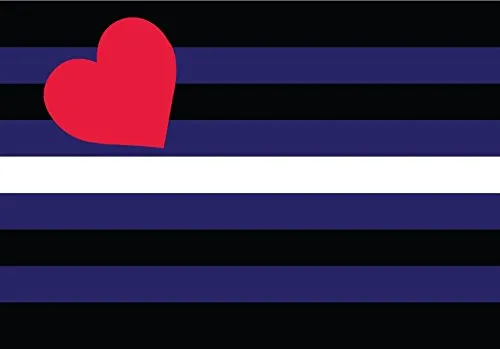
A nine-stripe horizontal flag alternating black and royal blue around a central white stripe, with a tilted red heart in the canton. Tony DeBlase designed it and first presented it at International Mr. Leather in Chicago on May 28, 1989, timed to the twentieth anniversary of Stonewall so that leather contingents would have a banner for that June's pride marches. He offered it as a working draft rather than a finished emblem, expecting the community to revise it, and it was adopted essentially unchanged. DeBlase assigned the colors no meanings — "I will leave it to the viewer to interpret the colors and symbols" — and never explained them; the readings in circulation since, black for leather, blue for denim, white variously for purity or integrity or safety, and the heart for love, were supplied by the community rather than the designer.
Key facts
- Designer
- Tony DeBlase
- Created
- First documented public use
- In use
- 1989–present
- Aspect Ratio
- 3:5
- Stripes
- 9
- Origin
- Chicago, Illinois, United States
- Represented Identity
- leather community
Also known as
- Leather Flag
Status Canonical
Archive categories Subculture Pride Flags · Historical and Early Pride Flags
Overview
DeBlase timed the flag to the 20th anniversary of Stonewall, framing leather identity within the broader liberation movement. He was inspired by the rainbow-colored balloons at Gay Games II and the pride rally in San Francisco and wanted something comparably "simple and elegant" for leather people. [1]
The flag was designed in 1989, deep in the AIDS crisis. San Francisco's Folsom Street "Miracle Mile" had been a center of leather culture from the 1960s through the 1980s. AIDS killed many in the community and closed venues across the district.
In 1984, Mayor Dianne Feinstein ordered the closure of San Francisco's bathhouses, dealing what historians call a "death blow" to the city's pioneering leather culture. Lesbian leatherwomen worked to care for gay men afflicted with AIDS, despite facing backlash from mainstream society and from "vanilla" Queer individuals who blamed kink for the epidemic. The leather community ran fundraising and caregiving efforts while the federal government was largely ignoring the disease. In 1985, the first Up Your Alley Street Fair was organized specifically to raise money for AIDS-related causes. [1] [2]
Identity & Context
- Represented Identity
- leather community
- Subcommunity
- leather, BDSM, and fetish communities, including but not limited to gay men
Creators
The Creator
Tony DeBlase
Designer
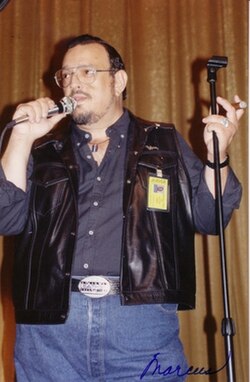
Anthony "Tony" DeBlase (April 3, 1942 – July 21, 2000) held a Ph.D. in biology specializing in mammalogy, and worked at Chicago's Field Museum of Natural History for at least ten years; his book The Bats of Iran (1977) described all 38 bat species of Iran and identified a new native species. He co-authored A Manual of Mammalogy (1974), and took the pen name "Fledermaus," German for bat, from the doctoral work on bats whose story he set in a German castle. He wrote fiction under that name and was editor of Drummer magazine. [1][3][2][4] DeBlase founded DungeonMaster magazine in 1979, which ran to 49 issues.
In 1986, he and partner Dr. Andrew Charles moved from Chicago to San Francisco and purchased the previously ailing Drummer family of magazines through their company Desmodus. He created Sandmutopia University, a nationwide network of BDSM instructors who lectured at leather bars in major American cities.
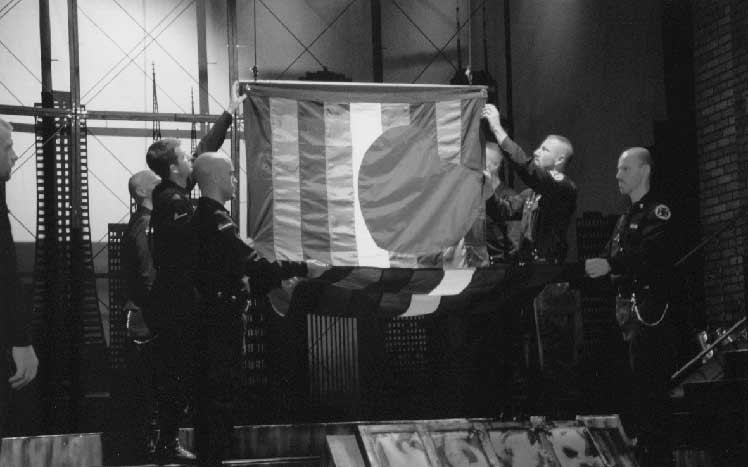
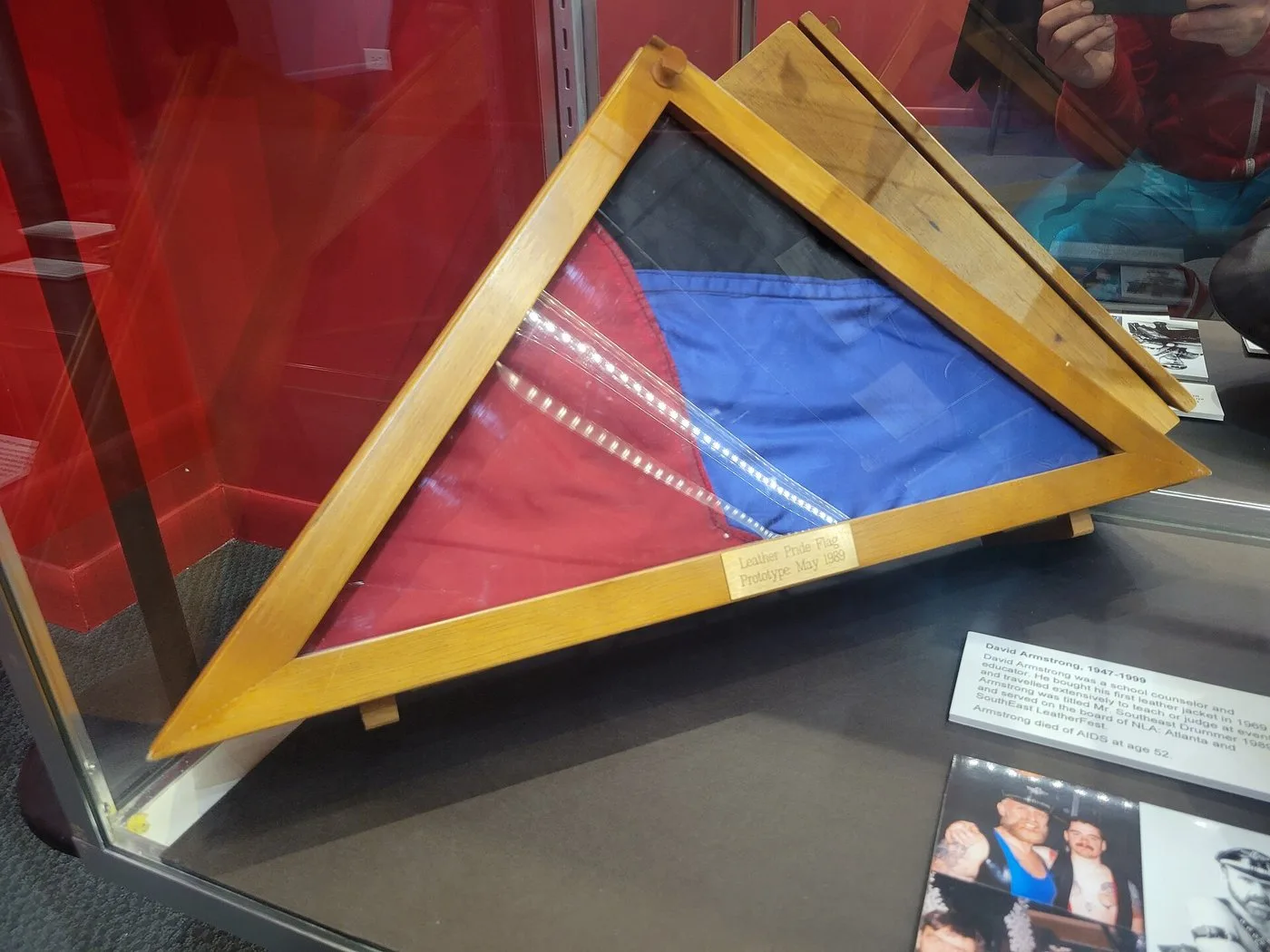
In 1988, DeBlase moved the Mr. Drummer contest to coincide with the Folsom Street Fair, creating San Francisco Leather Pride Weekend. He co-founded the Leather Archives & Museum in 1991 with Chuck Renslow, serving as Vice President until his death. The original prototype of the Leather Pride Flag is housed at the Leather Archives & Museum in Chicago. [1][2][3] His honors include NLA's Man of the Year (1987), Pantheon of Leather Lifetime Achievement Award (1994), and the Forebear Award (1997). He died July 21, 2000, in Portland, Oregon, of liver failure at age 58, survived by his partner of over 24 years. [1][2] DeBlase presented the Leather Pride Flag as a "proposed design idea" at International Mr. Leather 11 on May 28, 1989. He expected the community would suggest changes; instead, the flag was adopted as-is so quickly that no changes were ever made. He chose not to form a committee: "I decided that calling a committee meeting to design it would be counterproductive, so I just did it. I consulted with most of the staff here at Drummer and some of their suggestions were incorporated." The original design had a red central stripe; a colleague at Drummer Magazine suggested changing it to white, the only modification from his initial concept. [1][3]
For the 20th anniversary of Stonewall, I felt that the time was right for the Leather men and women who have been participating in these same parades and events more and more visibly in recent years to have a similar simple, elegant banner that would serve as a symbol of their own identity and interests.
I will leave it to the viewer to interpret the colors and symbols.
Motivations
Origin
- Country
- United States
- Region / state
- Illinois
- City
- Chicago
- Specific Place
- International Mr. Leather
- Place Type
- leather/kink community event
- Origin Type
- first_circulation
- Physical Origin Status
- verified
Created in Chicago, Illinois, on the traditional homeland of the Council of the Three Fires (Bodewadmik/Potawatomi, Ojibwe, Odawa) and the Myaamiaki (Miami), among other nations, ceded under the Treaty of Chicago (1833). [5][6]
Indigenous land context
Bodewadmik (Potawatomi) — homeland ceded under the Treaty of Chicago (1833). The Potawatomi are the primary nation associated with the Chicago area as "Keepers of the Fire" in the Council of the Three Fires alliance. [5][6]
Ojibwe — traditional territory of the Council of the Three Fires [5]
Odawa — traditional territory of the Council of the Three Fires [5]
Myaamiaki (Miami) — historic homeland. The Miami-Illinois language gave Chicago its name (shikaakwa, referring to wild leeks). [6]
Colonial / settler context
This flag debuted at International Mr. Leather on land ceded under the Treaty of Chicago (1833) through the Indian Removal Act. The treaty compelled the Council of the Three Fires to surrender their remaining lands east of the Mississippi. [6]
- Land status
- Treaty-ceded under duress (Treaty of Chicago, 1833; Indian Removal Act)
- Indigenous engagement
- None documented
- Continuing presence
- Council of the Three Fires descendants in Wisconsin, Michigan, Kansas, and Oklahoma; multiple additional nations (Ho-Chunk, Meskwaki, Sauk, Menominee, Kickapoo) maintain historic ties to the region
First presented at International Mr. Leather in Chicago on May 28, 1989. [7] [8]
Dates & Chronology
- Year Created
- Exact date
- First public use
- Period in Use
- 1989–present
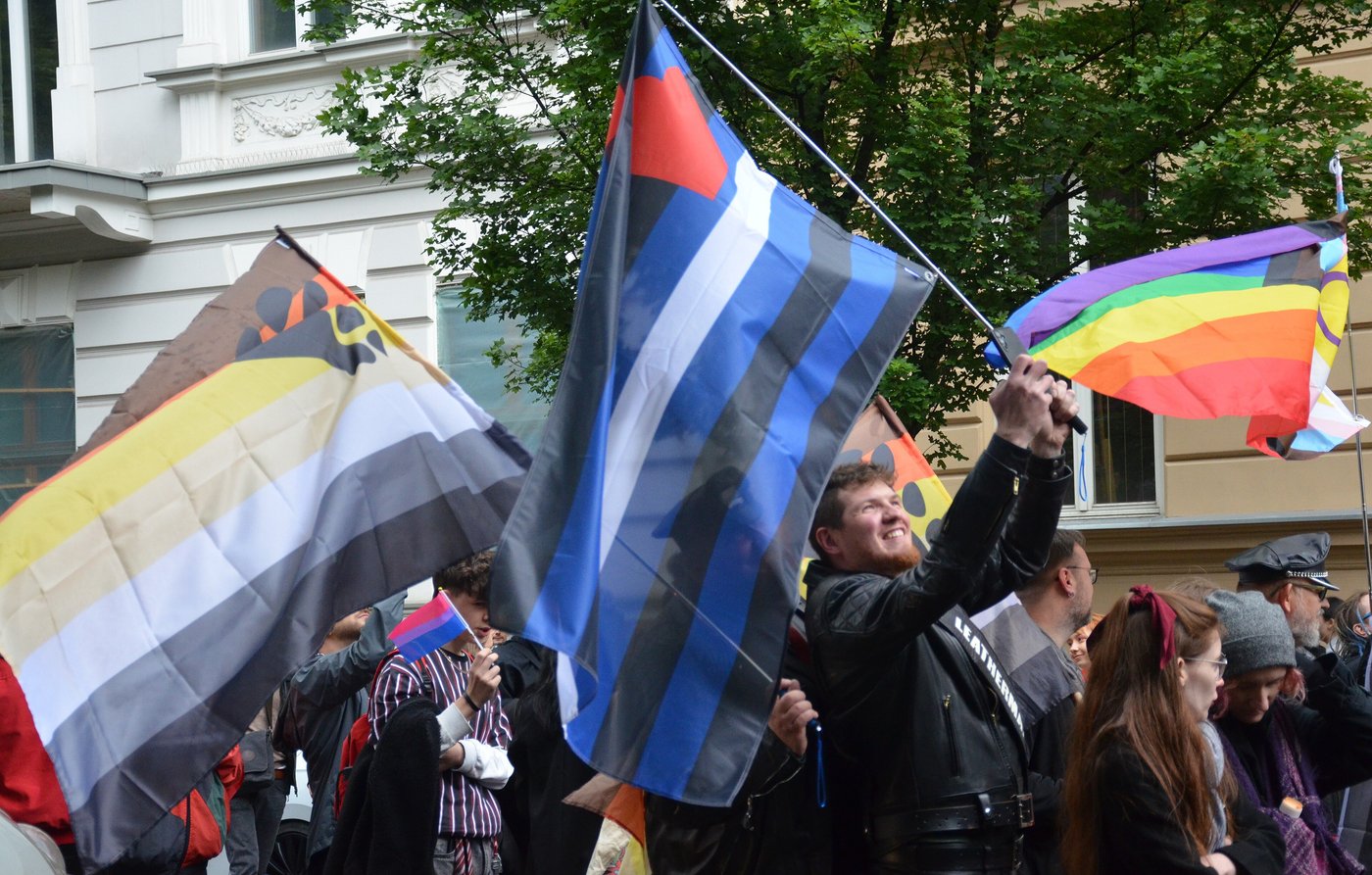

The flag appeared in parades within a month and as bumper stickers within two months of its debut. [1][3] Susie Shepherd, International Ms. Leather 1989, wrote to DeBlase for permission to make one, and her partner K.T. Chase carried it in Portland, Oregon's pride parade in June 1989.
IML incorporated the flag's design into its winner's sash in the early 1990s. Some on the East Coast were offended that DeBlase had not involved the community in creating the design, but the majority embraced it, and no significant revisions have ever been made. Its usage later expanded beyond exclusively gay male leather communities to encompass broader BDSM and fetish communities. [1][8]
In 1991, Melbourne Leather Men became the first club known to incorporate the flag's design into their identity. [9] In 2006, Kink.com flew the Leather Pride Flag atop the San Francisco Armory building. [10] In 2017, the South of Market Leather History Alley opened in San Francisco, featuring metal bootprints honoring DeBlase among other leather community figures. [11]
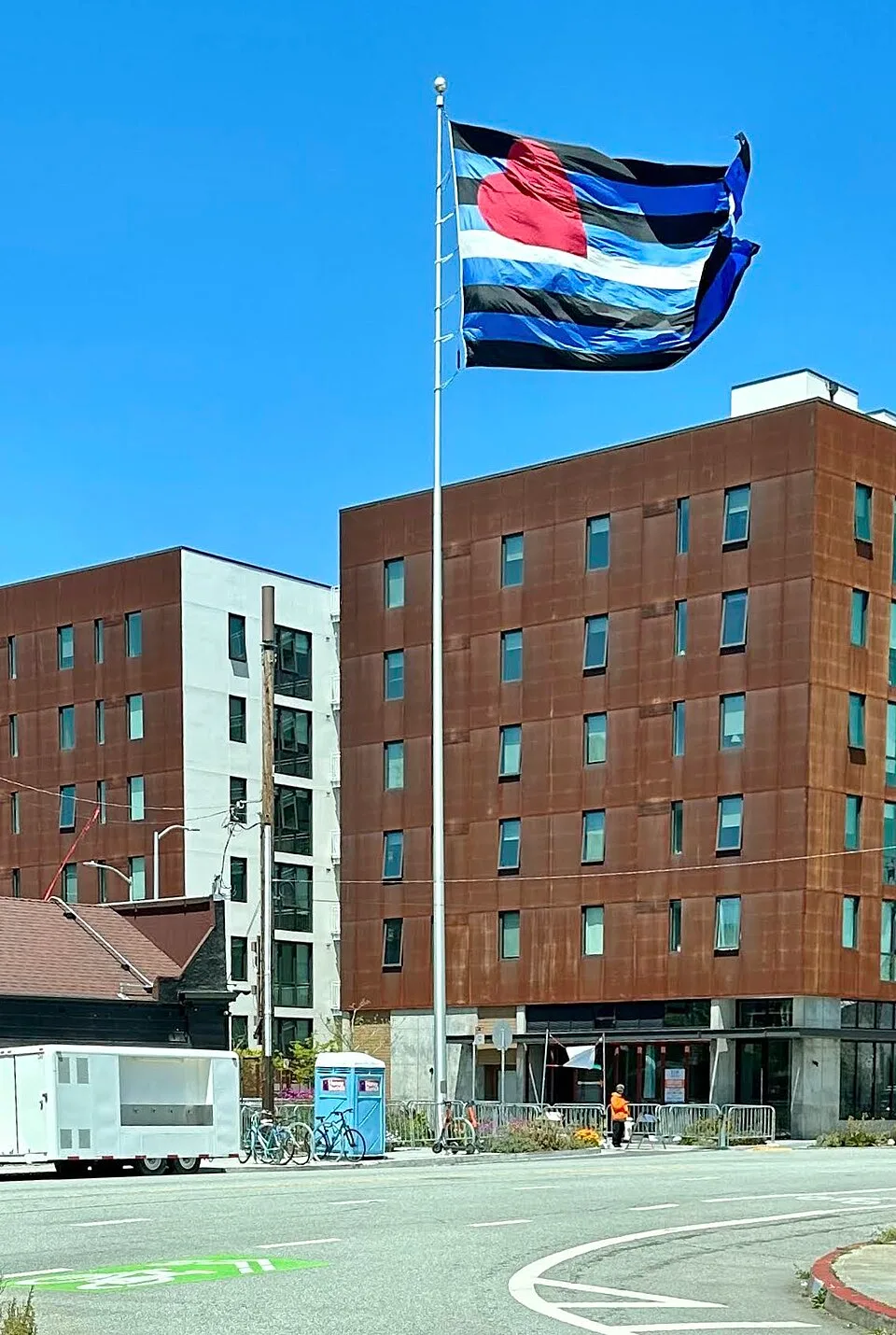
In 2023, Eagle Plaza in San Francisco installed a permanent 20-by-30-foot Leather Pride Flag flying 80 feet high. [11]
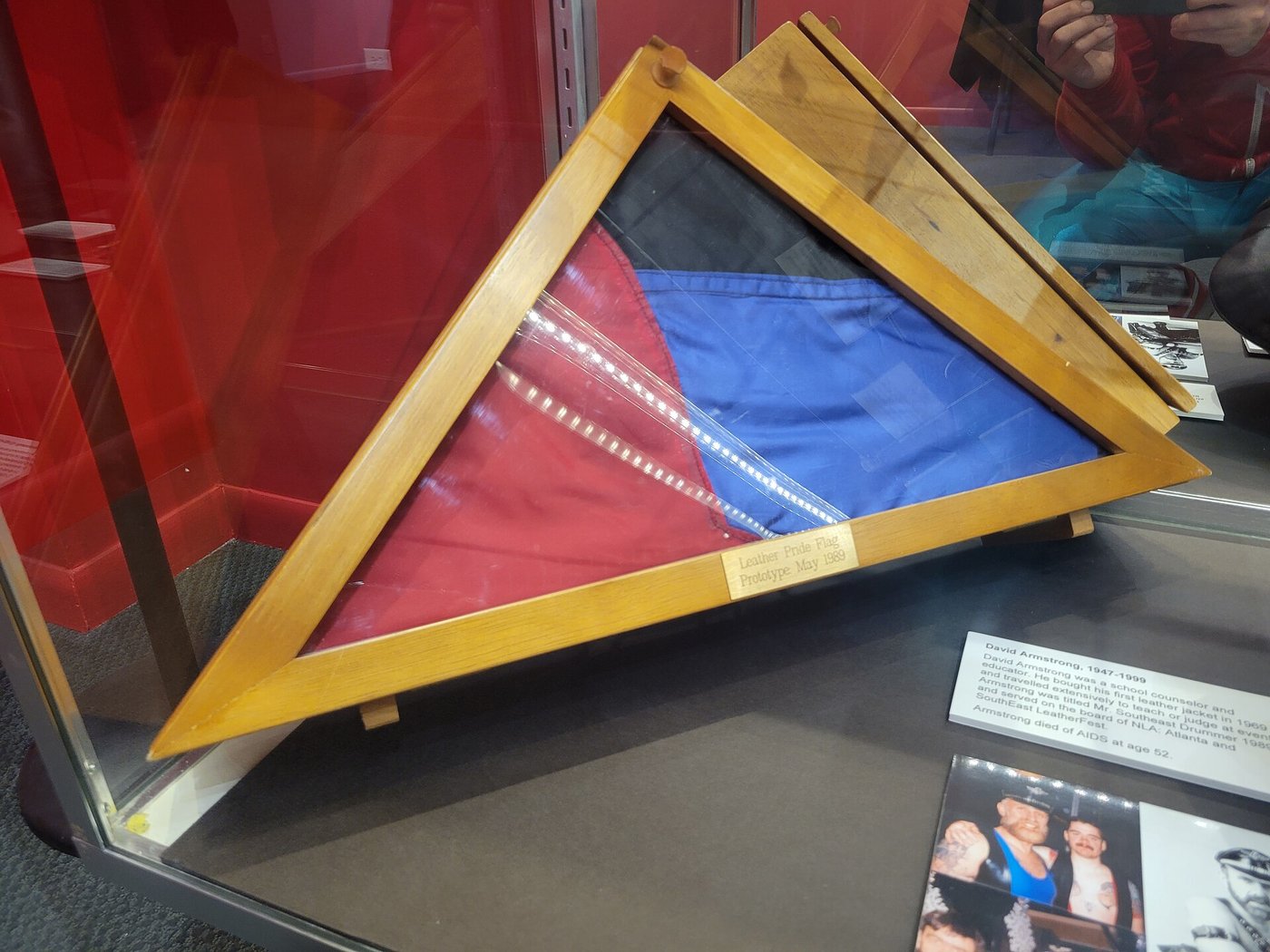

The original design had a red central stripe, changed to white on a colleague's suggestion at Drummer, the only modification from DeBlase's initial concept. He presented the flag as a 'proposed design idea' expecting the community to suggest modifications, but it was adopted as-is so quickly that no changes were ever made. [1][3] The original prototype is housed at the Leather Archives & Museum in Chicago, which DeBlase co-founded in 1991. [3]
DeBlase dated the variants himself in a tenth-anniversary retrospective. Laurie Lane of Leatherworld in Melbourne applied the Southern Cross to the flag in 1990, and the Melbourne Leathermen became the first organization to take its design elements into their club colors in 1991. The International Mr. Leather sash was made in the flag's image by May 1991. In October 1991 a group from Toronto exhibited a flag with a row of red maple leaves through the white stripe, which DeBlase understood to be the only one ever made, though he had also seen a version with the heart replaced by a maple leaf. Where Stein's dates differ, this entry follows DeBlase. [12]
Lineage
- Indirect influences
- Rainbow Pride Flag
- Direct children
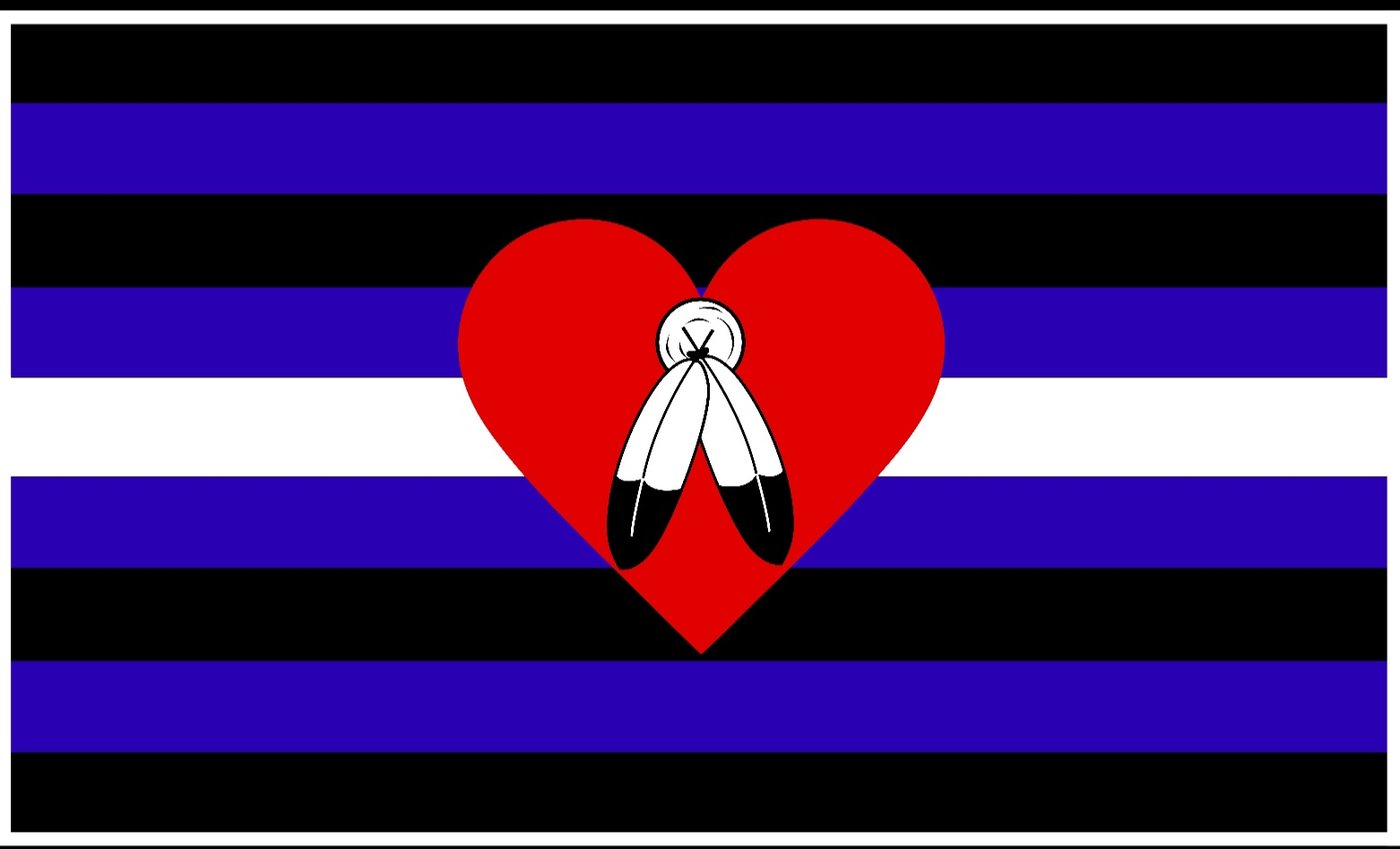
- BDSM Rights Flag (2005, Tanos), Chicago Leather Pride, Fetish Pride Flag, Foot Fetish Pride Flag (2020, Fetishie), Leather Girl Pride Flag, Leather Woman Pride Flag, Pup and Handler Pride Flag, Puppy Pride Flag, Two-Spirit Leather Pride Flag
- Related flags
- Rubber Pride Flag
An older neighboring subculture flag, not part of the direct gay-men-specific striped lineage. [7][8] The leather and bear communities share overlapping subcultural histories within gay male communities, and the International Bear Brotherhood Flag (1995) takes its layout from DeBlase's design: Paul Witzkoske, who drew it, wrote in 2011 that he "consciously chose to follow the layout of the Leather Flag placing the paw shape in the far corner at an angle and directly on the stripes," because the bear community "was perceived as a subset of the leather community," and that he chose seven stripes partly because this flag, the American flag and the original rainbow flag all carry an odd number. [13] Leather-side sources had asserted the connection for years without citing anything, and Les K. Wright's history of the bear flag does not mention this flag at all. [14] What Witzkoske claims is a debt of layout, for his own drawing rather than for Byrnes's crayon concept. Sheryl Dee's Leather Girl Pride Flag (2003) and Pup Flip Gray's Puppy Pride Flag (2011) both derive from DeBlase's design, extending the leather flag tradition into women's leather and pup play, respectively.
Lineage tree
Every record reachable from this one through documented parent and child relationships: 11 records across 3 generations.
- This record
- Leather Pride Flag
- Children
- Leather Girl Pride Flag, BDSM Rights Flag (2005, Tanos), Puppy Pride Flag, Leather Woman Pride Flag, Chicago Leather Pride, Fetish Pride Flag, Foot Fetish Pride Flag (2020, Fetishie), Two-Spirit Leather Pride Flag
- Generation 3
- Pup and Handler Pride Flag, Chicago Puppy Pride
Colors & Symbolism
DeBlase assigned the colors no meanings and refused to explain the design, in 1989 and again ten years later: "I will leave it to the viewer to interpret the colors and symbols." [12] The readings in circulation since were supplied by the community, not the designer.
| Colour | Hex | Designer | Community |
|---|---|---|---|
| Black | #000000 | None | Leather. [3][10] |
| Royal Blue | #2A2A7F | None | Denim. [3][10] |
| Black | #000000 | None | Leather. [3][10] |
| Royal Blue | #2A2A7F | None | Denim. [3][10] |
| White | #FFFFFF | None | Variously purity, integrity, safety, or solidarity with newcomers; the readings diverge here. [3][10] |
| Royal Blue | #2A2A7F | None | Denim. [3][10] |
| Black | #000000 | None | Leather. [3][10] |
| Royal Blue | #2A2A7F | None | Denim. [3][10] |
| Black | #000000 | None | Leather. [3][10] |
| Red (Heart) | #E70039 | — | — |
Circulating community values
This flag has no official digital palette. Color values shown are approximate.
- Tilted red heart
- None
DeBlase assigned the colors no meanings and said so in the announcement itself: "I will leave it to the viewer to interpret the colors and symbols." He never relented, writing ten years later that he remained glad he had never explained his reasons for the design elements, and that the interpretations he had heard since were all better than his originals. [12] The readings below were supplied by the community and are recorded with their attributions rather than presented as the flag's symbolism. They agree on black for leather and the red heart for love; they diverge on white — purity, innocence, integrity, safety, or solidarity with newcomers — and on blue, usually denim but sometimes devotion and loyalty. Library.LGBT's entry leaves its "Colors & Meanings" block empty, which on a site that fills it for every other flag reads as deliberate. [7] Secondary guides increasingly assert a fixed key as fact, including readings such as blue for "openness and diversity" that appear in no attributed community account.
Readings supplied by the community
- Stacey, Ms. National Leather Association International 1996 · 1996
- The red heart is for love, the white stripe for purity in an open, honest and understanding relationship, the black stripes for leather and the blue ones for denim — both materials frequently worn in the scene. [3]
- International Leatherman, issue 25, reported by Michael Wilson · 1999-07
- Black is for leather and for permanence; blue is for devotion, loyalty and community; white is for purity and innocence; the red heart is for the love of leathermen for each other and for their community. [3]
- Steve Kramer, Flags of the World · 2000
- The red heart stands for love, and the white middle stripe for safety over all. [3]
- German-language leather resource, translated by M. Schmöger · 2001-08-24
- Black is the color of S/M followers; blue for followers of the jeans fetish; white for solidarity with novices of the S/M scene; the heart signifies that S/M has nothing to do with raw violence but is practiced with mutual respect, consent and understanding. [3]
DeBlase did not publish exact color values, so no official hex specification exists. [8] The hex values given here are the most commonly circulating community conventions. Variant Royal Blue values include #252580 and #171796. Variant Red heart values include #E80035. The exact shade varies across flag manufacturers and digital reproductions. [15]
Design
- Aspect Ratio
- 3:5
- Orientation
- horizontal
- Stripe Count
- 9
- Layout
- horizontal_stripes_with_emblem
- Stripes (Top → Bottom)
- Black, Royal Blue, Black, Royal Blue, White, Royal Blue, Black, Royal Blue, Black
- Additional Symbols
- Tilted red heart in upper-left canton
Nine equal horizontal stripes. The centre stripe was originally red: a Desmodus staff member who drew up DeBlase's design pointed out that the tip of the red heart bleeding into a red stripe would not read, and DeBlase changed it to white. It was the only one of that designer's many suggestions he accepted, and the only change to his original concept. [12] No aspect ratio was specified by the designer. Flags are manufactured at the standard 3:5 (three feet by five), the ordinary commercial flag size, which is a production convention rather than a design specification. Owner-attested from physical copies; no published source states a ratio.
Usage & Adoption
- First Users
- Portland, Oregon pride parade leather contingent (June 1989) — first pride parade appearance, carried by K.T. Chase
- Organizations
- International Mr. Leather (IML), International Ms. Leather (IMsL), Leather Archives & Museum (co-founded by DeBlase, 1991), Folsom Street Fair, NLA (National Leather Association)
- Geographic Usage
- International circulation
- Event Usage
- International Mr. Leather and other leather/kink events, Pride events internationally
- Current Status
- active
The flag has been in continuous use as the primary leather-community pride symbol since 1989. [7] [8] Its use later expanded to encompass broader BDSM and fetish communities. [8]
Image Archive
The Original Flag
Variants and Descendants

The Flag in Use

Women in Leather
Archive
_(8020203285).jpg)
Discourse & Debates
- The expansion from a specifically gay male leather flag to a broader BDSM/fetish symbol has been contested. Some argue for preserving leather's specific gay male heritage and its roots in post-war masculine subculture; others work to make leather more inclusive across orientations and gender identities. The old idea that "to be leather you need to be super muscular or manly" has begun to dissolve. [2]
- DeBlase explicitly said the flag was for "Leather men and women," and a separate BDSM flag alternative was later created by "Master Tanos" (retaining white, blue, and black but substituting the red heart with a BDSM emblem) for those who wanted a symbol distinct from leather's specific cultural lineage. [1]
- The recurring tension between leather/kink visibility and respectability politics at Pride has deep historical roots. Leather and kink people were present at both the Compton's Cafeteria riot (1966) and the Stonewall uprising (1969). [10] Brenda Howard, widely known as the "Mother of Pride," was a bisexual leather fetishist who organized the first Christopher Street Liberation Day Parade in 1970. [19] Despite this foundational role, San Francisco Pride attempted to ban BDSM imagery as early as the late 1970s, and similar efforts have recurred in subsequent decades. [10][19]
- Whether one person should have designed it at all. Barry Douglas, then chair of GMSMA, wrote to DeBlase that the flag "lacked immediately recognizable meaning" and that "the colors black and blue are overly obvious and leave us open to criticism and possible sarcasm," and argued for a design contest open to leather and BDSM organizations. DeBlase answered that a competition would have taken too long and produced recriminations from every losing entrant. The Chicago Hellfire Club, of which he was a member, refused to fly the flag in 1989 as too controversial and relented in 1990. [1]
- Whether to assign the colors meanings at all. DeBlase declined to and never changed his mind. Some leather writers treat the openness as the point and resist fixing a key; others circulate one. Both positions are held within the community. [3][10][20]
- Kink at Pride. The flag is flown as an argument as well as an emblem: that leather and BDSM communities were present at Stonewall and in early Pride marches, and that excluding them concedes to respectability politics. The counter-position, held within the community rather than only outside it, is that kink belongs at adult-only Pride events rather than general ones. Both appear in the same 2025 thread. [21][10][19]
- The first flag given to New York did not survive its first year. DeBlase recorded that a GMSMA member later told him the flag had been found in a pile of trash at the community center where GMSMA met, and taken home by the man's partner. Barry Douglas, GMSMA's newly elected chair, had written to thank DeBlase for the gift and to describe the conflicted reactions it drew, closing "We will keep the flag safe and bring it out for the appropriate events." DeBlase wrote that he did not know where that original run had ended up and had received no reply from GMSMA. The San Francisco flag fared better: the Society of Janus, custodian for the city alongside the Outcasts, still held it a decade on. [12]
- The Schwules Museum, assessing the flag in 2019, described it as marking a turn away from covert signalling such as the hanky code and toward public visibility for leather and BDSM communities. [8]
Common misidentifications
- The flag has been claimed to originate as a shipping error rather than a design. William M. Grimes-Wyatt reported in 1996 that Taiwanese factories produced Frisian and East Frisian flags — blue and white stripes with red heart-shaped lily pads — and that an importer who received some by accident listed them as leather pride, after which the name stuck. Steve Kramer, who spoke with Grimes-Wyatt directly, records that the incident probably occurred but during the 1990s, after the flag already existed, and is therefore not its origin. [3]
Criticisms
- Despite facing the same stigma and police oppression as other Queer people, leather communities have been repeatedly excluded from Pride. Pride organizers tried to ban leather contingents, Queer leather groups were denied access to feminist and community centers, and their writing and art were excluded from bookstores and periodicals during the "Lesbian Sex Wars" of the 1980s. Calls to ban or moderate leather, overt sexuality, and drag from Pride persisted into the 1990s and resurface every Pride season. [2]
- The recurring "kink at Pride" debate asks whether leather and kink apparel is inappropriate in public Pride spaces. Critics argue this is really about policing LGBTQ sexuality — requiring some participants to suppress important elements of their identities so that LGBTQ culture appears compatible with mainstream standards. As one observer noted: "If you assimilate, if you give up what makes you different, you can have rights." [2]
The flag originated in gay male leather communities but is now used more broadly across BDSM and fetish communities regardless of orientation. Kink has been part of Pride since its inception, with leather contingents and Dykes on Bikes long visible in San Francisco's parade. Leathermen and women have long been educators and advocates for safe sex, with many protocols requiring political activism and community service to "earn" specific leather garments. [2]
Footnotes & Citations
Sources and footnotes 31 sources
- 1. Seven Things Most People Don't Know About the Leather Pride Flag. Stephen K. Stein. Medium (2022-03-08). Accessed 2026-07-27
- 2. Tony DeBlase. Leather Hall of Fame. Accessed 2026-03-15
- 3. Leather Pride Flag. FOTW contributors (David Hawks, Chris Zimmerman, M. Schmöger, Steve Kramer, Michael Wilson, Tomislav Todorović); page editor Randy Young. Flags of the World (FOTW) (2025-01-11). Accessed 2026-07-27
- 4. Encyclopedias & Reference Tony DeBlase. Wikipedia contributors. Wikipedia (2026-07-21). Accessed 2026-07-27
- 5. Organizations Native Truths: Our Voices, Our Stories. Field Museum. Accessed 2026-03-19
- 6. Academic Land Acknowledgement. University of Chicago. Accessed 2026-03-19
- 7. Leather Pride. Library.LGBT Pride Flag Guide (2021-06-21). Accessed 2026-07-27 · Archived version
An archived capture; the site went offline in July 2026. Published by Albany Pride, Western Australia; it names no author and cites no sources.
- 8. Leather pride flag. Wikipedia. Accessed 2026-07-27
A museum exhibition text. Its 2019 reading of the flag is an institutional interpretation, attributed as such.
- 9. Leather Pride Flag. GoPride Chicago. Accessed 2026-03-30
- 10. The Leather Pride Flag: The Complete History. Eloisa De Farias. INTO. Accessed 2026-07-27
- 11. Leather History. Aphyr. Accessed 2026-03-30
- 12. Archived Sources A Leather Pride Flag by Tony DeBlase — Leather Archives & Museum exhibit. Tony DeBlase. Leather Archives & Museum (1999). Accessed 2026-07-27 · Archived version
- 13. The Bear Flag and My Part in Its Creation. Paul Witzkoske. Originally a Facebook note (note_id 10207949587133610); archived by ArchivalFlags (2011-06-14). Accessed 2026-07-28
- 14. The Bear Flag: Craig Byrnes and the International Bear Brotherhood Flag. Les K. Wright. Bear World Magazine (2024-01-02). Accessed 2026-07-24
- 15. Leather Pride Flag Color Codes. SchemeColor. Accessed 2026-03-30
- 16. Articles & Reports Off the Top: A Leather Pride Flag. Fledermaus [Tony DeBlase]. Drummer 131 (July 1989), p. 4 · Desmodus, Inc., San Francisco (1989-07). Accessed 2026-07-27 · Archived version
- 17. Designer page Pride and Fetish Flag Gallery. The Twilight Guard. The Twilight Guard. Accessed 2026-08-03 · Archived version
- 18. Encyclopedias & Reference International Ms. Leather. Wikipedia. Accessed 2026-08-04
- 19. No Kink at Pride?. Out.com. Accessed 2026-03-30
- 20. Articles & Reports Tony DeBlase and the Leather Pride Flag. Robin Goodfellow. esclavecaroline (blog) (2010-05-20). Accessed 2026-07-27
- 21. Social media Kink at Pride — Why I'm Flying the Leather Flag Today. u/the_enbyneer. Reddit (r/lgbt) (2025-06). Accessed 2026-07-27
- 22. Designer page Frequently Asked Questions (The Emblem Project). Quagmyr. The Emblem Project. Accessed 2026-08-05
- 23. Government Circular 33: Works Not Protected by Copyright. U.S. Copyright Office. U.S. Copyright Office (2021-03). Accessed 2026-07-27
- 24. Government Compendium of U.S. Copyright Office Practices, Third Edition — Chapter 900, Visual Art Works. U.S. Copyright Office. U.S. Copyright Office (2019-03-15). Accessed 2026-07-27
- Articles & Reports Leather Pride Flag History. Lcroma. Accessed 2026-03-18
- Copyright in Pride Flags. Jonathan Bailey. Plagiarism Today (2023-06-26). Accessed 2026-07-27
- Government Treaty of Chicago (1833). Forest County Potawatomi Community. Accessed 2026-03-19
- Rubber/Latex Pride flag. Randy Young; Tomislav Todorovic. CRW Flags / Flags of the World (2020-07-11). Accessed 2026-07-24
- Rainbow flag (LGBTQ). Wikipedia contributors. Wikipedia (2026-06-25). Accessed 2026-07-24
- Articles & Reports The Copyright Battle Over the Bisexual Pride Flag. Jonathan Bailey. Plagiarism Today (2020-04-29). Accessed 2026-07-27
- File:BDSM flag in front of the San Francisco Eagle Bar.jpg. PigeonChickenFish. Wikimedia Commons (2023-04-30). Accessed 2026-07-29
Image Sources
- Rendering
- standard heart-in-canton version
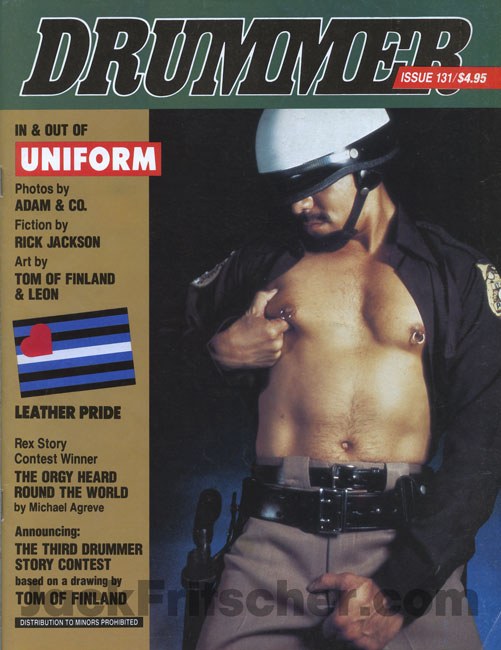
- Drummer 131, July 1989 — the issue carrying DeBlase's announcement of the flag on page 4. The flag appears on the cover under the words LEATHER PRIDE, which makes this its first published depiction. [16] · Credit: Desmodus, Inc. · via jackfritscher.com · fair use pending permission · Jack Fritscher — Drummer index
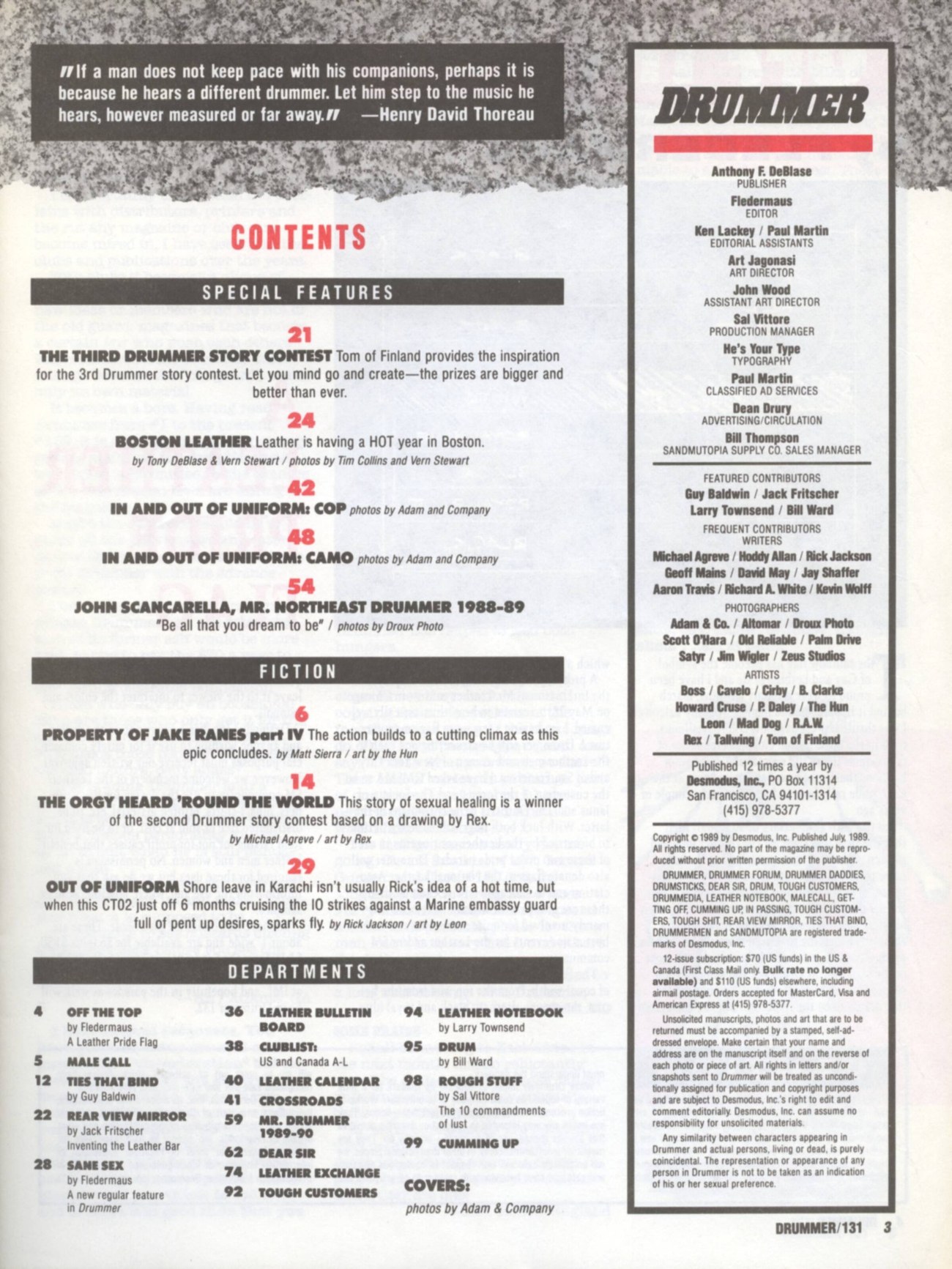
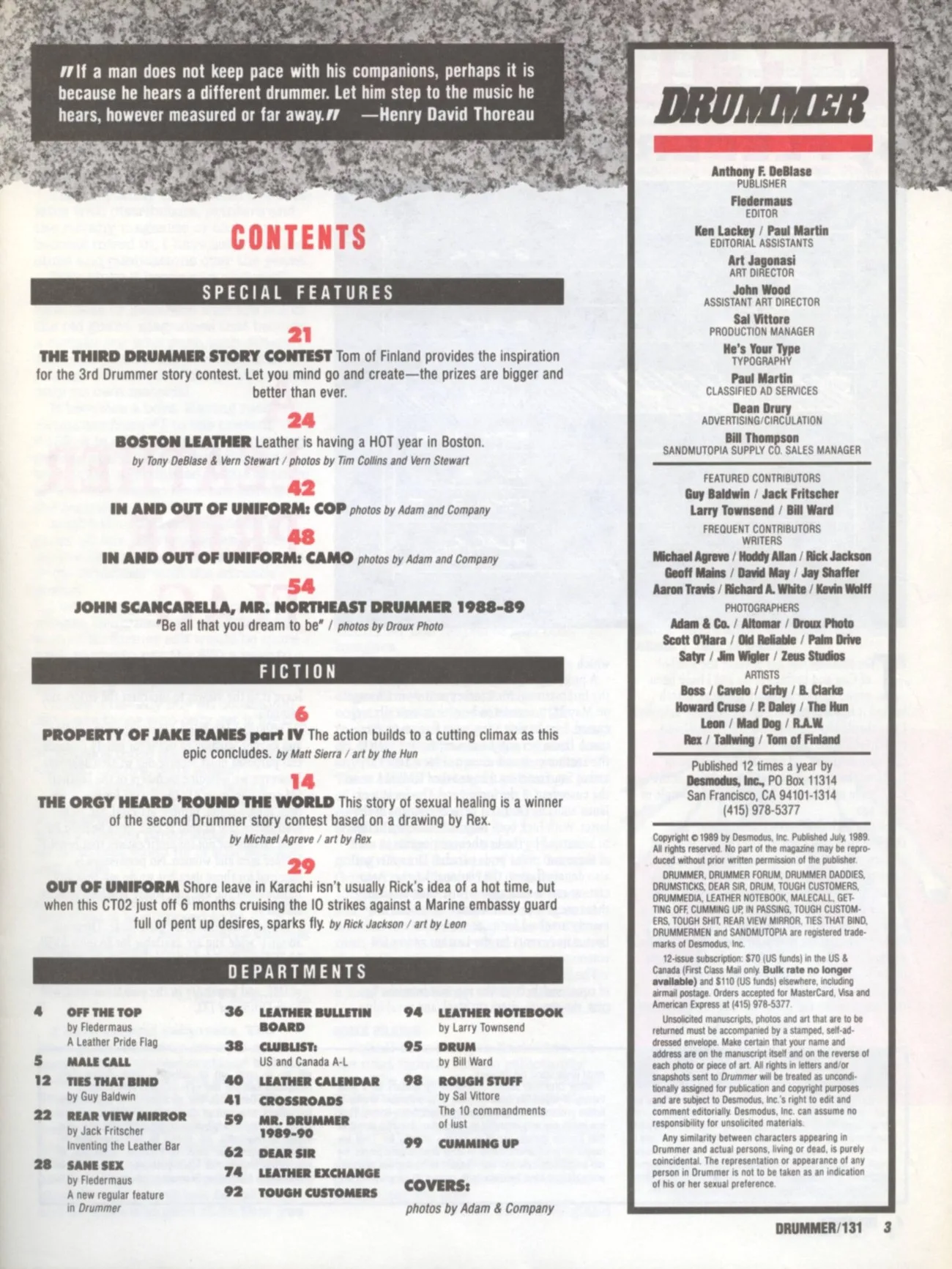
- The contents page that confirms the citation: "4 · OFF THE TOP by Fledermaus · A Leather Pride Flag." The masthead beside it credits Anthony F. DeBlase as publisher and Fledermaus as editor — the same man twice. [16] · Credit: Desmodus, Inc. · via jackfritscher.com · fair use pending permission · Jack Fritscher — Drummer index
- DeBlase presenting one of the three original flags he assembled as prototypes, at International Mr. Leather in 1999 — the tenth anniversary of the design's debut at the same event. It was received on behalf of the museum by the Men of Discipline. [12] · Credit: Leather Archives & Museum · fair use pending permission · Leather Archives & Museum
- The handover at IML 1999. DeBlase co-founded the museum with Chuck Renslow in 1991 and sat on its board until his death the following year. [12][4] · Credit: Leather Archives & Museum · fair use pending permission · Leather Archives & Museum
- One of the three original flags DeBlase assembled in 1989, on display at the Leather Archives & Museum in Chicago. He presented it to the museum, which he co-founded with Chuck Renslow, at International Mr. Leather in 1999. [8][4] · Credit: Found5dollar · CC BY-SA 4.0 · via Wikimedia Commons · Wikimedia Commons
- Two-Spirit Leather Pride Flag, created March 28, 2024 by boy Chris (Christopher Hammel), founder and president of the Leather boys of Houston, for Two-Spirit people in leather and kink communities. A recent example of the adaptation DeBlase invited. · Credit: Leatherheart · CC BY 4.0 · via Wikimedia Commons · Wikimedia Commons
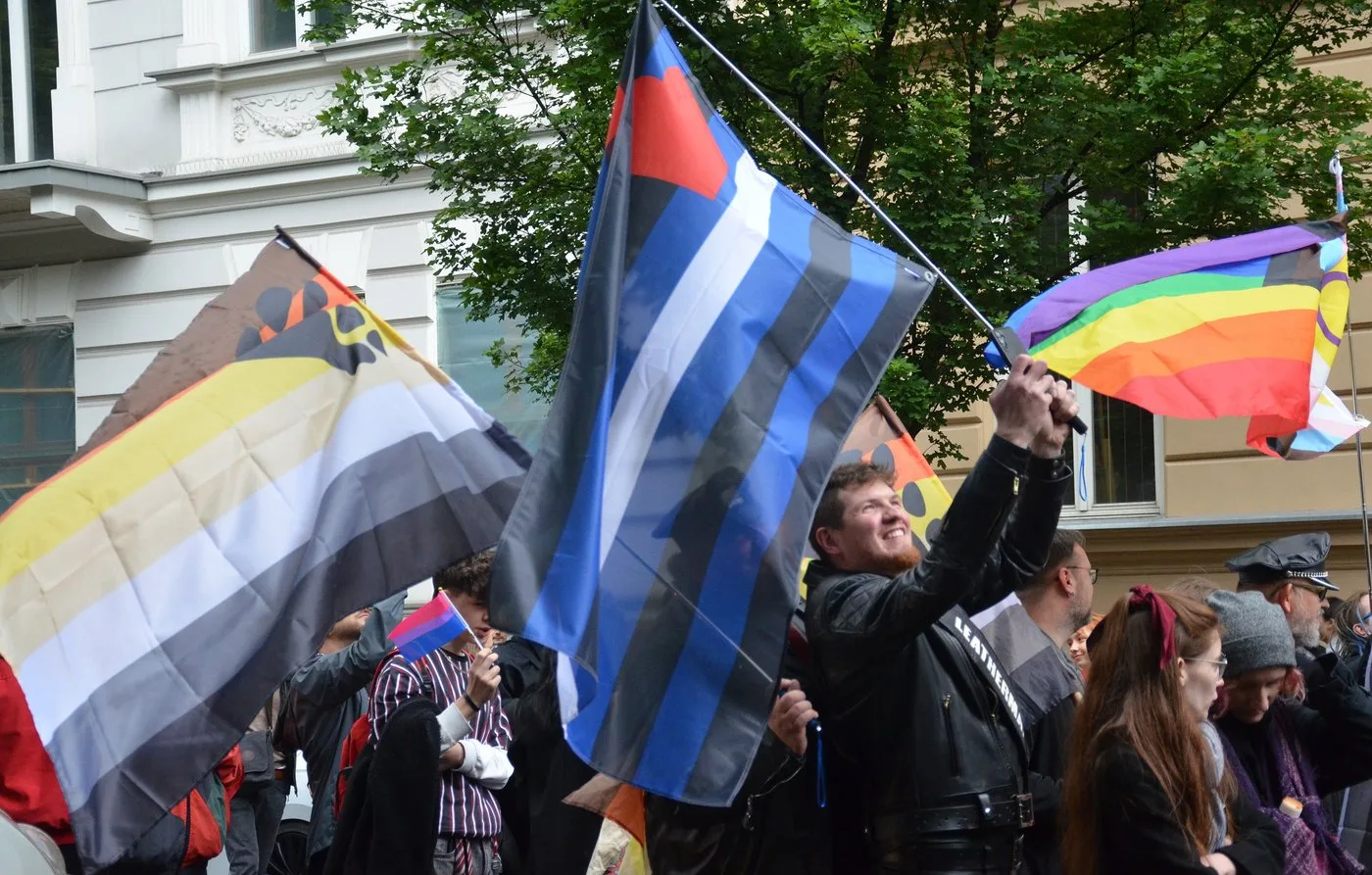
- The flag at the Equality March in Kraków, May 17, 2025 — leather contingents in European Pride marches thirty-six years after DeBlase intended it for exactly this use. [8] · Credit: Marsilar · CC BY-SA 4.0 · via Wikimedia Commons · Wikimedia Commons
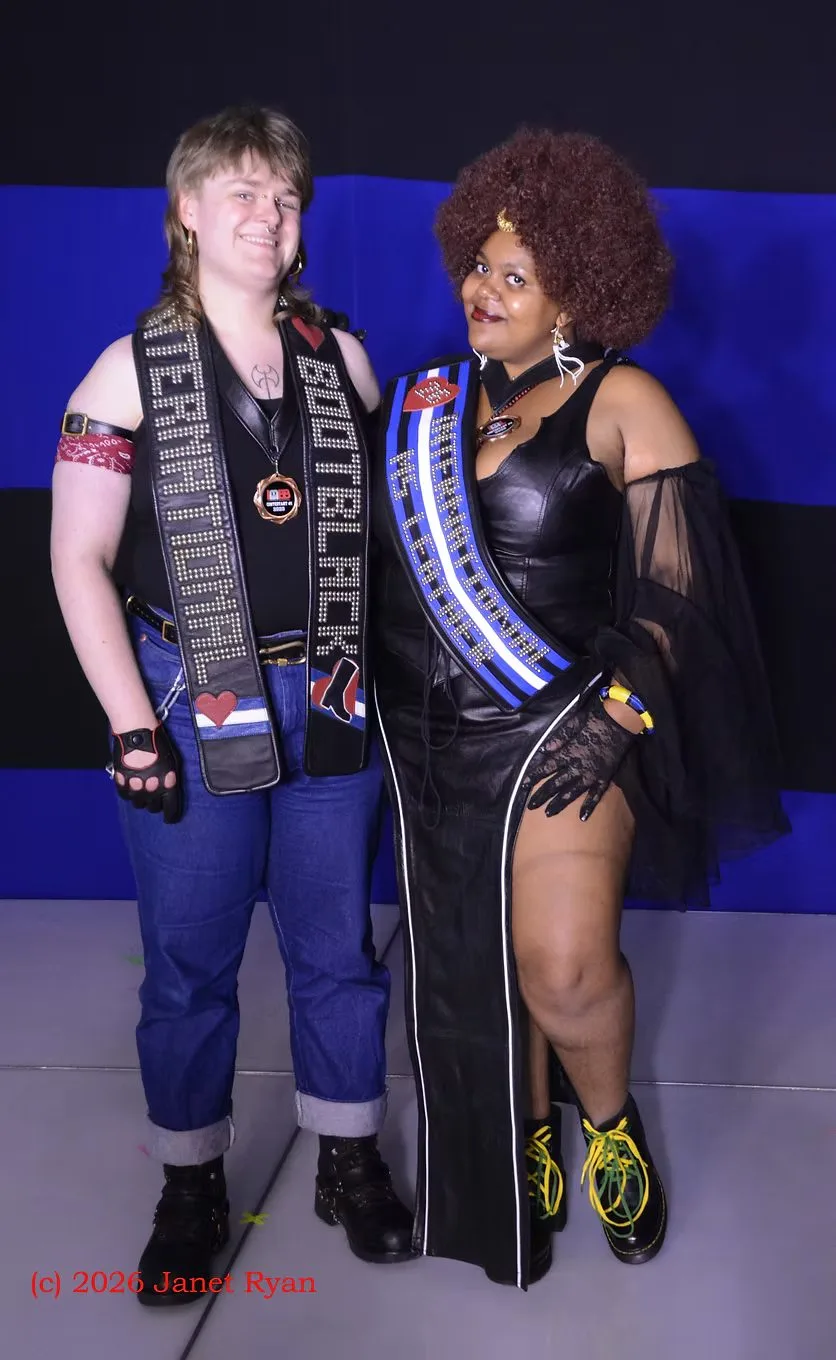
- The International Ms. Leather and International Ms. Bootblack titleholders of 2026, photographed by Janet Ryan. The Ms. Leather sash is striped as the Leather Pride Flag, red heart included, against a backdrop of the flag itself; per the contest's published tables the 2026 titleholders are Akasha Eden of New York (IMsL) and Astrid of London (IMsBB), the first IMsBB winner from outside North America. [18] · Credit: © 2026 Janet Ryan · IMsLBB
- A leather pride flag flown at the San Francisco Eagle, 30 April 2023. The bar stands in the city's Leather and LGBTQ Cultural District. · Credit: PigeonChickenFish, CC BY-SA 4.0 · Wikimedia Commons
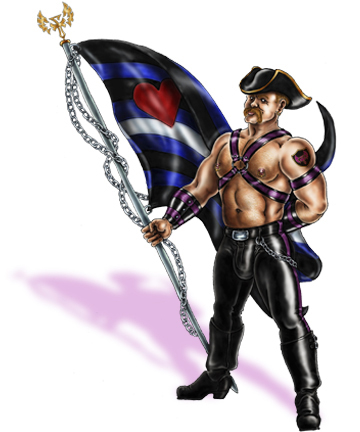
- The Leather Pride Flag as drawn for the Twilight Guard, a Connecticut and New York fellowship of leathermen and bears founded in July 1995. [17] · Credit: The Twilight Guard. Sean Patrick Campbell served the club as resident artist, webmaster and flyer designer, and six flags on the same gallery are marked as his work; this illustration is not among the marked items and its artist is not separately named · The Twilight Guard, Pride and Fetish Flag Gallery
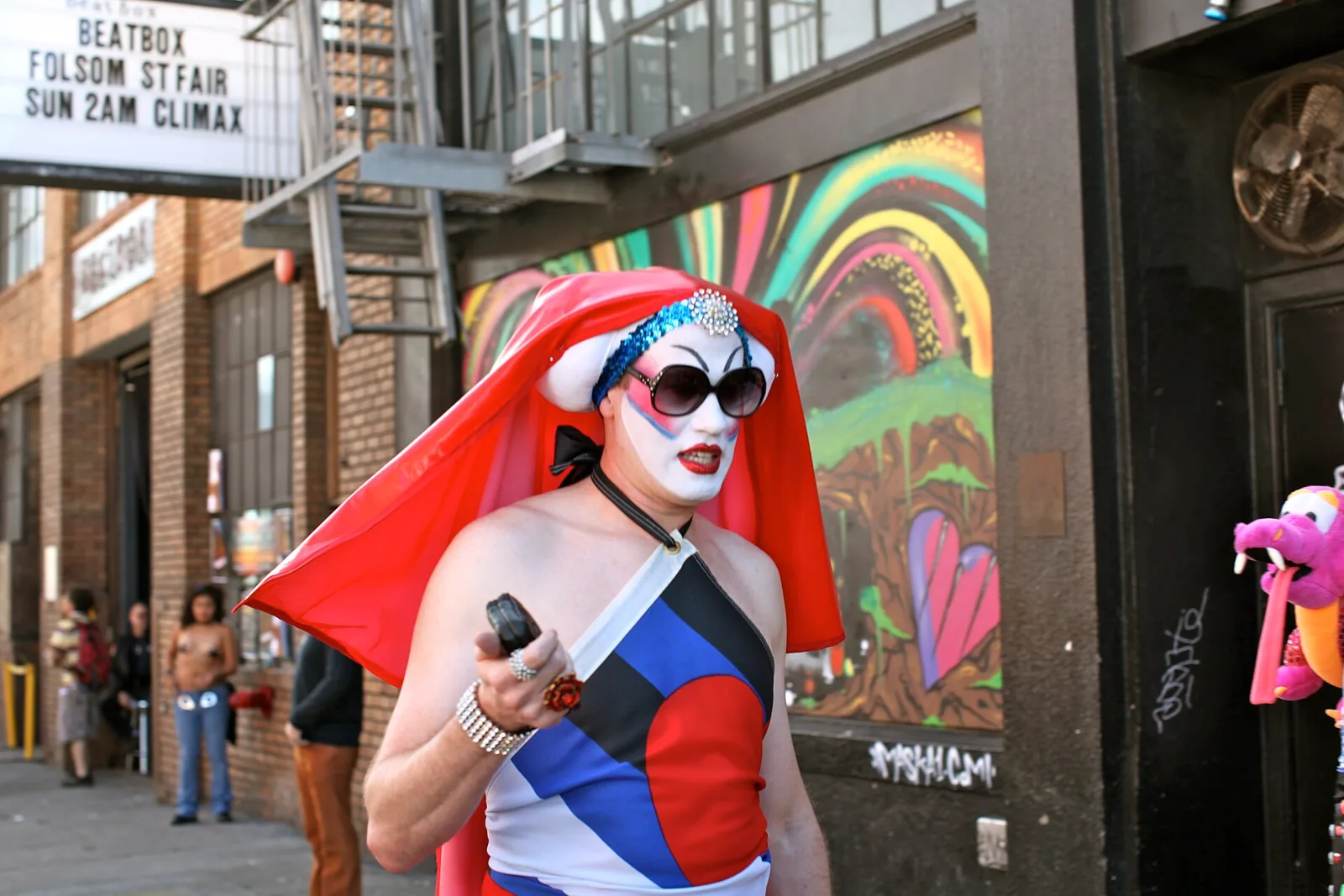
- A Sister of Perpetual Indulgence photographed at the Folsom Street Fair, San Francisco, 23 September 2012, wearing the Leather Pride Flag. A documented case of the flag in use. · Credit: Photograph: torbakhopper, 23 September 2012. · Wikimedia Commons, via FlickrRights CC BY 2.0 (Flickr, reviewed by FlickreviewR 2 on 10 June 2020).