Hijra Pride Flag
Cultural Gender Pride Flag ·
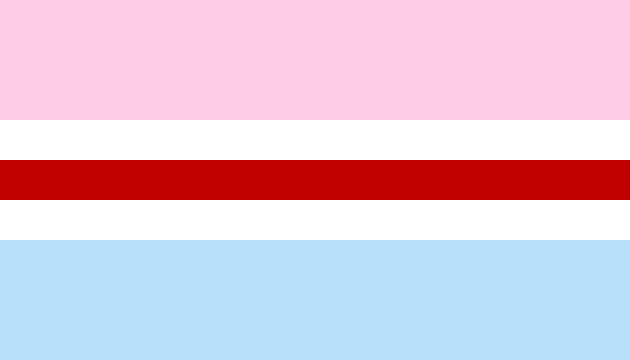
Five bands, pink, white, red, white and blue, designed in July 2018 by Samira, a Tumblr user who identified as hijra at the time and wrote that the red stands for "the divinity we were blessed with by Rama" [1]. In 2020 she disclosed she no longer identified as hijra and that "a community flag should be made by a member of said community" [1]. No documented use by hijra communities in South Asia exists; hijra organising runs through the transgender and rainbow flags, national flags, and traditional religious forms such as the Kinnar Akhara [2][3].
Key facts
- Designer
- Samira (floralfemmes)
- Created
- First documented public use
- In use
- 2018-present
- Aspect Ratio
- 7:4 · original artwork
- Stripes
- 5
- Represented Identity
- hijra
Also known as
- Hijra Flag
Status Proposed Contested
Archive categories Gender Identity Pride Flags · Cultural Gender Pride Flags · Regional and Language-Specific Pride Flags
Overview
The flag was made to give hijra identity a pride flag, which the creator, then identifying as hijra, believed it did not have.
Samira designed the flag in July 2018, identifying as hijra at the time and writing that to her knowledge no hijra flag existed [1]. In August 2020, with the post circulating widely, she added that she no longer identified as hijra and that "a community flag should be made by a member of said community", and said she would delete the original post [1]. The post remains up. No evidence has been found that hijra communities in South Asia were involved in the design or have adopted it [2].
Identity & Context
- Represented Identity
- hijra
- Subcommunity
- South Asian third gender / cultural gender identity
- Movement
- Hijra rights, third gender recognition
- Language Context
- Hindi, Urdu, Bengali, Nepali; internal language Hijra Farsi
- Religious Context
- Hindu (worship of Bahuchara Mata, Ardhanarishvara symbolism); also Muslim hijra communities
- Racial / Ethnic Context
- South Asian
- National Context
- India, Pakistan, Bangladesh, Nepal
Hijra is a culturally specific South Asian identity, organised through the guru-chela kinship system and structured into descent houses each led by a Nayak, that predates and does not map onto Western transgender frameworks [4][5]. How to name it is itself disputed: India's Supreme Court recognised hijra as a third gender in 2014 (NALSA v. Union of India), as have Nepal, Pakistan and Bangladesh, while hijras themselves have marched under signs reading "Hijras Are Women", and the writer Talia Bhatt argues the third-gender label is used to misgender them [6][7]. Accounts of the identity's age also differ, from epic-period references to a subculture emerging under the Delhi Sultanate [6][2].
Creators
The Creator
Samira (floralfemmes)
Designer
Known through her Tumblr blog, named divinehijra in 2018 and floralfemmes since. She identified as hijra when she designed the flag and stopped identifying as hijra by August 2020, repudiating the flag's basis in her own words. Nothing further about her has been documented.
"hi! I'm samir and I identify as hijra (an east indian/south asian trans/nonbinary identity) and to my knowledge there is no existing flag so I have made one." [1]
"this post is blowing up again, but I want people to know that I no longer identify as hijra. being lgbt+ means that I know that a community flag should be made by a member of said community, so I'm going to delete the original post" [1]
Attribution notes
Samira posted the flag on 4 July 2018 on her Tumblr blog, then named divinehijra and since renamed floralfemmes, identifying as hijra in the post itself [1][8]. On 4 August 2020 she added the retraction quoted above, saying she would delete the original post; it remains up, and carried 7,224 notes when read in August 2026 [1]. She signed the post samir in 2018 and samira in its current form [1].
Origin
- Digital Origin
- Tumblr (divinehijra, later renamed floralfemmes)
No verified physical origin location. The flag was created digitally on Tumblr.
Posted 4 July 2018 on the creator's Tumblr blog, then named divinehijra [2][1][8]. The ask-pride-color-schemes reblog through which the flag circulated is from the same month. The post carried 7,224 notes when read in August 2026 [1].
Dates & Chronology
- Year Created
- Exact date
- First public use
- Period in Use
- 2018-present (online circulation only)
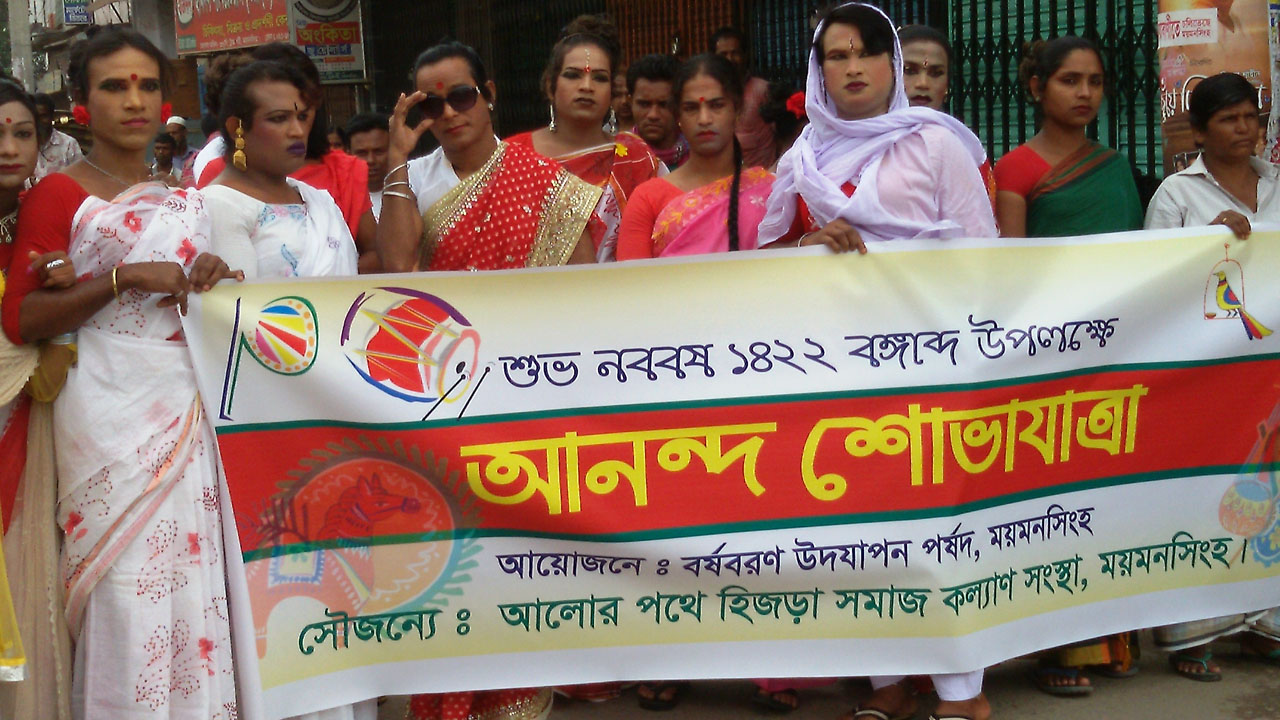

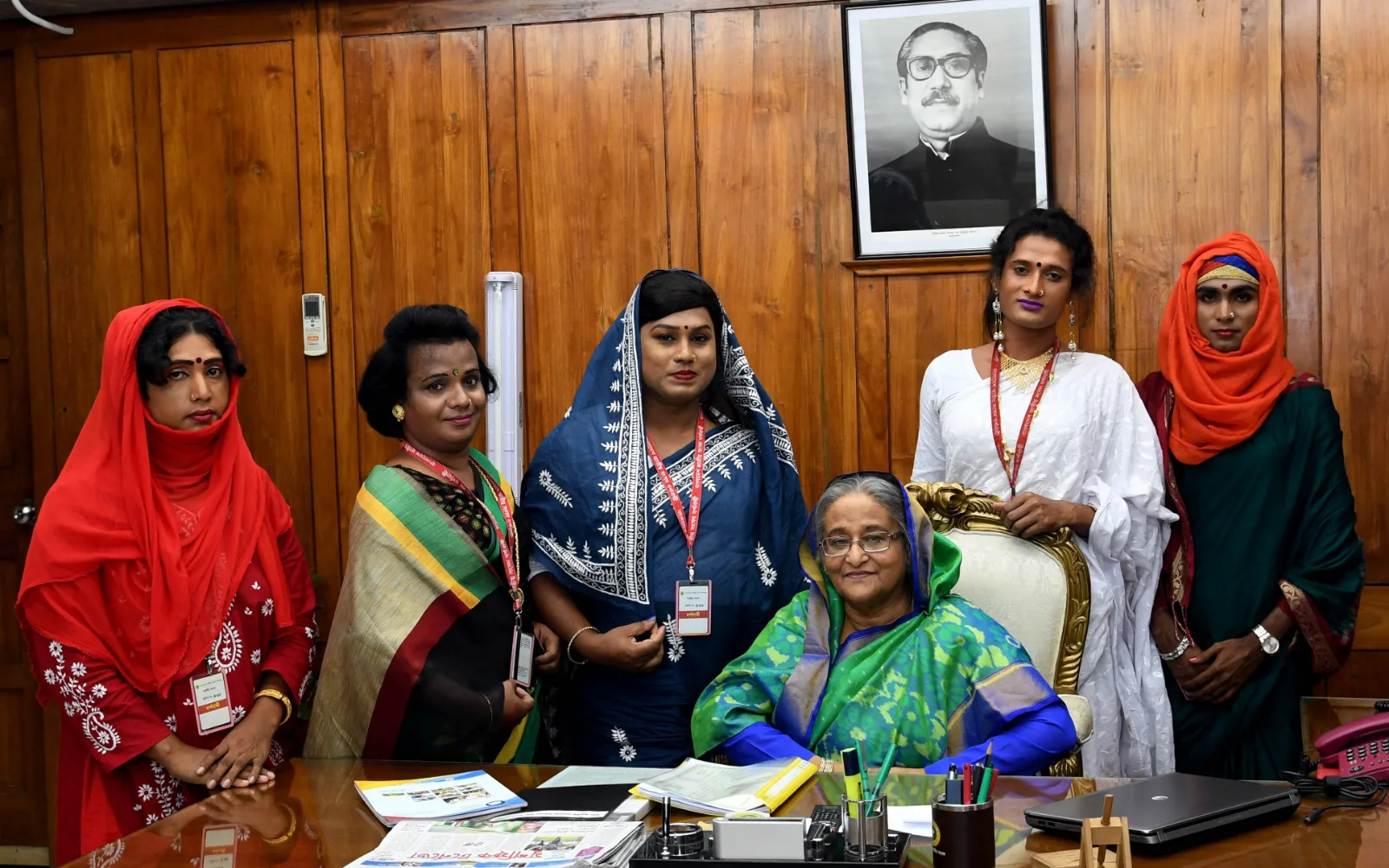
The flag circulates on English-language LGBTQ+ wiki sites, pride flag merchandise platforms, and color-code databases. No evidence exists of adoption by hijra communities, organizations, or advocates in South Asia. In practice, hijra communities in India use the transgender flag and the rainbow flag in their political organizing and marches. At Bangladesh's first Hijra Pride parade (2014, organized by Bandhu Social Welfare Society), participants carried Bangladeshi national flags and banners, not identity-specific pride flags. Hijra advocacy operates through traditional religious institutional forms (such as the Kinnar Akhara, an akhara established by the hijra community in 2018 with Laxmi Narayan Tripathi as a spokesperson, which showcased itself at the 2019 Kumbh Mela) and legal channels rather than through pride flag symbolism. [2][3][9][10]
Hijra identity long predates this flag, though accounts of its depth differ: institutional accounts trace references to the Ramayana and Mahabharata, while historians date the emergence of hijra culture as a subculture to the Delhi Sultanate in the thirteenth century, established under the Mughal Empire, and distinguish it from the Kama Sutra's broader tritiya prakriti category [6][2]. Under the Mughals, hijras held court positions as custodians, advisors and political figures [2][6]. The British criminalised hijra communities under the Criminal Tribes Act of 1871; the communities were denotified in 1952 [2]. The community is organised through guru-chela kinship, with many speaking Hijra Farsi, and Bahuchara Mata is its patron goddess [4][6][11]. The symbols hijra communities use for visibility draw from these traditions rather than from pride flag conventions [2][3].
Lineage
- Indirect influences
- Rainbow Pride Flag, Transgender Pride Flag
- Related flags
- Waria Pride Flag
The wide pink and blue bands and the white recall the transgender pride flag's palette in softer values; the narrow red centre band is the design's own, and the 3:1:1:1:3 geometry does not follow the transgender flag's equal stripes [1][12]. The borrowing of Western trans flag elements for an identity that does not map onto Western transgender categories is itself a point of scholarly discussion [5][13].
Colors & Symbolism
Five bands: pink and blue for hijra who identify with binary genders as trans people, white for those who are nonbinary, and a red centre band for "the divinity we were blessed with by Rama", in the creator's words. [1]
| Colour | Hex | Meaning | Note |
|---|---|---|---|
| Pink | #FFCCE6 | "for those of us who identify with binary genders as trans people", with the blue band. | The creator's own artwork, matched by the Commons vector. [1][12] |
| White | #FFFFFF | "for those of us who are nonbinary". | The creator's own artwork. [1] |
| Red | #C10000 | "the divinity we were blessed with by Rama". | The creator's own artwork, matched by the Commons vector. [1][12] |
| White | #FFFFFF | "for those of us who are nonbinary". | The creator's own artwork. [1] |
| Blue | #B9E0FB | "for those of us who identify with binary genders as trans people", with the pink band. | The creator's own artwork, matched by the Commons vector. [1][12] |
The meanings are the creator's own, from the original post, written while she identified as hijra [1]. The framing of hijra identity through binary-trans and nonbinary categories sits inside a wider documented dispute: hijras generally use feminine forms of address and many identify as women, and the third-gender label, though carried by legal recognition in India, Pakistan, Bangladesh and Nepal, is criticised as a means of misgendering, a position argued by the writer Talia Bhatt, who documents hijras marching under signs reading "Hijras Are Women" [7][2]. Scholars separately argue that translating hijra into Western transgender categories mobilises global inequalities [5][13].
Sampled from the artwork in the creator's original post; the public-domain vector on Wikimedia Commons carries the same values exactly, so the distributed file is faithful to the designer's [1][12].
Design
- Aspect Ratio
- 7:4 · original artwork
- Orientation
- horizontal
- Stripe Count
- 5
- Layout
- horizontal_stripes
- Stripes (Top → Bottom)
- Pink, White, Red, White, Blue
Five bands in depths of three, one, one, one and three parts: a wide pink band, narrow white, red and white bands, and a wide blue band. Measured from the artwork in the original post (997 by 570 pixels) and identical in the public-domain vector on Wikimedia Commons (viewBox 63 by 36) [1][12].
The pink, white and blue recall the transgender pride flag's palette in softer values; the red centre band is the design's own.
Five horizontal bands from top to bottom: wide pink, narrow white, narrow red, narrow white, wide blue, in the proportions 3:1:1:1:3.
Usage & Adoption
- Geographic Usage
- English-language internet circulation
- Online Usage
- LGBTQ+ wiki sites, Pride flag merchandise platforms
- Current Status
- online circulation only
No evidence of adoption by hijra communities in South Asia. The flag circulates in Western/English-language LGBTQ+ online spaces. Hijra communities use the transgender flag, rainbow flag, national flags, and traditional religious symbols (Bahuchara Mata iconography, Ardhanarishvara imagery, colorful saris) in their political organizing and pride events. [2][3][9]
Image Archive
People

Documented Use
.jpg)
Flag Designs
Discourse & Debates
- Whether hijra is best described as a third gender or as women. Legal recognition runs on third-gender categories: India's NALSA judgment held that hijras "have to be considered as Third Gender, over and above binary genders under our Constitution and the laws", and the 2011 census recorded 490,000 people identifying as third gender [2][7]. Against this, the writer Talia Bhatt, writing from within the community, documents hijras advocating for legal recognition as women and marching in Aurat Marches "holding signs that say 'Hijras Are Women' and 'Trans Women Are Women'"; in 2025 the Andhra Pradesh High Court ruled that transgender women, including hijras, may be legally recognised as women. [7][2]
- Whether Western-created pride flags for non-Western gender identities serve those communities or primarily serve Western taxonomic impulses. This flag exists in English-language wiki databases but has no documented presence in hijra community spaces. [2]
- The tension between international LGBTQ+ solidarity symbols and culturally specific identity markers. Erika Alm and Lena Martinsson, writing on the rainbow flag among Pakistani LGBTQ activists, argue that it “can function as a way to mobilize an imagined transnational community of belonging” but “can also enable homonationalism and transnational middle class formations that exclude groups of people, for example illiterates and people perceived of as traditional, such as Khwaja Siras”. Their argument concerns the rainbow flag rather than this design. [13]
Common misidentifications
- Hijra identity is frequently mistranslated as 'transgender' in Western sources; the word itself has a long history of use as a slur and is being reclaimed by some hijras, while in Pakistan it is generally considered derogatory and khawaja sira is used. [2][4][5]
- The pink, white and blue bands may cause confusion with the transgender pride flag.
Criticisms
- The creator herself repudiated the flag's basis: in August 2020 she wrote that she no longer identified as hijra and that "a community flag should be made by a member of said community". [1]
- The design frames hijra identity partly through Western transgender categories. Scholars argue that hijra identity does not map onto Western gender frameworks, and that applying such frameworks constitutes a form of neo-colonial intrusion. [5][13]
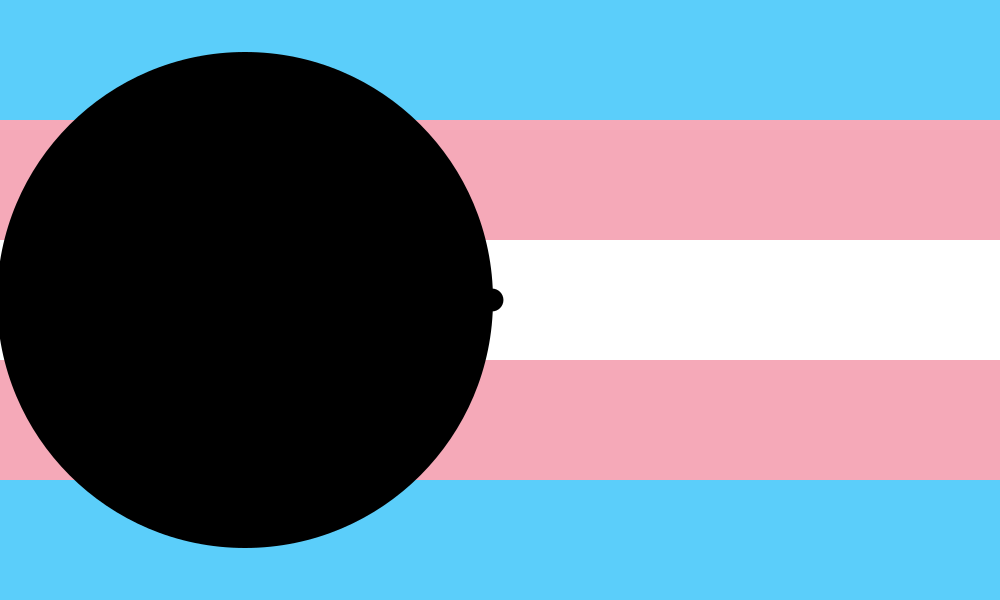
Hijra is also known as kinnar in parts of India; khawaja sira, the Urdu term, is preferred in Pakistan, where hijra is generally considered derogatory [2]. The community speaks Hijra Farsi, a centuries-old internal language [2][6]. A separate khawaja sira flag, the transgender flag bearing a black crescent and eight-pointed star, was in circulation by March 2021 with no designer named [15].
Footnotes & Citations
Sources and footnotes 17 sources
- 1. Community hi! I'm samir and I identify as hijra.... Samira (floralfemmes, then divinehijra). Tumblr (2018-07-04). Accessed 2026-08-12 · Archived version
The original post with the design, its meanings, and the August 2020 retraction. The creator signed it samir in 2018 and samira in its current form.
- 2. Encyclopedias & Reference Hijra. LGBTQIA+ Wiki. Accessed 2026-08-12
Read 12 August 2026. Documents the flag, its creator and her retraction, the khawaja sira flag, and the framing dispute over third gender, citing the writer Talia Bhatt.
- 3. News Hijras, Bangladesh's 'Third Gender', Celebrate First Ever Pride Parade. Rezwan. Global Voices (2014-11-15). Accessed 2026-08-12
- 4. Academic Neither Man Nor Woman: The Hijras of India. Serena Nanda. Wadsworth Publishing (Ruth Benedict Prize winner) (1990). Accessed 2026-03-30 [no stable URL]
A standard anthropological reference and a criticised one: Talia Bhatt quotes its second sentence calling hijras "a religious community of men who dress and act like women" and its description of hijra femininity as a "grotesque, sexually suggestive parody of feminine behavior", against Nanda's own reporting that hijras demanded to be counted as women. Cited here for kinship structure and religious context only.
- 5. Academic Hijras and South Asian historiography. Jessica Hinchy. History Compass (2022). Accessed 2026-03-30
- 6. Reference The Third Gender and Hijras. Harvard Religion and Public Life. Accessed 2026-03-30
- 7. Articles & Reports The Third Sex. Talia Bhatt. Trans/Rad/Fem (Substack) (2024-09-01). Accessed 2026-08-12 · Archived version
Bhatt writes from within the communities discussed. Cited for the framing dispute, the Aurat March signs, her critique of Nanda, and the NALSA judgment's language, which she quotes via the scholar Saria.
- 8. Social media divinehijra: hi! I'm samir... (reblog). uncommongenders. Tumblr (2018-09-01). Accessed 2026-08-12
A September 2018 reblog preserving the creator's blog under its earlier name, divinehijra.
- 9. Queer Azaadi Mumbai. Wikipedia. Accessed 2026-03-30
- 10. Encyclopedias & Reference Kinnar Akhara. Wikipedia. Accessed 2026-08-12
- 11. Reference Bahuchara Mata: An Indian Trans Icon. Sarmaya (2025-05-31). Accessed 2026-08-12
- 12. Image file page File:Hijra flag.svg. Samira (FloralFemmes); vectorized by Nikki. Wikimedia Commons (2020-06-30). Accessed 2026-08-12
Public-domain vector matching the original artwork's values exactly.
- 13. Academic The Rainbow Flag as Friction: Transnational, Imagined Communities of Belonging among Pakistani LGBTQ Activists. Erika Alm and Lena Martinsson. Culture Unbound, volume 8, issue 3, pages 218 to 239 (2016). Accessed 2026-08-16
Cited for the authors' argument about the rainbow flag's circulation among Pakistani LGBTQ activists, which is their own and concerns the rainbow flag rather than this design.
- 14. Image file page File:Hijra Community Delegation Meets Sheikh Hasina, Dhaka, 2018-09-16 (PID-0042453).jpg. Press Information Department. Wikimedia Commons (2018-09-16). Accessed 2026-08-12
Public domain, Government of Bangladesh. The file's English caption is an automatic translation of the Bengali original, which names the hijra community delegation.
- 15. Social media Khawaja Sira. Pride-Flags. DeviantArt (2021-03-02). Accessed 2026-08-12
The khawaja sira flag: the transgender flag with a black crescent and eight-pointed star. No designer named.
- Community Hijra. Nonbinary Wiki. Accessed 2026-03-30
- Rainbow flag (LGBTQ). Wikipedia contributors. Wikipedia (2026-06-25). Accessed 2026-07-24

Image Sources
- Rendering
- Samira 2018 original
- Credit: Samira (floralfemmes); values from her original post
- Credit: Labib Ittihadul, CC BY 2.0, via Wikimedia Commons
- Credit: Press Information Department, Government of Bangladesh, public domain, via Wikimedia Commons
- Credit: Nandanupadhyay, CC BY-SA 3.0, via Wikimedia Commons
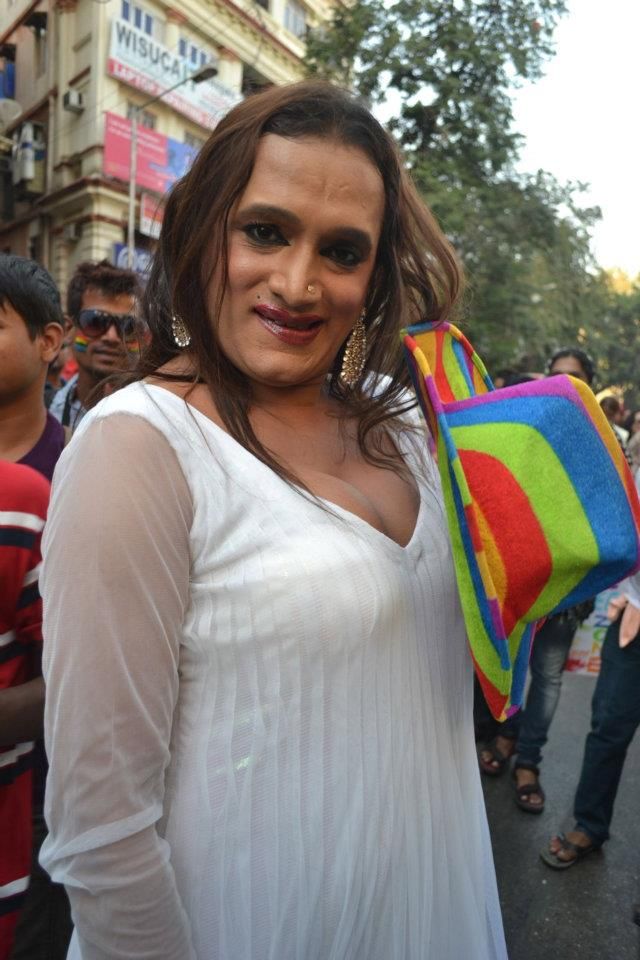
- Laxmi Narayan Tripathi, hijra rights activist and spokesperson of the Kinnar Akhara, the akhara established by the hijra community in 2018. Photographed in 2012. [10] · Credit: Nandanupadhyay · Wikimedia Commons · CC BY-SA 3.0
- Members of Alor Pothe Hijra Somaj Kollyan Songstha, a hijra community welfare organisation, march under their own banner in the Pohela Boishakh new year procession, Mymensingh, Bangladesh, 14 April 2015. Community visibility of this kind runs through organisational banners and cultural celebration rather than identity pride flags. [2][3] · Credit: Labib Ittihadul · Wikimedia Commons · CC BY 2.0
- The flag as Samira designed it: five bands in 3:1:1:1:3, with the red centre band for "the divinity we were blessed with by Rama". Values from the artwork in her original post. [1][12] · Credit: Samira (floralfemmes); Encycloflaggia rendering · Original post
- A delegation representing the hijra community meets Prime Minister Sheikh Hasina at the National Parliament House, Dhaka, 16 September 2018. Bangladesh recognised hijra as a separate gender in 2013. [14] · Credit: Press Information Department, Government of Bangladesh · Wikimedia Commons · Public domain
- The khawaja sira flag, in circulation by March 2021 with no designer named: the transgender flag bearing a black crescent and eight-pointed star, for the community known in Pakistan as khawaja sira. [15] · Encycloflaggia reconstruction