Disability Pride Flag (2016 proposal, Ann Magill)
Disability Pride Flag ·
Ann Magill published her first Disability Pride Flag proposal on Dreamwidth on August 10, 2016. The design placed four bright zigzagging stripes in blue, gold, green, and red across a black field. [1] A later version added a white stripe and entered the public domain in 2019. Magill withdrew the zigzag family in October 2021 after disabled viewers reported that it could produce a flicker or strobe effect when scrolled on backlit screens. [2]

Key facts
- Designer
- Ann Magill
- Created
- First published
- Documented record
- Published 2016
- Aspect Ratio
- 169:101 · apparent
- Ratio Notes
- The creator-posted image is 169 by 101 pixels, approximately 1.673 to 1. No proportion is published; the measurement is the evidence. [1] The 1920 by 1440 file, which is 4:3, is the later five-stripe zigzag iteration, not this proposal.
- Stripes
- 4
- Represented Identity
- Disabled people
Also known as
- Zigzag Disability Pride Flag
- Lightning-Bolt Disability Pride Flag
- Disability Pride Flag (original proposal)
Status Historical Obsolete
Archive categories Disability Pride Flags · Historical and Early Pride Flags
Overview
To give disabled people a public symbol that asserted disability identity outside the closed institutional spaces in which Magill had repeatedly seen disability commemorations confined, and to create a banner the disability community could carry into the same public spaces where other Pride symbols were already flown. [2]
Magill published the proposal on her Dreamwidth journal on August 10, 2016, under the title "This is my proposal for a Disability Pride Flag", with the flag as a 169 by 101 pixel image hosted on Flickr and an artist's statement giving the meaning of the field, the band and each of the four colours. [1] She described the longer arc in her 2019 post: the idea began at a 2010 observance for the 20th anniversary of the Americans with Disabilities Act, which she found "confined to the basement and grounds of the regional Independent Living Center, instead of out in the public." After the July 26, 2016 mass killing at the Tsukui Yamayuri En care home in Sagamihara, Japan, in which nineteen disabled residents were murdered and twenty-six injured because, by the killer's own confession, they were disabled, Magill "was driven to design an actual flag, instead of just wishing we had one." [2]
Identity & Context
- Represented Identity
- Disabled people
- Subcommunity
- the broad disability community across physical, sensory, neurodivergent, psychiatric, and invisible/undiagnosed disabilities
- Movement
- Disability Pride, disability rights, Disability Pride Month
- Language Context
- English-language origin, but designed to be reproducible from globally available standard flag colors
- National Context
- The creator's national context is the United States, where the Americans with Disabilities Act anniversary observances shaped her intent. That does not establish where the design was made. [2]
The flag is not specifically an LGBTQ+ symbol and represents disabled people of all sexualities and genders. It is included here because it has become a recurring component of intersectional Pride imagery and because the Disability-Inclusive Pride Flag (Vecchietti, 2024) and other Progress-lineage variants explicitly draw on its color system.
Creators
The Creator
Ann Magill
Designer
Ann Magill is a disabled writer and artist who published the first Disability Pride Flag proposal in 2016. She posts as capri0mni on Dreamwidth and Flickr, and later under capricorn-0mnikorn on Tumblr. After the zigzag design caused visually triggered symptoms for some viewers, she worked with disabled community participants to produce the straight-diagonal revision released in 2021. [2] [1]
This morning (4 June, 2019) I have officially waived all copyright claims to this flag, and registered it under International Public Domain.
The public-domain dedication of the zigzag
So -- would you fly this flag? I really am curious.
The closing line of the August 2016 proposal
Motivations
- Frustration with a 2010 ADA-anniversary observance held inside an Independent Living Center basement rather than in public space [2]
- Response to the 2016 Sagamihara care home massacre, in which nineteen disabled residents were killed [2] [3]
- A long-held wish for a flag that would let disabled people identify themselves to one another and assert disability as a public identity [2]
Stated inspirations
- The six internationally recognized standard flag colors (also used by the Olympic flag), chosen so the flag could be reproduced anywhere from materials people could actually find[2]
- LGBTQ pride and Black pride as movements that demonstrated how a flag could function as both a community symbol and a public claim[4]
Attribution notes
Magill considers the 2021 design a collaborative product of her work and feedback from the disability community on Tumblr. She declined to accept monetary tips for the flag in order to keep its public-domain status uncomplicated, even in her own thinking. [2]
Origin
- Digital Origin
- Dreamwidth (capri0mni), with the image hosted on Flickr
- Origin Type
- first_publication
- Physical Origin Status
- Not documented. Magill's national context is the United States; no source records where either file was made.
Published as a proposal on Magill's Dreamwidth journal on August 10, 2016, with the flag image served from her Flickr account. [1] No physical location is documented.
Dates & Chronology
- Year Created
- Exact date
- First published
- Date Retired
- Documented record
- Published 2016; the five-stripe zigzag that grew from it circulated most widely in 2021, and Magill withdrew the zigzag family that October. It remains in the public domain and continues to circulate.
The proposal drew a comment thread on Dreamwidth through late 2016. On December 5, 2016 a reader asked for an additional stripe for chronic illness, writing that "a lot of chronically ill people don't even feel addressed" by the physical and mental illness categories, and the thread discussed purple and orange candidates. [1] The surviving record does not establish the exact date on which a white stripe joined the design; by June 4, 2019, when Magill waived her copyright, the flag she released was a five-stripe zigzag. [2]
Magill reported in July 2021 that the flag had been "almost totally unknown for the last two years" until it began circulating on Reddit and Tumblr in the weeks before Disability Pride Month 2021. That circulation is also what surfaced the strobe problem, and the zigzag was withdrawn three months later. Institutional adoption belongs almost entirely to the revision that replaced it. [2] [4]
Major revisions
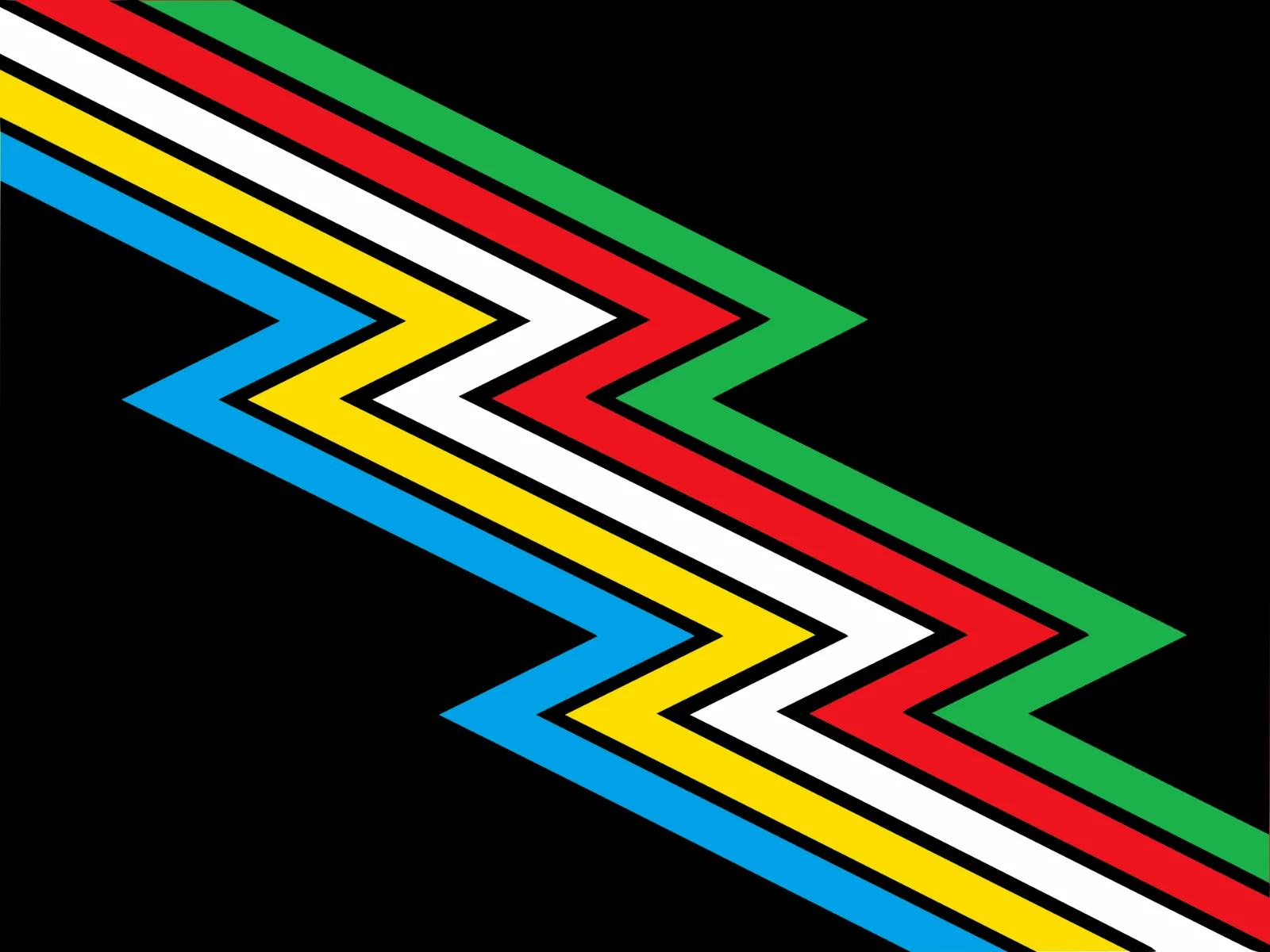
By the date of the public-domain dedication the zigzag carried five stripes, a white stripe having joined the original four during the design's development. The surviving five-stripe file is 1920 by 1440. The exact date the white stripe was added is not established by the surviving record. [2]
Magill withdrew the zigzag family and released the straight-diagonal revision, removing the zigzag from her own image gallery while noting it remains in the public domain. [2]
Withdrawn by its designer on October 13, 2021 and superseded by the straight-diagonal revision, which is the Disability Pride Flag as the term is now used. Magill removed the zigzag from her own image archive while noting that it remains in the public domain, and it continues to appear in published news articles and on Wikipedia file pages, sometimes presented as current. [2] [5]
Lineage
- Direct children
- Disability Pride Flag
Structurally original and not derived from any pride-flag predecessor. Its successor is Magill's own 2021 revision, which keeps the five colours and the diagonal idea, straightens the zigzag, mutes the palette, and moves the stripes into a different order. On this original the red stripe sits directly beside the green; on the revision the warm and cool colours are separated by the central white, which Magill gives as a deliberate accommodation for red-green colourblindness. Everything downstream in the Progress Pride lineage descends from the revision rather than from this design. [2]
Lineage tree
Every record reachable from this one through documented parent and child relationships: 4 records across 3 generations.
- This record
- Disability Pride Flag (2016 proposal, Ann Magill)
- Children
- Disability Pride Flag
Colors & Symbolism
Magill's 2016 artist's statement explains the black field three ways: mourning "for all those disabled people who have been murdered in the name of 'mercy'"; the pirates' Jolly Roger, "representing our determination to steal our lives back" from authorities that marginalise disabled people; and the Black Triangle badge as adopted in British disability protest against austerity. The lightning-bolt band carries two meanings: diagonal lines as the mark of former colonies breaking free, disabled people's lives having "long been 'colonized' by the medical, religious, and educational establishments", and the zigzag itself as the continual navigation around structural and attitudinal barriers, "the creative, 'lateral,' thinking we have to use to solve problems each day." These are the creator's historical wording, not definitions accepted by every disabled person. [1]
| Colour | Hex | Meaning | Note |
|---|---|---|---|
| Blue | #3D3DF1 | Mental illness disabilities. [1] | Sampled from the 169 by 101 creator-posted image; approximate. [1] |
| Gold | #FFF200 | Cognitive and intellectual disabilities. The statement names the colour yellow. [1] | Sampled from the 169 by 101 creator-posted image; approximate. [1] |
| Green | #22B025 | Sensory perception disabilities. [1] | Sampled from the 169 by 101 creator-posted image; approximate. [1] |
| Red | #ED1C24 | Physical disabilities. [1] | Sampled from the 169 by 101 creator-posted image; approximate. [1] |
| Black (field) | #000000 | — | The field of the creator-posted image. [1] |
The four category meanings above are the August 2016 artist's statement, which assigned no white stripe and no meaning for one. [1] The five-stripe zigzag that developed from this proposal carried revised per-stripe meanings, documented on the 2021 revision's entry together with Magill's later restatement of how she wants the bands read. Each symbolism statement belongs to its own stage of the design's history.
No specification was published for the proposal. The four coloured values are sampled from the flat interiors of the small, antialiased 169 by 101 raster Magill posted, so they are measurements of that file rather than a published palette. [1] The image contains no white pixels: the white stripe, and the values that circulate for the five-stripe zigzag, belong to the later iteration.
Design
- Aspect Ratio
- 169:101 · apparent
- Ratio Notes
- The creator-posted image is 169 by 101 pixels, approximately 1.673 to 1. No proportion is published; the measurement is the evidence. [1] The 1920 by 1440 file, which is 4:3, is the later five-stripe zigzag iteration, not this proposal.
- Orientation
- diagonal
- Stripe Count
- 4
- Layout
- zigzag_band_on_field
- Stripes (Left → Right)
- Blue, Gold, Green, Red
Four adjacent coloured stripes form a single zigzag band crossing the black field from the top of the hoist to the bottom of the fly: three long diagonal runs from hoist to fly alternating with two shorter return runs, in Magill's image description "three long sections running from hoist to fly, alternating with two short sections from fly to hoist". The stripes touch, with no black separators and no white stripe. Across the band they read blue, gold, green, red. [1] The five-stripe construction with thin black separators belongs to the later zigzag iteration, not to this proposal.
The stripes are saturated, not muted. The colours were revised and desaturated only in the 2021 straight-diagonal revision. [2] [1]
A black flag diagonally crossed from the top of the hoist to the bottom of the fly by a four-colour lightning bolt in stripes of blue, gold, green and red. [1]
Usage & Adoption
- First Users
- Ann Magill (capri0mni.dreamwidth.org and Flickr)
- Geographic Usage
- United States
- Online Usage
- The August 2016 Dreamwidth proposal and its comment thread. [1], Reddit and Tumblr, mid-2021: the circulation, largely of the five-stripe zigzag, that both spread the flag and surfaced the strobe problem. [2], Wikipedia file pages and published news articles, where the withdrawn zigzag has continued to appear after its replacement. [2] [5]
- Current Status
- Creator-withdrawn precursor; still public domain, still circulating, sometimes mistaken for the current flag
Almost totally unknown between publication and mid-2021 on Magill's own account, and the 2021 circulation was largely of the five-stripe zigzag rather than this exact four-stripe proposal. The institutional adoption recorded for the Disability Pride Flag, municipal flag-raisings, school districts, advocacy organisations, followed the 2021 revision and belongs to that entry. [2]
Image Archive
The design
Later iterations
Discourse & Debates
- Whether the flag's category boundary places it within LGBTQ+ pride flag archives at all. The flag is not an LGBTQ+ symbol and represents disabled people of all sexualities and genders; it appears here through Disability Pride and through its later use in intersectional Pride designs, including Valentino Vecchietti's 2024 Disability-Inclusive Pride Flag, and it is regularly displayed alongside other Pride flags during July Disability Pride Month.
- Magill asked Wikipedia's editors in 2022 to remove the zigzag image from the Disability flag article because it "is Dangerous to people with visually triggered Epilepsy", identifying herself as its designer; a separate commenter made the same accessibility request on the image's file talk page. Uptake of the revision was slow, and the withdrawn zigzag remained in circulation on the encyclopedia. [6] [5]
Common misidentifications
- The 2016 proposal, the later five-stripe zigzag, and the 2021 straight-diagonal flag are different stages of one design history. Images of the withdrawn zigzag should not be labelled as the current Disability Pride Flag. [2]
- The five-stripe zigzag is often presented as the August 2016 original. The 2016 proposal had four stripes and no white; the white stripe joined during the design's later development. [1] [2]
Criticisms
- The zigzag triggered seizures, migraines and other reactions in disabled viewers when scrolled on backlit screens. The report came from within the community the flag was made for, and it is the reason the design was withdrawn. [2] [7]
- The withdrawn image continues to be shared as current, including in published news articles and on Wikipedia file pages, because it remains in the public domain. Magill has recorded her frustration at seeing it treated as the flag. [2] [5]
Footnotes & Citations
Sources and footnotes 8 sources
- 1. Primary statement This is my proposal for a Disability Pride Flag. Ann Magill. Notes, Notings, and Common Refrains (Dreamwidth) (2016-08-10). Accessed 2026-08-15 · Archived version
The original proposal: the four-stripe image, the artist's statement for the field, the band and the four colours, and the December 2016 comment thread on chronic illness representation.
- 2. Social media This morning (4 June, 2019) I have officially waived all copyright to my Disability Pride Flag. Ann Magill (capri0mni). Dreamwidth (2019-06-04). Accessed 2026-08-15
Magill's June 4, 2019 public-domain dedication, updated October 13, 2021 with the withdrawal of the zigzag and the release of the straight-diagonal revision.
- 3. History of the Disability Pride Flag. Weinberg Family Cerebral Palsy Center, Columbia University Irving Medical Center (2023-07-03). Accessed 2026-04-07
- 4. Disability flag. Wikipedia. Accessed 2026-04-07
- 5. File talk:Disability Pride Flag Ann Magill copyrights waived.svg. Vermiceli. Wikipedia (2022-07-11). Accessed 2026-04-07
- 6. Talk:Disability flag (Wikipedia talk page). Multiple Wikipedia editors including Ann Magill. Wikipedia (2021–present). Accessed 2026-04-07
- 7. Have You Seen The New Disability Pride Flag?. Becca Block. Disability Belongs (formerly RespectAbility) (2022-07-15). Accessed 2026-04-07
- Primary statement An answer to Several Questions… about why I'm proposing moving away from each colored stripe representing a specific "type" of Disability. Ann Magill. Tumblr (2026-07-11). Accessed 2026-08-15
Magill's July 11, 2026 post on the current flag's symbolism. Cited here only for the design family's continuing history; the substance belongs to the 2021 revision's entry.

Image Sources
- Rendering
- 2016 four-stripe proposal
- The August 2016 proposal as posted: four zigzag stripes on black, no white. [1] · Credit: Ann Magill · Creator-posted image · 169 × 101Rights Covered by Magill's later public-domain statements. [2]
- The original artifact: the four-stripe proposal as published on August 10, 2016, 169 by 101, hosted on Flickr and embedded in the Dreamwidth post. [1] · Credit: Ann Magill · Creator-posted image · 169 × 101Rights Covered by Magill's later public-domain statements. [2]
- The later five-stripe zigzag, 1920 by 1440, which is 4:3: the iteration released to the public domain on June 4, 2019 and withdrawn in October 2021. A white stripe and thin black separators distinguish it from the 2016 proposal. [2] · Credit: Ann Magill · Public domain · 1920 × 1440Rights Public domain under Magill's June 4, 2019 statement. [2]