Drag Pride Flag (2016, Veranda L’Ni)
Drag Pride Flag ·
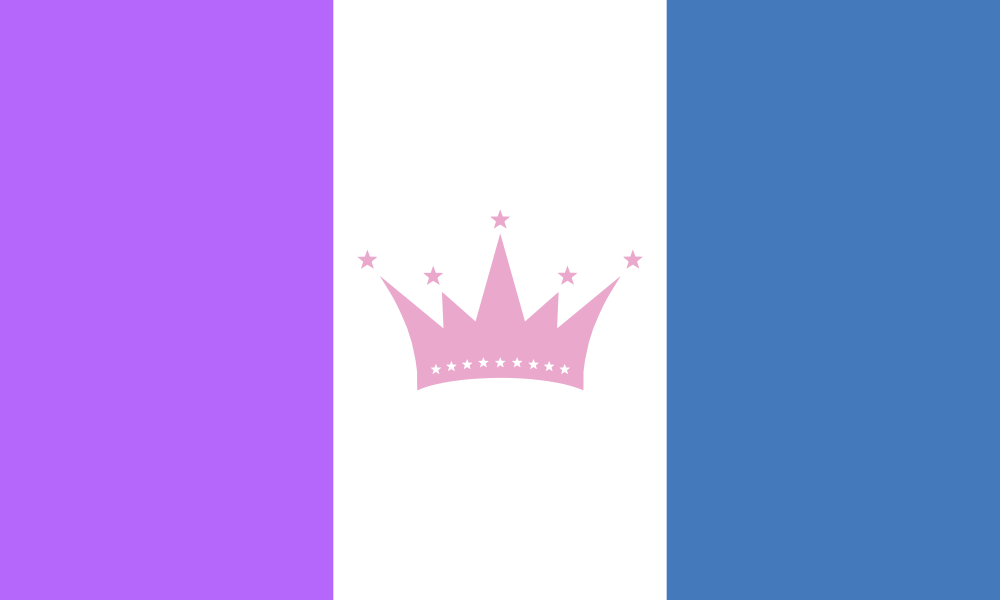
Cleveland drag performer Veranda L’Ni designed this purple, white and blue flag for a worldwide contest run by the Austin International Drag Foundation. A twelve-person panel selected the design on March 9, 2016, the Foundation announced it two days later, and its press release scheduled the first flag to fly at the Austin International Drag Festival from April 28. A pink crown stands for leadership in the community and the stars for the many forms of drag. [1]
Key facts
- Designer
- Veranda L’Ni
- Created
- Announced
- Documented record
- Documented from 2016
- Aspect Ratio
- Not standardized
- Ratio Notes
- No creator-prescribed proportion has been located. The flag as drawn on Veranda L’Ni’s 2016 contest sheet is about 1.86 times as wide as it is tall. [1] The later renderings are wider still and differ from each other: the 2024 Wikimedia Commons file is 2000 by 1200, and the reconstruction held here is 1000 by 600. [2] Those two are the archive’s and Commons’ normalisations, not the creator’s specification, and the contest sheet is the only proportion that comes from the 2016 artwork.
- Stripes
- 3
- Represented Identity
- Drag performers and the wider drag community
Also known as
- Drag Pride Flag
- Drag Flag
Archive categories Subculture Pride Flags
Overview
To give the drag community a visual representation of its own. The page preserving the contest documents puts the reasoning this way: “This was a way to engage the drag performers and drag lovers from every walk of life to share their passion for the art form.” [1]
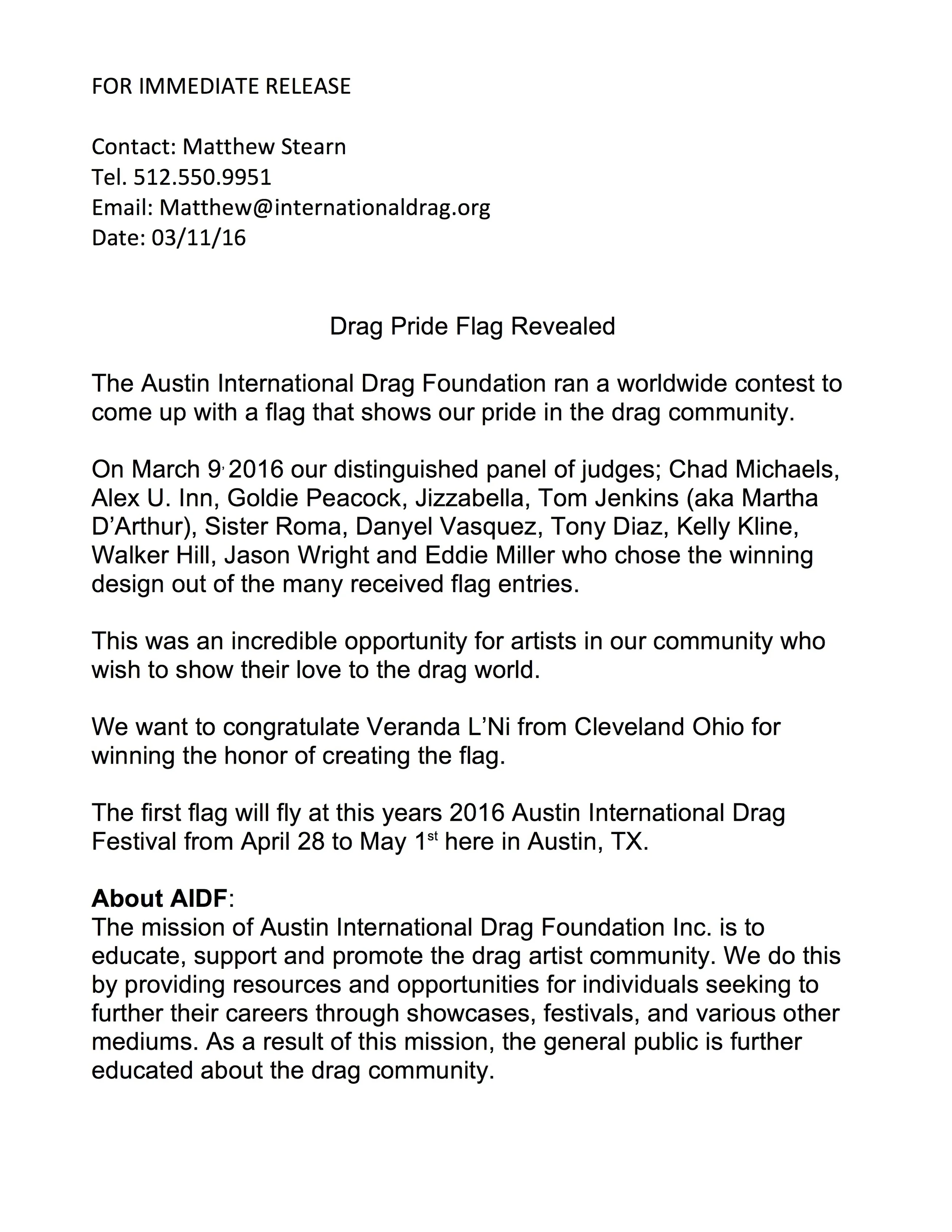
The Austin International Drag Foundation ran a worldwide contest in 2016 for, in its press release’s words, “a flag that shows our pride in the drag community”. A panel of twelve judges selected Veranda L’Ni’s entry on March 9: Chad Michaels, Alex U. Inn, Goldie Peacock, Jizzabella, Tom Jenkins (also known as Martha D’Arthur), Sister Roma, Danyel Vasquez, Tony Diaz, Kelly Kline, Walker Hill, Jason Wright and Eddie Miller. The Foundation announced the result on March 11 and scheduled the first flag to fly at the Austin International Drag Festival from April 28 to May 1. The Drag Pride organisation, which preserves both documents, describes the contest as one “to create the official flag of drag”, wording that records the organisers’ intent rather than adoption by any body speaking for drag performers generally. [1]
Identity & Context
- Represented Identity
- Drag performers and the wider drag community
- Subcommunity
- People who perform drag and participate in drag culture
- Movement
- Drag visibility within Pride
- National Context
- The contest was run from the United States by the Austin International Drag Foundation, which described it as worldwide, and the designer was based in Cleveland, Ohio. Where the design itself was made is not documented. [1]
Drag is a performance practice and cultural community encompassing varied relationships to gender, sexuality, theater, nightlife and self-expression. The Foundation presented the flag as a shared symbol for people who perform drag and participate in drag culture. [1]
Creators
The Creator
Veranda L’Ni
Flag designer
Veranda L’Ni is a Cleveland drag performer whose entry won the Austin International Drag Foundation’s worldwide flag contest in 2016. She returned to the Austin International Drag Festival as its headliner in 2017, produces shows in Cleveland including the annual Cleveland Drag Showcase, and hosts Drag Queen Story Hour at Near West Theatre. Describing her practice to Cleveland Magazine she framed drag as transforming the whole body and face into a character, and as a form of acting developed for catharsis, the same figure her contest sheet gives the flag’s white band. [3]
Motivations
- To answer the Austin International Drag Foundation’s call for a flag showing pride in the drag community. The contest-entry sheet states the meaning of each element in the designer’s own wording. [1]
Attribution
- Organization
- Austin International Drag Foundation
- Commissioned By
- Austin International Drag Foundation, through its 2016 worldwide flag contest
Attribution notes
Veranda L’Ni designed the winning entry, and the contest-entry sheet preserved with the press release carries her name and her statement of what each element means. The Austin International Drag Foundation ran the contest and a twelve-person panel selected the winner; the Foundation is the commissioning and selecting body, not a co-designer. [1] The Foundation is a 501(c)(3) nonprofit founded in 2015 that hosts the annual Austin International Drag Festival, the event at which the flag was scheduled to be presented. [4]
Origin
- Specific Place
- Austin, Texas, where the Austin International Drag Foundation ran the contest and scheduled the first presentation; Cleveland, Ohio, where the designer was based
- Place Type
- Design contest run by a nonprofit foundation, with the presentation scheduled at its annual festival
- Digital Origin
- Contest submission; the submission method is not documented
- Origin Type
- first_publication
- Physical Origin Status
- Not documented. No located source records where the entry was made.
The Foundation ran the contest from Austin, Texas, and its press release scheduled the first flag to fly at the Austin International Drag Festival there from April 28 to May 1, 2016. Veranda L’Ni was based in Cleveland, Ohio. [1] Neither city is documented as the place where the design was made.
Dates & Chronology
- Year Created
- Announced
- Documented record
- Documented from 2016; later distribution recorded
- Creation Bounds
- The date Veranda L’Ni made or submitted the entry is not documented. A twelve-person panel selected the winning design on March 9, 2016; the Austin International Drag Foundation announced the winner in a press release dated March 11; and that release scheduled the first flag to fly at the Austin International Drag Festival from April 28 to May 1. [1] April 28 is therefore the first scheduled presentation, not a verified first flying: no photograph or contemporaneous report of the flag in the air on that day has been located.
The Foundation selected and promoted the design through its 2016 contest and festival. Drag Pride later listed nine recipients of physical flags: the Austin International Drag Foundation; E! The Dragnificent in Pittsburgh; The Leather Stallion Saloon in Cleveland; the drag historian Dr. Lady J in Cleveland; Nina West in Columbus; Starina and Drag Story Hour in Iceland; Studio West 117’s Mansion in Cleveland; CampIt Outdoor Resort in Saugatuck, Michigan; and Camp Brave Trails in New York. [1] That list records distribution. It is not evidence that any recipient displayed the flag or adopted it institutionally, and no photograph of one in use has been located. The recipient in Iceland documents international distribution rather than adoption abroad.
Library.LGBT published a guide entry with a downloadable rendering on June 11, 2021. [5] A vector rendering was uploaded to Wikimedia Commons on October 10, 2024 by the user Intervex, who gave a National Park Service article on LGBTQ flags as its source; that article no longer resolves. [2]
Selection by contest is an unusual provenance for a pride flag, most of which are published by an individual maker rather than chosen by an organisation from submitted entries. Cleveland Magazine calls this “the first Drag Pride flag”. [3] The Drag Pride organisation’s own page contradicts that, dating Sean Campbell’s Feather Pride Flag to 1999. [1]
Lineage
- Direct children
- Drag King Pride Flag (2018, SilenceTheFox)
- Related flags
- Feather Pride Flag
No direct visual parent is documented. Sean Campbell’s Feather Pride Flag precedes this design as a flag made for drag culture, but nothing shows L’Ni used it as source material, and the two share no visual vocabulary. Drag Pride opens its own account of the subject with “Most drag entertainers do not know that there already is a drag pride flag.” The relationship is historical predecessor in purpose, not descent. [1]
Sources disagree on when the Feather Pride Flag was made. Drag Pride dates it to 1999; this database’s entry for that flag, and the sources behind it, give 2000. [1] The disagreement is recorded rather than resolved here.
One direct child is registered: SilenceTheFox’s Drag King Pride Flag of June 2018, which its maker described as “Based on the new drag flag”. It keeps the white centre band, the blue, the pink crown, the five larger stars and the row of smaller white stars, and replaces the purple band with a second blue. [6] Other drag-specific designs incorporating this one exist and are not yet registered here.
Lineage tree
Every record reachable from this one through documented parent and child relationships: 2 records across 2 generations.
- This record
- Drag Pride Flag (2016, Veranda L’Ni)
Colors & Symbolism
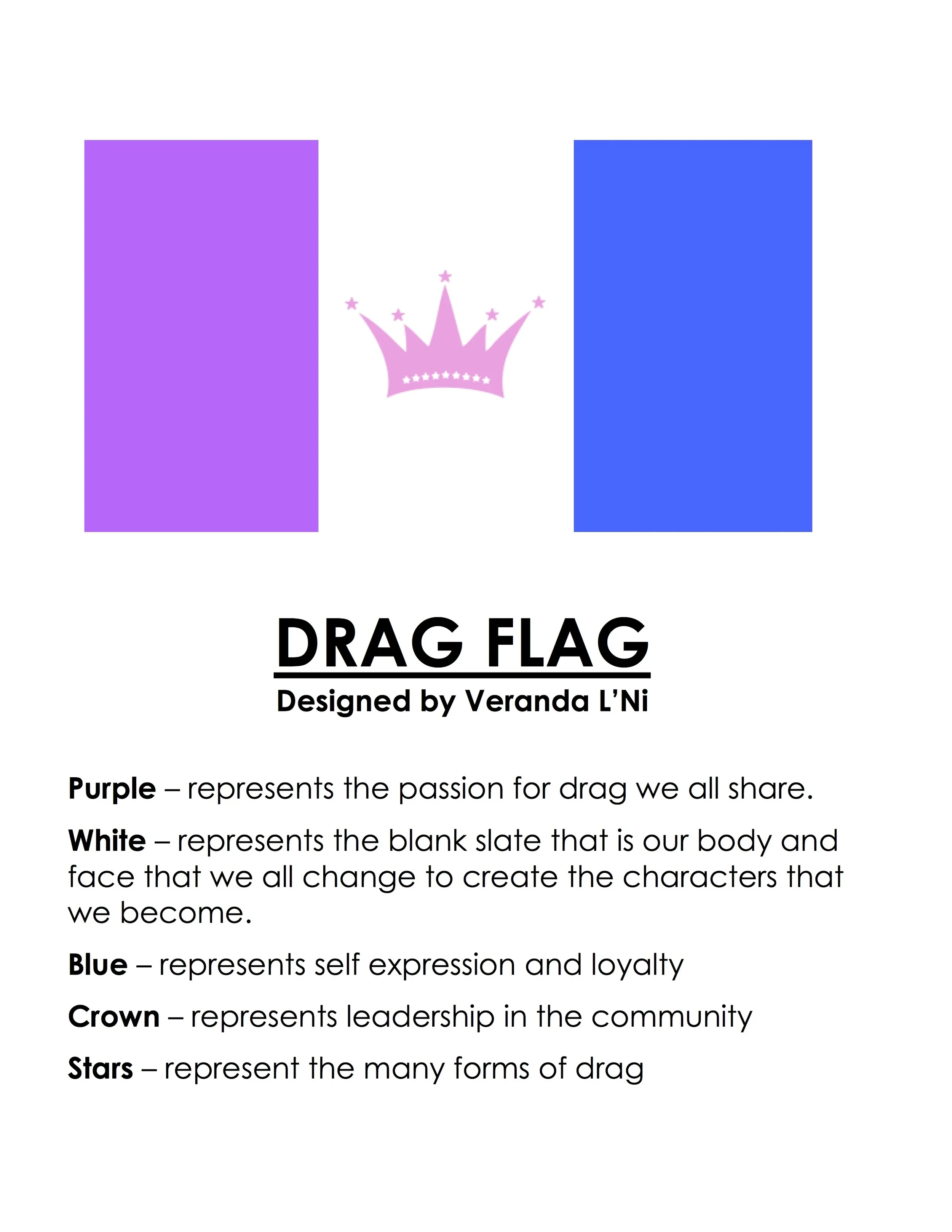
Three vertical bands of purple, white and blue carry a pink crown and stars at the centre. Veranda L’Ni’s contest-entry sheet gives the meanings: purple for “the passion for drag we all share”, white for “the blank slate that is our body and face that we all change to create the characters that we become”, blue for “self expression and loyalty”, the crown for “leadership in the community” and the stars for “the many forms of drag”. [1]
| Colour | Hex | Meaning | Note |
|---|---|---|---|
| Purple | #B567FB | “Represents the passion for drag we all share.” [1] | Library.LGBT’s later rendering, which is the value this entry’s reconstruction draws. The 2016 contest sheet renders this band at #CD67FE and the 2024 Commons vector at #B06AD6. None of the three is creator-issued. [1] [5] [2] |
| White | #FFFFFF | “Represents the blank slate that is our body and face that we all change to create the characters that we become.” [1] | White in all three surviving renderings: the 2016 contest sheet, Library.LGBT’s later rendering and the 2024 Commons vector. [1] [5] [2] |
| Blue | #4479BC | “Represents self expression and loyalty.” [1] | Library.LGBT’s later rendering, which is the value this entry’s reconstruction draws. The 2016 contest sheet renders this band at #3267FF and the 2024 Commons vector at #3A60CD. None of the three is creator-issued. [1] [5] [2] |
| Pink | #E9A8CC | The crown and the five larger stars. | Library.LGBT’s later rendering, which is the value this entry’s reconstruction draws. The 2016 contest sheet renders this band at #FFA2E3 and the 2024 Commons vector at #FFA1E2. None of the three is creator-issued. [1] [5] [2] |
The wording above is the creator’s own, from the contest-entry sheet preserved beside the press release. [1] L’Ni used the same figure outside the contest: describing her practice to Ideastream Public Media in 2022 she said, “we have a blank slate with our face to create whatever look that we’re trying to go for”. [7] The sheet glosses the stars as a group and does not separate the five larger stars above the crown from the nine smaller ones set into its base.
Veranda L’Ni’s contest sheet publishes the meanings and no hexadecimal values, so there is no creator-issued palette for this design. [1] The three surviving renderings do not agree, and each set belongs to its own file:
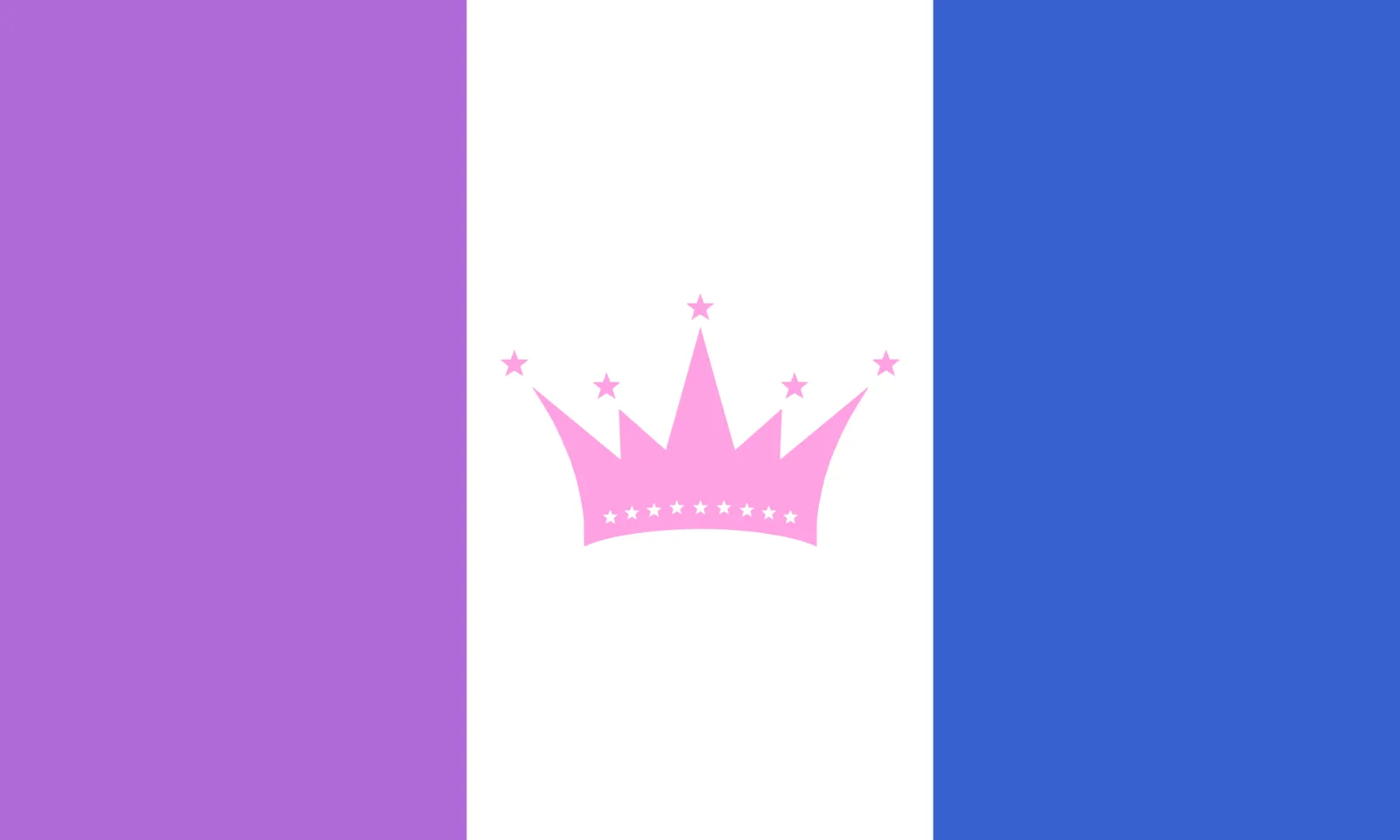
The 2016 contest-sheet depiction measures approximately #CD67FE, #FFFFFF, #3267FF and #FFA2E3, the brightest of the three and a property of that document’s export. [1] Library.LGBT’s later rendering uses #B567FB, #FFFFFF, #4479BC and #E9A8CC. [5] The 2024 Commons vector uses #B06AD6, #FFFFFF, #3A60CD and #FFA1E2, its pink within one step of the contest sheet’s. [2]
The table above carries Library.LGBT’s values because the reconstruction on this page draws them, which keeps the table and the image consistent. That is a presentation choice, not a finding about the 2016 artwork.
Design
- Aspect Ratio
- Not standardized
- Ratio Notes
- No creator-prescribed proportion has been located. The flag as drawn on Veranda L’Ni’s 2016 contest sheet is about 1.86 times as wide as it is tall. [1] The later renderings are wider still and differ from each other: the 2024 Wikimedia Commons file is 2000 by 1200, and the reconstruction held here is 1000 by 600. [2] Those two are the archive’s and Commons’ normalisations, not the creator’s specification, and the contest sheet is the only proportion that comes from the 2016 artwork.
- Orientation
- vertical
- Stripe Count
- 3
- Layout
- vertical_tricolor_with_central_emblem
- Stripes (Left → Right)
- Purple, White, Blue
- Center Symbol
- Pink crown and stars
Three vertical bands of equal width: purple at the hoist, white in the centre, blue at the fly. A pink crown with five points sits centred on the white band, five larger pink stars stand above it, one over each point, and nine smaller white stars run in a row across the band at the crown’s base. Those counts, five and nine, are the same in the creator’s 2016 contest sheet and in the 2024 Commons vector. [1] [2]
In the reconstruction the bands meet at exact thirds of the width, at 333.333 and 666.667 units across a 1000 unit canvas, so no seam falls between them. The crown and stars are the source emblem rather than a substitute icon.
A vertical tricolour of purple, white and blue with a pink crown centred on the white band, five larger pink stars above the crown’s points and nine smaller white stars across its base. [1]
Usage & Adoption
- Online Usage
- A guide entry with a downloadable rendering at Library.LGBT, published June 11, 2021. [5], A vector rendering on Wikimedia Commons, uploaded October 10, 2024. [2]
- Event Usage
- Austin International Drag Festival, April 28 to May 1, 2016: the press release scheduled the first flag to fly there. [1]
- Current Status
- 2016 AIDF contest winner; later distribution documented
Drag Pride lists nine recipients of physical flags and continues to reproduce the design. [1] The list records distribution, not display or institutional adoption, and no body speaking for drag communities generally has designated this or any design their official flag. How its circulation compares with that of other drag flags is not established by any located source.
Image Archive
Primary creator artifact
Primary organisational document
Later renderings

Flag design
Discourse & Debates
Common misidentifications
- Credited to the Austin International Drag Foundation rather than to Veranda L’Ni. The Foundation ran the contest and a twelve-person panel selected the winner; L’Ni designed it. [1]
- Confused with the Feather Pride Flag, Sean Campbell’s earlier design for the same community, which shares none of its visual vocabulary. [1]
Drag Pride opens its account of the subject with a claim about the field the flag entered: “Most drag entertainers do not know that there already is a drag pride flag.” [1]
Footnotes & Citations
Sources and footnotes 7 sources
- 1. Drag Pride Flag. Drag Pride. Drag Pride. Accessed 2026-08-14
The page preserving the two 2016 primary artifacts: Veranda L’Ni’s contest-entry sheet with its statement of meanings, and the Austin International Drag Foundation press release of March 11, 2016 naming the twelve judges, the March 9 selection and the April 28 to May 1 festival dates. The page also carries the contest wording, the list of nine flag recipients, and a 1999 date for the Feather Pride Flag.
- 2. Image file page File:Drag Pride Flag.svg. Uploaded by Intervex; design credited to Veranda L’Ni. Wikimedia Commons (2024-10-10). Accessed 2026-08-14
The file record for the 2024 vector: 2000 by 1200, uploaded October 10, 2024, sourced by the uploader to the former National Park Service LGBTQ flags article, and marked public domain under Commons’ threshold-of-originality treatment for flags.
- 3. Articles & Reports Most Interesting People 2021: Veranda L’Ni. Candice Wilder. Cleveland Magazine (2021-01-04). Accessed 2026-08-14
A profile of the designer: the contest win, the 2017 headliner return, and the quotation about drag as transformation.
- 4. Austin International Drag Festival. Austin International Drag Foundation. Austin International Drag Foundation. Accessed 2026-08-14
Cited for current organisational identity only: the Foundation is a 501(c)(3) nonprofit founded in 2015 that hosts the annual festival.
- 5. Pride Flag Guide: Drag. Library.LGBT (Albany Pride). Library.LGBT (2021-06-11). Accessed 2026-08-15 · Archived version
A pride flag guide with a downloadable rendering, first published June 11, 2021, and the source of the four digital values this entry’s reconstruction draws. The guide is cited from the Internet Archive capture of April 12, 2026: the live host no longer serves it.
- 6. Drag King Pride Flag. SilenceTheFox. DeviantArt (2018-06-08). Accessed 2026-08-14
The child design’s own posting, cited here for the derivation its maker states: “Based on the new drag flag”.
- 7. Articles & Reports Get to know Veranda L’Ni and fellow Cleveland drag queens and kings. Dave DeOreo and Jean-Marie Papoi. Ideastream Public Media (2022-08-12). Accessed 2026-08-14
Later commentary by the designer on drag practice, including the “blank slate” figure that the flag’s white band carries.
Image Sources
- Rendering
- 2016 contest-winning design
- The hero is the archive’s reconstruction: 1000 by 600, three bands at exact thirds, Library.LGBT’s palette, and the crown-and-stars emblem of the source artwork. [1] [5] · Credit: Design by Veranda L’Ni; reconstruction drawn for this archiveRights Technical reconstruction; no new rights claim. No creator-issued licence has been located for the original design.
- A 1200 by 720 raster of the reconstruction. · Credit: Encycloflaggia technical derivativeRights Technical derivative; no new rights claim.
- The creator’s contest-entry sheet, the primary artifact for the design and its meanings. Held on the source page at 2550 by 3300; the copy shown is the 2500 by 3235 rendition that page serves. No reuse licence located. [1] · Credit: Veranda L’Ni · Preserved by Drag Pride
- The Austin International Drag Foundation press release of March 11, 2016, announcing Veranda L’Ni of Cleveland as the winner, naming the twelve judges who chose the design on March 9, and scheduling the first flag to fly at the festival from April 28 to May 1. No reuse licence located. [1] · Credit: Austin International Drag Foundation · Preserved by Drag Pride
- A raster of the Wikimedia Commons SVG, 2000 by 1200, uploaded on October 10, 2024 by the user Intervex with the design credited to Veranda L’Ni and the former National Park Service LGBTQ flags article given as its source. Its palette, #B06AD6, #FFFFFF, #FFA1E2 and #3A60CD, is that file’s own and not the 2016 artwork’s. Commons marks the file public domain under its threshold-of-originality treatment for flags. [2] · Credit: Uploaded by Intervex; design by Veranda L’Ni · Wikimedia Commons · 2000 × 1200
- Encycloflaggia reconstruction normalised to the archive’s 3:5 standard, 1000 by 600, with the bands at exact thirds, Library.LGBT’s palette and the source crown-and-stars emblem. Technical reconstruction; no new rights claim. · Credit: Design by Veranda L’Ni; reconstruction drawn for this archive · Archive reconstruction