Gay Men's Pride Flag (Five-Stripe, 2019, gayflagblog)
Gay Men's Pride Flag ·
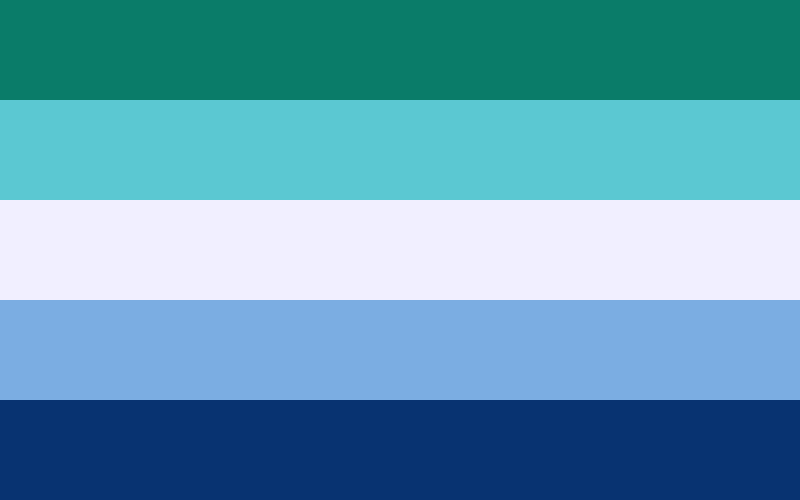
A five-stripe flag published by the Tumblr blog gayflagblog on 10 July 2019, running green, light green, white, light blue and indigo. It was released alongside a seven-stripe version by the same designer on the same day, and is that flag with two stripes removed. Every stripe carries a meaning the designer published with it.
Key facts
- Designer
- gayflagblog
- Created
- First published
- In use
- 2019–present
- Aspect Ratio
- 3:5 · standard
- Ratio Notes
- The designer's own files are 5:3, at 2048 by 1229 and 1280 by 768. [1] The Commons SVG is drawn on a 25 by 15 viewBox and served at 1200 by 720, the same proportion. [2] The archive renders it at the standard 3:5.
- Stripes
- 5
- Represented Identity
- gay men
Also known as
- Vincian Pride Flag (applied usage)
- Ocean Gay Flag (informal)
- Gay Men Five-Stripe Flag
Status Proposed
Archive categories Sexual & Romantic Orientation Pride Flags
Overview
To publish a gay men's flag whose stripe meanings were stated with the design rather than borrowed, and whose trans, nonbinary and gender-nonconforming inclusion was written into those meanings.
gayflagblog published the flag on Tumblr on 10 July 2019, in a post that names the complaints it was written to answer: "no meaning behind the stripes, seemed to be 'lipstick lesbian but blue for boys instead of pink for girls'". The earlier design's creator approved the proposal, and the post says so in terms, adding that the two are "two separate people working on our own blogs". [1]
Two versions went up together, one of seven stripes and one of five. [1][3] The palette answers the complaints point by point. Green and light green stand for Nature, because "love between men is often seen as 'unnatural' in the eyes of society and in religion" and because "gay men have historically used green flowers and plants (Carnations, hyacinths, etc.) to symbolize our love". The white stripe is taken from the Transgender Pride Flag "because trans, nb, and GNC men are often erased or talked over and need explicit representation". And the blue runs on into indigo rather than stopping: "seeing as common criticism of other gay man flag proposals is 'oh blue for boy? bleh', I decided to have a light blue stripe leading into a deep purple to symbolize how some of us might be stereotypical, some of us might not be, and some of us are in-between or fluid". [1]
Identity & Context
- Represented Identity
- gay men
The designer states the scope himself: "This flag is inclusive of all gay men. This includes Aro, Questioning/Unsure, NB, Ace, & Gay men that are Gender Non Conforming". [1] The FAQ answers the question directly: asked whether aro and ace gay men can use the flag, he replies "Yes, they've always been welcome to." [4] "MLM" and "vincian", both wider than gay men, are applied to the flag by later usage rather than by the designer.
Creators
The Creator
gayflagblog
Designer
gayflagblog is a Tumblr blog run by a trans, gay, disabled man, in his own words: "I am a trans gay disabled guy". [1] No legal name is documented, and no photograph or self-portrait has been located; the handle is the whole of the public identity.
He published the flag on 10 July 2019 as a proposal answering complaints about the earlier gay men's flag, which he set out plainly: "no meaning behind the stripes, seemed to be 'lipstick lesbian but blue for boys instead of pink for girls'". [1] The date is the post's, and he has explained why it is the one he uses: "July 10th, 2019 was when I first published it. It was in my drafts for longer but I no longer have the phone it was made on, so I just use the post date." [4]
He calls it the gay man flag for a practical reason: "it's mostly because it's very hard to find the flag in search engines or on websites if it's just labelled as 'gay' (many people use gay as an umbrella term) and I wanted to make it more accessible." [4]
He names his sources for the meanings: "my personal research of LGBT+ history, my (and others) experiences as gay men, and the meanings on Gilbert Baker's original rainbow flag which I love dearly and hold close to my heart, this flag is not meant to replace or erase it in any way! I would love for them to be used in tandem like I personally do." [1] He consults gender-nonconforming, nonbinary and lesbian followers on wording and holds polls before major changes, and has revised the documentation more than once: an earlier version of the stripe-meaning graphic read "GNC & Trans Men" on the white stripe, wording he changed, and the proposal post carries an edit date of 9 May 2022. [1]
The earlier flag's creator approved the proposal and the post says so: "THESE FLAGS AND STRIPE/COLOR MEANINGS ARE 'APPROVED' BY THE CREATOR OF THE ORIGINAL FLAG, meaning they don't mind that I've made this proposal to address the issues with theirs. We're two separate people working on our own blogs". [1] Mod Hermy confirmed it from the other side in 2021, calling this design "a better version made by @gayflagblog to deal with the problems with my proposal/suggestion". [5]
Many people are unhappy with the current popular proposed flag because of a variety of reasons (no meaning behind the stripes, seemed to be "lipstick lesbian but blue for boys instead of pink for girls", etc.) so I decided to make a similar proposal to address some of these issues.
Opening the proposal post, 10 July 2019
The green (Community) and teal (Joy) in the flag represent Nature. I thought this was important because love between men is often seen as "unnatural" in the eyes of society and in religion. Furthermore, gay men have historically used green flowers and plants (Carnations, hyacinths, etc.) to symbolize our love, reinforcing our connection with Nature.
On the green and light green stripes
The white stripe is adopted from the Trans Pride flag because trans, nb, and GNC men are often erased or talked over and need explicit representation.
On the centre stripe
Purple is a mix of blue and red, and seeing as common criticism of other gay man flag proposals is "oh blue for boy? bleh", I decided to have a light blue stripe leading into a deep purple to symbolize how some of us might be stereotypical, some of us might not be, and some of us are in-between or fluid.
On the run from light blue into indigo
This flag is inclusive of all gay men. This includes Aro, Questioning/Unsure, NB, Ace, & Gay men that are Gender Non Conforming, be you Masc, Fem, or Androgynous in any way! Same goes for gay men of any religious background.
On who the flag is for
All of my flags are free to use for commercial and personal use, just please at least try to credit or link back/source to this post so it's meanings don't get lost.
The reuse terms, stated with the reason for them
Motivations
- To answer specific complaints about the earlier gay men's flag by publishing a design whose stripe meanings were stated with it
Stated inspirations
- Gilbert Baker's original rainbow flag, named as a source for the stripe meanings and explicitly not something the new flag is meant to replace[1]
- The Transgender Pride Flag, from which the white stripe is taken[1]
Origin
- Digital Origin
- Tumblr (gayflagblog)
Digital origin; no verified physical location.
Published on the designer's own Tumblr blog. [1] No offline launch is documented.
Dates & Chronology
- Year Created
- Exact date
- First published
- Period in Use
- 2019–present
The five-stripe version is the one that travelled. It appears across pride-flag guides, on social platforms and on merchandise, and a vector copy has been on Wikimedia Commons since April 2021, uploaded there by a third party and marked public domain. [2][3]
The designer has not claimed any status for it beyond what it is. The post presents the flag as a proposal, the flag has no formal name by his own account, and no government or institution has adopted it: "It doesn't have an official name, but many people are fond of calling it the 'Ocean Gay flag' which I am fine with." [4] Guide inclusion, commercial reproduction and platform reach are circulation rather than ratification, and the entry records them as such.
The flag is often called the vincian flag, after a term proposed as a masculine counterpart to "sapphic". The designer treats the label as adopted rather than assigned: "It's been adopted by many people who use the term Vincian (referring to Leonardo da Vinci) but you are free to use it under any other similar terms." [4] The word travels more widely than this design, and applying it to the flag without qualification collapses a label for an identity into a name for one image. [3][4]
"Ocean gay flag" is the other informal name, and it is the one the designer endorses, without treating it as the flag's name. [4] Neither name is formal.
Lineage
- Indirect influences
- Gay Men's Pride Flag (Seven-Stripe, 2016, Anonymous and Mod Hermy), Rainbow Pride Flag, Transgender Pride Flag
- Direct children
- Gay Mspec Gay Ally Flag, Gay Turigirl Ally Flag
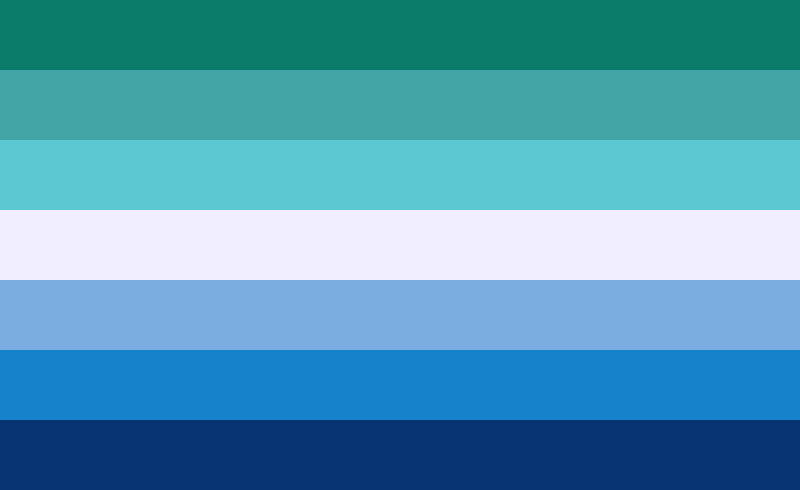
The immediate parent is the designer's own seven-stripe flag, published in the same post on the same day and recorded separately in this archive. This flag is that one with two stripes removed: the seven-stripe runs #078D70, #26CEAA, #98E8C1, #FFFFFF, #7BADE2, #5049CC, #3D1A78, and the five-stripe keeps the first, third, fourth, fifth and seventh of those, dropping the teal and the purple. [1][6]
The 2016 seven-stripe flag by Anonymous and Mod Hermy is the historical precursor, not the design parent. gayflagblog wrote this design to answer complaints about that one and its creator approved the proposal, but no stripe value passes between them apart from the light blue #7BADE2, which occupies the same position in both. [1][5]
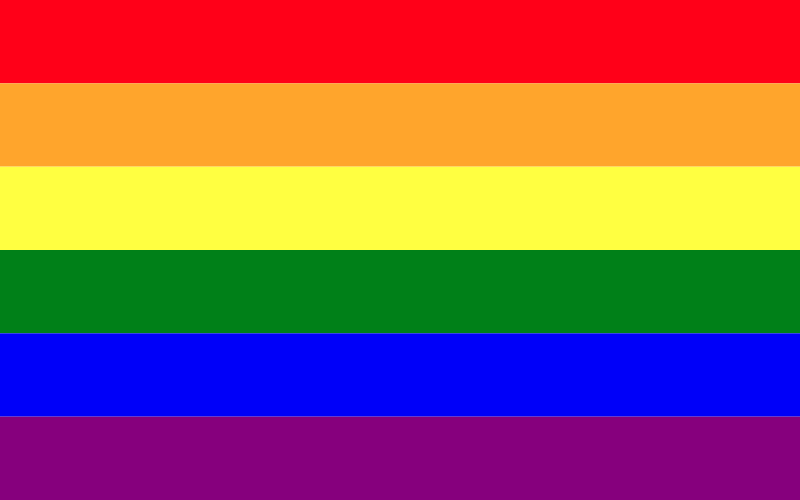
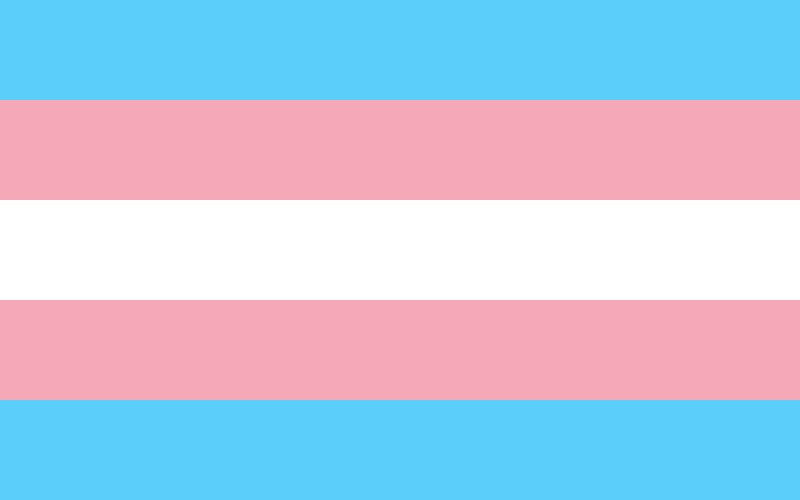
The white stripe is taken from the Transgender Pride Flag, which the designer states outright. [1] Gilbert Baker's rainbow flag is named as a source for the stripe meanings and explicitly not as something the new flag replaces; it is not a visual parent. [1]
Lineage tree
Every record reachable from this one through documented parent and child relationships: 4 records across 3 generations.
- This record
- Gay Men's Pride Flag (Five-Stripe, 2019, gayflagblog)
Colors & Symbolism
Five stripes, each with a meaning the designer published alongside the flag. Green is Community and light green is Joy, and together they stand for Nature; the white stripe is trans, nonbinary and gender-nonconforming men, its white taken from the Transgender Pride Flag; light blue is Pure love and indigo is Diversity, "diversity in presentation, relationships, & life experience". [1][6]
| Colour | Hex | Meaning |
|---|---|---|
| Green | #078D70 | Community. With the light green it stands for Nature, against the framing of love between men as unnatural. [1][6] |
| Light green | #98E8C1 | Joy. With the green it stands for Nature, and for the green flowers gay men have used to signal their love. [1][6] |
| White | #FFFFFF | Trans, nonbinary and gender-nonconforming men, "often erased or talked over and need explicit representation". The stripe is taken from the Transgender Pride Flag. [1] |
| Light blue | #7BADE2 | Pure love, and the start of the run into indigo that answers "oh blue for boy? bleh". [6][3] |
| Indigo | #3D1A78 | Diversity in presentation, relationships and life experience. [1][6] |
Read from the Wikimedia Commons vector whose author field credits the designer, and matched against his own posted files. [1][2]
This flag has no official digital palette. Color values shown are approximate.
The meanings were published with the flag rather than assigned to it afterwards, which was one of the complaints the proposal answered. [1]
The proposal post names four of the five directly, Community, Joy, Fortitude and Diversity, but it is describing the seven-stripe version, where Fortitude belongs to a purple stripe this flag does not carry. The full seven-name sequence, Community, Healing, Joy, GNC and trans men, Pure love, Fortitude, Diversity, is listed on the Pride-Flags posting of the seven-stripe flag and reported the same way in the reference literature. [3][6] On the five stripes kept here, that makes the light blue Pure love, not Fortitude.
An earlier version of the stripe-meaning graphic read "GNC & Trans Men" on the white stripe; the designer changed the wording and says why: "because people don't know how to not be cruel to others & because black on darker purple is hard on some people's eyes". [1]
The designer published no hex specification. The values above are read from the SVG on Wikimedia Commons whose author field credits gayflagblog and whose EXIF original date is the day of publication, 10 July 2019. [2] They match the colours he names in the proposal post. [1]
His own posted files differ from the Commons vector by one unit in one channel: the top stripe samples to #078E70 in the 2048 by 1229 and 1280 by 768 files he served, against the #078D70 the Commons vector carries and reference sites circulate. [1][2] The difference is invisible at any size; this entry publishes the circulating value and records the measurement.
Design
- Aspect Ratio
- 3:5 · standard
- Ratio Notes
- The designer's own files are 5:3, at 2048 by 1229 and 1280 by 768. [1] The Commons SVG is drawn on a 25 by 15 viewBox and served at 1200 by 720, the same proportion. [2] The archive renders it at the standard 3:5.
- Orientation
- horizontal
- Stripe Count
- 5
- Layout
- horizontal_stripes
- Stripes (Top → Bottom)
- Green, Light green, White, Light blue, Indigo
Each stripe is a fifth of the height. In the designer's own 2048 by 1229 file they measure 240 to 245 pixels, and no stripe is emphasised by width. [1][2]
Five equal horizontal stripes running green, light green, white, light blue and indigo, with no emblem. The seven-stripe version published in the same post carries two more, a brighter teal below the green and a violet-blue above the indigo; removing those two gives this flag. The green and light green stand for Nature, the white is taken from the Transgender Pride Flag, and the light blue leads into a deep indigo rather than stopping at the blue that gay men's flags are usually reduced to. [1]
Usage & Adoption
- Online Usage
- Pride-flag guides, social platforms and merchandise listings
- Current Status
- active
The most widely reproduced of the gay men's flags in circulation. Reproduction is not adoption: no institution has enacted it, and the designer presents it as a proposal. [1][3][4]
Image Archive
The flag
The flags it is built from
What it answered
Photograph by the Tumblr user feral-critter. No licence is stated and none has been sought; published at the site owner's direction with the rights status recorded as undetermined.
Discourse & Debates
- Whether "vincian" should be the standard label for men-loving-men identity, as "sapphic" is for women. The designer neither coined nor claimed it, and treats it as one term among others: "you are free to use it under any other similar terms". [4]
- Whether the flag stands for gay men specifically or for men who love men generally. The designer's documentation says gay men, and lists who that includes; wider MLM usage came later. [1]
- How the flag relates to the achillean flag, which uses a different visual language, a green carnation on a blue field, for an overlapping community. [3]
- Whether the mirrored structure with a white centre borrows a lesbian-flag format. The designer says he consulted lesbian and WLW followers during the design; the structure had already been used for a gay men's flag in 2016, before the sunset lesbian redesign family of 2018. [1][7]
Common misidentifications
- Confused with the seven-stripe version published in the same post on the same day, which is this flag plus a brighter teal and a violet-blue. [1][6]
- Treated as a recolour of the 2016 flag by Anonymous and Mod Hermy. The two share one stripe value out of five, and this design descends from the designer's own seven-stripe version. [1]
- Attributed to the transmedicalist account that reposted the 2016 flag. That repost concerns the earlier design; this one postdates it. [5]
- Given the light blue stripe the meaning Fortitude. Fortitude belongs to the seven-stripe version's purple stripe, which this flag does not carry; the light blue is Pure love. [3][6]
- Called the vincian flag without qualification. The term is applied to the design by users and covers more than this one image; the designer says the flag has no formal name. [4]
Criticisms
- Some hold that a separate gay men's flag is unnecessary, on the reasoning that the rainbow flag already stands for gay men and that a new symbol implies the rainbow has been conceded to the wider LGBTQ+ community. The designer addressed the premise directly in the proposal, naming Baker's flag as a source for his meanings and saying the new flag "is not meant to replace or erase it in any way". [1][3]
- The proposal was criticised from the other direction for the inclusion it states. A community history preserves a screenshot of a post on r/LGBDropTheT, a trans-exclusionary subreddit, objecting to the flag on the grounds that it covers trans men and nonbinary gay men. The subreddit was later removed by Reddit for breaching its terms of service and its posts survive only as those screenshots. [8]
- The design inherits suspicion earned by its precursor. The 2016 flag was reposted without credit by a transmedicalist blogger and read for years as that account's work, and some readers still treat any green-and-blue gay men's flag as carrying that association. The 2019 proposal postdates the repost, states its meanings, and was approved by the earlier flag's creator. [1][5][8]
The designer states that the flag has no formal name and names the two informal ones readers will meet. "Ocean gay flag" he endorses: "many people are fond of calling it the 'Ocean Gay flag' which I am fine with." "Vincian" he treats as adopted usage rather than the flag's name, and says so in the same answer. [4] He also addresses the nicknames he does not accept, without repeating them: "Some people who are unaware of the flag's development, stripe/color historical symbolism, or simply those who don't like the original proposal design (often due to homo/nb/transphobia or misinfo) might call it other derogatory terms, but obviously these don't reflect anything the flag stands for or anyone involved with it." [4] "MLM" and "achillean" are wider identity terms that the flag is often filed under; the documentation says gay men. [1][3]
Footnotes & Citations
Sources and footnotes 9 sources
- 1. Social media Gay Man Flag. gayflagblog. gayflagblog (Tumblr) (2019-07-10). Accessed 2026-08-14
The proposal post: the complaints it answers, the earlier creator's approval, a meaning for every stripe, the seven-stripe and five-stripe versions side by side, the reuse terms, and an edit date of 9 May 2022.
- 2. Image file page 5-striped New Gay Male Pride Flag. Wikimedia Commons. Accessed 2026-08-14
The design on Commons: 1200 by 720 on a 25 by 15 viewBox, its author field crediting gayflagblog and its EXIF original date the day of publication. Uploaded by a third party and marked public domain by that uploader. The source for the five published values.
- 3. Encyclopedias & Reference Gay men's flags. Wikipedia. Accessed 2026-08-14
Corroborates the same-day release of the seven-stripe and five-stripe versions and reports the seven stripe meanings in order, including pure love for the light blue.
- 4. Social media gayflagblog FAQ. gayflagblog. gayflagblog (Tumblr). Accessed 2026-08-14 · Archived version
The designer's standing answers: why the 10 July 2019 date is used, that the flag has no formal name, and how he regards "ocean gay flag" and "vincian".
- 5. Designer page Clearing up some things about the gay man flag. Pride-Flags (Mod Hermy). DeviantArt (2021-03-05). Accessed 2026-08-14 · Archived version
The earlier flag's creator on this one, calling it "a better version made by @gayflagblog to deal with the problems with my proposal/suggestion". The approval recorded in the 2019 post, confirmed from the other side.
- 6. Designer page Gay Man (1). Pride-Flags. DeviantArt (2020-05-13). Accessed 2026-08-14
The seven-stripe version reposted to the Pride-Flags gallery with its seven stripe meanings listed in order, including "Light blue stripe: Pure love". Carries the earlier "GNC & Trans Men" wording on the white stripe and a Creative Commons Attribution 3.0 licence applied by that account.
- 7. Articles & Reports What Is The Gay Men's Pride Flag, And Where Did It Come From?. Heckin' Unicorn. Accessed 2026-03-30
This page no longer resolves; the URL returns HTTP 404.
- 8. Community A compiled history of the first popularized Gay / Gay Man / Gay Men / Gay Male flag proposal. archivalflags. archivalflags (Tumblr) (2020-05-25). Accessed 2026-08-14 · Archived version
A footnoted community history of the flag family, updated 12 April 2022, transcribing each source it uses. The source for the r/LGBDropTheT screenshots and for that subreddit's removal by Reddit.
- Community Gay Man Flag Facts. Carrd. Accessed 2026-08-14
An anonymous community explainer about the flag family, cited for its account of how the variants are grouped. It names no author and cites no sources of its own.

Image Sources
- Rendering
- five-stripe version
- Redrawn at the five values carried by the Commons vector and matched against the designer's own files. [1][2] · Credit: Design: gayflagblog. Rendering: Encycloflaggia. · Encycloflaggia rendering · SVG at 3:5Rights The designer grants free commercial and personal use of his flags and asks for credit or a link back, so that the meanings travel with the image. [1] The Commons vector of the same design is separately marked public domain by its uploader. [2] This rendering is the archive's own redraw.
- The rainbow flag, named by the designer as a source for the stripe meanings and explicitly not as something this flag replaces: "this flag is not meant to replace or erase it in any way! I would love for them to be used in tandem like I personally do." [1] · Encycloflaggia
- The Transgender Pride Flag. The designer states that this flag's white stripe is taken from it, "because trans, nb, and GNC men are often erased or talked over and need explicit representation". [1] · Credit: Monica Helms · Encycloflaggia
- The 2016 flag by Anonymous and Mod Hermy, the design this proposal was written to answer. Its creator approved the proposal. The two flags share one stripe value, the light blue #7BADE2. [1][5] · Credit: Anonymous and Mod Hermy · Encycloflaggia
- The flag as published on 10 July 2019, redrawn at 3:5. The five values are the Commons vector's, matched against the designer's own posted files. [1][2] · Credit: Design: gayflagblog. Rendering: Encycloflaggia. · Encycloflaggia rendering
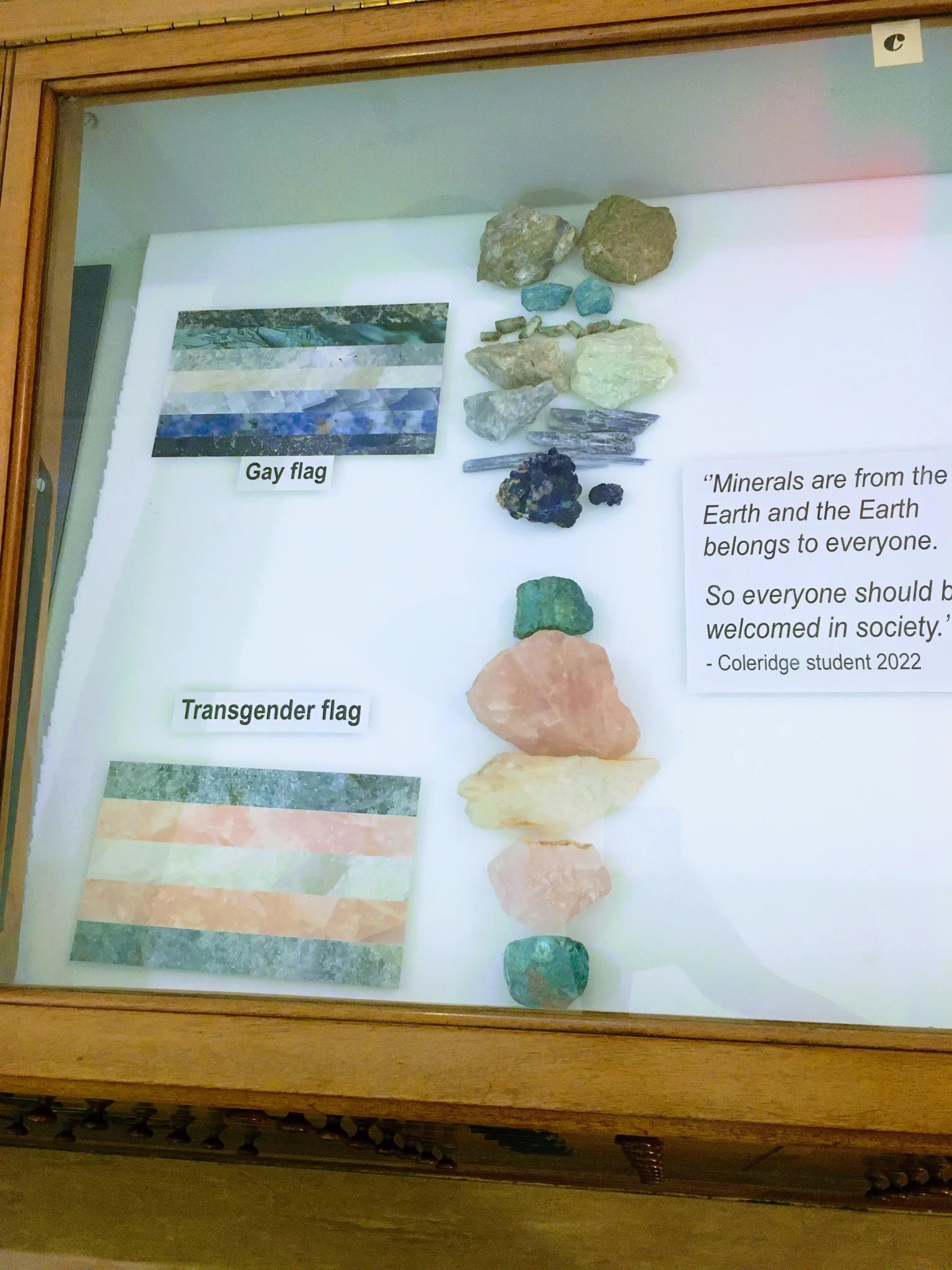
- Pride flags rendered in rock and mineral specimens in a museum display case, each flag laid out beside the stones its colours were taken from. This case shows a flag labelled "Gay flag" and the transgender flag. The case is most likely in the Cambridge geology museum: the quotation card in it is credited to a Coleridge student in 2022, and Coleridge Community College is a Cambridge school. The museum has not confirmed it. If you can add its formal name or the dates the display ran, contribute. · Credit: feral-critter, via Tumblr · feral-critter on Tumblr