Aroflux Pride Flag
Identity Pride Flag ·
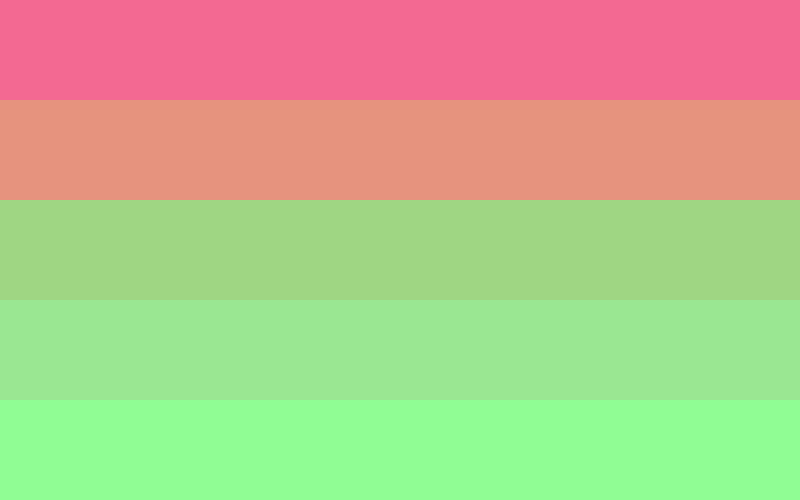
A five-band pride flag for aroflux identity, running from red for alloromanticism through beige to green for aromanticism. Aroflux describes people whose position on the aromantic spectrum fluctuates over time. Its designer is unrecorded; the earliest surviving copy is the Pride-Flags rendering on DeviantArt of 3 July 2015. [1] The term was coined by the Tumblr user ngc2068, whose blog has since been wiped; the same user coined aceflux. [2]
Key facts
- Designer
- Unknown
- Created
- First documented public use
- In use
- 2015-present
- Aspect Ratio
- 3:5 · standard
- Stripes
- 5
- Represented Identity
- aroflux
Also known as
- Aroflux Flag
Archive categories Sexual & Romantic Orientation Pride Flags
Overview
To provide a visual symbol for aroflux identity, which sits on the aromantic spectrum and describes people who fluctuate between aromantic and alloromantic experiences.
The flag represents people whose position on the aromantic spectrum fluctuates over time. Its designer is unrecorded. The earliest surviving copy is the Pride-Flags rendering of 3 July 2015, published by an account that archives other people's designs. [1] The term aroflux was coined before the flag, by the Tumblr user ngc2068. [2][3]
Identity & Context
- Represented Identity
- aroflux
- Subcommunity
- aro spectrum umbrella
Creators
The Creator
Unknown
Designer
The designer of this flag is not named in any located source. The closest period documentation, Pride Color Schemes in 2016, lists the coiner as anonymous and supplies no designer at all. [4] If you can identify the designer, the archive would like to hear from you.
Pride-Flags
Earliest located archive publisher and renderer
The DeviantArt archive that published the earliest copy of this flag located for this entry, on 3 July 2015, at roughly 1154 by 692. [1] Pride-Flags publishes renderings of other people’s designs and credits makers where it knows them; it names no designer here. Hosting is not authorship.
ngc2068
Later-attributed coiner of the term aroflux
Credited by later community wikis with coining the word aroflux. [2][3][5] The closer documentation, Pride Color Schemes in 2016, records the coiner as anonymous instead. [4] No source read for this entry connects ngc2068 to the flag’s design.
the-circus
Designer of the 2020 accessible redesign
Author of the February 2020 aroflux redesign, posted for Aromantic Spectrum Awareness Week and described by its maker as keeping the meanings of the original while fixing the colours: "here’s a redesign of the Aroflux flag! I wanted to keep the meanings of the original flag but fix up" the palette. [6] The surviving copy is a reblog chain in which the blog toothcity adds a companion aceflux redesign and refers to "we", and aroaesflags then builds an aroaceflux flag on both. Whether the-circus and toothcity are the same person, a renamed account or separate people is not established by that post, and the two are recorded here as distinct handles. The redesign is documented in its own entry. [6]
Attribution notes
No designer has been identified. The period documentation, Pride Color Schemes in 2016, records the coiner as anonymous and gives no designer; the credit to ngc2068 for coining the word is the later wikis’, and none of them connects ngc2068 to the design. [4][2] The earliest located copy of the flag is the Pride-Flags rendering of 3 July 2015, which is an archive publication rather than an original. [1]
Origin
- Specific Place
- DeviantArt (Pride-Flags archive)
- Place Type
- online community
- Digital Origin
- Yes
Digital origin; no verified physical location.
First archived on DeviantArt by Pride-Flags on 3 July 2015. The flag may have circulated on another platform before that posting. [1]
Dates & Chronology
- Year Created
- First public use
- Period in Use
- 2015-present
- Creation Bounds
- The earliest surviving copy is the Pride-Flags DeviantArt rendering, published 3 July 2015. This record previously gave 28 August 2015, which appears to belong to the ten-stripe companion version. [1]
Documented in community wikis and flag guides including the LGBTQIA+ Wiki, Pride Flag Wiki, and MOGAI Wiki. It was reblogged by the pride-color-schemes Tumblr archive. [2][3][5][4]
Major revisions
Tumblr user the-circus created an alternative aroflux flag with modified colors designed to reduce eyestrain while preserving the original meanings. [6]
Fandom user Starri-Night created a second alternative using pink, black, and grey with a different meaning structure. [2]
The flag mirrors the design structure of the aceflux flag. While aceflux uses a red-to-purple gradient representing fluctuation on the asexual spectrum, aroflux uses a red-to-green gradient representing fluctuation on the aromantic spectrum. Both terms are attributed to Tumblr user ngc2068. [2]
Lineage
- Direct children
- Aroflux Accessible Flag (2020)
No design ancestry is documented. Earlier versions of this entry carried the aromantic flag as a direct predecessor; the two share green and a subject, which is contextual resemblance rather than evidence that this flag’s unknown designer worked from it. Aceflux is a parallel coinage on the same gradient logic, related but not co-designed. The 2020 accessible redesign by the-circus is a documented derivative, because its maker describes it as a colour revision preserving the original meanings, and it is recorded in its own entry. [6]
Lineage tree
Every record reachable from this one through documented parent and child relationships: 2 records across 2 generations.
- This record
- Aroflux Pride Flag
- Children
- Aroflux Accessible Flag (2020)
Colors & Symbolism
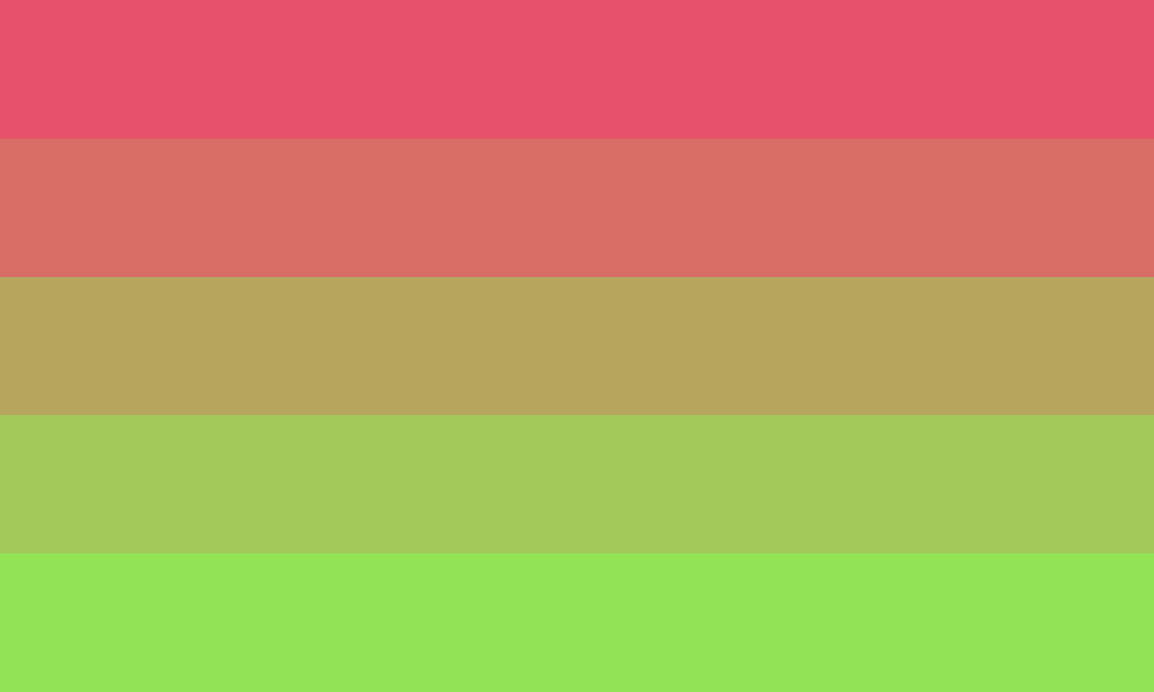
The gradient from red (top) to green (bottom) represents the fluctuating nature of aroflux orientation, moving between alloromantic and aromantic experiences. The red end represents alloromanticism (experiencing romantic attraction), while the green end represents aromanticism (experiencing little to no romantic attraction). [2][3]
| Colour | Hex | Meaning |
|---|---|---|
| Red | #E7516C | Alloromanticism, experiencing romantic attraction. [2][3] |
| Pink | #D96E66 | Transition between alloromantic and aromantic experiences. [2] |
| Beige (pink-green) | #B7A55D | Grayromanticism, experiencing romantic attraction with lesser frequency or intensity. [2][3] |
| Light green | #A3C95A | Transition toward aromanticism. [2] |
| Green | #92E356 | Aromanticism, experiencing little to no romantic attraction. [2][3] |
Modal colour of the middle sixty per cent of the band, measured from the Pride-Flags rendering of 3 July 2015 at 1154 by 692, the earliest surviving copy. Not creator-issued. [1]
This flag has no official digital palette. Color values shown are approximate.
The five bands form a continuous progression from red to green, standing for the range of romantic attraction an aroflux person moves through over time. The middle band, which some community sources call beige, measures #B7A55D, a muted yellow-green. [2][4]
No creator specification exists. The values are the modal colour of the middle sixty per cent of each band in the Pride-Flags rendering of 3 July 2015, which is flat to the pixel across that area. [1] The rendering is a JPEG, so the values carry its compression. Earlier versions of this entry published two different palettes at once: this table carried values close to these, while the artwork, the design description and the stripe table all carried #F36992, #E6937E, #9FD683, #9AE792 and #90FD94, a lighter set matching no located rendering. The artwork has been redrawn to the measured values and the three lists now agree.
Design
- Aspect Ratio
- 3:5 · standard
- Orientation
- horizontal
- Stripe Count
- 5
- Layout
- horizontal_stripes
- Stripes (Top → Bottom)
- Red, Pink, Light green, Light green, Green
Some sources describe the second and fourth stripes as half the width of the other stripes, though equal-width versions are more commonly reproduced. [4]
Five horizontal stripes forming a gradient from red (top) to green (bottom). No emblem or additional symbols. [2][1]
Five horizontal bands of equal depth running from red at the top to green at the bottom: #E7516C, #D96E66, #B7A55D, #A3C95A, #92E356. The progression from red to green stands for movement along the aromantic spectrum. [1]
Usage & Adoption
- Online Usage
- Wikis and community flag guides, pride-color-schemes Tumblr archive, LGBTQIA+ Wiki, MOGAI Wiki
- Current Status
- widely circulated community design; predominant documented aroflux flag
Documented in community wikis and flag guides. Alternative versions exist for accessibility (by the-circus, 2020) and stylistic variation (by Starri-Night, 2021). [2][6]
Image Archive
Circulating rendering
Flag design
Discourse & Debates
- The original aroflux flag's red-to-green gradient was reported to cause eyestrain for some viewers, prompting multiple redesigns (the-circus, 2020; Starri-Niqht, 2021). [6][2]
- A February 2020 redesign by toothcity, posted for Aromantic Spectrum Awareness Week, kept the meanings while fixing colours the creator found "eyestrainy," offered with "Feel free to use, no credit is required"; it is documented in its own entry. [6]
Common misidentifications
- Sometimes confused with other aro-spectrum flags due to the green palette
- Aroflux is sometimes confused with aceflux. Aroflux specifically describes fluctuation along the aromantic spectrum (romantic attraction), while aceflux describes fluctuation along the asexual spectrum (sexual attraction). [2]
Criticisms
- Some users reported the original flag's color combination causing eyestrain, leading to alternative designs. [6]
The term 'aroflux' was coined by Tumblr user ngc2068 (blog since deleted). It describes people whose position on the aromantic spectrum fluctuates over time, ranging from aromantic to alloromantic. The same user also coined 'aceflux.' [2]
Footnotes & Citations
Sources and footnotes 8 sources
- 1. Aroflux (1) by Pride-Flags on DeviantArt. Pride-Flags. DeviantArt (2015-07-03). Accessed 2026-08-14
- 2. Aroflux. LGBTQIA+ Wiki. Accessed 2026-03-20
- 3. Aroflux Flag. Pride Flag Wiki (Fandom). Accessed 2026-03-20
- 4. Social media Aroflux (pride-color-schemes). pride-color-schemes. Tumblr (pride-color-schemes) (2016-06-26). Accessed 2026-08-14
Documents both 2015 versions; lists the coiner as anonymous and the designer as unknown.
- 5. Aroflux. MOGAI Wiki. Accessed 2026-03-20
- 6. Social media Aroflux flag redesign discussion. toothcity (via aroflagarchive). Tumblr (aroflagarchive) (2020-02-16). Accessed 2026-08-14
- Aroflux Color Palette. sillykittyelijah. color-hex.com. Accessed 2026-03-20
- Aroflux. Sexuality Wiki (Fandom). Accessed 2026-03-31
Image Sources
- Rendering
- five-stripe gradient standard
- The five-stripe aroflux flag as rendered by the Pride-Flags DeviantArt account, published July 3, 2015; the earliest surviving copy located. [1] · Credit: Pride-Flags (DeviantArt) · DeviantArt
- The Aroflux Pride Flag, a five-stripe gradient design representing fluctuating romantic orientation. Original designer unknown, earliest located copy published 3 July 2015. · SVG reconstruction (approximate hex)