Unlabeled Pride Flag
Identity Pride Flag ·
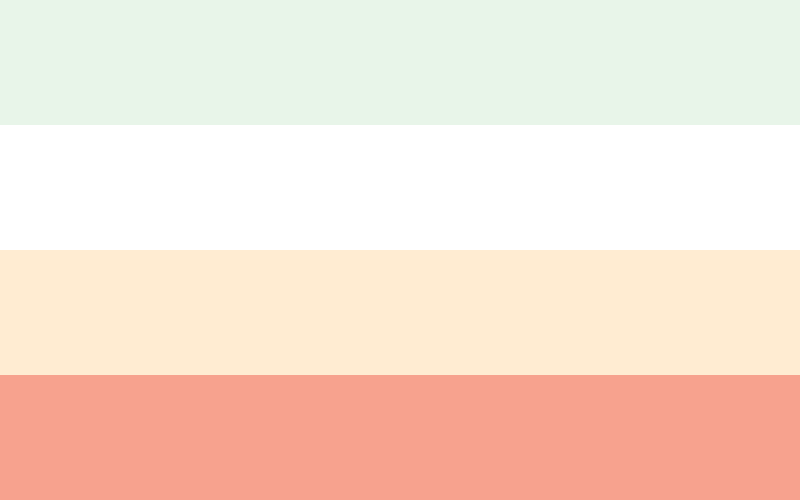
A four-stripe pride flag in pale green, white, pale blue, and pale orange for people who choose not to identify under specific labels for sexuality, gender, or other aspects of identity. Attributed to Twitter user lwtroses, with the earliest known use dating to December 11, 2020. [1] The creator's account has since been suspended, making verification difficult.
Key facts
- Designer
- Creator uncertain
- Created
- First documented public use
- In use
- Earliest located or reported use 11 December 2020
- Aspect Ratio
- 3:5 · standard
- Ratio Notes
- The source proportion is not documented. 3:5 is the archive’s production ratio for its own reconstruction and is not the creator’s specification. The reconstruction is drawn at 1000 by 600; the file this entry used until August 2026 was 800 by 500, which is 8:5 and did not match the label it carried.
- Stripes
- 4
- Represented Identity
- unlabeled
Also known as
- Unlabeled Flag
- No Label Flag
Status Contested
Archive categories Sexual & Romantic Orientation Pride Flags · Inclusive and Progress Pride Flags
Overview
To provide a visual symbol for people who actively choose not to adopt specific identity labels.
The flag appeared on Twitter in late 2020, during a period of active online discourse about identity labels and their limitations. The "unlabeled" concept originally emerged in lesbian communities (describing those who did not identify as butch or femme) and gradually broadened to include people who reject or decline labels for sexuality, gender, or identity more broadly. [1]
Identity & Context
- Represented Identity
- unlabeled
"Unlabeled" describes people who choose not to adopt specific labels for their sexuality, gender, or other identity. The term was originally used by lesbians who did not identify as butch or femme, and has since broadened to encompass sexuality and gender identity more generally. [1]
Creators
The Creator
Creator uncertain
Designer
No source securely identifies the designer. The fullest account available says the creator is unclear, names lwtroses as the earliest use, and reports LOVERSHSLOT and fearlesslyhaz as alternative attributions. [2] The original post is gone and the creation date is unverified. If you can identify the designer, the archive would like to hear from you.
lwtroses
Earliest attributed publisher
The Twitter user to whom later sources trace the flag’s earliest use, reported to 11 December 2020. [2] The account has since been suspended and the original post has not been recovered, so the attribution rests on later reporting rather than on an inspected post. Being the earliest attributed user is not the same as being the designer.
LOVERSHSLOT and fearlesslyhaz
Alternative creator attributions
Two handles named by a later account as people who may also have created the flag. [2] No source read here establishes either claim, and they are recorded so the disagreement stays visible rather than being resolved by silence.
Attribution notes
The designer is not securely established and the sources disagree. A later account states plainly that the creator is unclear, that the earliest use was by the Twitter user lwtroses, and that LOVERSHSLOT or fearlesslyhaz may also have created it. [2] The original Twitter post has not been recovered and no creation date is verified. The earliest located or reported use is 11 December 2020. lwtroses is recorded here as the earliest attributed publisher rather than as the confirmed designer, and the suspension of that account is not evidence of authorship.
Origin
- Digital Origin
- Yes
Digital origin; no verified physical location.
Created on Twitter (now X). The creator's account (lwtroses) has been suspended, making the original post inaccessible. [1]
Dates & Chronology
- Year Created
- First public use
- Period in Use
- Earliest located or reported use 11 December 2020; creation date unverified
The flag has gained traction in online communities since late 2020, appearing in wiki resources and pride flag directories. [1][3] Its adoption is concentrated in online spaces.
The term "unlabeled" was originally used by lesbians who did not identify as butch or femme, and later broadened to include people who decline labels for sexuality, gender, or identity more generally. The 2020 flag sits adjacent to earlier label-refusing vocabularies, including the pomosexual flag, but the entry's single located source does not document a direct lineage. [1]
Lineage
- Indirect influences
- Rainbow Pride Flag
No design ancestry is documented. The rainbow flag was carried here as an indirect influence and is removed: no source connects the two designs. Pomosexual is a useful contextual comparison, since both concern resistance to fixed labels, but it is a comparison rather than an ancestor and no source presents it as one.
Colors & Symbolism
The four pastel stripes represent qualities associated with the decision to exist outside of fixed identity categories: freedom, understanding, acceptance, and flexibility. [1]
| Colour | Hex | Meaning |
|---|---|---|
| Pale green | #E8F5E9 | Freedom. [1] |
| White | #FFFFFF | Understanding. [1] |
| Pale blue | #D2ECFF | Acceptance. [1] |
| Pale orange | #F7A28E | Flexibility. [1] |
Archive value, read from the Encycloflaggia reconstruction. The creator published no colour specification and no source file has been located. [1]
This flag has no official digital palette. Color values shown are approximate.
The palette is pastel rather than saturated. No stripe-level meanings beyond the four-term list (freedom, understanding, acceptance, flexibility) are documented in the located sources. [1]
No creator specification has been located, so every value here is an archive value rather than the designer’s. The four band meanings are consistently reported and are preserved; the reasons for those particular colour associations were not recovered. [1] The third band was wrong until August 2026: the archive artwork painted #FFECD2, a pale cream, while the entry and the sources all described a pale blue. #FFECD2 is the exact byte-reversal of #D2ECFF, a pale blue, which is consistent with a red and blue transposition; the other three bands are unchanged by that swap. The band is restored to a pale blue so the artwork agrees with its own description.
Design
- Aspect Ratio
- 3:5 · standard
- Ratio Notes
- The source proportion is not documented. 3:5 is the archive’s production ratio for its own reconstruction and is not the creator’s specification. The reconstruction is drawn at 1000 by 600; the file this entry used until August 2026 was 800 by 500, which is 8:5 and did not match the label it carried.
- Orientation
- horizontal
- Stripe Count
- 4
- Layout
- horizontal_stripes
- Stripes (Top → Bottom)
- Pale Green, White, Pale Blue, Pale Orange
Four horizontal bands of equal depth. The reconstruction published here paints them #E8F5E9, #FFFFFF, #D2ECFF and #F7A28E. No source proportion or creator palette has been located, so all four are archive values. [1]
Four equally sized horizontal stripes ordered top to bottom: pale green, white, pale blue, pale orange. [1]
A four-stripe horizontal flag in soft pastel tones. The muted palette distinguishes it from most other pride flags, which typically use saturated colors. [1]
Usage & Adoption
- Current Status
- documented online circulation and directory listings since December 2020
Growing recognition in online spaces since late 2020, but limited visibility at in-person events or in institutional contexts.
Image Archive
Archive reconstruction
Discourse & Debates
- Whether "unlabeled" constitutes an identity in its own right, or is better understood as a stance toward identity labels. Some argue that creating a flag and community around being unlabeled reintroduces the very labeling the identity rejects. [1]
Common misidentifications
- Sometimes confused with pomosexual identity, which specifically rejects sexual orientation labels. "Unlabeled" is broader, encompassing gender, sexuality, and other identity dimensions. [1]
Criticisms
- The concept of an "unlabeled" identity has prompted debate about whether applying the label "unlabeled" to someone contradicts the identity's core premise. Critics note the irony of categorizing people under a flag and label whose purpose is to reject categorization. [1]
The term "unlabeled" was originally used within lesbian communities for people who did not identify as butch or femme. It has since broadened significantly to include people who decline labels for sexuality, gender, or identity generally. [1]
Footnotes & Citations
Sources and footnotes 5 sources
- 1. Unlabeled. LGBTQIA+ Wiki. Accessed 2026-03-30
- 2. Evolve Inc: Unlabeled Identity. Orientation Wiki (Fandom). Accessed 2026-03-30
States that the creator is unclear, that the earliest use was by lwtroses, and that LOVERSHSLOT or fearlesslyhaz may also have created it.
- 3. Unlabeled. LGBTQIA+ Wiki (Fandom). Accessed 2026-03-30
- Unlabeled Pride Flag. VexiWiki (Fandom). Accessed 2026-03-31
- Pride Flags Glossary: Unlabeled. UCSB Resource Center for Sexual & Gender Diversity. Accessed 2026-03-31
Image Sources
- Rendering
- four-stripe standard
- Encycloflaggia reconstruction at the house 3:5 production ratio. No source file has been located and the creator published no proportion or palette, so this is an archive drawing rather than the original artwork. · Credit: Encycloflaggia reconstruction. · Encycloflaggia