Transneutral Alternate Flags (2016)
Identity Pride Flag ·
Three separate transneutral designs published on DeviantArt in 2016, each five symmetric horizontal bands in a single hue: one yellow and one purple on 5 October, one green on 6 December. [1][2][3] The compilation that preserves all three records the designer as unknown and gives one explanation for the family, that green, purple and yellow are used as nonbinary colours because they avoid blue and pink or are read as mixtures of them. [4] They are not versions of a single tricolour flag, and none of them carries a documented creator.
Key facts
- Created
- Earliest located publication
- Aspect Ratio
- 3:5 · standard
- Ratio Notes
- The three source files are each 5000 by 3000 pixels, which reduces to 3:5 and agrees with the standard production ratio shown here. [1][2][3]
- Stripes
- 5
- Represented Identity
- Transneutral people, transgender people who identify with neutral gendered feelings more than with femininity or masculinity
Also known as
- Transneutral Alternate Flag (2016)
- Transneutral (1)
- Transneutral (2)
- Transneutral (3)
Archive categories Gender Identity Pride Flags
Overview
No statement of intent has been located for any of the three. The compilation gives a reason for the hues rather than for the designs: green, purple and yellow are "commonly used as nonbinary colors because of either not having blue or pink, or being a mix of them." [4]
Three transneutral designs were published on the Pride-Flags DeviantArt gallery in 2016. Two went up on 5 October, one second apart: a yellow design and a purple design. A third, in greens, followed on 6 December with the note that "Someone suggested using greens as an alternate color scheme for transneutral designs. The colors are taken straight from the agender and neutrois designs and go really well together!" [1][2][3] All three share one arrangement, five horizontal bands symmetric about the centre, worked in a single hue.
Identity & Context
- Represented Identity
- Transneutral people, transgender people who identify with neutral gendered feelings more than with femininity or masculinity
- Subcommunity
- transgender / nonbinary umbrella
- Language Context
- The source defines the term: "Transneutral is a term used to describe transgender people who were assigned male or female at birth, but identify with neutral gendered feelings to a greater extent than with femininity or masculinity. They usually are nonbinary but could be trans men or trans women." [4]
Transneutral is not a synonym for nonbinary. Not all nonbinary genders are neutral in nature, and the term covers trans men and trans women who describe their gender as neutral. [4]
Creators
Associated Figure
Pride-Flags
Uploader and renderer of the source files
The DeviantArt account of the person who ran the pride-color-schemes and ask-pride-color-schemes Tumblr blogs, where flags were redrawn at 5000 by 3000 pixels and filed by identity. The three transneutral files here are the account's renderings; the compilation on its own blog records the designer as unknown. [4][1]
All designs in this gallery are HQ and are free to use for anything pride-related! You can download the full size on the right sidebar.
The reuse statement published in the descriptions of the yellow and purple deviations of 5 October 2016. [1][2]
Someone suggested using greens as an alternate color scheme for transneutral designs. The colors are taken straight from the agender and neutrois designs and go really well together!
The note published with the green design on 6 December 2016. [3]
Attribution notes
The designer is not documented. The pride-color-schemes compilation that reproduces all three designs states "Designed by: Unknown", and gives the term's coiner as unknown as well. [4] The Pride-Flags account uploaded and rendered the three files and is credited as their author on DeviantArt, which records who made those files rather than who designed the flags; the account's own file pages for other flags distinguish its own designs by marking them "me", and these do not carry that mark. [1][2][3]
Origin
- Place Type
- online platform
- Digital Origin
- Yes
Digital origin; no verified physical location.
The three files were published on DeviantArt and compiled on the pride-color-schemes Tumblr blog on 28 January 2017. No location is documented for the designs or for whoever made them. [4][1][2][3]
Dates & Chronology
- Year Created
- Earliest located publication
- Creation Bounds
- The three designs were published on DeviantArt on 5 October 2016 (the yellow and the purple, one second apart) and 6 December 2016 (the green). Those are upload timestamps on the account that rendered the files, not dates of design, and the compilation that preserves them names no designer. [1][2][3][4]
Documented circulation runs from the DeviantArt gallery where the files were published to the pride-color-schemes compilation of 28 January 2017, which reproduces all three side by side and links each to its file page. [4][1][2][3] No organisational adoption, manufacture or photographed use has been located.
A later and more widely circulated transneutral flag was published by arco-pluris in 2018, built from the transmasculine and transfeminine designs rather than from these. It is the later of the two and no source documents it as derived from this family. Further transneutral designs followed from ElderflowerJuice on 29 July 2021 and from carrot!/Dandy on 11 December 2021.
Lineage
- Indirect influences
- Agender Pride Flag, Neutrois Pride Flag
The green design of December 2016 is the only one of the three with a stated source: its file page says the colours were taken from the agender and neutrois designs. [3] Measured against the archive's copies of those flags the values are close rather than identical, the agender pastel green #B8F483 against this design's #B6F583 and the neutrois green #1F9F00 against #2F9C1D. Nothing has been located about where the yellow and purple designs came from. The 2018 arco-pluris transneutral flag is later, not descended: it is built from the transmasculine and transfeminine flags, and chronological succession is not design descent.
Colors & Symbolism
pride-color-schemes gives one explanation for the family: "Green, purple, and yellow are commonly used as nonbinary colors because of either not having blue or pink, or being a mix of them." [4]
| Colour | Hex | Note |
|---|---|---|
| Yellow design: outer bands | #FFFAA4 | Measured from the 5000 by 3000 source file [1] |
| Yellow design: inner bands | #FFF443 | Measured from the 5000 by 3000 source file [1] |
| Yellow design: centre band | #FFFCCC | Measured from the 5000 by 3000 source file [1] |
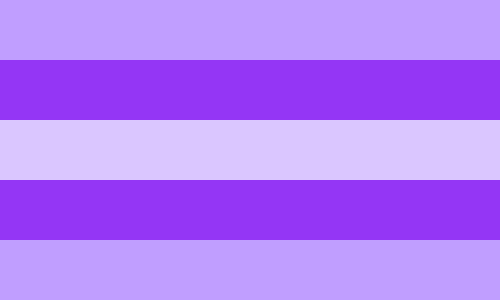
| Purple design: outer bands | #C09EFF | Measured from the 5000 by 3000 source file [2] |
| Purple design: inner bands | #9436F5 | Measured from the 5000 by 3000 source file [2] |
| Purple design: centre band | #DAC6FF | Measured from the 5000 by 3000 source file [2] |
| Green design: outer bands | #73C950 | Measured from the 5000 by 3000 source file [3] |
| Green design: inner bands | #2F9C1D | Measured from the 5000 by 3000 source file [3] |
| Green design: centre band | #B6F583 | Measured from the 5000 by 3000 source file [3] |
No meanings have been published for individual bands, and the explanation above covers all three designs rather than any one of them. [4]
Nine values for three designs, three to each. They were measured on 16 August 2026 from the 5000 by 3000 files served by the three DeviantArt pages, each of which holds exactly three colours and no others. No hex values were published with the designs. [1][2][3]
Design
- Aspect Ratio
- 3:5 · standard
- Ratio Notes
- The three source files are each 5000 by 3000 pixels, which reduces to 3:5 and agrees with the standard production ratio shown here. [1][2][3]
- Orientation
- horizontal
- Stripe Count
- 5
- Layout
- horizontal stripes
- Stripes (Top → Bottom)
- Mid tone, Saturated tone, Palest tone, Saturated tone, Mid tone
Five horizontal bands in a single hue, symmetric about the centre: a mid tone top and bottom, the most saturated tone inside those, and the palest tone across the centre. Each of the three documented designs uses this arrangement in its own hue. On the 5000 by 3000 source files the band depths run 601, 600, 598, 600 and 601 pixels against an exact fifth of 600. [1][2][3]
Five equal horizontal stripes. The source's own description of the green design reads "5 stripes, green, dark green, light green, dark green, green". [4]
Three designs sharing one structure of five equal horizontal bands, symmetric about the centre. The yellow design runs #FFFAA4, #FFF443, #FFFCCC, #FFF443, #FFFAA4; the purple design #C09EFF, #9436F5, #DAC6FF, #9436F5, #C09EFF; the green design #73C950, #2F9C1D, #B6F583, #2F9C1D, #73C950. [1][2][3]
Usage & Adoption
- Online Usage
- DeviantArt, where the three files were published [1][2][3], The pride-color-schemes Tumblr compilation of 28 January 2017, which reproduces all three [4]
- Current Status
- Documented online publication; adoption unknown
Documented circulation is the DeviantArt gallery and the pride-color-schemes compilation. No adoption by an organisation, manufacture, or photographed use has been located. [4][1][2][3]
Image Archive
The Three Documented Designs (2016)

Discourse & Debates
Common misidentifications
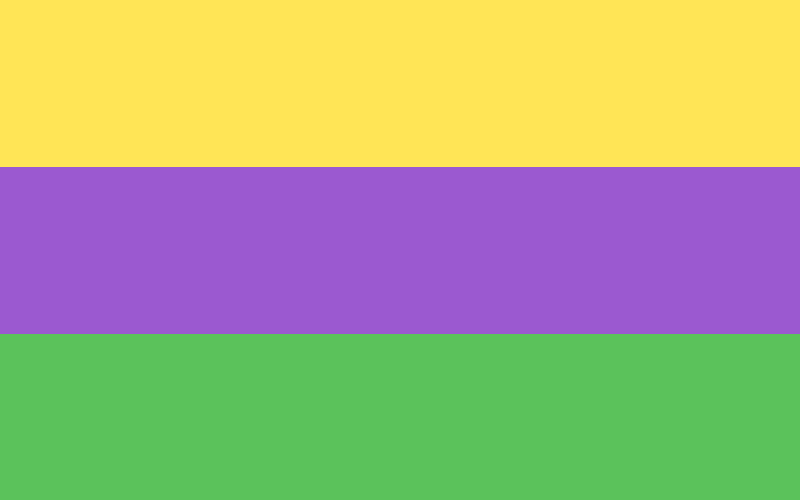
- There is no single tricolour transneutral flag in yellow, purple and green. The sources document three separate designs, each in one hue, and the three hues are named together only in the explanation of why those hues were chosen. [4]
- The designs may be confused with the nonbinary pride flag, which also uses yellow and purple. [5]
- They may also be confused with the more widely circulated transneutral flag published by arco-pluris in 2018, which is a different design built from the transmasculine and transfeminine flags.
Transneutral is distinct from nonbinary as a whole. Not all nonbinary genders are neutral-aligned, and not all nonbinary people identify as transgender. [4]
Footnotes & Citations
Sources and footnotes 6 sources
Image file page
- 1. Transneutral (1). Pride-Flags. DeviantArt (2016-10-05). Accessed 2026-08-16
The yellow design. Five symmetric bands, 5000 by 3000, published one second after the purple one.
- 2. Transneutral (2). Pride-Flags. DeviantArt (2016-10-05). Accessed 2026-08-16
The purple design. Five symmetric bands, 5000 by 3000, the earliest of the three by one second.
- 3. Transneutral (3). Pride-Flags. DeviantArt (2016-12-06). Accessed 2026-08-16
The green design, added on 6 December 2016 with the note that its colours came from the agender and neutrois designs.
Social media
- 4. Transneutral. pride-color-schemes. Tumblr (pride-color-schemes) (2017-01-28). Accessed 2026-08-16
The compilation that preserves all three designs together, records the designer as unknown, gives the family-wide colour explanation, and links each design to its own file page.
Encyclopedias & Reference
- 5. Transneutral. Gender Wiki (Fandom). Accessed 2026-03-31
- Transneutral. LGBTQIA+ Wiki. Accessed 2026-03-31
Image Sources
- Rendering
- one of three documented alternate designs
- The yellow design, one of three documented alternate transneutral designs. Normalised 3:5 reconstruction drawn from the fills of the 5000 by 3000 source file published as "Transneutral (1)" on 5 October 2016: #FFFAA4, #FFF443, #FFFCCC. [1] · Credit: Reconstruction by Encycloflaggia from the source file rendered by Pride-Flags. · Pride-Flags, DeviantArt, 5 October 2016Rights The source file page carries the notice "© 2016 - 2026 Pride-Flags" and the gallery statement that the designs are free to use for anything pride-related. The reconstruction shown here is the archive's own drawing.
- The purple design, published one second before the yellow one. Normalised 3:5 reconstruction drawn from the fills of the 5000 by 3000 source file published as "Transneutral (2)" on 5 October 2016: #C09EFF, #9436F5, #DAC6FF. [2] · Credit: Reconstruction by Encycloflaggia from the source file rendered by Pride-Flags. · Pride-Flags, DeviantArt, 5 October 2016Rights The source file page carries the notice "© 2016 - 2026 Pride-Flags" and the gallery statement that the designs are free to use for anything pride-related. The reconstruction shown here is the archive's own drawing.
- The green design, added two months after the other two. Normalised 3:5 reconstruction drawn from the fills of the 5000 by 3000 source file published as "Transneutral (3)" on 6 December 2016: #73C950, #2F9C1D, #B6F583. Its file page states that the colours were taken from the agender and neutrois designs. [3] · Credit: Reconstruction by Encycloflaggia from the source file rendered by Pride-Flags. · Pride-Flags, DeviantArt, 6 December 2016Rights The source file page carries the notice "© 2016 - 2026 Pride-Flags". The reconstruction shown here is the archive's own drawing.