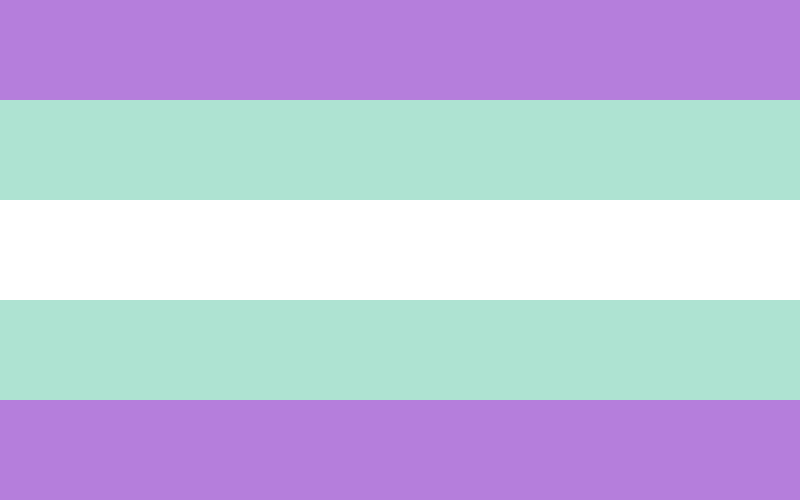
Straight Queer Pride Flag
Identity Pride Flag ·
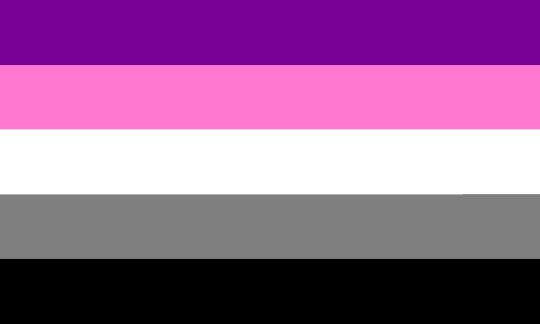
Five bands in dark purple, pink, white, gray and black, posted by Mod AP of the Beyond MOGAI Pride Flags blog on 27 August 2018 for people who identify as both straight and Queer. [1] The designer gave one meaning for the whole design rather than a meaning per band: "First colors for queerness and last ones for straightness." [1] The surviving creator-era artwork is 540 by 324 pixels, and several other flags circulate for the same label. [2][3]
Key facts
- Designer
- Mod AP (arco-pluris)
- Created
- Earliest located publication
- In use
- 2018-present
- Aspect Ratio
- 3:5 · apparent
- Ratio Notes
- Measured from the artwork the creator's own post embeds: 540 by 324 pixels, a width to height of exactly 5:3, which is 3:5 read as hoist to fly. No proportion is stated in words. [2]
- Stripes
- 5
- Represented Identity
- people who identify as both straight and Queer
Also known as
- Heteroqueer Pride Flag
- Queerhet Pride Flag
- Queer Straight Pride Flag
Status Proposed
Archive categories Sexual & Romantic Orientation Pride Flags
Overview
To supply a pride symbol for people who identify mutually as Queer and straight, in the wording of the post that introduced it. [1]
Mod AP published the flag on the Beyond MOGAI Pride Flags blog on 27 August 2018, with a definition and a single line about the colours: "First colors for queerness and last ones for straightness." [1] The post defines Queer Straight as "individuals identifying mutually as queer and straight" and supplies coined short forms for the label and for people who hold it: queerst or quaight for the identity, and streerian, queraightian, qlq, qls, slq and sls for a "straight queerian". [1]
The mirror's timestamp is 28 August 2018 at 03:02 UTC. Sources giving 27 August are reporting the same post in a western-hemisphere local time. [1]
Identity & Context
- Represented Identity
- people who identify as both straight and Queer
- Subcommunity
- Queer umbrella (contested)
The label covers populations whose situations differ. Trans, nonbinary, intersex and a-spec people who are heterosexual in orientation use it as an identity term. Cisgender heterosexual people who defy gender norms, practise kink or non-monogamy, or align with Queer community and politics have also used it, and academic masculinity studies have used it for straight men whose gender presentation is read as Queer. Mod AP's 2018 post defines only the mutual straight-and-Queer sense. [4][5][1]
Creators
The Creator
Mod AP (arco-pluris)
Designer of the 2018 five-band flag and author of its published meaning
Tumblr flag designer active in the late 2010s, posting as Mod AP on the Beyond MOGAI Pride Flags blog and signing posts "ap". [1] The blog coined and published identity terms alongside flags for them, and the straight Queer post follows that pattern: a definition, a set of coined short forms, and one line on the colours. [1] Mod AP is also credited with the transneutral, MTX/MTNB and FTX/FTNB pride flags. [4] Ten months later the same blog published a twelve-band heteroqueer flag under a separate definition, "describing queer folks that are hete(r(o))-/het(r(o))-". [6]
Queer Straight (queerst or quaight): individuals identifying mutually as queer and straight; a straight queerian (streerian/queraightian, qlq/qls/slq/sls).
First colors for queerness and last ones for straightness. ~ ap
Hetroqueer or Heteroqueer: describing queer folks that are hete(r(o))-/het(r(o))-.
Motivations
- To give a pride symbol to people who identify mutually as Queer and straight, the group the post's own definition names. [1]
Attribution
- Organization
- Beyond MOGAI Pride Flags
Attribution notes
Mod AP, who signs posts "ap" and is also known as arco-pluris, published the flag on the Beyond MOGAI Pride Flags blog on 27 August 2018. [1] Other designs circulate under the same label and are the work of other people: a seven-band heteroqueer flag by Gayer9000, recorded on the LGBTA Wiki in December 2020, and a five-band queerhet flag by the Tumblr user kaestral of March 2021. [4][3] Mod AP posted a separate twelve-band heteroqueer flag on 29 June 2019, under a definition of its own. [6]
Origin
- Digital Origin
- Yes
Digital origin; no verified physical location.
Published on the Beyond MOGAI Pride Flags Tumblr blog. The surviving mirror of that post on the blog's own WordPress site carries a publication time of 28 August 2018 at 03:02 UTC, which is the evening of 27 August across the Americas; the two dates that circulate for this flag are the same posting. [1]
Dates & Chronology
- Year Created
- Exact date
- Earliest located publication
- Period in Use
- 2018-present
Circulation is online and limited, and no version of the label has consolidated. Besides this flag, the LGBTQIA+ Wiki records a seven-band heteroqueer flag by Gayer9000 uploaded by the FANDOM user Homesick Moonstone on 16 December 2020 and reposted by Pride-Flags on DeviantArt in April 2021; a queerhet flag by the Tumblr user xenogender-aligned of 19 December 2020, combining the Queer chevron flag's shape with the straight flag's monochrome scheme; two straight Queer flags by the FANDOM user Scourgeface of 12 January 2021, whose stripes run vertically; an alternate by the Reddit user potaTARDIS_ of 22 March 2021; and a straightqueer flag posted by the Twitter user queerstraight on 15 January 2022, whose colour meanings are not recorded. [4][3] The kaestral queerhet flag of 18 March 2021 runs five desaturated bands and came with a definition and a waiver: "Queerhet - Any straight person that also exists within the LGBT community. This would include straight: Trans; Nonbinary; Intersex; Aspec; Split Attraction. Please use as you wish, no need to credit me!" [4][7]
Major revisions
Earliest located print use of the compound: a zine titled Straightqueer. Little beyond the title is documented.
Ann Powers used 'queer straight' for a straight person who passes as Queer in Queer spaces. One source dates the article to 1993 in its text while its own reference gives The Village Voice of 29 June 1996; the discrepancy is internal to that source.
Leah Lakshmi Piepzna-Samarasinha used 'straight queer' pejoratively, for a Queer person who was conventionally gendered and monogamously partnered.
Tristan Taormino described the 'Queer Heterosexual' in The Village Voice.
Robert Heasley published a typology of 'queer masculinities of straight men' in Thinking Straight (Routledge).
Mod AP posted this five-band flag on Beyond MOGAI Pride Flags, with the definition of Queer Straight and the note that the first colours stand for queerness and the last for straightness.
Mod AP posted a twelve-band heteroqueer flag on the same blog under a separate definition. The post does not present it as a revision of the 2018 design.
A seven-band heteroqueer flag by Gayer9000 was uploaded to the LGBTA Wiki by the FANDOM user Homesick Moonstone.
The Tumblr user kaestral posted a five-band queerhet flag with its own definition and an explicit waiver of credit.
The label is older than any of its flags, and has carried at least four documented and non-interchangeable uses.
Trans, nonbinary, intersex and a-spec people whose orientation is heterosexual use it for a position the standard orientation labels do not name; "heteroqueer" appears in this sense in studies of the partners of trans men in 2009 and 2011, one participant explaining, "I've been without my lesbian ID card for several years now, but I can't really call myself straight either... so heteroqueer seems to fit best." [4] Cisgender heterosexual people whose gender presentation, kink practice, non-monogamy or community alignment falls outside hegemonic norms have also used it; Robert Heasley's 2005 typology of "queer masculinities of straight men" made that an academic category, with sub-types including "straight sissy boys" and "social justice straight-queers". [5] Ann Powers used "queer straight" in the 1990s for a heterosexual person who could pass as Queer in Queer spaces. [4] Leah Lakshmi Piepzna-Samarasinha used "straight queer" pejoratively in 1997, for a Queer person who was conventionally gendered and monogamously partnered. [4] The last two describe opposing positions and appeared in print within a few years of each other. Earlier still, a 1972 zine carried the title Straightqueer, though little beyond the title is documented. [4]
Mod AP's 2018 post adopts none of these histories explicitly. Its definition is its own, and the later populations associated with the term are documented uses of the label rather than extensions the post makes.
Lineage
- Indirect influences
- Rainbow Pride Flag
No design source is documented for this flag, and the designer names none. [1]
The other flags for this label are separate proposals rather than descendants. Mod AP's twelve-band heteroqueer flag of 29 June 2019 carries its own definition, "describing queer folks that are hete(r(o))-/het(r(o))-", and does not present itself as a revision or expansion of the 2018 design. [6] Gayer9000's seven-band flag and kaestral's queerhet flag were made by other people for a similar identity and cite no source. [4][7] The straight ally flag addresses an adjacent subject and is a thematic relation, not an ancestor. All four are recorded as related.
Colors & Symbolism
Mod AP published one meaning for the design as a whole and none for individual bands: "First colors for queerness and last ones for straightness." [1] The dark purple and pink at the top are the Queer end and the gray and black at the foot are the straight end, with white between them. No per-band meaning has been published for this flag.
| Colour | Hex |
|---|---|
| Dark Purple | #790196 |
| Pink | #FF78D0 |
| White | #FFFFFF |
| Gray | #7F7F7F |
| Black | #000000 |
Measured from the artwork embedded in the creator's post. [2]
This flag has no official digital palette. Color values shown are approximate.
The per-band meanings that circulate under this label belong to other designs. Scourgeface's 2021 flag assigns lavender to trans individuals, pink to binary women and women-aligned individuals, yellow to nonbinary genders, green to aromantic-spectrum individuals, blue to binary men and men-aligned individuals, and purple to asexual-spectrum individuals, and runs its stripes vertically. [3] The kaestral queerhet flag of 2021 gives a scope rather than a palette key. [7] Neither belongs to Mod AP's design.
The designer published no hex values. The five above are measured from the 540 by 324 PNG that the creator's own post embeds, taking each band's flat interior. [2] They match the description in the reference wikis, which give this label's flags as using "shades of purple, pink, white, gray, and/or black". [4]
Values published for the other flags under this label belong to those flags. Scourgeface's 2021 design has been recorded with #C8A2C8, #F5A9B8, #FFD800, #3DA542, #5BCEFA and #7F3F98, themselves approximations borrowed from other flags for the named hues, and its stripes run vertically. [3]
Design
- Aspect Ratio
- 3:5 · apparent
- Ratio Notes
- Measured from the artwork the creator's own post embeds: 540 by 324 pixels, a width to height of exactly 5:3, which is 3:5 read as hoist to fly. No proportion is stated in words. [2]
- Orientation
- horizontal
- Stripe Count
- 5
- Layout
- horizontal stripes
- Stripes (Top → Bottom)
- Dark Purple, Pink, White, Gray, Black
Five horizontal bands of near-equal depth. In the 540 by 324 source file the bands occupy 65, 63, 64, 63 and 65 rows, separated by single rows of antialiasing. [2]
Five horizontal bands: dark purple, pink, white, gray, black. [1][2]
Five horizontal bands running dark purple, pink, white, gray and black from top to bottom. [2] Other flags proposed for this label look nothing like it: Mod AP's own heteroqueer flag of 29 June 2019 has twelve bands, Gayer9000's of December 2020 has seven, kaestral's queerhet flag of March 2021 has five desaturated bands, and Scourgeface's runs six bands vertically. [4][3][7][6]
Usage & Adoption
- Earliest located user
- Beyond MOGAI Pride Flags (the blog that published it)
- Online Usage
- Beyond MOGAI Pride Flags, LGBTQIA+ identity wikis
- Current Status
- documented online proposal; limited located circulation
A documented online proposal with limited located circulation. It appears in identity-wiki catalogues of the label's flags alongside at least six other designs, none of which has consolidated. [4][3]
Image Archive
Creator-era artwork (2018)
Discourse & Debates
- The central tension is that 'straight Queer' has described genuinely different populations. For trans, nonbinary, intersex and a-spec people who are heterosexual, the label names a position existing orientation labels do not capture. For cisgender heterosexual people it may describe gender nonconformity, alternative relationship structures or Queer community alignment, and the legitimacy of claiming Queerness in those cases is disputed. [4]
- Some people prefer 'heteroqueer' to 'straight Queer' because it separates heterosexuality as an orientation from straightness as normativity.
- Which flag came first. Two wikis disagree. One dates this five-band design to August 2018 and Mod AP's twelve-band heteroqueer flag to 29 June 2019. [4] The other records that "the current definition and first heteroqueer flag may have been coined by Tumblr blog beyond-mogai-pride-flags on June 29, 2019", hedged with "may have been". [3] The blog's own mirror carries both posts at their separate dates. [1][6]
Common misidentifications
- The term has carried opposite meanings in different contexts: Ann Powers used 'queer straight' for a straight person passing as Queer, while Leah Lakshmi Piepzna-Samarasinha used 'straight queer' pejoratively for a conventionally gendered Queer person. [4]
- Straight Queer is not the straight ally concept. For trans, nonbinary and a-spec people who are heterosexual it is an identity label, not an allyship label.
- Described with the colours of a different version. At least six distinct flags exist for this label, with band counts of five, six, seven and twelve; this entry documents Mod AP's 2018 five-band design. [4][3]
Criticisms
- Some Queer community members argue that cisgender heterosexual people should not identify as Queer at all, on the grounds that Queerness is defined by non-heterosexual orientation, non-cisgender identity, or both. This position appears recurrently in trans community writing and in Queer-of-color writing on the politics of the reclaimed term. [4]
- When cisgender straight people use 'Queer,' a term reclaimed from a slur, the word can lose the political charge that the reclamation was meant to carry. This is one of the standard objections to the cis-het use of the label. [4]
- The label can flatten meaningful internal differences. The trans-partner heteroqueer use and the cis-het gender-noncon use describe different situations, and a single flag treats them as interchangeable when they are not.
Mod AP's post supplies its own vocabulary, preserved here as published: Queer Straight, with the short forms "queerst" and "quaight"; and a person holding the identity as a "straight queerian", with the variants "streerian", "queraightian", "qlq", "qls", "slq" and "sls". [1]
The LGBTQIA+ Wiki treats queerhet as an umbrella rather than a single identity, listing transhets, strayts, a-spec people who are also heterosexual, people who experience hetero tertiary attraction, varioriented people, those with fluid identities, and straight people in Queer relationships through ethical non-monogamy. It adds a caution: these terms "may be seen as derogatory if used on an individual who has not chosen to use or reclaim them voluntarily". [3] It also records a fandom sense with its own history, "queer het" as a description of M/F fanworks that break heteronormative conventions, in use since before the 2000s. [3]
Editorial note
The label stays contested because one compound word covers populations whose situations are not the same. Trans, nonbinary, intersex and a-spec people whose orientation is heterosexual use it for a position the standard orientation labels do not name. Cisgender heterosexual people whose gender presentation, kink practice, non-monogamy or community alignment falls outside hegemonic norms have also used it. Both uses are documented, and they are not the same use. The objection that cisgender heterosexual people should not claim "Queer" at all is a long-standing position in trans community discourse and in Queer-of-colour writing. [4] Mod AP's post defines only the first of these; the later associations are documented uses of the term rather than the designer's wording.
Footnotes & Citations
Sources and footnotes 10 sources
- 1. Blogs & Personal Sources Straight Queer Pride Flag. Mod AP (arco-pluris). Beyond MOGAI Pride Flags (2018-08-28). Accessed 2026-08-16
The blog's own surviving mirror of the original Tumblr post, carrying the definition, the colour line and the original artwork. Its publication time is 28 August 2018 at 03:02 UTC.
- 2. Image file page Straight Queer Pride Flag, artwork as published. Mod AP (arco-pluris). Tumblr (2018-08-28). Accessed 2026-08-16
The Tumblr-hosted file the creator's post embeds: 540 by 324 pixels, five flat bands. The colour values in this entry are measured from it.
- 3. Encyclopedias & Reference Straight Queer. LGBTQIA+ Wiki. Accessed 2026-08-16
Lists seven flags with designers and dates, gives the Scourgeface stripe meanings and the reason its stripes are vertical, and sets out the queerhet umbrella. Last edited 20 July 2026.
- 4. Encyclopedias & Reference Straight queer. LGBTQIA+ Wiki (Fandom). Accessed 2026-03-30
- 5. Books Crossing the Borders of Gendered Sexuality: Queer Masculinities of Straight Men. Robert Heasley. Thinking Straight: The Power, the Promise, and the Paradox of Heterosexuality (Routledge, ed. Chrys Ingraham) (2005). Accessed 2026-04-07 [no stable URL]
- 6. Blogs & Personal Sources Heteroqueer Pride Flag. Mod AP (arco-pluris). Beyond MOGAI Pride Flags (2019-06-29). Accessed 2026-08-16
Mod AP's later twelve-band flag, under a definition of its own. It makes no reference to the 2018 design.
- 7. Social media Queerhet Flag. @kaestral. Tumblr (2021-03-18). Accessed 2026-04-07
The kaestral queerhet flag of 18 March 2021, a separate design; the source of the credit waiver quoted in this entry.
- Articles & Reports Heteroqueer Ladies: Some Performative Transactions between Gay Men and Heterosexual Women. Roberta Mock. Feminist Review, vol. 75 ('Identities'), Sage Publications (2003-12). Accessed 2026-04-07
- Articles & Reports The Queer Heterosexual. Tristan Taormino. The Village Voice (2003-05-06). Accessed 2026-04-07 [no stable URL]
- Encyclopedias & Reference Queer heterosexuality. Wikipedia. Accessed 2026-03-30

Image Sources
- Rendering
- Mod AP (arco-pluris), 27 August 2018
- Credit: Mod AP (arco-pluris), Beyond MOGAI Pride Flags, 27 August 2018Rights Unknown. No reuse or licensing statement by the designer has been located. [1]
- Credit: Encycloflaggia, drawn from the creator-era fileRights Reconstruction by this archive; the underlying design's rights are unknown. [2]
- The flag as Mod AP published it on 27 August 2018, 540 by 324 pixels. The colour values recorded in this entry are measured from this file. [1][2] · Credit: Mod AP (arco-pluris), Beyond MOGAI Pride Flags · Beyond MOGAI Pride Flags