Sapphic Flag
Identity Pride Flag ·
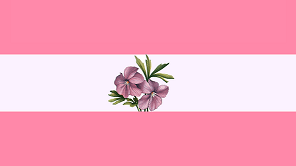
A three-band pink and lavender flag bearing a central violet flower, designed by the Tumblr user lesbeux-moved on 14 August 2015. [1] Two days later the same user rewrote the explanation after criticism that describing white as purity was exclusionary and eurocentric; the image did not change, only the words attached to it. [2] The flat, simplified version that now circulates most widely is a separate artifact by a different person: Mod Hermy published it on the Pride-Flags DeviantArt account on 10 September 2016, and the palette recorded here is measured from that file. [3]
Key facts
- Designer
- lesbeux-moved
- Created
- First documented public use
- In use
- 2015–present
- Aspect Ratio
- 148:83 · apparent
- Ratio Notes
- Measured from lesbeux-moved’s own file, 296 by 166 pixels, which reduces to 148:83, about 1.783 to 1. Tumblr’s larger derivatives of the same upload return the identical image, so those are the dimensions as posted. [1] Mod Hermy’s 2016 simplification is a separate artifact at 5000 by 3000, exactly 5:3. [3] The 900 by 600 file this entry displayed until August 2026 is an archive derivative at 3:2 and matches neither.
- Stripes
- 3
- Represented Identity
- Sapphic people: women and woman-aligned nonbinary people who are sexually or romantically attracted to women and woman-aligned people, covering lesbian, bisexual and pansexual women among others, and so not a synonym for lesbian.
Also known as
- Sapphic Pride Flag
- WLW Flag
- Sapphic / WLW / SGA Women Flag
Archive categories Sexual & Romantic Orientation Pride Flags
Overview
To provide a broader women-loving-women symbol not limited to lesbian identity alone, grounding it in the historical tradition of violet symbolism associated with Sappho and sapphic desire. [4][5]
Posted to Tumblr by lesbeux-moved on 14 August 2015 under the heading "Sapphic / WLW / SGA Women Flag", tagged sapphic, wlw, women loving women, same gender loving and lgbt+. [1] The violet is the flag's organising symbol, referring to the flowers in Sappho's poetry and to their later exchange between women who loved women.
Identity & Context
- Represented Identity
- Sapphic people: women and woman-aligned nonbinary people who are sexually or romantically attracted to women and woman-aligned people, covering lesbian, bisexual and pansexual women among others, and so not a synonym for lesbian.
- Subcommunity
- sapphic umbrella
The flag's own documentation defines the term as "women or woman-aligned NB people who are sexually and/or romantically attracted to other women(-aligned) people", applying to "lesbian, pansexual, bisexual, and other women(-aligned)" people. [6]
Creators
The Creator
lesbeux-moved
Designer
The Tumblr user who designed and posted the sapphic flag on 14 August 2015, in the detailed form with a botanical illustration of violets on the centre band. [1] On 16 August the same user revised the written explanation: pink had been given as love and white as purity, and after readers objected that purity was an exclusionary and eurocentric framing, the centre was instead described as a lavender-like field carrying violets, tied to the long association between violets and women loving women. [2] The image itself was not redrawn.
Mod Hermy
Simplifier and rendering artist of the 2016 version
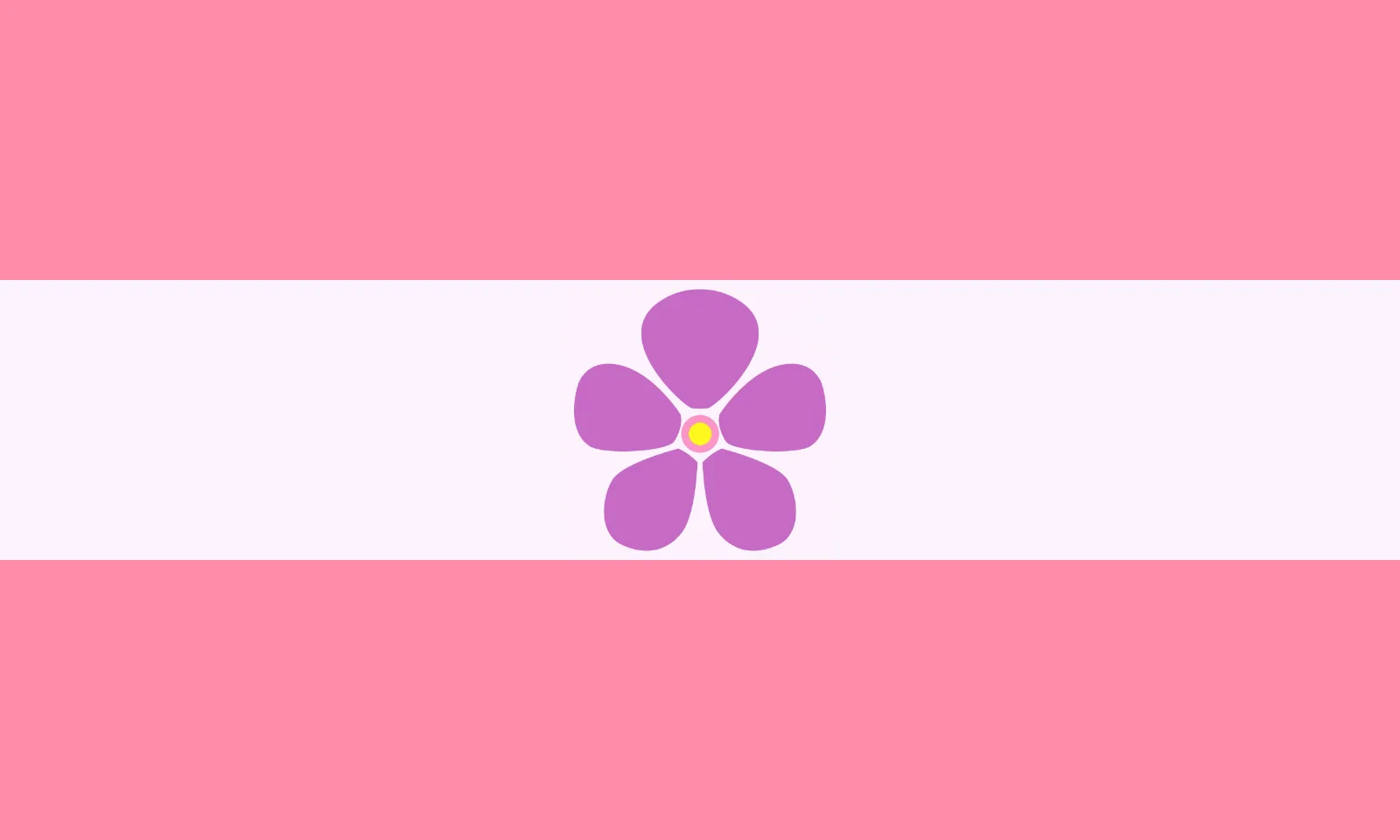
A contributor to the Pride-Flags DeviantArt account who published a simplified rendering of the sapphic flag on 10 September 2016, replacing the botanical illustration with a flat vector flower at 5000 by 3000. [3] The simplification is Mod Hermy’s work, not lesbeux-moved’s, and the two artifacts are recorded separately here.
Attribution notes
lesbeux-moved designed and published the flag on Tumblr on 14 August 2015. [1] Two days later the same user rewrote the explanation of the design after criticism that describing white as purity was exclusionary and eurocentric; the posted image did not change, only the words attached to it. [2] The simplified rendering that now circulates most widely is a different artifact by a different person: Mod Hermy of the Pride-Flags DeviantArt account published it on 10 September 2016. [3] A pride-color-schemes post of 25 June 2017 is later documentation of that rendering, not its creation, and pride-color-schemes did not design either version. [6]
Origin
- Digital Origin
- Tumblr
Digital origin; no verified physical location.
Posted on Tumblr on 14 August 2015. [1] The simplified rendering was published separately on DeviantArt on 10 September 2016 by Mod Hermy. [3]
Dates & Chronology
- Year Created
- Exact date
- First public use
- Period in Use
- 2015–present
The flag is widely recognized in online Queer communities, particularly on Tumblr, Twitter/X, and TikTok, where it serves as the primary visual marker for sapphic identity. It is less institutionally dominant than the orange-pink lesbian flag, reflecting the sapphic label's status as an umbrella rather than a primary organizational identity. Some institutional pride flag guides, including those from the University of British Columbia and Mid-South Pride, include it alongside the lesbian flag. [4]
Major revisions
The centre band's meaning changed. As first posted the flag read "Pink - love / White - purity / Violets - Sga women used to give violets to whom they were wooing". Tumblr users objected to the purity reading, one writing that "the notion of purity and comes with a lot of baggage and it makes the flag inaccessible to too many of us. we don't need to be 'pure' to be worthy or good." The same user, milfdiaries, proposed the solution: "lavender is another color for wlw. maybe pick a complimentary shade and swatch out the white? the colors dont have to be symbolic of anything except for loving women, after all. also, it will match with the violets". The designer agreed and edited the original post's text, leaving the image unchanged. [2]
Mod Hermy of the Pride-Flags project published a simplified vector at 5000 by 3000, replacing the drawn cluster of violets with a single five-petal flower, and credited lesbeux-moved as the designer. The colours were altered after upload: "Edit: Changed the colors to be more like the other sapphic flags." [3]
The original 2015 version has a more detailed flower; the 2017 simplification changes the rendering but not the basic concept. [4] The September 11, 2016 intermediate Pride-Flags simplification (Mod Hermy's first attempt at a simpler violet) is recorded in history.major_revisions.
Lineage
- Indirect influences
- Sappho / violet symbolism, Labrys Lesbian Flag, Rainbow Pride Flag
No design ancestry is documented. Earlier versions of this entry carried the labrys lesbian flag and the 1979 rainbow flag as indirect parents; neither is named in any source read here, and the violet symbolism the designer invokes is a literary and historical association rather than a flag the design descends from. [2] The 2016 simplification is a derivative of this design by a different person and is recorded as an artifact rather than as a separate flag. [3]
Colors & Symbolism
The designer gives two meanings: "Pink - love" and "Violets (and the lavender-ish color) - Sga women used to give violets to whom they were wooing, symbolizing their 'sapphic' desire". [1] The violet reference is to the flowers Sappho's poetry describes and which women who loved women exchanged. The simplified version repeats both meanings unchanged. [3]
| Colour | Hex | Meaning | Note |
|---|---|---|---|
| Pink (upper and lower bands) | #FD8BA8 | Love. [1][3] | Measured from Mod Hermy’s 2016 simplified rendering, 5000 by 3000. [3] |
| Pale lavender-white (centre band) | #FBF2FF | Read with the violets as sapphic desire. The designer originally gave this band as "White - purity" and withdrew that reading two days later. [1][2] | Measured from Mod Hermy’s 2016 simplified rendering, 5000 by 3000. [3] |
| Pink (upper and lower bands) | #FD8BA8 | Love. [1][3] | Measured from Mod Hermy’s 2016 simplified rendering, 5000 by 3000. [3] |
| Violet (flower petals) | #C76BC5 | — | Measured from Mod Hermy’s 2016 simplified rendering. [3] |
| Pink (flower petals) | #F996C9 | Love. [1][3] | Measured from Mod Hermy’s 2016 simplified rendering. [3] |
| Yellow (flower centres) | #FFF71E | — | Measured from Mod Hermy’s 2016 simplified rendering. [3] |
This flag has no official digital palette. Color values shown are approximate.
- Violet flower
- Sapphic desire, linked to the historical tradition of violets exchanged among women and Sappho's poetry.
The flag as first posted carried a third meaning, "White - purity", for the centre band. It was removed within two days after Tumblr users objected that purity symbolism is eurocentric, and the band was rebadged as the lavender-ish colour belonging with the violets. [2] The meanings in circulation today are the post-correction set, because the designer edited the original post's text rather than making a new one. The image was not changed.
These are flat values measured from Mod Hermy’s 2016 simplified rendering and they describe that artifact only. [3] lesbeux-moved published no palette, and the 2015 original cannot supply one in the same sense: its centre carries a botanical illustration of violets in continuous tone rather than flat fields. Sampled at 296 by 166 its bands read #FF89AA and #FBF2FF, close to but not identical with the simplification. [1]
Design
- Aspect Ratio
- 148:83 · apparent
- Ratio Notes
- Measured from lesbeux-moved’s own file, 296 by 166 pixels, which reduces to 148:83, about 1.783 to 1. Tumblr’s larger derivatives of the same upload return the identical image, so those are the dimensions as posted. [1] Mod Hermy’s 2016 simplification is a separate artifact at 5000 by 3000, exactly 5:3. [3] The 900 by 600 file this entry displayed until August 2026 is an archive derivative at 3:2 and matches neither.
- Orientation
- horizontal
- Stripe Count
- 3
- Layout
- horizontal_stripes_with_emblem
- Stripes (Top → Bottom)
- Pink, Pale lavender-white, Pink
- Center Symbol
- Violet flower
Three horizontal bands in equal thirds, the outer two pink and the centre a very pale lavender-white, with the violet emblem centred on the pale band. Both published images are exactly 3:5, at 1280 by 768 and 1153 by 692. [6] In the simplified version the flower is described as "a simplified vector of a 5 petaled violet. The center being a small pink and yellow circle and not attached to the petals"; in the original it is "two violet flowers, one facing to the left and one facing to the bottom right" with leaves at the upper and lower left. [6]
Three horizontal bands, pink above and below a pale lavender-white centre, with a violet flower centred on the middle band. The upper and lower bands are the same colour, so the flag is mirrored about its centre. [3]
Three horizontal bands: pink, pale lavender-white, pink, carrying a violet flower at the centre. The original flag of August 2015 drew the violets in detail; the version in general use is a simplification published in September 2016 with a single five-petal violet. [1][3]
Usage & Adoption
- Geographic Usage
- Rio de Janeiro, Brazil, printed and mounted on a pub wall alongside sixteen other pride flags, photographed 10 June 2024. [7]
- Current Status
- documented online circulation
Stable in online Queer communities, but less institutionally dominant than the current lesbian flag. [4]
Image Archive
Original design
Later simplified rendering
Archive derivative
Discourse & Debates
- Whether 'sapphic' and 'WLW' (women-loving-women) are synonymous or whether sapphic carries more historical and poetic weight. Some users prefer WLW for its directness; others prefer sapphic for its connection to Sappho and literary tradition. [5]
- Whether nonbinary people attracted to women can use the sapphic label, or whether it is inherently tied to womanhood. Most contemporary usage treats sapphic as inclusive of nonbinary people who feel a connection to femininity or womanhood. [5]
- The flag's original "White - purity" meaning was challenged within two days of posting as eurocentric. The exchange is preserved: users objected in turn, the designer answered that they are multiracial and had been "kinda iffy about adding that part in because of eurocentricism", and accepted a reader's proposal to reread the band as lavender rather than white. The meaning was changed by editing the original post. [2]
Common misidentifications
- Sometimes confused with the lesbian flag by people unfamiliar with the umbrella distinction -- the sapphic flag includes all WLW orientations, not only lesbians.
- 'WLW Flag' is common but not perfectly equivalent in all contexts. 'Sapphic Flag' is the primary record title.
- The sapphic flag is sometimes confused with the achillean flag by people unfamiliar with both, since both use soft-hued stripes with floral emblems.
Criticisms
- Some lesbian community members argue that the 'sapphic' umbrella dilutes lesbian specificity by grouping lesbians with bisexual and pansexual women under a single banner. Others counter that the umbrella is precisely the point -- it provides solidarity across orientations without replacing more specific labels. [5]
The term 'sapphism' has been in use since the 1890s. 'Sapphic' functions as the women-loving-women counterpart to 'achillean' (men-loving-men), and the two flags form a loose conceptual pair -- both are umbrella flags with floral emblems (violets for sapphic, green carnations for achillean). [5] The flag's documentation traces the word to "the Greek poet Sappho, a bisexual woman from the Isle of Lesbos, from which we get the term lesbian", and records the term's own coiner as unknown; the characterisation of Sappho is that source's. [6]
Footnotes & Citations
Sources and footnotes 11 sources
- 1. Social media Sapphic / WLW / SGA Women Flag. lesbeux-moved. Tumblr (2015-08-14). Accessed 2026-08-17
The designer's original post, carrying the flag and its meanings. Its text was edited on 16 August 2015 and now reads as the corrected version; the pre-edit text survives in SAP-S12.
- 2. Social media Sapphic / WLW / SGA Women Flag, reblogged with the thread. lesbeux-moved and others. Tumblr (2015-08-16). Accessed 2026-08-17
Preserves the original post's pre-edit text, including "White - purity", together with the exchange in which that meaning was challenged and withdrawn.
- 3. Designer page Sapphic (2). Pride-Flags (Mod Hermy). DeviantArt (2016-09-10). Accessed 2026-08-17
The simplified vector in general use, 5000 by 3000. Credits "Designed by: lesbeux-moved", repeats the designer's meanings, gives the simplifier's reason for redrawing the flower, and records a post-upload colour change.
- 4. Reference Pride Flag Guide: Sapphic. Library.LGBT (Albany Pride initiative). Library.LGBT Pride Flag Guide. Accessed 2026-03-09
- 5. Encyclopedias & Reference Sapphism. Wikipedia. Accessed 2026-03-15
- 6. Designer page Sapphic. pride-color-schemes. Tumblr (2017-06-25). Accessed 2026-08-16
- 7. Image file page Bandeiras do orgulho na parede de restaurante. Solon26125. Wikimedia Commons (2024-06-10). Accessed 2026-08-17
A photograph of seventeen printed pride flags on the wall of a pub in Rio de Janeiro. The photographer's own description identifies the flags column by column and names the sapphic flag among the first three. Released into the public domain.
- Reference Sapphic Flag & Sexuality Meaning. Evolve. Accessed 2026-03-15
- Articles & Reports The Sapphic Flag: Meaning, Design, and History Explained. CU Independent. Accessed 2026-03-30
- Reference Sapphic Pride Flag. FlagColorCodes. Accessed 2026-03-30
- Encyclopedias & Reference Sapphic. LGBTQIA+ Wiki. Accessed 2026-03-30

Image Sources
- Rendering
- 2017 simplified version
- The flag as lesbeux-moved published it on 14 August 2015, with a botanical illustration of violets on the centre band. 296 by 166 pixels, the size as posted. This is the original design, not the later simplification. [1] · Credit: Design and image by lesbeux-moved. · TumblrRights No licence stated by the designer. Rights unresolved, and separate from rights in any later rendering.
- Mod Hermy’s simplified rendering, published on the Pride-Flags DeviantArt account on 10 September 2016 at 5000 by 3000, replacing the botanical illustration with a flat vector flower. The palette recorded in this entry is measured from this file. [3] · Credit: Simplified rendering by Mod Hermy (Pride-Flags); original design by lesbeux-moved. · DeviantArtRights The deviation carries a Creative Commons Attribution licence, which covers this rendering and not the underlying 2015 design.
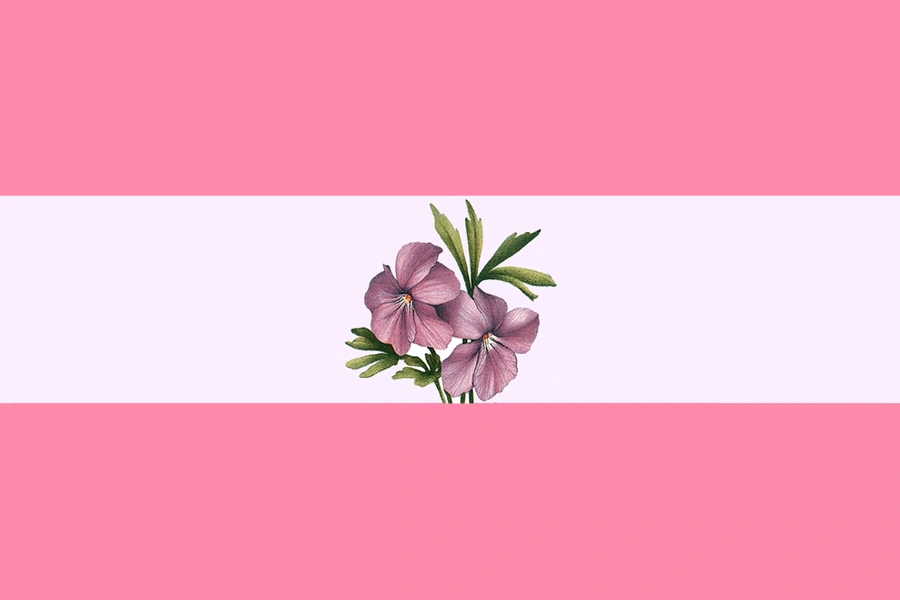
- An archive derivative of the 2015 design at 900 by 600, which this entry displayed as its artwork until August 2026. Its 3:2 proportion matches neither source file. [1] · Credit: Archive derivative of lesbeux-moved’s design. · EncycloflaggiaRights Archive derivative. The underlying design’s rights are unresolved.