Christian Gay Pride Flag
Rainbow Pride Flag · Photographed public use, 2002 to 2011
The Christian Gay Pride Flag combines the six-stripe Rainbow Pride Flag with the blue canton and red Latin cross of the Christian Flag. Its designer and place of creation remain unknown. The earliest located photograph of this specific design was taken at Greenbelt Festival in England in 2002; later photographs document related renderings in the United States and Canada. [1] [2] [3] [4] [5]
Key facts
- Designer
- Unknown
- Earliest located photograph of this specific canton design
- Documented circulation
- Photographed public use, 2002 to 2011
- Aspect Ratio
- Varies by rendering
- Ratio Notes
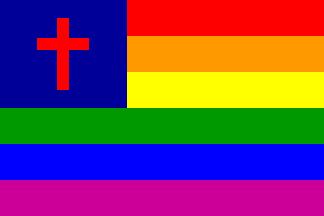
- No official specification has been located and the documented artifacts do not share one ratio. The Flags of the World illustration displayed here is 2:3, measured from the file. [2] A current retail example is sold at 3 by 5 feet. [6] The Christian Flag itself has no official specification for the dimensions of flag or canton, which may account for the variation. [7]
- Stripes
- 6
- Represented Identity
- Christian and LGBTQ+
Also known as
- Christian Rainbow Flag
- Christian Gay Pride/Rainbow Flag
Status Variant
Archive categories Religious and Spiritual Pride Flags
Overview
The design places the canton of the Christian Flag within the six-stripe Rainbow Pride Flag. The Christian Flag was conceived by Charles C. Overton in 1897 and later promoted by Ralph E. Diffendorfer as a non-denominational Protestant banner. [7] No statement from the unknown designer of the combined flag has been located, so its intended denominational scope and symbolism cannot be stated directly.
A photograph from Greenbelt Festival in 2002 is the earliest located image of this specific canton design. [1] António Martins illustrated a two-blue rendering for Flags of the World in February 2003. Later photographs show single-blue and dark-cross versions at Pride events in Portland, Edmonton, and Kalamazoo. The differences indicate a family of related renderings rather than one fixed digital specification. [2]
Identity & Context
- Represented Identity
- Christian and LGBTQ+
- Religious Context
- Christianity
The flag combines two recognizable visual traditions: the six-stripe rainbow associated with LGBTQ+ Pride and the blue canton with a red Latin cross used by the Christian Flag. The surviving evidence documents the design at a Christian arts festival and several Pride events, but no creator statement defining its intended audience has been located. [2] [7]
At the Portland Pride march on 21 June 2008, a single-blue version was carried beside marchers holding GLSEN signs reading "Safe Schools for GLBT People." That is context for the Portland photograph, not evidence about the flag's creation or its earliest use. [3]
Creators
Creator unknown
No identification located
No designer has been identified. António Martins drew a two-blue illustration for Flags of the World on 8 February 2003. Tomislav Todorović produced later comparative renderings of documented variants on 16 January 2016. Both are illustrators of an existing design, not its documented creators. [2]
Contribute information about who designed this flag.
Attribution
- Primary Designer
- Unknown
Origin
- Physical Origin Status
- unknown
No source identifies where the design was created. Its earliest located photograph was taken at Greenbelt Festival in England in 2002, but the location of an early sighting does not establish the flag's place of origin. [1] [2] Later photographs come from the United States and Canada.
Dates & Chronology
- Earliest located photograph of this specific canton design
- Documented circulation
- Photographed public use, 2002 to 2011; matching design commercially available in 2026
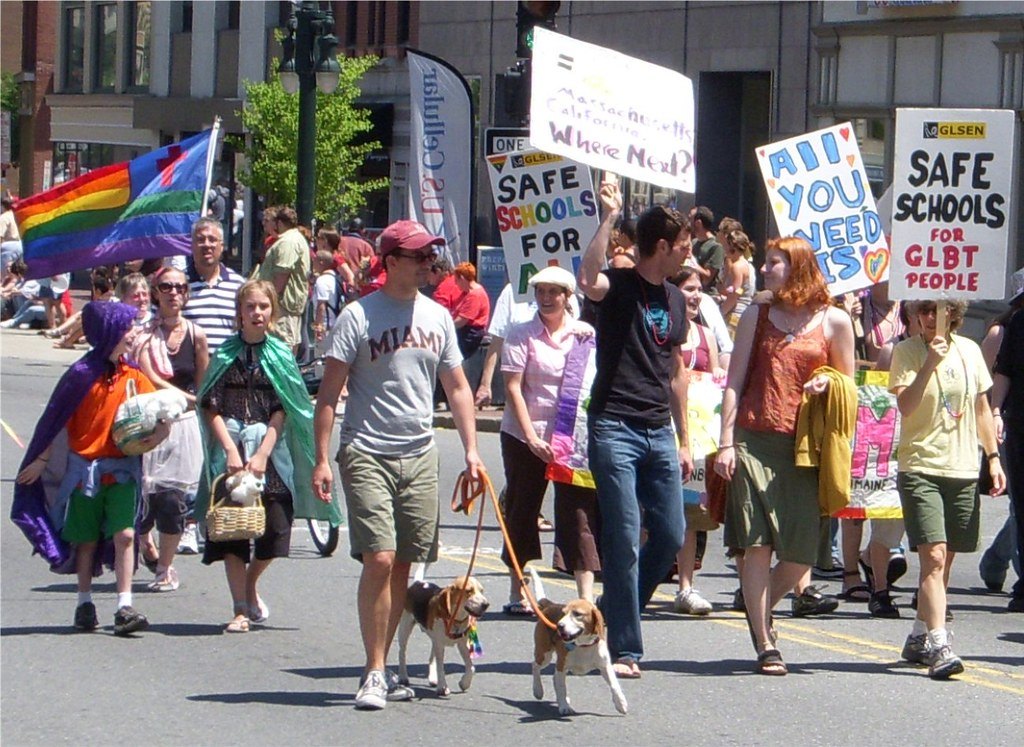
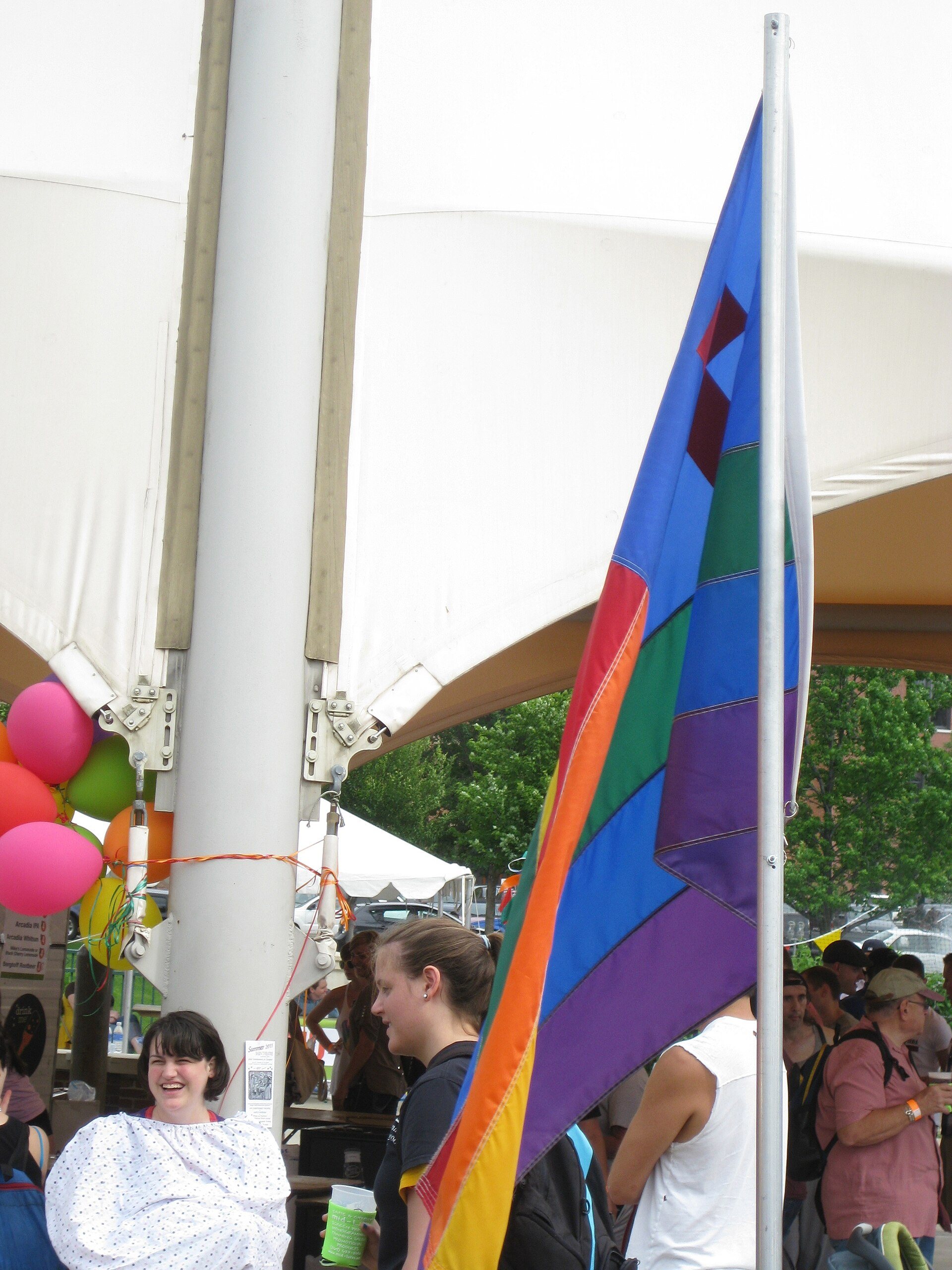
Photographs document the flag at Greenbelt Festival in 2002, Pride in Portland in 2008, the Edmonton Pride Parade in 2010, and Kalamazoo Pride in 2011. [1] [3] [4] [8] [5] Flags of the World also reports an Edmonton example from 2008 whose cited photograph is no longer available. [2] A matching design remains commercially available under the name "Christian Rainbow Flag" in 2026, although no recent event photograph or formal organizational adoption was located. [6]
2002: earliest located photograph of this specific design, taken at Greenbelt Festival. Greenbelt's own retrospective describes the 2000s as "a decade that saw the rebirth of Greenbelt at Cheltenham Racecourse"; the exact day on which the photograph was taken is not established. [1] [9]
8 February 2003: António Martins publishes a two-blue illustration through Flags of the World, remarking that the design "looks better with two shades of blue" and that it "can be found on the Web, for example in patches or illustrations, but seems that there are currently no flag photos." [2]
26 September 2003: Dov Gutterman reports the Greenbelt photograph to Flags of the World. [2]
2008: Flags of the World reports a version with two shades of red, the cross the darker, at Edmonton Pride; its cited photograph is no longer available. [2]
21 June 2008: a single-blue version is photographed at Pride in Portland, Maine. [3]
12 June 2010: a related flag is photographed at the Edmonton Pride Parade. [4]
11 June 2011: two photographs document the flag at Kalamazoo Pride. [8] [5]
16 January 2016: Tomislav Todorović publishes comparative renderings and notes the visible colour variants. [2]
2026: a matching 3 by 5 foot design is commercially offered under the name "Christian Rainbow Flag". This demonstrates current retail availability, not current organizational adoption or recent event use. [6]
Lineage

The design is a visual hybrid of the six-stripe Rainbow Pride Flag and the Christian Flag. It retains the rainbow's six horizontal stripes while placing the Christian Flag's blue canton and red Latin cross over the upper hoist. This relationship is visually direct, but no statement from the unknown designer has been located. [2] [7]
The Christian Flag is an external source work without an Encycloflaggia entry of its own. The Christian Advocate reported on 7 January 1909 that it "was originated by Charles C. Overton of Brooklyn, N.Y., whose first thought of it came to him while addressing a Sunday school at a rally day service." Flags of the World describes Ralph E. Diffendorfer as its co-designer and propagator; he set out its use in the 1917 manual Missionary Education in Home and School. [7]
Colors & Symbolism
No symbolism statement by the designer of the combined flag has been located. Meanings associated with its parent flags should not be presented as direct statements of this flag's intent. The rainbow field visibly connects the design to the six-stripe Rainbow Pride Flag; the blue canton and red Latin cross come from the Christian Flag. [2] [7]
| Colour | Hex |
|---|---|
| Canton navy | #000099 |
| Red stripe and cross | #FF0000 |
| Orange | #FF9900 |
| Yellow | #FFFF00 |
| Green | #009900 |
| Blue stripe | #0000FF |
| Violet | #CC0099 |
Measured from António Martins's 8 February 2003 GIF. [2]
- Blue canton
- Published for the Christian Flag, from which the canton is taken, not by the designer of this flag. The Christian Advocate described it on 7 January 1909 as "a blue square, the color of the unclouded sky, emblematic of heaven, the home of the Christian; also a symbol of faith and trust."
- Red Latin cross
- Published for the Christian Flag, not by the designer of this flag. The same 1909 account gives "in the center of the blue is the cross, the ensign and chosen symbol of Christianity: the cross is red, typical of Christ's blood."
- Rainbow stripes, replacing the Christian Flag's white field
- The Christian Flag's white ground was described in 1909 as "representing peace, purity, and innocence." That white field is absent here and replaced by the rainbow. No source records who made the substitution or why.
The meanings above are the Christian Flag's published symbolism, recorded for that flag and not for this one. Whether the person who combined the two designs intended any of it to carry over is not documented. No individual meanings are assigned to the six rainbow stripes here; those belong to the parent Rainbow Pride Flag. [7]
These values are measured from one illustration, António Martins's 8 February 2003 GIF, and are not creator-specified or universal colours. [2] The photographed flags differ: the Greenbelt canton is light blue, the Kalamazoo cross is a dark red close to maroon, and Flags of the World reports an Edmonton version with two shades of red. Colours are not sampled from oblique, compressed event photographs.
Design
- Aspect Ratio
- Varies by rendering
- Ratio Notes
- No official specification has been located and the documented artifacts do not share one ratio. The Flags of the World illustration displayed here is 2:3, measured from the file. [2] A current retail example is sold at 3 by 5 feet. [6] The Christian Flag itself has no official specification for the dimensions of flag or canton, which may account for the variation. [7]
- Orientation
- horizontal
- Stripe Count
- 6
- Layout
- horizontal_stripes_with_canton
- Stripes (Top → Bottom)
- Red, Orange, Yellow, Green, Blue, Violet
- Additional Symbols
- Red Latin cross in the canton
All documented renderings use six horizontal rainbow stripes and a canton containing a Latin cross. The surviving examples vary in proportion and in the shades assigned to the canton, blue stripe, and cross. [2]
Measured from António Martins's 8 February 2003 GIF: the file is 324 by 216 pixels, a ratio of 2:3, with six equal stripes 36 pixels high. The canton is 127 by 108 pixels, covering the upper three stripe bands. The cross has a bounding box of 52 by 72 pixels, a vertical bar 12 pixels wide and a horizontal bar 52 by 12 pixels. These are measurements of one illustration, not a creator specification. [2]
Four renderings are visually distinct in the surviving record: the 2003 two-blue illustration; photographed single-blue versions from Portland and Kalamazoo; the Edmonton version Flags of the World reports with two shades of red, the cross the darker; and the light-blue canton visible in the Greenbelt photograph. Exact colours and proportions are not inferred from oblique or compressed event photographs. [2] [1]
Six horizontal rainbow stripes with a canton at the upper hoist: a blue square charged with a red Latin cross, taken from the Christian Flag.
Usage & Adoption
- Geographic Usage
- England, United States, Canada
- Event Usage
- Greenbelt Festival, Cheltenham Racecourse, Cheltenham, England, 2002, photographed [1], Pride march, Portland, Maine, 21 June 2008, photographed [3], Edmonton Pride Parade, Alberta, 2008, reported by Flags of the World with the original photograph now unavailable [2], Edmonton Pride Parade, Alberta, 12 June 2010, photographed [4], Kalamazoo Pride, Arcadia Creek Festival Place, Michigan, 11 June 2011, photographed [8] [5]
- Current Status
- Documented historical use; current retail availability
Photographs document the flag at Greenbelt Festival in 2002, Pride in Portland in 2008, the Edmonton Pride Parade in 2010, and Kalamazoo Pride in 2011. Flags of the World also reports an Edmonton example from 2008 whose cited photograph is no longer available. A matching design remains commercially available under the name "Christian Rainbow Flag" in 2026, although no recent event photograph or formal organizational adoption was located. A seller listing is not evidence of widespread adoption, community consensus, or recent public display. [1] [3] [4] [8] [5] [2] [6]
Image Archive
Photographed use


Parent design

Discourse & Debates
Common misidentifications
- Not the earliest Christian LGBTQ+ flag in general. Earlier organizational banners and other Christian rainbow designs fall outside this specific canton design's chronology, which begins with the 2002 Greenbelt photograph. [1]
Flags of the World heads the design "Christian Gay Pride/Rainbow Flag"; "Christian Rainbow Flag" is the name under which a matching design is sold. [2] [6]
Editorial note
Flags of the World also reports a variant with a light blue stripe and canton and a very dark, indigo-like cross, illustrated on a website that gave no source for the image; its attribution to Des Moines therefore could not be verified, and that page is not linked here. [2]
Footnotes & Citations
Sources and footnotes 10 sources
- 1. Image file page Greenbelt Festival 2002 site photograph. Jonathon Watkins. Greenbelt Festival (2002). Accessed 2026-08-14
The earliest located photograph of this specific canton design, from the festival's own website, listed by Flags of the World and reported there by Dov Gutterman on 26 September 2003. The original file URL is no longer reliably accessible, and copyright and reuse permission are not established, so the photograph is cited rather than reproduced.
- 2. Databases Gay Pride/Rainbow Flags - Religious Variants. randy young (editor); flag documentation by Tomislav Todorović and António Martins. Flags of the World (2023-09-30). Accessed 2026-08-14
The page carrying this design, headed "Christian Gay Pride/Rainbow Flag". Records the Greenbelt photograph reported by Dov Gutterman on 26 September 2003, António Martins's illustration of 8 February 2003 and his remark that it "looks better with two shades of blue", Tomislav Todorović's comparative renderings of 16 January 2016, and the dated sightings at Portland, Kalamazoo and Edmonton. A signed contributor page: its dated sightings and design descriptions are cited here, and contributor opinion is attributed to the named contributor and date.
- 3. Image file page safe schools for all. Sam T (samm4mrox). Flickr (2008-06-21). Accessed 2026-08-14
A single-blue version at Pride in Portland, Maine. Camera date 21 June 2008; released under CC BY 2.0 by the photographer, whose Flickr display name is Sam T.
- 4. Image file page 2 Flags. JMR64. Flickr (2010-06-12). Accessed 2026-08-14
Edmonton Pride Parade, taken 12 June 2010 and uploaded 21 June 2010 by the Flickr photographer JMR64. CC BY-NC-SA 2.0.
- 5. Image file page Kalamazoo Pride 2011 - 06. Equality Michigan, through the LGBT Free Media Collective. Wikimedia Commons (2011-06-11). Accessed 2026-08-14
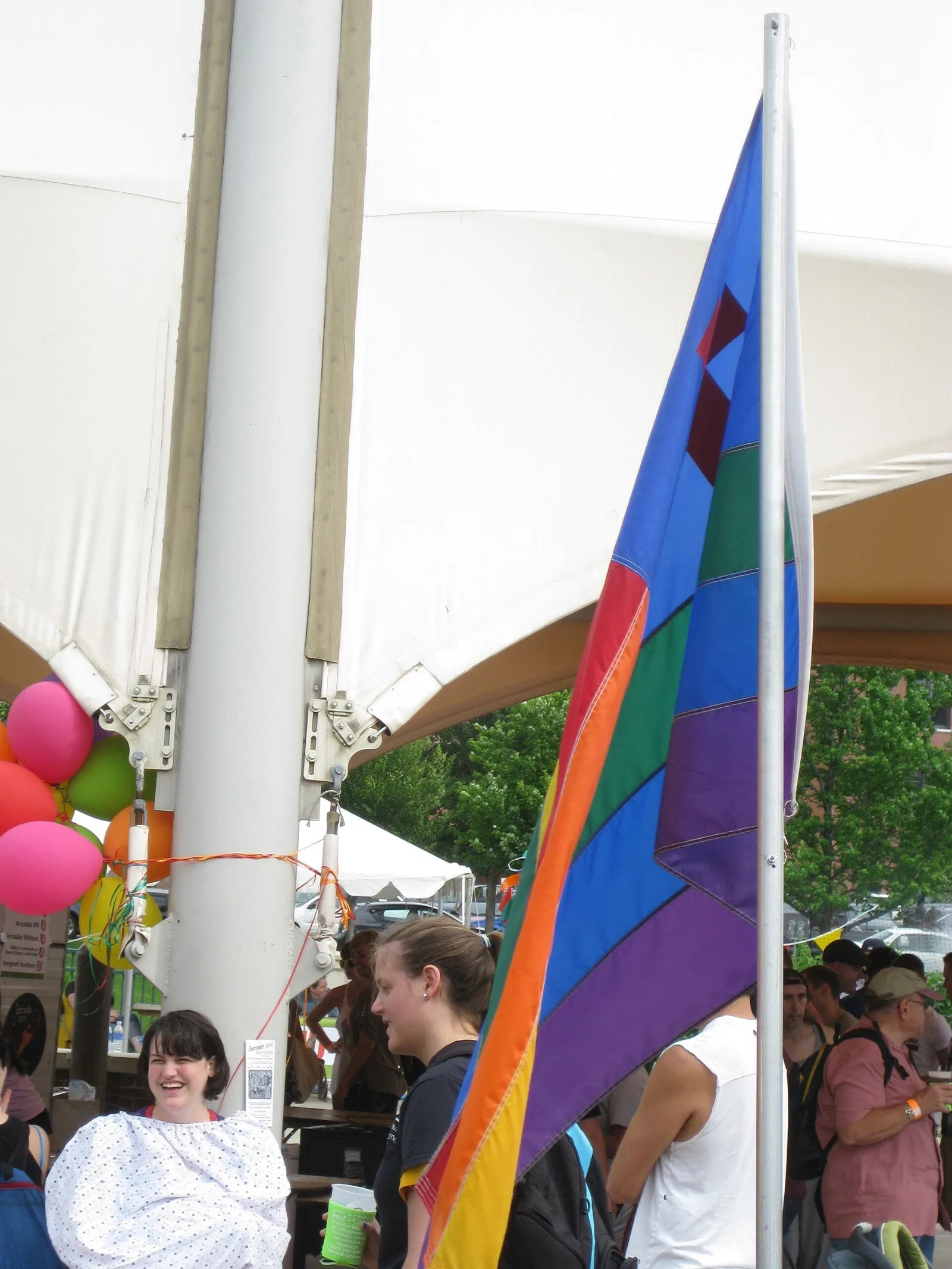
Photograph of the flag on its pole at the Arcadia Creek Festival Place, showing the blue canton and dark red cross. CC BY-SA 3.0.
- 6. Retail listing Christian Rainbow Flag 3x5 FT. El Cheapo Flags. elcheapoflags.com. Accessed 2026-08-14
Cited only for the retail-attested alias "Christian Rainbow Flag", the 3 by 5 foot product, and commercial availability at the date of access.
- 7. Databases Christian Flag. FOTW contributors; quoting The Christian Advocate (1909) and Ralph E. Diffendorfer (1917). Flags of the World. Accessed 2026-08-14
Reproduces the contemporary material: the 7 January 1909 Christian Advocate account of the flag's origin and symbolism, and Diffendorfer's 1917 Missionary Education in Home and School on its free manufacture. Used in place of the Wikipedia article previously cited here.
- 8. Image file page Kalamazoo Pride 2011 - 05. Equality Michigan, through the LGBT Free Media Collective. Wikimedia Commons (2011-06-11). Accessed 2026-08-14
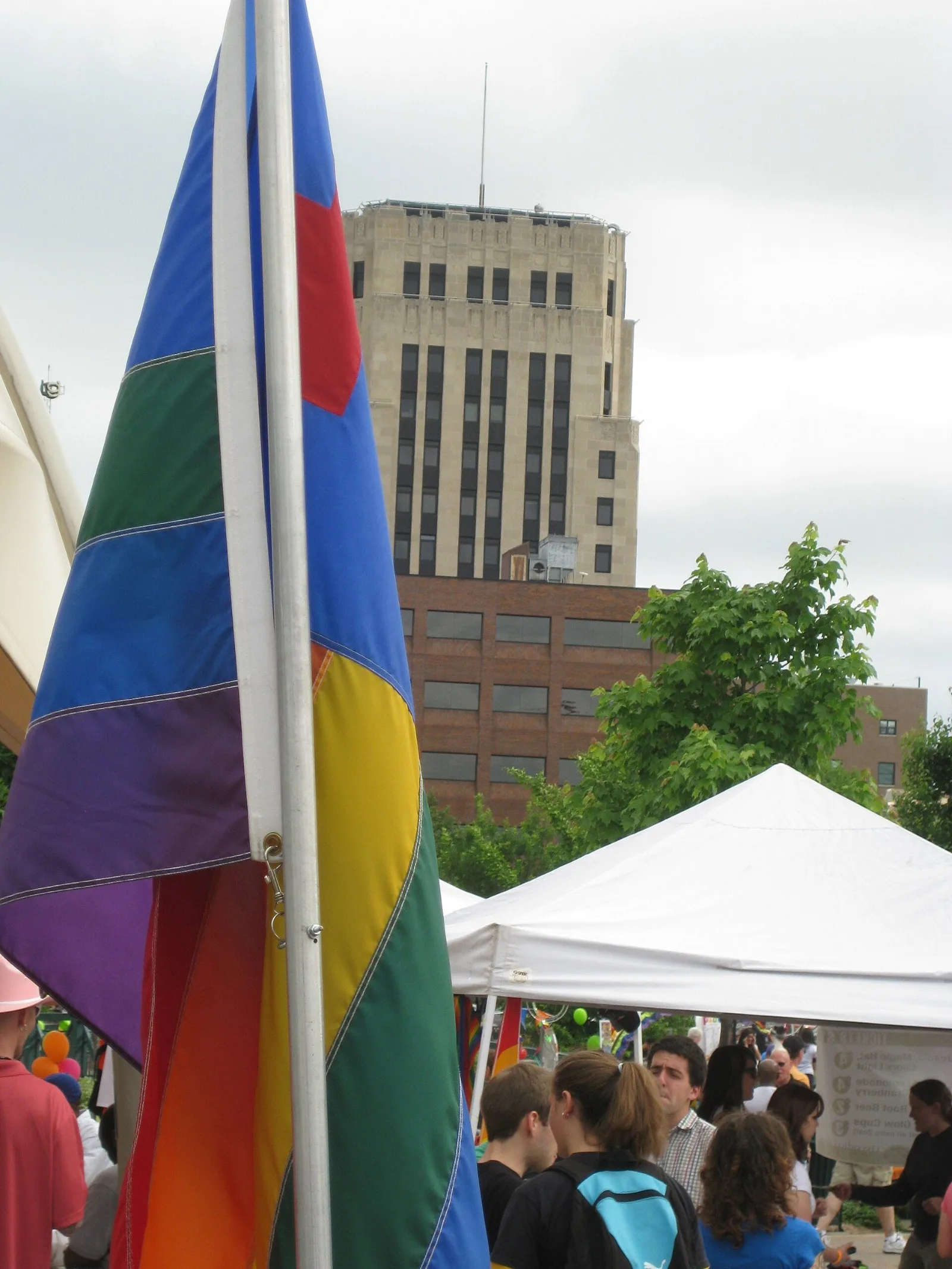
The same flag beside a plain six-stripe rainbow flag. CC BY-SA 3.0.
- 9. Official Greenbelt: the 2000s. Andy Turner, for Greenbelt Festival. Greenbelt Festival. Accessed 2026-08-14
The festival's own retrospective, describing the 2000s as "a decade that saw the rebirth of Greenbelt at Cheltenham Racecourse".
- 10. Official Disclaimer and copyright. Flags of the World. Flags of the World. Accessed 2026-08-14
The site's reuse conditions: quote the author, quote the website, do not alter the images or text, keep the use non-commercial and non-political, and limit it to a maximum of 5% of the site's images or content.

Image Sources
- Rendering
- illustration of one documented variant
- A two-blue illustration of one documented variant, not a reconstruction of the Greenbelt flag. [2] · Credit: António Martins, 8 February 2003, via FOTW Flags Of The World website at https://www.fotw.info/Rights Flags of the World permits reuse of contributor material with the author and the website quoted, the image unaltered, and the use non-commercial and non-political. The file here is served unaltered and credited on those terms. [10]
- Credit: Sam T (samm4mrox), CC BY 2.0, via FlickrRights Creative Commons Attribution 2.0 Generic: https://creativecommons.org/licenses/by/2.0/ . The copy held is Flickr's 1024 by 747 rendition, reproduced unmodified.
- Credit: JMR64, CC BY-NC-SA 2.0, via FlickrRights Creative Commons Attribution-NonCommercial-ShareAlike 2.0 Generic: https://creativecommons.org/licenses/by-nc-sa/2.0/ . The non-commercial condition applies to this file. The copy held is a 1550 by 1036 PNG; Flickr publishes the photograph at sizes up to 2927 by 1959 and none at 1550 wide, so the local file is a derivative whose making is not recorded.
- Credit: Equality Michigan, through the LGBT Free Media Collective, CC BY-SA 3.0, via Wikimedia CommonsRights Creative Commons Attribution-ShareAlike 3.0: https://creativecommons.org/licenses/by-sa/3.0/ . Reduced from the 2448 by 3264 original to 1920 by 2560, the framing unchanged.
- Credit: Equality Michigan, through the LGBT Free Media Collective, CC BY-SA 3.0, via Wikimedia CommonsRights Creative Commons Attribution-ShareAlike 3.0: https://creativecommons.org/licenses/by-sa/3.0/ . Reduced from the 2448 by 3264 original to 1920 by 2560, the framing unchanged.
- Credit: Public domain, via Wikimedia CommonsRights Public domain. Rasterised from the SVG, nominally 600 by 400, to a 960 by 640 WebP for display.
- A single-blue version carried at Pride in Portland, Maine, on 21 June 2008, beside marchers holding GLSEN "Safe Schools for GLBT People" placards. The photographer titled the picture "safe schools for all". [3] · Credit: Sam T (samm4mrox), CC BY 2.0, via Flickr · Flickr · CC BY 2.0Rights https://creativecommons.org/licenses/by/2.0/ . Reproduced unmodified.
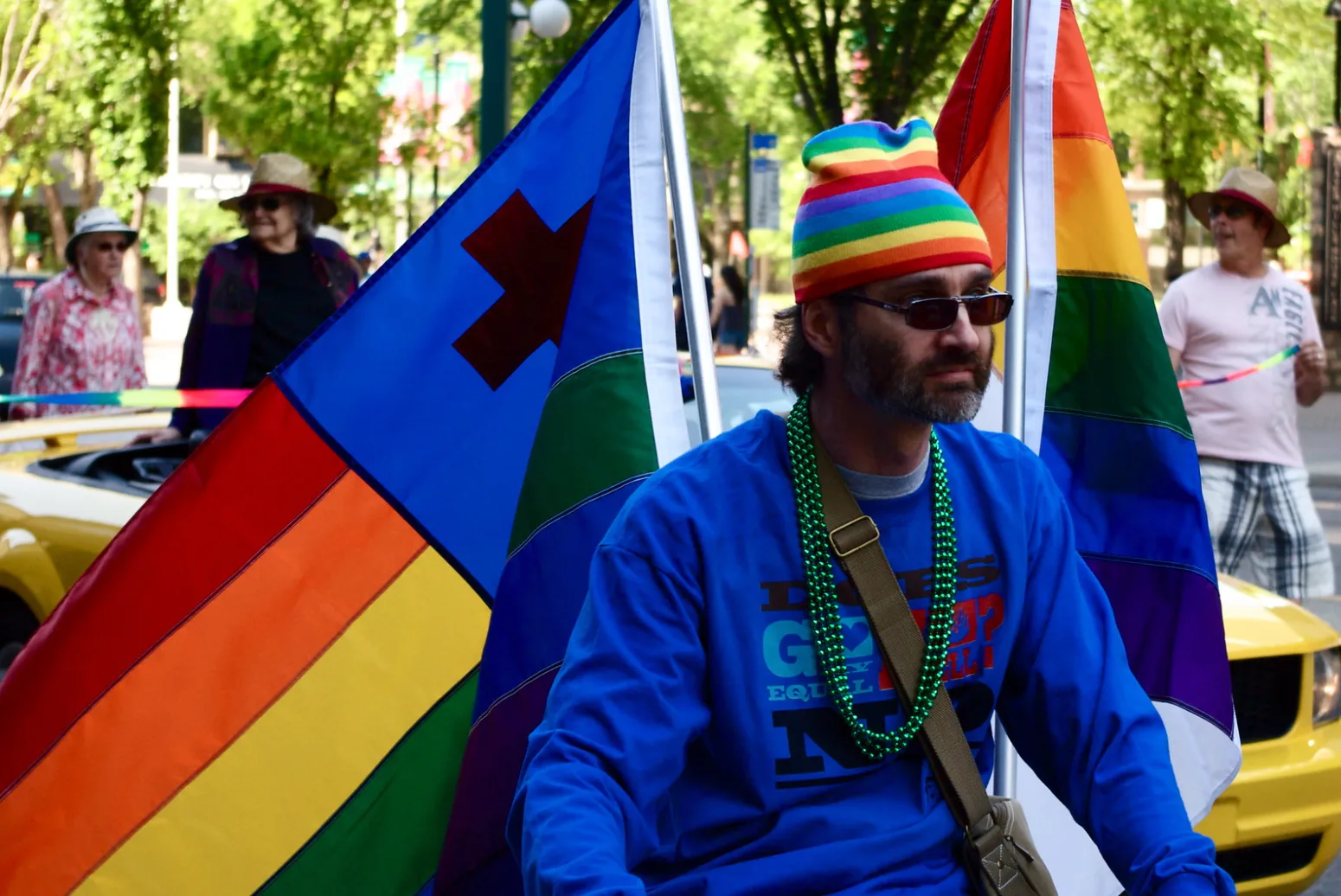
- Carried alongside a plain rainbow flag at the Edmonton Pride Parade, Alberta, on 12 June 2010. Flags of the World notes that the shades are not easy to detect in this photograph. The photographer titled it "2 Flags". [4] [2] · Credit: JMR64, CC BY-NC-SA 2.0, via Flickr · Flickr · CC BY-NC-SA 2.0Rights https://creativecommons.org/licenses/by-nc-sa/2.0/ . Non-commercial condition applies. Reproduced unmodified.
- The flag on its pole at Kalamazoo Pride, Arcadia Creek Festival Place, Michigan, on 11 June 2011. The canton is a single blue and the cross a dark red, close to maroon. [5] · Credit: Equality Michigan, through the LGBT Free Media Collective, CC BY-SA 3.0, via Wikimedia Commons · Wikimedia Commons · CC BY-SA 3.0Rights https://creativecommons.org/licenses/by-sa/3.0/ . Cropped from the 2448 by 3264 original.
- The same flag beside a plain six-stripe rainbow flag at Kalamazoo Pride on 11 June 2011. [8] · Credit: Equality Michigan, through the LGBT Free Media Collective, CC BY-SA 3.0, via Wikimedia Commons · Wikimedia Commons · CC BY-SA 3.0Rights https://creativecommons.org/licenses/by-sa/3.0/ . Cropped from the 2448 by 3264 original.
- The Christian Flag, the source of this design's canton. The Christian Advocate reported on 7 January 1909 that it was originated by Charles C. Overton of Brooklyn; Ralph E. Diffendorfer is described by Flags of the World as its co-designer and propagator. The combined flag keeps the blue canton and red cross and replaces the white field with the six-stripe rainbow. [7] · Credit: Public domain, via Wikimedia Commons · Wikimedia CommonsRights Public domain. Converted from the 600 by 400 SVG to WebP for display; rendered at 2:3.