Skoliosexual / Ceterosexual Pride Flag (SavvyRed, 2013)
Identity Pride Flag ·
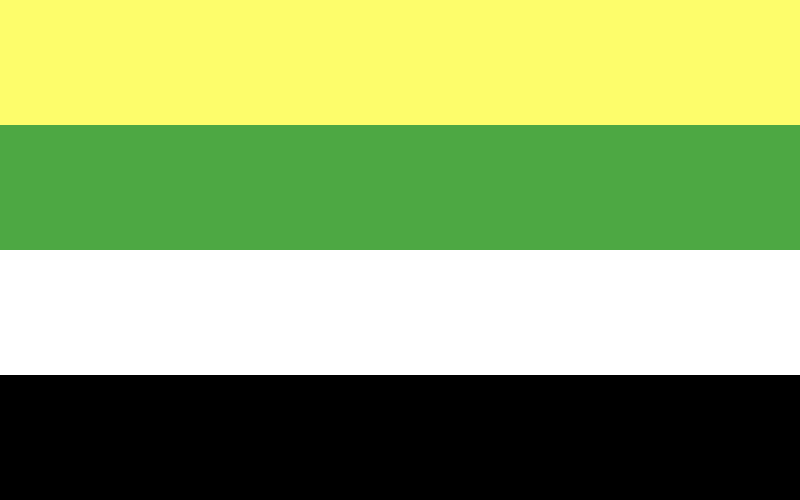
Four stripes in yellow, green, white and black with a heart outline at the centre, published by SavvyRed on DeviantArt in October 2013 under the title Proposed Skoliosexual Flag. [1] The name Ceterosexual Pride Flag attached to the design later as the identity term shifted, and both names remain in circulation, as do both forms, with the designer's heart and without it. [2] [3] [4] The word came first: Nelde coined skoliosexual in a 2010 diagram and had no part in the flag. [5]
Key facts
- Designer
- SavvyRed
- Created
- First published
- Documented online circulation
- 2013–present
- Aspect Ratio
- 3:5 · standard
- Ratio Notes
- No proportion is specified by the designer. Her published file is 438 × 300 pixels and is recorded at that native canvas as source evidence; the hero is the archive's standard 3:5 reference reconstruction, with the heart recalculated proportionally from the artwork rather than stretched. [1]
- Stripes
- 4
- Represented Identity
- skoliosexual, later also called ceterosexual; definitions of both terms vary
Also known as
- Proposed Skoliosexual Flag
- Skoliosexual Pride Flag
- Skoliosexual Flag
- Ceterosexual Pride Flag
- Ceterosexual Flag
Status Proposed Contested
Archive categories Sexual & Romantic Orientation Pride Flags
Overview
SavvyRed could not find an existing skoliosexual flag, and made one. [1]
SavvyRed published the design on DeviantArt on 14 October 2013 Pacific time under the title Proposed Skoliosexual Flag, defining the identity as she then understood it: "a person who is romantically and/or sexually attracted to non-binary identified individuals. Skoliosexuals are not necessarily attracted to all non-binary or non-conforming genders, but some of them are." [1] She had no contact with the person who coined the word and learned who that was three months later. [6]
Identity & Context
- Represented Identity
- skoliosexual, later also called ceterosexual; definitions of both terms vary
- Subcommunity
- nonbinary-attracted umbrella
- Language Context
- The identity was named skoliosexual, from the Greek skolios, which the standard Greek lexicon glosses "curved, bent," opposed to straight, and figuratively "crooked, i.e. unjust." [7] Nelde's stated derivation, printed on the 2010 chart, was different: "I invented that term using the Greek word for queer „skolio“. As I never studied Greek, it might be wrong. I'm open for corrections." [5] The bent-or-crooked reading is the objection the later name answers. [8] [2] Ceterosexual replaced it, from the Latin ceterus, the other or the rest, as in et cetera. [9] [2]
Creators
The Creator
SavvyRed
Designer of the flag
SavvyRed is an American artist who has posted on DeviantArt since around 2010, using she/her. [1] She published the design on 14 October 2013 Pacific time under the title Proposed Skoliosexual Flag, offering it as a proposal rather than a standard. [1] Three months earlier she had written a journal cataloguing the colour meanings of some fifty Pride flags, the grounding she names for this design's colours. [10] No photograph of her is published on the account; a portrait or further information is sought.
I couldn't find a single skoliosexual flag, so I decided to create one myself! I don't know if it will catch on, but I liked making it either way!
From the flag's description on DeviantArt.
I based this on explanations of various colors from other pride flags.
On where the colour scheme came from.
The outline of the lavender heart represents love outside the gender norms.
On the central emblem, given in the same words in the flag description and the colour journal.
Motivations
- She could not find an existing skoliosexual flag. [1]
Stated inspirations
Attribution notes
SavvyRed drew the flag; Nelde coined the word it was drawn for, three years earlier, and had no part in the design. [1] [5] SavvyRed did not know who had coined it until AuzloPup told her: "Skoliosexual Flag was created by SavvyRed. But the word doesn't belong to her, or me! It was coined by Nelde." She replied on 15 January 2014: "I actually didn't know that nelde coined the word, so I'm happy to give them credit. I'll mention that on the deviation page of my flag." The credit line on the flag's own page dates from after that exchange. [6] [1] SavvyRed spells the name nedle in her colour journal and Nelde on the flag page, where she links to the account; this entry uses Nelde. [10] [1]
Origin
- Specific Place
- DeviantArt (SavvyRed)
- Place Type
- website
- Digital Origin
- Yes
Digital origin; no verified physical location.
Published on DeviantArt on 14 October 2013. [1] The designer's profile gives her country as the United States and the word's coiner gives his as Switzerland, but neither states where the flag or the term was made, and no geographic origin is documented. [1] [5]
Dates & Chronology
- Year Created
- First published
- Documented online circulation
- 2013–present
- Creation Bounds
- Made in 2013, on or before publication, which DeviantArt records at 20:21:45 on 14 October 2013 Pacific time, 03:21:45 on 15 October UTC. [1]
.jpg)
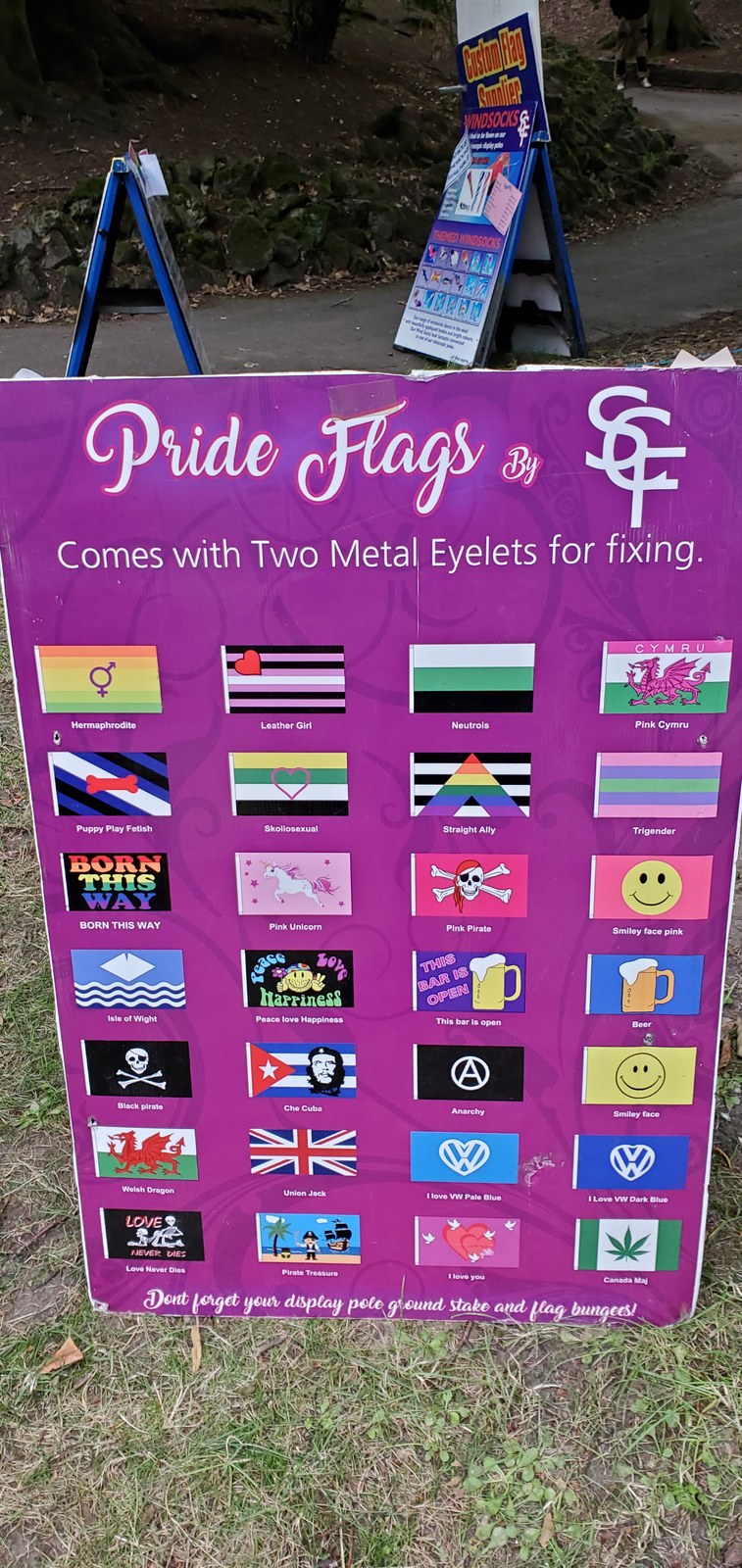
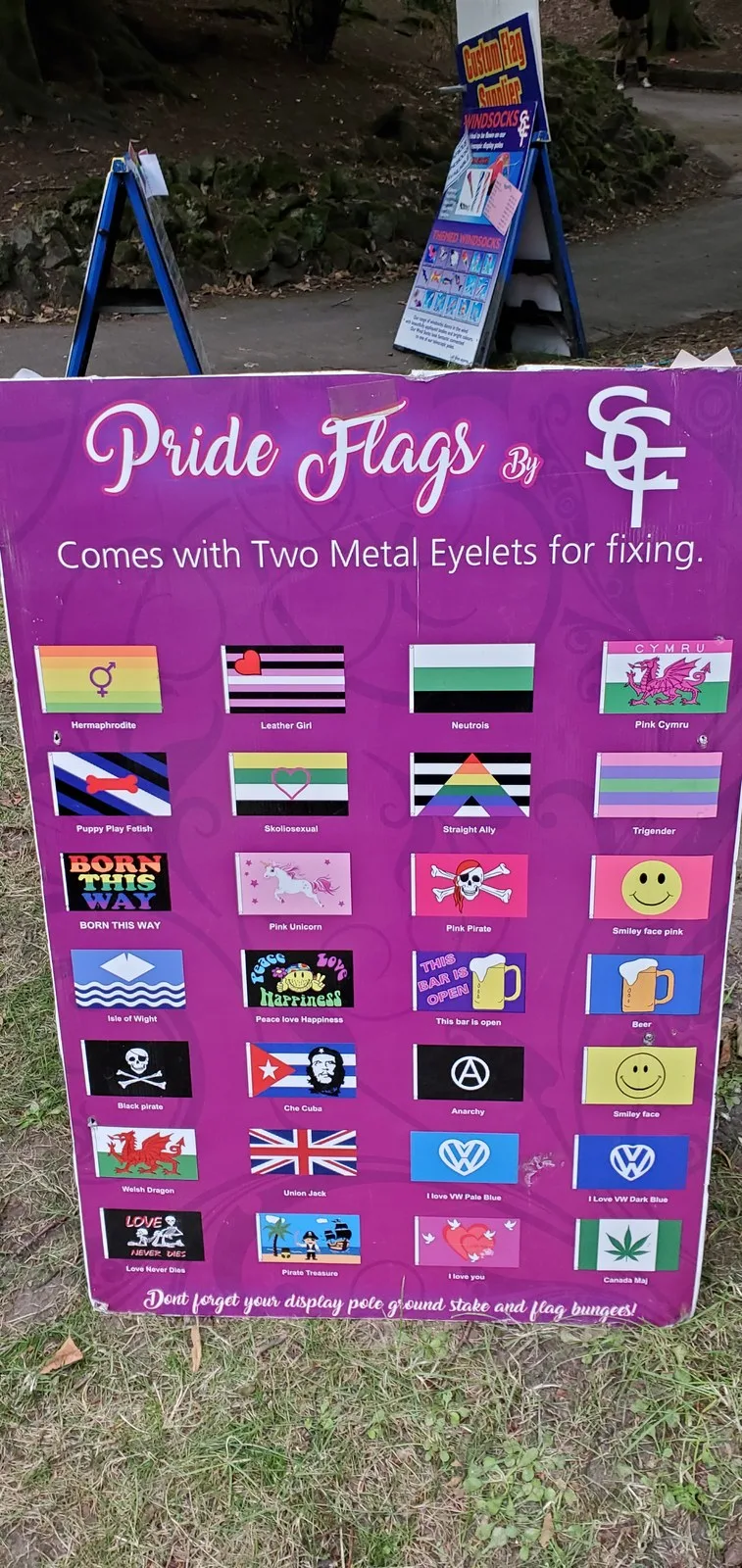
Documented circulation begins on DeviantArt, where the original post has drawn 5.2 thousand views, 71 comments and 26 favourites, [1] and where AuzloPup posted a smaller rendering ten weeks later, recorded 27 December 2013 Pacific time, 28 December UTC, which SavvyRed linked from the flag's own page and called "a very cute little flag." [6] [1] The name changed without the flag changing. Ceterosexual is documented on flags from August 2015, when the Pride-Flags account posted the first to carry it; Dictionary.com places the word's emergence around 2013 on DeviantArt without naming a first use, and who coined it is not known. [2] [9] The MOGAI Wiki puts the continuity plainly: "While ceterosexual is a new term, it uses the same flags that skoliosexual used." [11] A heartless redraw uploaded to Wikimedia Commons in 2021, and enlarged in a 2022 revision, became the form most reproduced online. [3] The one documented physical example is commercial: a vendor's sample board photographed at Swindon Pride on 7 August 2021 carries a manufactured flag, heart included, labelled Skoliosexual. [4] The photograph documents manufacture and offer for sale at one event; wider display or adoption by organisers, attendees or community bodies is not documented.
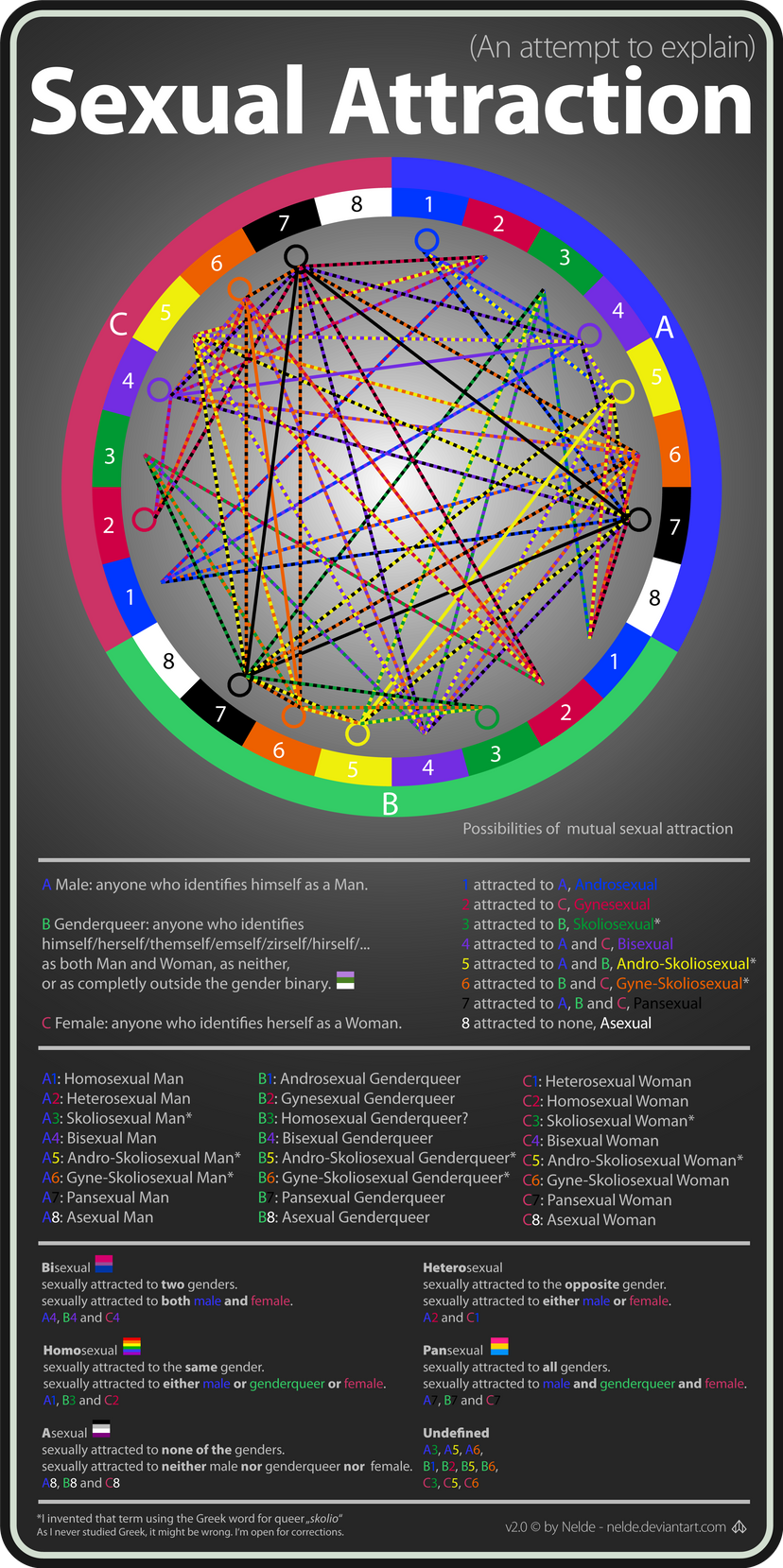
The word came first, and from a chart. On 23 September 2010 Nelde, a Swiss artist on DeviantArt, published Sexual Attraction v2, "version 2 of my attempt at visualizing sexual attraction," a diagram sorting people into three groups by self-identification and naming the eight possible patterns of attraction between them. Group A is "anyone who identifies himself as a Man," group C "anyone who identifies herself as a Woman," and group B "anyone who identifies himself/herself/themself/emself/zirself/hirself/... as both Man and Woman, as neither, or as completly outside the gender binary." Attraction to B alone is number 3 on the chart, and the name given to it is skoliosexual. [5] The same chart names androsexual, gynesexual, bisexual, pansexual and asexual, along with two compounds that did not take, andro-skoliosexual and gyne-skoliosexual. [5]
Because its three groups are defined by how a person identifies rather than by how they were assigned, binary trans men and women fall in A and C on Nelde's own terms. Later accounts report that early definitions of skoliosexual covered "non-binary and transgender individuals" or "non-cisgender individuals," a framing the wikis describe as othering and fetishising trans people; Dictionary.com likewise records the stereotyping and fetishisation concern among the reasons ceterosexual is preferred. [11] [9] That framing is not in the diagram the word was coined in. [5]
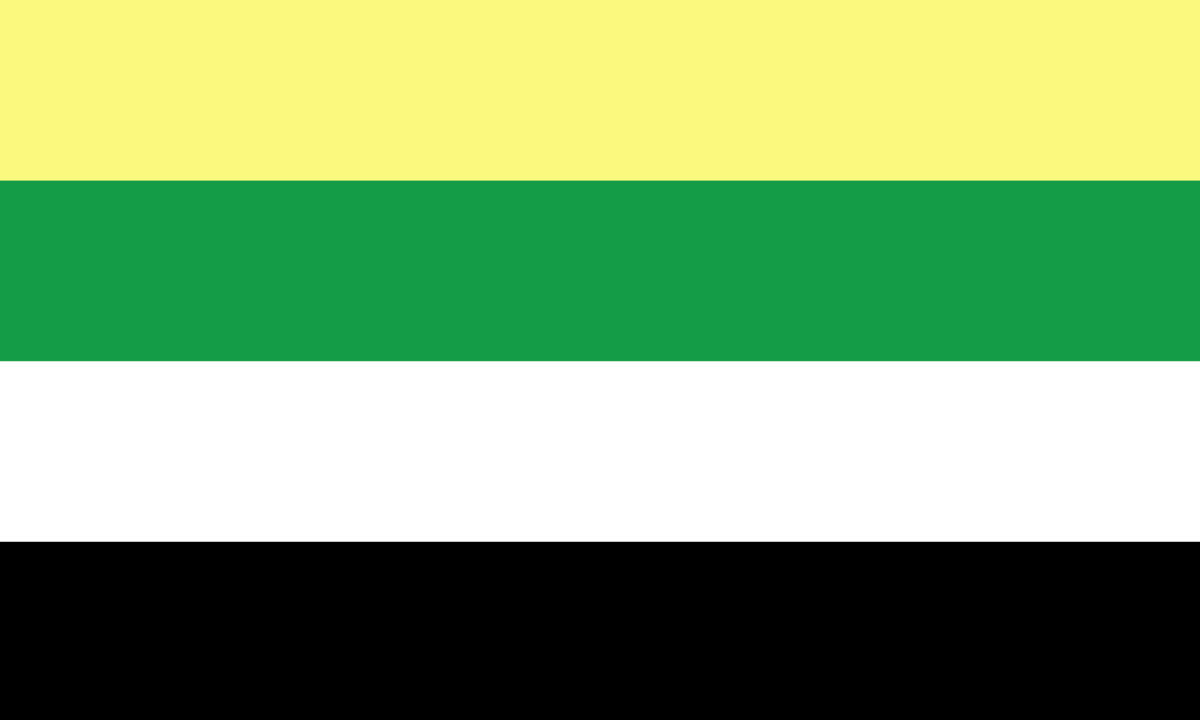
The design has lost its heart somewhere in circulation. SavvyRed's flag has a heart outline at the centre and her description turns on it. [1] [10] The rendering on Wikimedia Commons, uploaded in November 2021 and redrawn at higher resolution in March 2022, and most that follow it, show four plain stripes in paler colours. [3] Both forms are current: the manufactured flag photographed at Swindon Pride three months before that upload has the heart. [4] No source reviewed explains when or why the emblem was dropped.
Sources split on the publication day, and both are right. DeviantArt's stored timestamp for the flag is 20:21:45 on 14 October 2013 in Pacific time, which is 03:21:45 on 15 October in UTC. [1] The MOGAI Wiki gives 14 October in its prose while naming its image file for the 15th; the LGBTQIA Wiki gives the 15th. [11] [2] Where a single calendar date is shown, this entry uses 14 October, the calendar date of the platform's stored Pacific timestamp; where the designer herself was at publication is not documented.
The colour journal is a moving document. DeviantArt dates it 21 June 2013, four months before the flag existed, yet it describes the flag and uses the name ceterosexual, which is later still. [10] Its publication date does not date the passage cited from it.
Lineage
- Direct children
- Ceteroromantic Pride Flag (Four-Stripe Heart, 2016)
The ceteroromantic flag derives from this design: the Pride-Flags account published Ceteroromantic Pride Flag (1), this flag's four stripes with a heart overlay for romantic attraction, at 21:35 on 9 May 2016 Pacific time, 04:35 on 10 May UTC. [12] [13] The 26 April 2016 date in the Wikimedia Commons record of that flag matches neither timestamp and is not supported by the original publication. [12] AuzloPup's Skolio Flag of December 2013 is a smaller rendering of this flag rather than a new design. [6] SavvyRed named no design predecessor, only the colour conventions of Pride flags generally, and no source documents a specific flag as her model. [1] The identity's kinship with androsexual, gynesexual and the other terms of Nelde's 2010 chart runs through the word rather than the artwork, so those flags are not listed as design relatives. [5]
Lineage tree
Every record reachable from this one through documented parent and child relationships: 2 records across 2 generations.
- This record
- Skoliosexual / Ceterosexual Pride Flag (SavvyRed, 2013)
Colors & Symbolism
Four stripes for the genders the identity is oriented toward, with a heart outline at the centre for the love itself. [1]
| Colour | Hex | Meaning | Note |
|---|---|---|---|
| Yellow | #FFFC01 | Being non-binary, or attraction to non-binary people. | Sampled from the designer's published artwork [1] |
| Green | #218D03 | Bigender, third gender, genderqueer, or other genders. | Sampled from the designer's published artwork [1] |
| White | #FFFFFF | With the black stripe: neutral genderlessness, agender, questioning gender identity. The designer gives the two a single joint meaning rather than separate ones. | Sampled from the designer's published artwork [1] |
| Black | #000000 | With the white stripe: neutral genderlessness, agender, questioning gender identity. | Sampled from the designer's published artwork [1] |
| Magenta (heart outline) | #F656EA | — | Sampled from the designer's published artwork; described in words as lavender [1] |
This flag has no official digital palette. Color values shown are approximate.
All of the meanings are the designer's own, given twice in the same words: in the flag's description and in the colour journal. [1] [10] SavvyRed describes the heart as lavender in both. In the published artwork it is a saturated magenta, sampled at #F656EA, not a lavender. [1]
SavvyRed published no colour values, and nothing here is an official palette. The values are sampled from the designer's published 438 × 300 file, so they are the artwork's colours rather than a specification. [1] The rendering in circulation on Wikimedia Commons is paler in both the yellow and the green and carries no heart. [3]
Design
- Aspect Ratio
- 3:5 · standard
- Ratio Notes
- No proportion is specified by the designer. Her published file is 438 × 300 pixels and is recorded at that native canvas as source evidence; the hero is the archive's standard 3:5 reference reconstruction, with the heart recalculated proportionally from the artwork rather than stretched. [1]
- Orientation
- horizontal
- Stripe Count
- 4
- Layout
- horizontal_stripes
- Stripes (Top → Bottom)
- Yellow, Green, White, Black
- Center Symbol
- Heart outline
Four horizontal stripes of equal depth, each a quarter of the hoist, with an unfilled heart centred on the field. In the designer's file the heart spans 47 per cent of the height and about a third of the width, its outline about 7 per cent of the height in thickness, its midpoint slightly above the field's centre. [1]
The heart is not filled: the stripes show through it. [1] Versions without the heart circulate and are the more common form online. [3]
Four equal horizontal stripes: yellow at the top, then green, white and black. Centred over them, spanning the green and white stripes and reaching into the yellow, is a large heart drawn as an open outline in magenta, through which the stripes remain visible. [1]
Usage & Adoption
- Geographic Usage
- United Kingdom (Swindon, 2021: a manufactured flag offered for sale) [4]
- Online Usage
- DeviantArt, where the design was published in October 2013 and reposted from December 2013 [1] [6], Community wikis and flag guides, under both names [2] [13] [11], Wikimedia Commons, from November 2021, in the heartless form [3]
- Event Usage
- Swindon Pride, 7 August 2021, offered for sale on a flag vendor's sample board [4]
- Current Status
- active
The documented evidence spans distinct levels: online publication, reposting and wiki circulation, later heartless redraws, and one photographed instance of commercial manufacture at a 2021 event. [1] [6] [2] [3] [4] The name in commercial use in 2021 was still Skoliosexual, and the manufactured flag kept the heart. [4] Commercial availability does not itself establish endorsement or prevalence, and no adoption by organisations or community bodies is documented.
Image Archive
The Coining Document
Documented Use
Variants

Discourse & Debates
- Whether the term should be used only by non-binary people. Several sources report that view as widely held, and the wikis note that ceterosexual and its alternatives were coined with that intent, while others hold that it should be open to anyone. [11] [13]
- Whether the rename is settled. Ceterosexual dates from August 2015, but the flag was still being manufactured and sold as Skoliosexual in 2021. [2] [4]
- Whether the term should exist at all, a position the MOGAI Wiki records without endorsing. [11]
Common misidentifications
- The flag is widely reproduced without its heart. The emblem is the designer's and carries a stated meaning; a plain four-stripe rendering is a later variant. [1] [3]
- The designer's word for the heart is lavender; the artwork's heart is magenta. [1]
- SavvyRed is often credited with the word as well as the flag. She coined neither the term nor its definition, and said so once she knew. [6] [5]
- Sources give both 14 and 15 October 2013 for publication. The two are the same recorded moment on either side of the UTC date boundary. [1] [11] [2]
- Ceterosexual is the sexual orientation and ceteroromantic the romantic one. [13]
Criticisms
- The prefix skolio- is glossed curved or bent in the standard Greek lexicon, and figuratively crooked or unjust, which reads as calling attraction to non-binary people twisted or wrong. This is the objection the replacement name answers. [7] [8] [2] [11]
- Later accounts report that early definitions covered "non-binary and transgender individuals" or "non-cisgender individuals," a framing the wikis describe as othering and fetishising trans people by treating trans men and trans women as though they were not men and women; Dictionary.com records the same stereotyping and fetishisation concern. [11] [9] The diagram the word was coined in does not define it that way: its groups turn on how a person identifies. [5]
- The term is held by some to invite fetishisation when used by cis people, and by others to imply that non-binary is one gender rather than a wide category, which would make an orientation defined around it incoherent. The wikis record both positions. [11] [13]
- One contemporary commenter on Nelde's diagram objected to the Greek on different grounds: "A skolio was a banquet song at a feast, extolling noble qualities of either the host or guest. It seems a bit esoteric to me. Why not just 'queer'?" The remark is one reader's reaction, not lexical evidence. [5]
Published as the Proposed Skoliosexual Flag and later attached to the name ceterosexual, which is documented on flags from August 2015 and whose coiner is unknown. [2] SavvyRed's own journal now carries both: "ceterosexual is another word for skoliosexual." [10] Definitions are not settled: Dictionary.com defines ceterosexual as a nonbinary person attracted to other nonbinary people, while the wikis apply the word to anyone attracted to nonbinary people and reserve ceterian for the former. [9] [2] Other replacements circulate for the same identity, among them allotroposexual, enbysexual, idemosexual and medissosexual; those are related terminology, not documented names of this flag. [2] [11] The suffix family extends to ceteroromantic, ceteroplatonic, ceterosensual, ceteroflexible and ceterocurious. [2]
Footnotes & Citations
Sources and footnotes 13 sources
- 1. Primary statement Proposed Skoliosexual Flag. SavvyRed. DeviantArt (2013-10-14). Accessed 2026-08-11
The design as its creator published it, with the description, the colour meanings and the credit for the word. DeviantArt's stored timestamp is 20:21:45 on 14 October 2013 Pacific time, 03:21:45 on 15 October UTC. The page states 5.2K views, 71 comments and 26 favourites, and asserts copyright for SavvyRed.
- 2. Encyclopedias & Reference Cetero (orientation). LGBTQIA Wiki contributors. LGBTQIA Wiki (2025-07-11). Accessed 2026-08-11
Last edited 11 July 2025 and marked a work in progress. The wiki is closed to new edits and its content is being ported back to Miraheze. It dates the earliest ceterosexual-named flags to August 2015 and gives the fullest list of the term's alternatives and relatives.
- 3. Image file page File:Ceterosexual Flag.png. Jmia5211. Wikimedia Commons (2021-11-04). Accessed 2026-08-11
CC BY-SA 4.0. Uploaded by Jmia5211 on 4 November 2021 at 547 × 328 pixels; replaced by Tazuco's 2000 × 1200 redraw on 30 March 2022. The copy shown in this entry derives from the 2022 revision. Neither is the designer's artwork.
- 4. Image file page File:Swindon Pride 2021 (51368261562).jpg. Callum Darragh. Wikimedia Commons (2021-08-07). Accessed 2026-08-11
Public domain. A flag vendor's sample board photographed at Swindon Pride, showing a manufactured flag labelled Skoliosexual.
- 5. Primary statement Sexual Attraction v2. Nelde. DeviantArt (2010-09-23). Accessed 2026-08-11
The diagram in which skoliosexual was coined, with its full eight-part scheme. 2373 by 4755 pixels, 217 comments, copyright asserted for Nelde. A version 1 preceded it.
- 6. Primary statement Skolio Flag. AuzloPup. DeviantArt (2013-12-27). Accessed 2026-08-11
A smaller version of the flag made ten weeks after the original, which SavvyRed linked from the flag's own page. DeviantArt's stored timestamp is 23:14:01 on 27 December 2013 Pacific time, 07:14:01 on 28 December UTC.
- 7. Reference σκολιός. Henry George Liddell, Robert Scott and Henry Stuart Jones. A Greek–English Lexicon (LSJ), Perseus Digital Library. Accessed 2026-08-12
The standard Greek lexicon's entry for skolios: "curved, bent," opposed to straight; of winding rivers and paths; figuratively "crooked, i.e. unjust, unrighteous."
- 8. Reference Skoliosexual, Gender and Sexuality Dictionary. Dictionary.com. Dictionary.com (2019-09-19). Accessed 2026-08-12
An informal terminology summary dated 19 September 2019. It glosses skolio- as a Greek root meaning bent or curved, seen in scoliosis, credits Nelde's 2010 coining and diagram, and records the community preference for ceterosexual.
- 9. Reference Ceterosexual, Gender and Sexuality Dictionary. Dictionary.com. Dictionary.com (2020-02-19). Accessed 2026-08-11 · Archived version
An informal terminology summary from Dictionary.com's Gender & Sexuality Dictionary, dated 19 February 2020. It gives the Latin ceterus, the other or the rest; places the word's emergence around 2013 on DeviantArt without naming a first use; and defines the term more narrowly than the wikis, as a nonbinary person attracted to other nonbinary people.
- 10. Primary statement Pride Flags Colors explained!. SavvyRed. DeviantArt (2013-06-21). Accessed 2026-08-11
The designer's own catalogue of pride flag colour meanings. Published 21 June 2013, before this flag existed, and edited since: its entry for this flag uses the name ceterosexual, which came later. The publication date is the journal's, not that of the passage cited here.
- 11. Encyclopedias & Reference Ceterosexual. MOGAI Wiki contributors. Miraheze (2025-11-28). Accessed 2026-08-11
Last edited 28 November 2025. The page carries two of the wiki's own maintenance notices, that it needs work and that it is copied wholesale from the LGBTA Wiki. Its prose dates the flag to 14 October 2013 while the file it displays is named for 15 October.
- 12. Social media Ceteroromantic Pride Flag (1). Pride-Flags. DeviantArt (2016-05-09). Accessed 2026-08-12
The ceteroromantic flag's original publication. DeviantArt's stored timestamp is 21:35:31 on 9 May 2016 Pacific time, 04:35:31 on 10 May UTC. The 26 April 2016 date in the Wikimedia Commons record of this flag matches neither.
- 13. Encyclopedias & Reference Ceteroromantic. LGBTQIA+ Wiki contributors. Fandom. Accessed 2026-08-11
A stub, filed under emerging terminology. Cited for the ceteroromantic flag's date and for the controversy over who should use the term. Its own sources include Ash Hardell's The ABC's of LGBT+ (2016) and San Diego State University's Safe Zones terminology sheet (2011).
Image Sources
- Rendering
- the designer's 2013 artwork, with the heart
- Credit: Design by SavvyRed; archive-standard 3:5 reconstruction measured from the designer's artwork · DeviantArt
- Nelde's Sexual Attraction v2, published 23 September 2010: the document in which skoliosexual was coined. Three groups are set out by self-identification, A a man, C a woman, B "both Man and Woman, as neither, or as completly outside the gender binary," and the eight possible patterns of attraction between them are named. Attraction to B alone is number 3, skoliosexual. The same chart names androsexual, gynesexual, bisexual, pansexual and asexual. A footnote carries Nelde's own caveat about the Greek. [5] · Credit: Nelde · DeviantArtRights DeviantArt displays a copyright line for Nelde and no licence is stated. Published at the site owner's direction with the rights status recorded as undetermined.
- Swindon Pride, 7 August 2021. A flag vendor's sample board, where the design is on sale under its original name, Skoliosexual, and with the heart the designer put on it. Neighbouring samples include the Puppy Play, Straight Ally, Neutrois and Trigender flags. [4] · Credit: Callum Darragh · Wikimedia Commons · Public domain
- The heartless rendering on Wikimedia Commons: uploaded by Jmia5211 on 4 November 2021 at 547 × 328 pixels and replaced by Tazuco's 2000 × 1200 redraw on 30 March 2022, the revision this copy derives from. Four plain stripes, paler than the designer's artwork and without the heart. It is the form most reproduced online, and it is an uploader's drawing rather than SavvyRed's. [3] · Credit: Jmia5211, 2021 upload; current file from Tazuco's 2022 revision · Wikimedia Commons · CC BY-SA 4.0