Genderfae Pride Flag
Identity Pride Flag ·
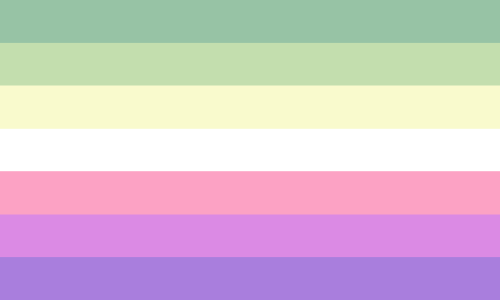
A seven-band pastel flag for genderfae, a genderfluid identity that never encompasses feeling masculine. Pride-Flags and superpopcorn101 published it jointly on DeviantArt on 9 January 2017, giving one rationale for the whole range rather than a meaning for each band: blue is left out, and the colours are pastel "to give it a more 'fae' feeling". [1] The identity term is older than the flag and is attributed to an anonymous 2014 submission to the MOGAI-Archive Tumblr blog. [2]
Key facts
- Designer
- Pride-Flags
- Created
- Earliest located publication
- Documented circulation
- 2017 onward
- Aspect Ratio
- 3:5 · standard
- Ratio Notes
- The designers' own file is 5000 by 3000 pixels, which reduces to 3:5 and agrees with the standard production ratio shown here. [1]
- Stripes
- 7
- Represented Identity
- genderfae
Also known as
- Genderfae Flag
Archive categories Gender Identity Pride Flags
Overview
To give the genderfae label a flag. The rationale published with it is for the palette rather than the identity: "A range of colors that don't include blue to aesthetically represent this gender. The colors are pastel to give it a more 'fae' feeling." [1]
Pride-Flags published the flag on DeviantArt on 9 January 2017 under the credit "Designed by: me and superpopcorn101", and gave the term's coiner as unknown. [1] The term is the older of the two. Genderfae is attributed to an anonymous submission to the MOGAI-Archive Tumblr blog in 2014, three years before this design; MOGAI-Archive coined roughly 229 terms before going dormant in March 2015. [2]
Identity & Context
- Represented Identity
- genderfae
- Subcommunity
- nonbinary umbrella; genderfluid spectrum; never male, masculine, or male-aligned
- Language Context
- The "fae" element is a shortened form of "faerie". [3]
Creators
The Creators
Pride-Flags
Designer
Pride-Flags is the DeviantArt account of the person who ran the pride-color-schemes and ask-pride-color-schemes Tumblr blogs, where flags submitted or requested by readers were redrawn at 5000 by 3000 pixels and filed by identity. The account's file pages follow a fixed format giving a definition, colour meanings, a coiner and a designer, and mark the account's own work as "me". The Genderfae deviation of 9 January 2017 is one it made with a collaborator. [1]
A range of colors that don't include blue to aesthetically represent this gender. The colors are pastel to give it a more "fae" feeling.
The colour meanings published with the flag, 9 January 2017. [1]
An experience of genderfluidity that never encompasses feeling masculine.
The definition of genderfae given on the same file page. [1]
Motivations
- To give the genderfae label a flag built from a range that leaves blue out, the account's stated reason being that the identity never encompasses feeling masculine. [1]
superpopcorn101
Designer
A DeviantArt user credited jointly with Pride-Flags for the design, linked from the deviation as a user tag. The credit gives no division of labour between the two, and no statement by superpopcorn101 about the flag has been located. [1]
Attribution notes
The DeviantArt file page carries a joint credit, "Designed by: me and superpopcorn101", the second name linked as a DeviantArt user tag. The account marks its own designs "me", so the credit names two designers. The same page records the term's coiner as unknown, and the term and the flag have separate attribution: the identity is attributed to an anonymous 2014 submission to MOGAI-Archive, the flag to these two in January 2017. [1][2]
Origin
- Place Type
- online platform
- Digital Origin
- Yes
Published on DeviantArt on 9 January 2017. Neither designer's location is documented, and the publication date is the earliest located, not a proven date of design. [1]
Dates & Chronology
- Year Created
- Earliest located publication
- Documented circulation
- 2017 onward
The flag illustrates the genderfae sections of community reference wikis. [2][3] Gender Census write-in counts for the label are recorded at twelve respondents in 2019 and fifty-three, 0.21 percent of that survey, in 2020, [2] and at 145, about 0.33 percent, in 2021 and 115 of 43,096 respondents in 2025. [3]
Genderfaun, published by the same account on 31 May 2017, is the documented counterpart. Its file page calls it "Complimentary to Genderfae" and describes the mirrored palette rule: where genderfae leaves out blue, genderfaun avoids pinks and reds "to show the lack of femininity". Its credits differ from this flag's, reading "Coined by Shadowofthedude. Designed by anonymous." [4]
Lineage
- Related flags
- Genderfaun Pride Flag
Genderfaun is the one documented relation: its own file page describes it as complementary to genderfae and built on the mirrored colour rule. [4] The pairing is a counterpart relationship between two designs by the same account, not descent in either direction. Demifae, Genderfaer, Genderfaunet, Genderflor, Gendervae and Genderselkie are related identity terms rather than related flags. [2] No source deriving this design from an earlier flag has been located.
Colors & Symbolism
Blue is absent by design. The file page gives one rationale for the range as a whole and none for individual bands: "A range of colors that don't include blue to aesthetically represent this gender. The colors are pastel to give it a more 'fae' feeling." The identity is defined on the same page as "An experience of genderfluidity that never encompasses feeling masculine." [1]
| Colour | Hex |
|---|---|
| Sage Green | #97C3A5 |
| Light Green | #C3DEAE |
| Pale Yellow | #F9FACD |
| White | #FFFFFF |
| Pink | #FCA2C4 |
| Orchid | #DB8AE4 |
| Purple | #A97EDD |
Measured from the 5000 by 3000 DeviantArt original [1]
No meanings have been published for individual bands. What the designers published is the reason for the range. [1]
The designers published no hex values. These are measured from the 5000 by 3000 file published with the deviation, which holds these seven colours and no others. The archive's 500 by 300 copy carries the same seven values; the six single-row blends at the band boundaries are an artefact of the reduction, not part of the design. [1]
Design
- Aspect Ratio
- 3:5 · standard
- Ratio Notes
- The designers' own file is 5000 by 3000 pixels, which reduces to 3:5 and agrees with the standard production ratio shown here. [1]
- Orientation
- horizontal
- Stripe Count
- 7
- Layout
- horizontal_stripes
- Stripes (Top → Bottom)
- Sage Green, Light Green, Pale Yellow, White, Pink, Orchid, Purple
Seven horizontal bands of equal depth. On the designers' 5000 by 3000 file the depths run 429, 426, 433, 424, 433, 426 and 429 pixels, against an exact seventh of 428.57. [1]
Seven equal horizontal stripes, sage green at the top through white at the centre to purple at the foot. No blue appears anywhere on the flag. [1]
Seven equal horizontal bands: sage green #97C3A5, light green #C3DEAE, pale yellow #F9FACD, white #FFFFFF, pink #FCA2C4, orchid #DB8AE4, purple #A97EDD. [1]
Usage & Adoption
- Online Usage
- DeviantArt, where it was published [1], Community reference wikis, which use it to illustrate the genderfae entry [2][3]
- Current Status
- circulating online
Documented circulation is online reference and community use. No manufacture, organisational adoption or photographed physical use has been located. Gender Census write-in counts for the label run from twelve respondents in 2019 [2] to 115 of 43,096 in 2025. [3]
Discourse & Debates
- The dispute over the "fae" element is unresolved. Some community members hold the term appropriative of faerie traditions and others reject that reading. [2]
Common misidentifications
- Genderfae and genderfaun are sometimes conflated. The definitions are mirrored: genderfae is never male or male-aligned unless the gender in question is also female-aligned, genderfaun never female or female-aligned unless also male-aligned. [2][4]
Criticisms
- The name has been criticised as disrespectful to cultures and religions that revere fae or faeries. Genderdoe was proposed as an alternative for people who wish to avoid that, and genderthil has also been proposed. [2]
Genderdoe and genderthil are alternative identity terms proposed in response to the naming dispute, not attested names for this flag. [2] Demifae, Genderfaer, Genderfaunet, Genderflor, Gendervae and Genderselkie name related but separate fluid-gender identities. [2]
Footnotes & Citations
Sources and footnotes 8 sources
- 1. Image file page Genderfae. Pride-Flags. DeviantArt (2017-01-09). Accessed 2026-08-16
The file page for the artwork itself. It carries the joint designer credit, the definition, the palette rationale, and the 5000 by 3000 file the colour values here are measured from.
- 2. Encyclopedias & Reference Genderfae. Nonbinary Wiki. Accessed 2026-04-07
- 3. Encyclopedias & Reference Genderfluid: Genderfae. LGBTA Wiki (Fandom). Accessed 2026-08-16
The former lgbta.wikia.org/wiki/Genderfae address redirects to this section. Community-edited, but it cites its sources.
- 4. Image file page Genderfaun. Pride-Flags. DeviantArt (2017-05-31). Accessed 2026-08-16
The counterpart flag's file page, which is where the pairing with genderfae is stated.
- 5. Image file page Transneutral (1), carrying the Pride-Flags gallery reuse statement. Pride-Flags. DeviantArt (2016-10-05). Accessed 2026-08-16
The gallery-wide reuse statement is published in the descriptions of Pride-Flags deviations rather than on a single terms page. This is one that carries it verbatim; the Genderfae file page does not.
- Social media genderfae. MOGAI-Archive (Tumblr) (2014). Accessed 2026-04-07 [no stable URL]
The blog is defunct and no capture of the original submission has been located. The coinage is carried by later community documentation.
- Social media genderfae, and why we need to change the term. en.bees. Tumblr (2020-07-25). Accessed 2026-04-07 [no stable URL]
No URL is on record for this post.
- Encyclopedias & Reference Genderfae. Gender Wiki (Fandom). Accessed 2026-04-07
Image Sources
- Rendering
- 500 by 300 archive copy of the 2017 DeviantArt file